Hard Water vs Soft Water on Hair: The Complete Evidence-Based Guide
10 min read ·
Understand the real science of Hard Water vs Soft Water on Hair, from mineral buildup and cuticle friction to breakage, lather performance, and styling routines.
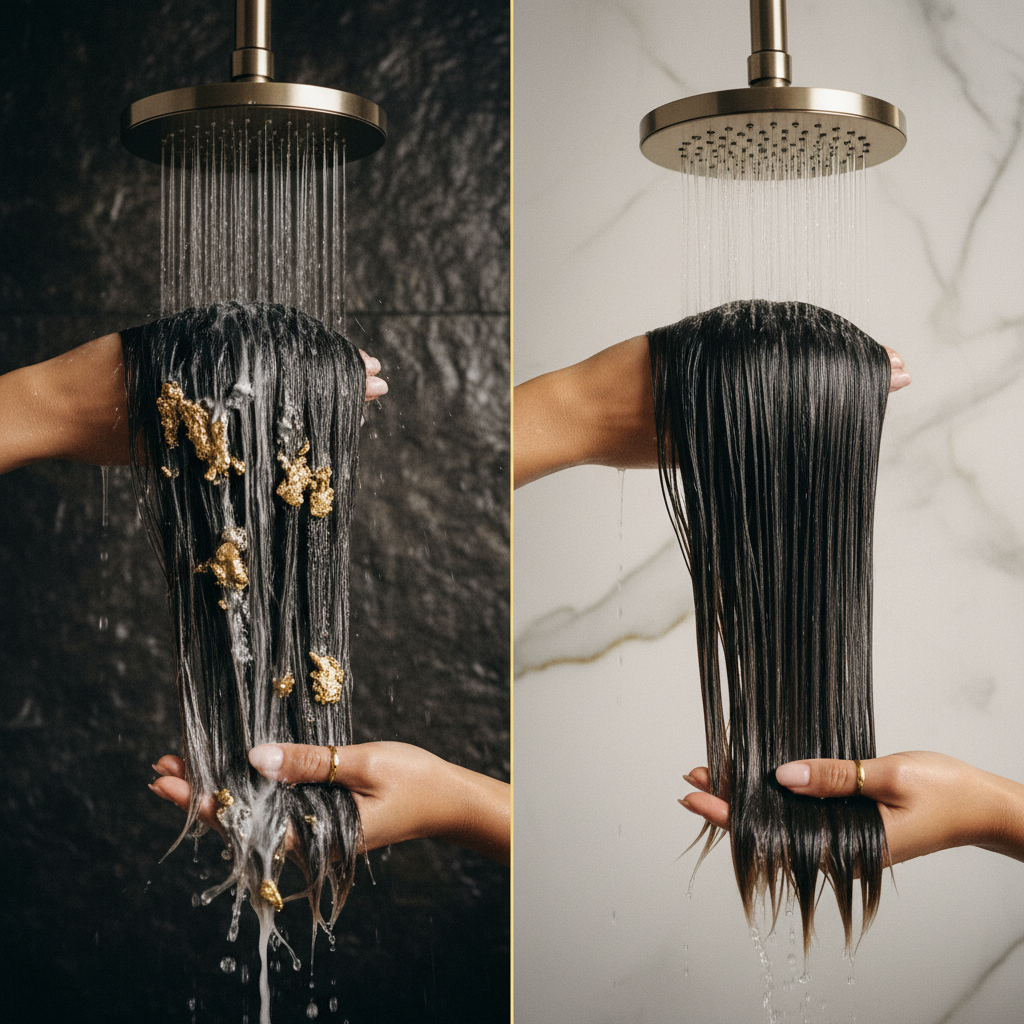
Quick answer: Comparing Hard Water vs Soft Water on Hair reveals distinct impacts on fibre health and styling. Hard water contains high concentrations of dissolved calcium and magnesium that bind to the hair shaft, leaving mineral deposits that cause dullness, tangling, and brittle breakage. Soft water lacks these minerals, allowing shampoos to lather richly but sometimes leaving hair feeling slippery or limp. The main limitation is that hard water causes mechanical surface breakage, not follicular hair loss or medical alopecia.
Key takeaways
- Mineral accumulation: Hard water leaves calcium and magnesium carbonate on the cuticle, creating a rough film that reduces shine and elasticity.
- Breakage versus loss: Hard water mineral build-up increases friction and leads to shaft breakage, but clinical research shows it does not cause follicular shedding or true hair loss.
- Rinsing differences: Soft water lathers effortlessly and rinses clean of minerals, though it can feel like it never fully washes out because native hair proteins remain unhindered.
- Chelating solutions: Chelating shampoos, acidic rinses, and shower water filters neutralise mineral deposits effectively.
- Targeted routine: Balancing your wash routine depends entirely on your local water supply and personal hair porosity.
Hard Water vs Soft Water on Hair: what the evidence shows
The scientific debate surrounding Hard Water vs Soft Water on Hair focuses primarily on surface chemistry and structural tensile strength. Water hardness is defined by the concentration of dissolved multivalent cations, predominantly calcium ($Ca^{2+}$) and magnesium ($Mg^{2+}$). According to the World Health Organization (WHO) and water authorities, water with less than 60 milligrams per litre (mg/L) of calcium carbonate equivalent is classed as soft, while anything exceeding 180 mg/L is considered very hard.
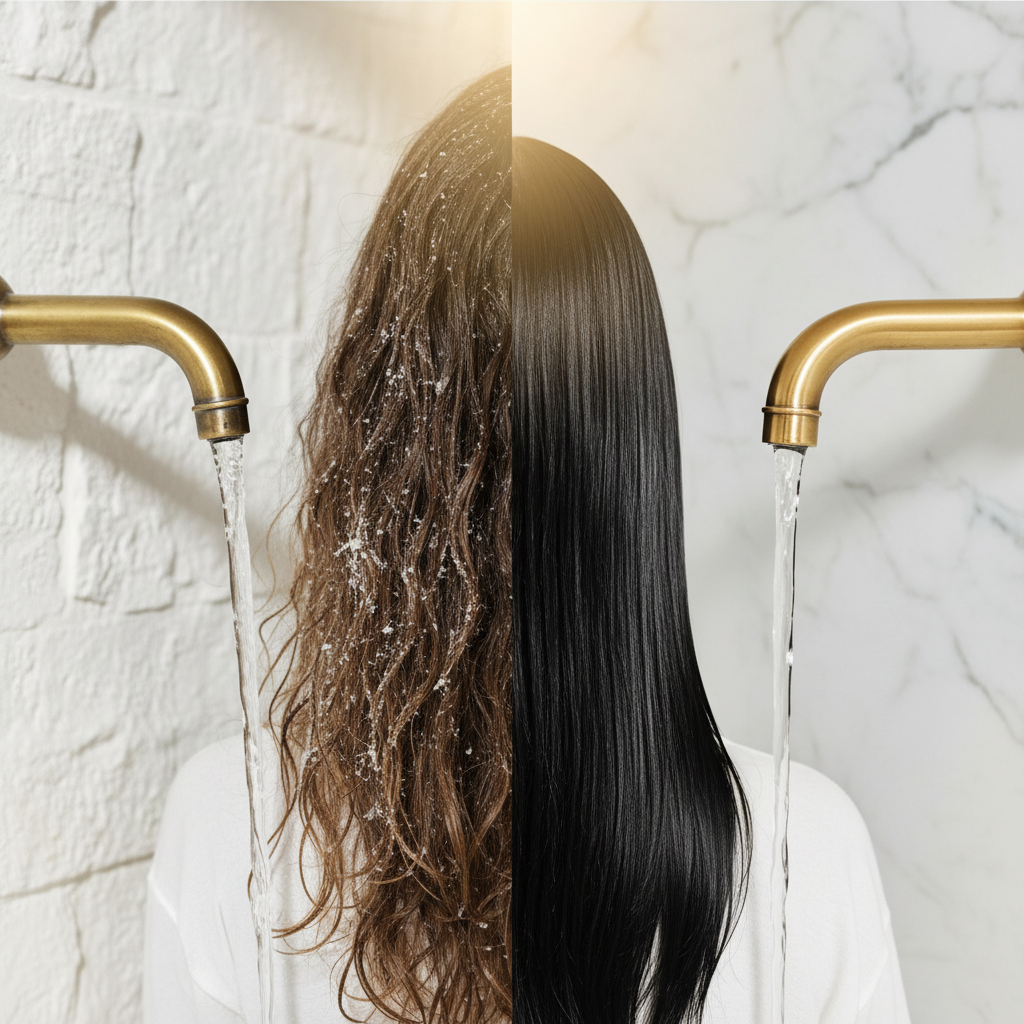
When you wash your hair in hard water, these dissolved minerals react with surfactant molecules in standard shampoos. Instead of creating a free-rinsing emulsion, calcium ions form an insoluble precipitate known as curd or soap scum. Research published in the International Journal of Trichology investigated the tensile strength of hair exposed to hard versus distilled soft water over time. The researchers found that while hard water did not alter the core tensile strength of the hair fibre within the test duration, it significantly increased cuticle roughness and mineral deposition on the outside of the shaft.
Soft water acts very differently. Naturally soft or artificially softened water possesses low levels of calcium and magnesium, often replaced with sodium ions. Shampoos foam vigorously because surfactants remain soluble. Cuticle scales lie flatter because there are no mineral crystals wedged beneath them, resulting in smoother light reflection and less mechanical friction when detangling.
What the evidence does not show
There is a widespread belief that moving to a hard water area causes permanent baldness or thinning from the root. The dermatological evidence does not support this claim.
Hard water does not shut down follicles, trigger androgenetic alopecia, or induce telogen effluvium. When people notice increased hair in the shower drain after relocating to a hard water city, they are almost always witnessing physical breakage. Minerals degrade the flexibility of the strand, meaning daily brushing snaps dry fibres mid-shaft.
Equally, soft water is not an automatic cure for existing scalp conditions. While it prevents mineral build-up, it will not resolve autoimmune hair shedding, genetic miniaturisation, or systemic deficiencies like low ferritin or thyroid dysfunction.
The physical mechanisms: cuticle damage and lather performance
Understanding what happens at a microscopic level explains why hard and soft water produce such contrasting textures.
Cuticle calcification and friction
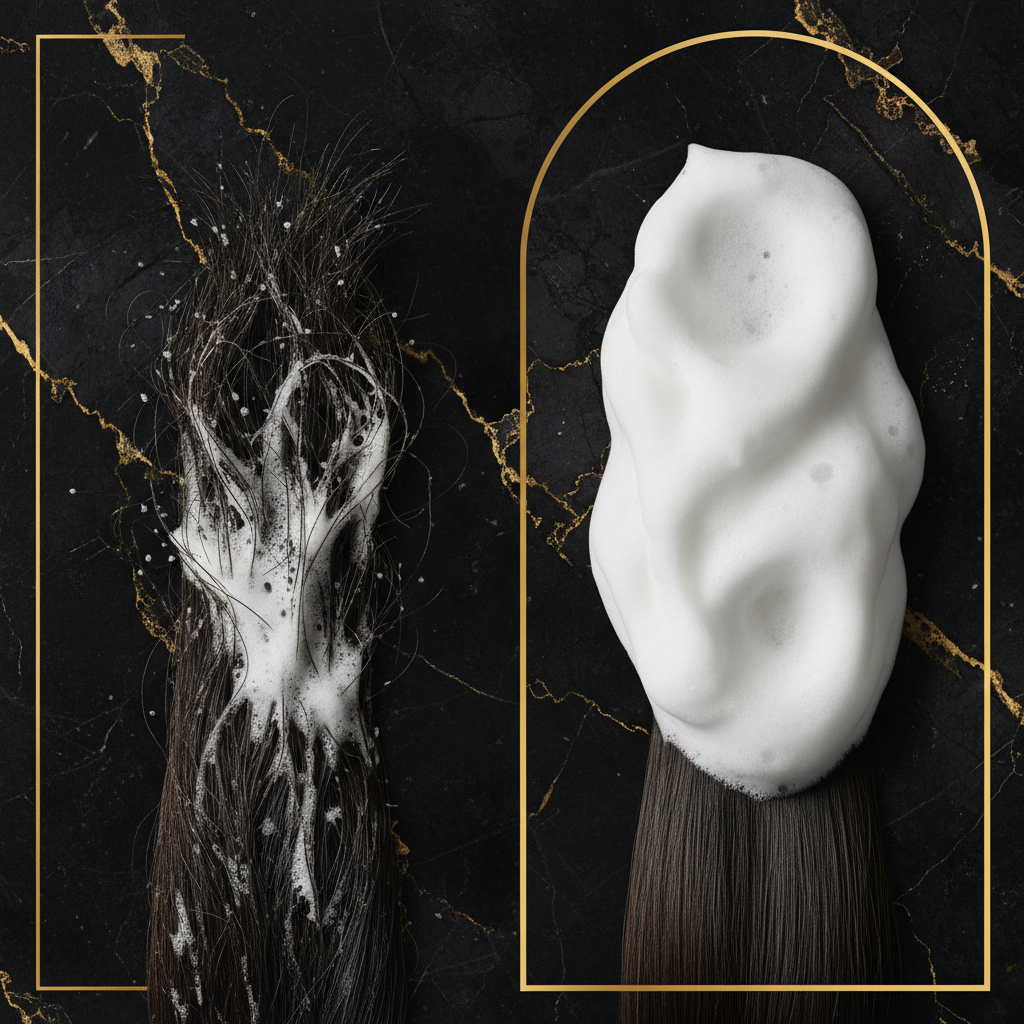
Hair fibres carry a negative electrostatic charge, particularly on damaged or porous areas. Calcium and magnesium ions carry strong positive charges. This natural attraction draws minerals straight to the cuticle. As the water evaporates, microscopic mineral salts crystallise beneath and around the imbricated cuticle scales. This forces the protective scales open, transforming what should be a smooth, reflective surface into an abrasive, sandpaper-like texture.
When adjacent hair strands rub together, this friction causes knotting, fraying, and split ends. Furthermore, the raised cuticle allows natural internal moisture to escape, leaving the cortex dehydrated.
Surfactant interference
Surfactants rely on clean water to form cleansing micelles that trap sebum and wash away. In hard water, calcium binds directly to surfactant molecules, neutralising their cleansing action. This forces you to use twice as much shampoo to generate a lather, which further strips natural lipids from the scalp while still leaving behind insoluble mineral film.
In soft water, surfactants perform at peak efficiency. However, because no minerals adhere to the strand, your hair retains its natural hydrated slip. This often leads people to believe that shampoo or conditioner is impossible to rinse out completely. In reality, you are feeling your clean, uncalcified cuticle rather than residual soap.
| Hair Metric | Hard Water Impact | Soft Water Impact |
|---|---|---|
| Mineral Content | High (>120 to 180+ mg/L $CaCO_3$) | Low (<60 mg/L $CaCO_3$) |
| Cuticle Condition | Scales forced open by mineral crystals | Scales remain flat and aligned |
| Texture & Feel | Rough, coated, straw-like, brittle | Silky, smooth, sometimes limp or flat |
| Lather Performance | Poor; surfactants form insoluble curd | High; rich lather with minimal product |
| Colour Retention | Rapid fading, brassiness, green tints from copper | Longer-lasting colour vibrancy |
| Breakage Risk | High, caused by surface friction and dryness | Low, flexible fibre with good elasticity |
Visible signs of hard water build-up
Recognising mineral build-up allows you to address the problem before chronic breakage develops. Watch for these practical indicators:
- Persistent dullness: Hair lacks shine even after deep conditioning because rough mineral deposits scatter light rather than reflecting it.
- Tangled, unmanageable lengths: Strands knot instantly upon drying, resisting wide-tooth combs.
- Faded or altered colour: Salon colour fades quickly. Bleached or blonde hair often develops a brassy, muddy yellow, or greenish cast due to trace copper and iron oxidising on the calcium base.
- Scalp discomfort: Soap curd can settle on the scalp, exacerbating flaking, itching, and dryness.
- Product failure: Masks and leave-in treatments seem to sit on top of the hair without penetrating the fibre.
Visible signs of soft water washing
Washing in soft water brings noticeable benefits, though it presents its own styling quirks:
- Slick, weightless texture: Strands feel noticeably silkier and easier to brush through when wet.
- Reduced product volume: A tiny drop of shampoo produces ample, dense foam.
- Difficulty holding volume: Fine hair may fall flat or feel limp because the natural friction needed to hold textured styling is absent.
- Perceived residue: You might spend several extra minutes rinsing under the stream, mistaking natural fibre slip for unwashed product.
Restoring hair health across water types
Whether you have mineral-heavy supplies or completely soft plumbing, tailoring your wash technique restores balance.
Strategies for hard water areas
- Incorporate chelating agents: Clarifying shampoos formulated with tetrasodium EDTA, disodium EDTA, or citric acid bond with metal ions and pull them free from the keratin matrix. Use these treatments once every one to two weeks.
- Apply acidic rinses: An acidic rinse (such as a diluted apple cider vinegar solution at a 1:8 ratio with filtered water) helps lower the hair's surface pH to its natural zone between 4.5 and 5.5. This helps seal down the cuticle scales and dissolve light calcium deposits.
- Use showerhead filters or softeners: Mesh shower filters do not remove dissolved calcium (only a true ion-exchange water softening unit can do this), but high-quality KDF-55 filters successfully reduce chlorine, copper, and sediment that worsen brittleness.
- Prioritise leave-in moisture: Penetrating oils and light leave-in conditioners cushion the hair shaft against the high mechanical friction caused by hard water minerals.
Strategies for soft water areas
- Reduce product dosages: Halve your usual shampoo and heavy conditioner amounts to prevent product build-up.
- Opt for lightweight volumisers: Use protein-balanced formulas and weightless leave-ins to give structure and body to strands that otherwise lean limp.
- Ensure thorough mechanical rinsing: Spend adequate time massaging the scalp under the water stream to guarantee all surfactant micelles are cleared.
Supporting the scalp and fibre: the Watermans approach
For individuals contending with the harsh, dehydrating environment of hard water or the flat texture common with soft water, targeted cosmetic care makes a substantial difference. Watermans focuses on balancing scalp comfort while strengthening the hair shaft against daily friction.
Products like Watermans Grow Me Shampoo incorporate nourishing botanicals, biotin, and rosemary that help fortify the fibre. Because hard water depletes elasticity and raises cuticle friction, incorporating a nutrient-rich, sulphate-free cleanser supports a stronger-feeling shaft, reducing the snapping that many mistake for thinning. Paired with a scalp-focused routine, it keeps the hair environment clean and refreshed regardless of municipal water hardness.
When the cause is something else
If you are experiencing true diffused thinning, widening part lines, or sudden clumps of hair shedding from the root (characterised by a small white bulb at the base), water hardness is not the root problem.
Common alternative triggers include:
- Telogen effluvium: Triggered by high physiological stress, illness, high fever, or dramatic nutritional changes, resulting in heavy shedding roughly two to three months after the event.
- Androgenetic alopecia: Genetic sensitivity to dihydrotestosterone (DHT) causing gradual miniaturisation of follicles across the crown and temples.
- Nutritional deficiencies: Inadequate iron stores (ferritin), vitamin D deficiency, or insufficient dietary protein.
- Thyroid dysfunction: Both hypothyroidism and hyperthyroidism disrupt the hair's normal growth cycle.
When to get professional advice
Consult a GP, dermatologist, or registered trichologist if:
- You observe round, smooth patches of total hair loss (indicative of alopecia areata).
- Scalp itching is accompanied by severe redness, scaling plaques, burning, or pustules.
- Shedding exceeds 100 to 150 hairs daily for more than six to eight weeks.
- Your hair density visibly declines across the scalp despite changing your wash and water routine.
Frequently asked questions about Hard Water vs Soft Water on Hair
Does hard water cause permanent hair loss?
No. The mineral deposits from hard water coat the outside of the hair fibre, causing stiffness and friction that leads to surface breakage. It does not penetrate the follicle, alter hormones, or cause permanent medical hair loss.
Which is better: Hard Water vs Soft Water on Hair?
Soft water is generally better for hair health. It preserves cuticle smoothness, prevents mineral buildup, and maintains strand elasticity. However, those with very fine hair may find soft water makes their hair feel slightly flat, requiring lighter styling products to retain volume.
Can a shower filter completely turn hard water into soft water?
Standard screw-on shower filters cannot soften water. Most contain KDF or carbon, which remove chlorine, heavy metals, and rust, but do not extract dissolved calcium and magnesium. To fully convert hard water to soft water, you need an ion-exchange water softener system installed on your main plumbing.
How often should I use a chelating shampoo for hard water?
Most people benefit from using a chelating or hard-water clarifying shampoo once every 7 to 14 days. Overusing clarifying formulas can strip natural scalp sebum, so always follow chelating treatments with a deeply moisturising conditioner.
Why does soft water make my hair feel like it still has soap in it?
Soft water lacks the calcium ions that react with soap to create friction. When hair is clean in soft water, your fingers glide smoothly over the naturally slick, undamaged cuticle scales. That slippery feeling is the true texture of clean hair without mineral grit.
Managing your wash routine across water supplies
Evaluating Hard Water vs Soft Water on Hair makes it clear that while water quality plays a profound role in cosmetic texture, it operates on the cuticle rather than the follicle. Hard water binds minerals to your strands, demanding regular chelating, deep moisture, and friction-reducing care to prevent mechanical snapping. Soft water keeps your cuticles smooth and flexible, requiring little more than lighter product doses to maintain natural bounce. By understanding your local water profile and adjusting your cleansing habits accordingly, you can maintain strong, resilient, and manageable hair in any environment.
Sources and references
- World Health Organization. Guidelines for Drinking-water Quality: Hardness in Drinking-water, 2011.
- Srinivasan, G., et al. "Effects of hard water on hair tensile strength." International Journal of Trichology, 2013.
- Evans, T., & Wickett, R. R. Practical Modern Hair Science. Allured Business Media, 2012.
- British Water. Code of Practice: Water Softeners for Domestic Use, 2020.
- Robbins, C. R. Chemical and Physical Behavior of Human Hair. Springer-Verlag, 5th Edition, 2012.
Find these ingredients in Watermans products
- Vitamin D: you will find this ingredient in our Hair Vitamins.