Hard Water Effects on Textured Hair: Science, Symptoms, and Solutions
10 min read ·
Hard water minerals bind to textured hair, blocking moisture and causing breakage along curl curves. Discover the evidence, mechanisms, and proven solutions.
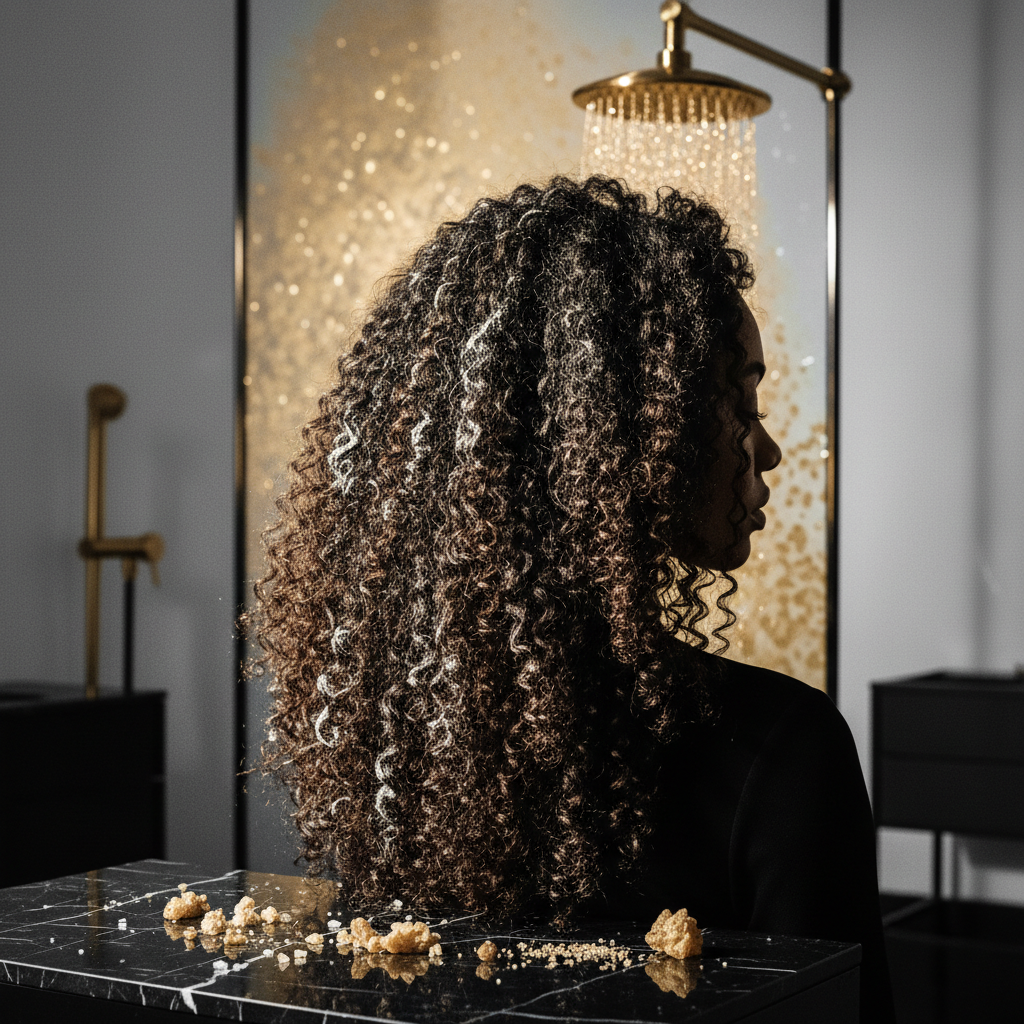
Quick answer: The physical Hard Water Effects on Textured Hair stem from dissolved calcium and magnesium ions binding to the cuticle. This mineral buildup forms an insoluble film, disrupts moisture uptake, increases inter-fibre friction, and accelerates mechanical breakage along natural curl torsion points. Hard water does not cause follicular hair loss or stop growth at the root. Instead, it severely compromises tensile elasticity and surface smoothness. Addressing these effects requires targeted chelating washes, acidic surface balancing, and rich lipid restoration.
Key takeaways
- Dissolved calcium and magnesium bind strongly to the negatively charged surface of textured hair, forming a stubborn mineral crust.
- Textured hair (curl patterns 3A to 4C) is uniquely vulnerable because its elliptical cross-section and frequent curvature twists create natural stress points where friction triggers breakage.
- Mineral buildup blocks water absorption, leaving curls chronically brittle, dull, and unresponsive to conditioning treatments.
- Hard water increases breakage along the shaft; it does not shut down follicles, trigger telogen effluvium, or cause genetic alopecia.
- Chelating agents like disodium EDTA and sodium phytate, paired with mild acidic rinses, remove deposits without stripping natural moisture.
Hard Water Effects on Textured Hair: what the evidence shows
Textured hair possesses an elliptical cross-section, irregular diameter, and asymmetric cuticle distribution along its curves. Research into hair biophysics shows that the twists and turns of curly, coily, and kinky hair fibres represent inherent mechanical weak points. When exposed to mineral-dense tap water, these structural features amplify cosmetic and physical damage.
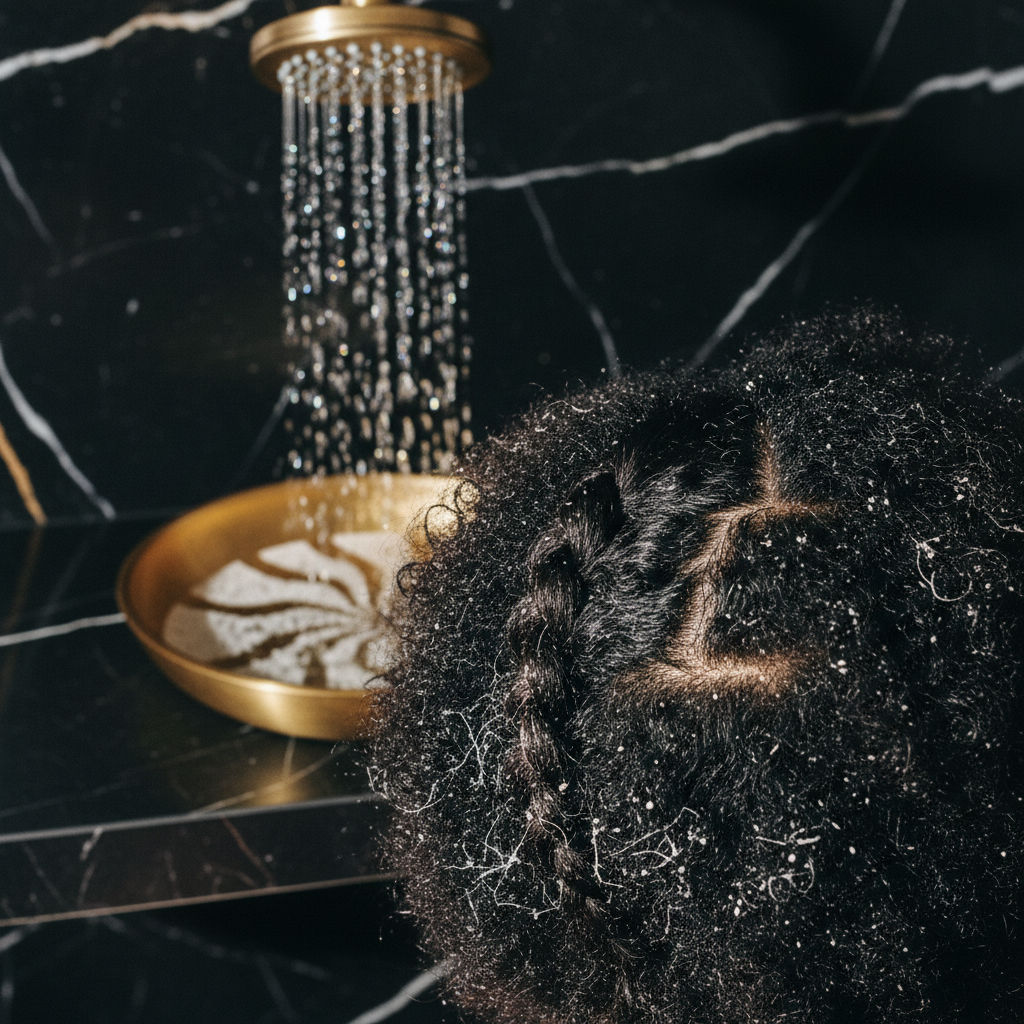
Hard water contains elevated concentrations of dissolved minerals, primarily calcium carbonate ($CaCO_3$) and magnesium carbonate ($MgCO_3$). In the UK, water hardness frequently exceeds 200 mg/L of calcium carbonate in central, southern, and eastern regions. When you wash your hair, the alkaline pH of hard tap water (often pH 7.5 to 8.5) causes the cuticle scales to lift slightly.
The hair fibre carries an overall negative electrical charge (anionic), especially on damaged or weathered surfaces. Positively charged calcium ($Ca^{2+}$) and magnesium ($Mg^{2+}$) ions are chemically drawn to these sites. As the water evaporates, these ions precipitate out, adhering to the cuticle surface as insoluble salt deposits.
On straight, cylindrical hair fibres, mineral deposits cause noticeable dullness and stiffness. On textured hair, the consequences multiply:
- Cuticle flaking and roughness: Mineral deposits lodge beneath and around raised cuticle edges, preventing the cuticles from lying flat.
- Elevated inter-fibre friction: Coils and curls naturally rub against each other. Surface mineral crystals turn this friction abrasive, leading to severe tangling and matting.
- Moisture barrier disruption: The mineral film acts as a barrier, preventing conditioners and humectants from penetrating the cortex.
- Loss of elasticity: Textured hair relies on hydration to retain its stretch and bounce. Deprived of moisture, dry fibres snap when combed or styled.
What the evidence does not show
It is critical to distinguish between hair breakage along the fibre and true hair loss at the follicle level. Controlled dermatological studies have evaluated the relationship between hard water and follicular hair loss, finding no direct causal link.
Hard water minerals do not penetrate into the dermal papilla, nor do they trigger androgenetic alopecia, alopecia areata, or telogen effluvium. The hair bulb resides several millimetres beneath the scalp surface, supplied by the bloodstream rather than topical shower water.
When people living in hard water areas notice thinning, the primary culprits are almost always increased shaft breakage, friction snapping during detangling, or an unaddressed internal scalp disorder. Calling hard water breakage "hair loss" is factually inaccurate.
The biological mechanism: why textured fibres suffer more
The distinct geometry of curly, coily, and afro-textured hair accounts for its extreme sensitivity to mineral buildup.
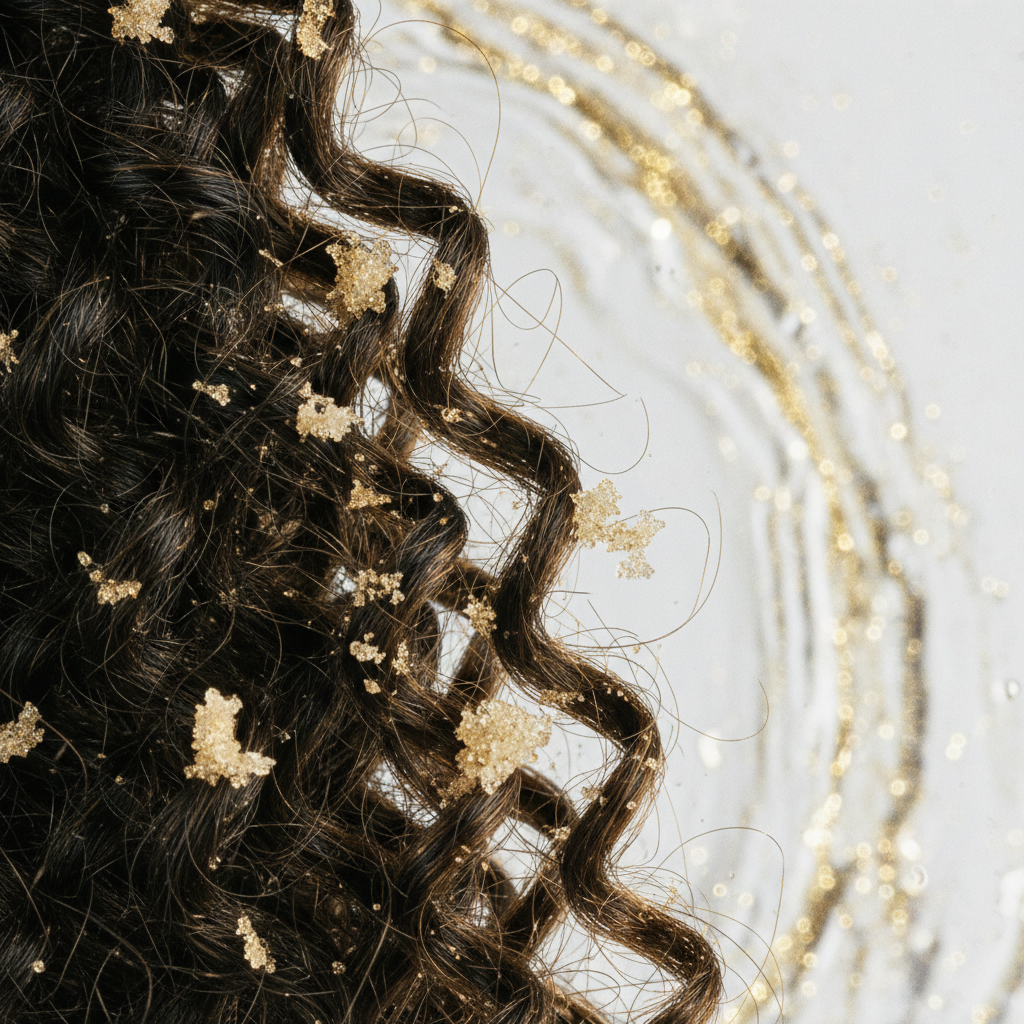
Straight hair has a uniform, circular cross-section that allows sebum to travel smoothly down the shaft from the sebaceous glands. Textured hair has an asymmetric, elliptical cross-section. Sebum struggles to coat the irregular curves, leaving the mid-lengths and ends inherently dry.
[Normal Cuticle] -> Smooth, flat overlapping scales -> Low friction, high light reflection
[Hard Water Coat] -> Cuticles forced open by mineral crust -> High friction, light scattering
[Torsion Point] -> Bending curve under mineral tension -> Fibre snaps under styling stress
Furthermore, whenever a hair fibre twists to form a curl or coil, the cuticle scales on the outer bend are stretched and thinner, exposing more of the underlying cortex. These exposed points carry a higher negative charge, attracting greater concentrations of calcium and magnesium.
Calcium ions also react with traditional fatty acid soaps and anionic surfactants to form "soap scum" (calcium stearate). This waxy, insoluble residue coats the strands, locking out water molecules. Because textured hair has fewer cuticle layers at its narrowest points (often only 4 to 6 layers compared to 8 to 10 in straight East Asian hair), physical abrasion from mineral crystals wears through the protective barrier much faster.
Signs of hard water damage on textured hair
Recognising hard water buildup early prevents severe fibre snap:
- Persistent dryness despite deep conditioning: Heavy butters and oils sit on top of the hair like grease rather than absorbing, leaving hair feeling like straw underneath.
- Lost curl definition: Ringlets, spirals, and coils lose their clump and spring, appearing fuzzy, undefined, and limp.
- Tackiness or a chalky film: Wet hair feels gritty, coated, or oddly rough to the touch, and shampoo lathers poorly.
- Audible snapping during detangling: Combing yields numerous short, root-free fragments rather than full-length strands with white bulbs attached.
- Scalp irritation and flaking: Minerals mix with sebum to form an occlusive crust on the scalp, which can exacerbate conditions like seborrhoeic dermatitis.
Hard water vs soft water on textured hair
The table below contrasts how water chemistry affects textured hair fibres during and after washing.
| Factor | Hard Water (Over 180 mg/L $CaCO_3$) | Soft Water (Under 60 mg/L $CaCO_3$) |
|---|---|---|
| Cuticle Response | Forced open by higher pH and mineral deposits | Remains smooth, flatter, and sealed |
| Surface Residue | Heavy insoluble calcium and magnesium salts | Minimal to zero mineral deposition |
| Hydration Level | Severe moisture exclusion; dry and brittle | High cortex hydration uptake |
| Inter-Fibre Friction | High; coils snag, tangle, and knot rapidly | Low; curls glide past each other smoothly |
| Breakage Risk | Very high along curl curves during detangling | Low; elasticity and flexural strength preserved |
| Styling Performance | Products sit on the surface; definition fails | Gels, creams, and leave-ins absorb evenly |
What you can do to protect textured hair
Resolving mineral buildup requires a strategic wash routine tailored to textured patterns:
1. Incorporate chelating shampoos
Clarifying shampoos remove surface oils, but only chelating shampoos can break chemical bonds with metal ions. Look for formulas containing tetrasodium EDTA, disodium EDTA, or sodium phytate. For textured hair, use a chelating wash once every 2 to 4 weeks, followed immediately by an intensive, protein-balanced deep treatment to prevent moisture depletion.
2. Acidic rinses to lower surface pH
Hard water elevates the hair's surface pH above its natural isoelectric point (around pH 4.5 to 5.5). Diluted apple cider vinegar (one part vinegar to four parts water) or formulated post-wash acidifiers help contract and smooth the cuticle scales, facilitating the release of loose mineral deposits.
3. Shower filters and water softeners
Standard shower head filters containing KDF (Kinetic Degradation Fluxion) media reduce free chlorine and some dissolved heavy metals, improving hair feel. However, true hard water minerals (calcium and magnesium) can only be completely eliminated by an ion-exchange water softener system installed at the mains.
4. Layer leave-in humectants with rich emollients
After chelating, restore hydration using water-based humectants (glycerin, aloe vera, panthenol) applied to damp hair, sealed with plant oils or butters. This creates a flexible lipid barrier that cushions curls against mechanical friction.
When the cause may be something else
Before blaming hard water entirely for poor hair condition, evaluate other potential variables:
- Protein-moisture imbalance: Overuse of hydrolysed keratin, wheat protein, or silk proteins can cause identical symptoms of brittleness, stiffness, and snapping.
- Heat damage: Regular blow-drying or flat-ironing strips the protective 18-MEA lipid layer from the cuticle, making hair porous and fragile.
- Chemical processing: Relaxers, texturisers, bleach, and permanent dyes alter the cortex's internal disulphide bonds, leaving the fibre far more susceptible to everyday breakage.
- Scalp microbiome shifts: Excessive flaking, itching, or redness might point to seborrhoeic dermatitis, psoriasis, or contact dermatitis rather than mineral buildup.
When to seek professional advice
Consult a registered trichologist or a consultant dermatologist if you observe:
- Significant shedding where full-length hairs with white bulbs come out in clusters.
- Widening of the central parting, receding along the temples, or patchy coin-sized bald spots.
- Persistent burning, tenderness, or pustules across the scalp surface.
If your issues are strictly cosmetic, such as extreme knotting, matting, split ends, and poor styling retention, a curl specialist or textured hair stylist can perform a salon-grade chelating treatment and trim away unrecoverable split ends.
Supporting textured hair vitality with Watermans
Restoring hair that has been compromised by mineral friction requires a two-pronged approach: strengthening the fibre against breakage and maintaining a clean, balanced scalp environment.
Watermans Grow Me Shampoo and Condition Me Conditioner provide a targeted, sulphate-free cosmetic system designed to fortify fragile strands. Packed with premium botanical extracts, biotin, rosemary, caffeine, and argan oil, this routine improves hair feel, delivers lightweight moisture, and enhances resilience along fragile curl torsion points. It supports the optimal scalp conditions necessary for strong, healthy-looking hair growth without stripping the fibre's essential moisture barrier.
Frequently asked questions about Hard Water Effects on Textured Hair
How do Hard Water Effects on Textured Hair differ from straight hair?
Textured hair features an elliptical shaft and multiple curves where cuticle scales naturally lift. Hard water minerals lodge in these torsion points, rapidly increasing friction, tangling, and mechanical snapping. Straight hair, by contrast, possesses a uniform circular structure, showing hard water damage primarily as surface dullness rather than rapid breakage.
Can hard water permanently alter my natural curl pattern?
No, hard water does not alter your underlying genetics or follicle structure. It coats the outer fibre in a rigid, mineral-laden crust that weighs down curls, inhibits natural clumping, and prevents elasticity. Once you remove the deposits with a chelating cleanser and restore hydration, your natural curl pattern returns.
Does a standard shower filter prevent hard water damage on afro hair?
Most basic carbon shower filters only remove chlorine and sediment; they cannot extract dissolved calcium and magnesium ions. To genuinely soften water, you require an ion-exchange softening system. However, KDF shower filters still offer real benefits by removing chlorine, which works alongside hard water to dry out afro-textured hair.
How often should textured hair be chelated in hard water areas?
Textured hair should typically be chelated once every two to four weeks. Chelating cleansers are formulated to strip away mineral ions, but overusing them can deplete natural sebum and lipid reserves. Always follow any chelating wash with a rich, moisturising deep conditioner.
Can apple cider vinegar completely dissolve calcium buildup on coils?
Apple cider vinegar has mild acidic properties that help loosen surface mineral salts and close the hair cuticle. However, it cannot match the bond-breaking strength of chelating agents like EDTA for heavy, long-standing mineral buildup. It works best as an intermediate balancing rinse rather than a total replacement for chelation.
Protecting your curls from mineral damage
Navigating the Hard Water Effects on Textured Hair requires an understanding of how mineral salts interact with unique curl geometry. Hard water minerals act as an abrasive, moisture-blocking film that weakens the hair shaft and increases mechanical snapping, but they do not cause follicular hair loss or stop growth at the root. By adopting regular chelating routines, maintaining an acidic pH balance, and protecting fragile curls with lipid-rich emollients, you can completely neutralise mineral buildup and preserve the bounce, softness, and resilience of your textured hair.
Sources and references
- International Journal of Trichology: "Evaluation of the Effect of Hard Water on Hair Tensile Strength", 2013.
- Journal of Cosmetic Science: "Effects of hard water on hair properties and the efficacy of chelating agents", 2011.
- Dermatologic Clinics: "Hair Cosmetics: An Overview", 2015.
- British Journal of Dermatology: "Structural and biophysical properties of afro-textured hair", 2007.
- Drinking Water Inspectorate (DWI): "Water Hardness in England and Wales", Annual Report Data.
Find these ingredients in Watermans products
- Biotin: you will find this ingredient in our Hair Growth Shampoo.
- Panthenol (Provitamin B5): you will find this ingredient in our Heat Protection Spray.
- Aloe Vera: you will find this ingredient in our Curly Hair Conditioner.