Hair Follicle Miniaturisation: The Science of Follicle Shrinkage
9 min read ·
Hair follicle miniaturisation causes hair to grow progressively thinner and shorter. Learn the science behind follicle shrinkage, key signs, and proven ways to manage it.
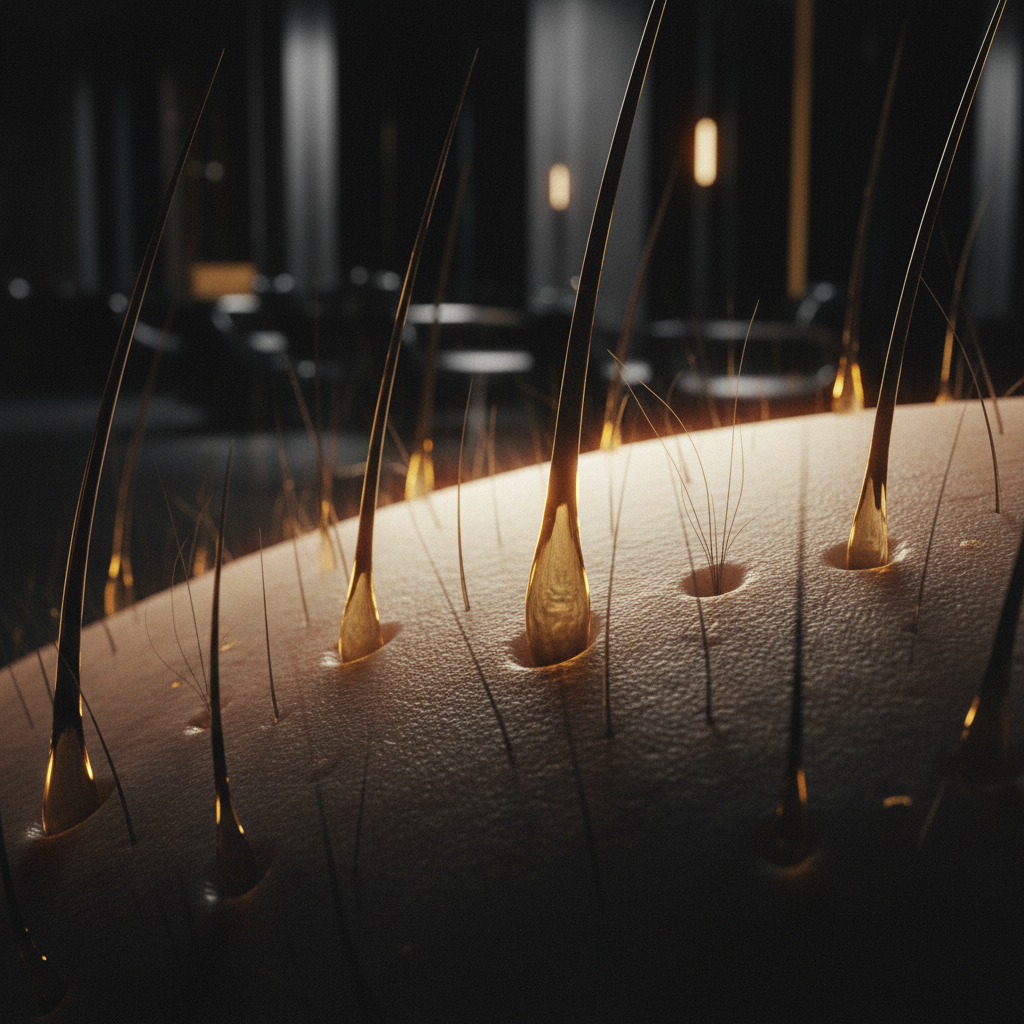
Quick answer: Hair follicle miniaturisation is the progressive biological process where hair follicles shrink in size across successive growth cycles. Driven primarily by genetics and dihydrotestosterone (DHT) in androgenetic alopecia, this shrinkage transforms robust, deeply pigmented terminal hairs into fine, short, barely visible vellus hairs. The main limitation is that once a follicle miniaturises completely and undergoes fibrous tract replacement, hair regrowth is clinically impossible. Early detection and intervention remain essential to preserving existing density.
Key takeaways
- Hair follicle miniaturisation is the core pathological mechanism behind male and female pattern hair loss.
- The process progressively shortens the anagen (active growth) phase and elongates the kenogen or telogen (resting) phases.
- Dihydrotestosterone (DHT) binds to androgen receptors in genetically susceptible dermal papilla cells, triggering inhibitory signalling cascades.
- Miniaturisation differs fundamentally from telogen effluvium, which involves diffuse shedding rather than structural follicle shrinkage.
- Topical and systemic medical treatments can halt or partially reverse miniaturisation, provided the follicle has not fully atrophied.
- Cosmetic scalp care supports follicle anchorage and optimal scalp barrier function, but cannot alter underlying genetic receptor sensitivity.
Hair Follicle Miniaturisation: what the evidence shows
Hair follicle miniaturisation represents a gradual structural decline in follicular architecture rather than sudden hair loss. Research published in dermatological literature demonstrates that miniaturisation is not an all-or-nothing event. Instead, individual follicles cycle through repeated stages of growth and shedding, returning smaller, shallower, and thinner with each subsequent cycle.
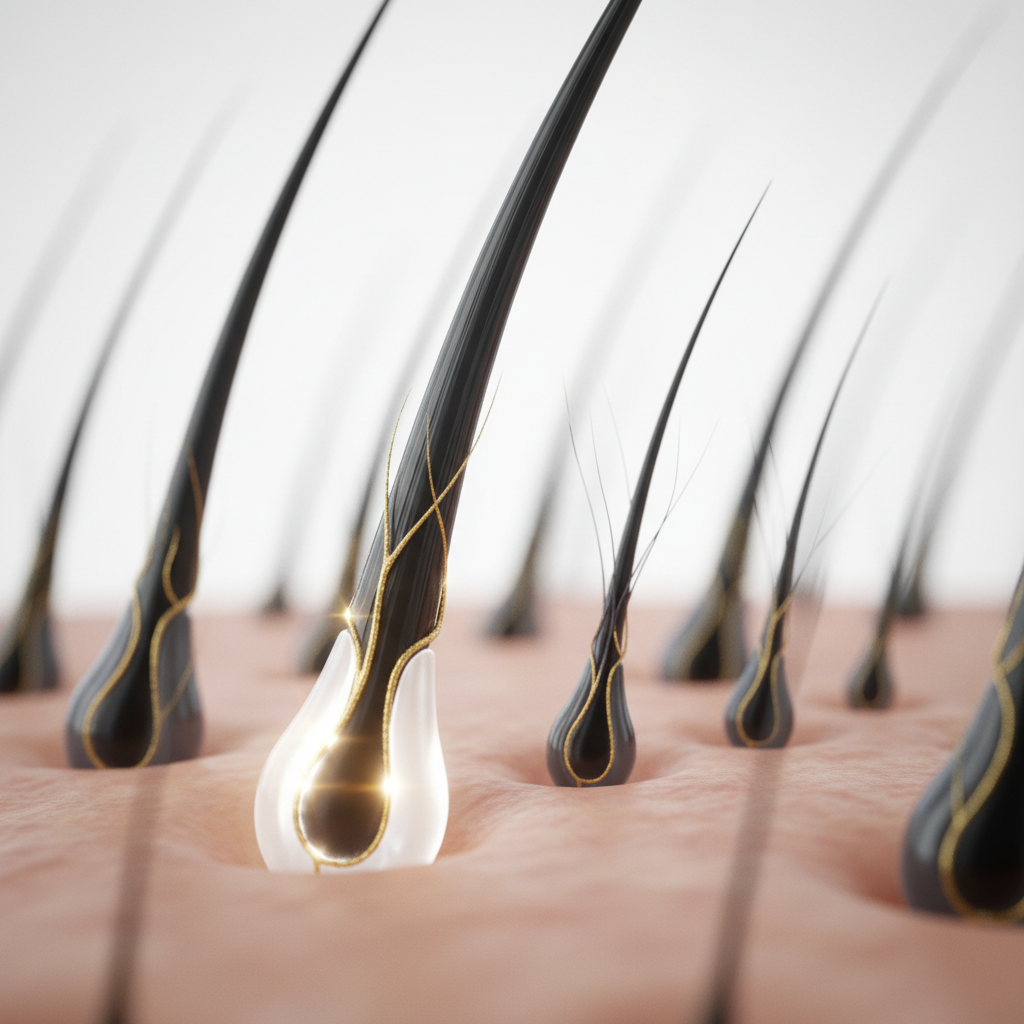
Under normal physiological conditions, a scalp follicle produces a terminal hair fibre with a diameter between 0.06 mm and 0.08 mm, anchored deep within the subcutaneous fat layer. In follicles undergoing miniaturisation, the hair diameter progressively narrows below 0.03 mm. The follicle root also ascends into the upper dermis, creating a fragile, wispy fibre that mimics peach fuzz.
Dermoscopic evaluations (trichoscopy) reveal this phenomenon as hair diameter diversity. In a healthy scalp, more than 80 percent of hair fibres display uniform thickness, with follicular units containing two to four terminal hairs. When follicle miniaturisation takes hold, trichoscopy identifies an increase in single-hair follicular units and more than 20 percent variation in hair diameter across a given zone.
The biological mechanism of follicle shrinkage
The biology driving miniaturisation centres on the interaction between circulating androgens and genetically predisposed dermal papilla cells. The enzyme 5-alpha reductase converts circulating testosterone into dihydrotestosterone (DHT), a potent androgen with approximately five times greater affinity for the androgen receptor.
When DHT binds to receptors within the dermal papilla of sensitive follicles, it triggers the release of inhibitory cytokines, most notably transforming growth factor beta (TGF-beta) and dickkopf-1 (DKK-1). These signalling molecules alter normal hair cycling in three ways:
- Shortened anagen phase: The active growth stage drops from an average of two to seven years down to a few months or weeks. As a result, the fibre cannot grow long.
- Prolonged telogen and kenogen phases: The resting stage lengthens, and the kenogen phase (the interval during which the follicle remains entirely empty after shedding) expands significantly.
- Volume loss in the dermal papilla: The total cell count of the dermal papilla declines. Because the volume of the dermal papilla directly dictates the thickness and calibre of the resulting hair shaft, the physical strand emerges markedly thinner.
Over multiple cycles, the capillary network nourishing the follicle diminishes. If left unchecked, the follicle eventually reaches an end-stage state termed follicular steatosis or fibrosis, where connective tissue replaces the epithelial structures, making functional hair generation impossible.
What the evidence does not show
It is vital to separate clinical facts from common misconceptions surrounding thinning hair.
The evidence does not show that miniaturisation is caused by poor blood flow alone. While microcirculation diminishes as a follicle atrophies, reduced blood flow is an outcome of follicular shrinkage, not the initial trigger. Shampoos, scalp massages, or therapies claiming to reverse miniaturisation purely through increased circulation fail to address the underlying hormonal receptor signalling.
Furthermore, evidence does not show that hair follicle miniaturisation stems from clogged pores or sebum build-up. Sebum contains minor traces of DHT, but external sebum sitting on the scalp surface does not penetrate into the deep dermal papilla to initiate follicular shrinkage. Hygiene plays a role in scalp barrier health, not genetic androgen sensitivity.
Finally, clinical research does not support the idea that dead or fully fibrosed follicles can be revived by non-surgical means. Cosmetic tonics and peptide serums can improve fibre strength, nourish the scalp, and support active follicles, but they cannot create new follicular structures out of scar tissue.
How miniaturisation compares to other hair conditions
Understanding whether your hair is miniaturising or shedding temporarily dictates your choice of treatment.
| Feature | Hair Follicle Miniaturisation | Telogen Effluvium | Hair Shaft Breakage |
|---|---|---|---|
| Primary site | Follicle bulb and dermal papilla | Follicle cycling timing | Hair fibre shaft |
| Root cause | Androgens (DHT) and genetic sensitivity | Systemic shock, stress, illness, deficiency | Mechanical, chemical, or heat trauma |
| Visible pattern | Receding hairline, crown thinning, widening part | Diffuse thinning across the entire scalp | Patchy thinning, frayed ends, uneven lengths |
| Fibre diameter | Progressively fine, variable thickness | Uniform thickness across shed hairs | Uniform thickness, but broken ends without bulb |
| Reversibility | Progressive; requires ongoing intervention | High; resolves when trigger clears (3 to 6 months) | High; resolves with reduced styling trauma |
| Timeframe | Develops over years | Sudden onset (2 to 3 months post-trigger) | Immediate or gradual depending on styling habits |
Signs to look for: identifying early miniaturisation
Because early intervention preserves density, identifying the initial signs of miniaturisation is critical:
- Increased hair diameter diversity: You notice that hairs falling out or framing your hairline are noticeably finer, lighter, and shorter than the hairs at the back of your head.
- Reduction in multi-hair units: Healthy follicular units produce two, three, or four hairs. As miniaturisation advances, these diminish to single-hair units, creating visible scalp visibility without massive shedding.
- Difficulty growing length: If your hair in specific zones (temples, crown, or central parting) seems unable to grow past a few inches, a shortened anagen phase is likely present.
- Sunburn on the scalp: You may burn more easily along your part line or vertex due to diminished hair density and thinner fibres exposing the scalp.
What you can do: evidence-based interventions
Managing miniaturisation depends on whether the goal is biological intervention, scalp health maintenance, or structural cosmetic support.
Clinical and medical options
Approved medical treatments focus on interrupting androgen activity or stimulating follicular cell proliferation. Dermatologists often recommend:
- 5-alpha reductase inhibitors: Oral medications that lower systemic DHT levels, effectively slowing or halting miniaturisation at its biological root.
- Topical vasodilators and potassium channel openers: Agents that lengthen the anagen phase and increase blood flow to active dermal papillae, encouraging thicker shaft production.
- Platelet-rich plasma (PRP) and low-level laser therapy (LLLT): Adjunctive therapies that deliver growth factors or cellular photobiomodulation to sluggish follicles.
The role of cosmetic haircare
Cosmetic routines cannot alter genetic coding, but they play a critical supportive role in maintaining the hair you have.
Clarifying shampoos remove oxidative build-up and environmental pollutants that cause micro-inflammation around the follicular infundibulum. When the scalp microenvironment is compromised, follicular stress increases, accelerating hair decline.
Watermans formulations are engineered specifically to provide a supportive cosmetic environment for thinning hair. Products like Watermans Grow Me shampoo and Condition Me conditioner incorporate functional ingredients such as biotin, rosemary, caffeine, niacinamide, and argan oil. While these cosmetic formulations do not treat clinical androgenetic alopecia, they support scalp vitality, improve fibre tensile strength to reduce breakage, and give thinning strands a fuller, denser appearance.
When the cause may be something else
Miniaturisation is the hallmark of pattern hair loss, but several other conditions mimic its appearance:
- Diffuse alopecia areata: An autoimmune variant that causes widespread thinning without the circular bald patches typical of classic alopecia areata.
- Chronic telogen effluvium: Persistent, diffuse shedding lasting longer than six months, often linked to iron deficiency (ferritin below 30 to 50 micrograms per litre), thyroid dysfunction, or extreme dietary restriction.
- Cicatricial (scarring) alopecias: Conditions such as frontal fibrosing alopecia (FFA) or lichen planopilaris (LPP) destroy the follicle stem cell region permanently through inflammatory processes. These require urgent medical management rather than standard androgen-targeting therapies.
When to seek professional advice
Consult a GP, dermatologist, or qualified trichologist if you notice:
- Rapid or sudden shedding over a few weeks.
- Scalp pain, burning, redness, or scaling accompanying the thinning.
- Thinning that occurs in a patchy or irregular pattern.
- Loss of eyebrow or body hair alongside scalp hair changes.
A clinician can use dermoscopy to calculate your exact hair diameter diversity, perform blood tests to exclude nutritional or endocrine disorders, and guide targeted medical management.
Frequently asked questions about Hair Follicle Miniaturisation
Can hair follicle miniaturisation be completely reversed?
Partial reversal is possible in early to moderate stages, where shrunk follicles regain some diameter and length through targeted medical treatments. However, hair follicle miniaturisation cannot be reversed once the follicle atrophies fully and forms scar tissue. In those advanced areas, surgical hair restoration remains the only method to reintroduce active follicles.
Does washing hair daily accelerate follicle miniaturisation?
No, washing daily does not cause or accelerate follicle miniaturisation. Hair shed during washing was already in the telogen (resting) phase and detached from the dermal papilla weeks prior. Cleansing actually protects follicles by preventing sebum accumulation, flaking, and inflammation around the scalp pores.
At what age does follicle miniaturisation typically start?
Miniaturisation can begin any time after puberty when androgen levels rise. In genetically susceptible individuals, subtle changes often start in the late teens, twenties, or thirties. The rate of progression varies considerably based on individual genetic sensitivity and circulating hormone levels.
Does high stress directly cause follicle miniaturisation?
Stress does not directly trigger miniaturisation, but it can accelerate it. Severe physiological stress often causes telogen effluvium, forcing follicles to enter the resting phase prematurely. If those follicles are already genetically predisposed to miniaturise, repeated shedding cycles can speed up the thinning process.
Preserving follicle health for the future
Understanding hair follicle miniaturisation gives you the clarity to make evidence-based decisions about your hair. Follicular shrinkage is a complex genetic and hormonal process that happens gradually over years, giving you time to respond. By combining professional medical diagnosis for hormonal factors with gentle, fortifying scalp care to protect existing strands, you can maintain scalp wellness and keep your hair looking its fullest.
Sources and references
- British Association of Dermatologists: Androgenetic Alopecia Guidelines, 2018.
- National Institute for Health and Care Excellence (NICE): Alopecia, androgenetic - Clinical Knowledge Summary, 2022.
- Sinclair, R.: Male pattern androgenetic alopecia, BMJ, 1998.
- Whiting, D. A.: Diagnostic and predictive value of horizontal sections of scalp biopsy specimens in male pattern androgenetic alopecia, Journal of the American Academy of Dermatology, 1993.
- Blume-Peytavi, U., et al.: Hair Growth and Disorders, Springer-Verlag, 2008.
Find these ingredients in Watermans products
- Niacinamide: you will find this ingredient in our Hair Mask.