Hair Fibre Structure and Chemistry: An Evidence-Based Reference
9 min read ·
Explore the science of hair fibre structure and chemistry, from cuticle lipids and cortical keratin to disulphide bonds, moisture dynamics, and breakage prevention.
Quick answer: Understanding Hair Fibre Structure and Chemistry explains why strands stretch, snap, or absorb moisture. Human hair consists of three anatomical zones (cuticle, cortex, and medulla) composed of roughly 85 percent keratin protein, 10 to 15 percent water, and small fractions of lipids, melanin, and trace elements. Disulphide, hydrogen, and salt bonds hold this protein matrix together. The main limitation is that the exposed hair fibre is biologically non-living; damaged chemical bonds cannot truly regenerate biologically, meaning structural integrity must be managed through cosmetic care and mechanical protection.
Key takeaways
- Human hair is predominantly keratin protein (roughly 65 to 95 percent by dry weight), organised into crystalline microfibrils surrounded by an amorphous, sulphur-rich matrix.
- Structurally, the fibre contains an external protective cuticle, a load-bearing cortex, and an intermittent central medulla.
- Chemical stability relies on three bond systems: covalent disulphide bonds, pH-dependent ionic salt bonds, and heat- or water-sensitive hydrogen bonds.
- The fibre is naturally acidic, with an isoelectric point between pH 3.67 and pH 5.5, meaning alkaline exposure increases swelling, friction, and cuticle lift.
- The external shaft contains no living cells, so structural degradation from bleaching, heat, or weathering is cumulative and irreversible at a biological level.
Hair Fibre Structure and Chemistry: what the evidence shows
Scientific evaluation of Hair Fibre Structure and Chemistry through electron microscopy, X-ray diffraction, and amino acid profiling reveals a complex biological composite material.
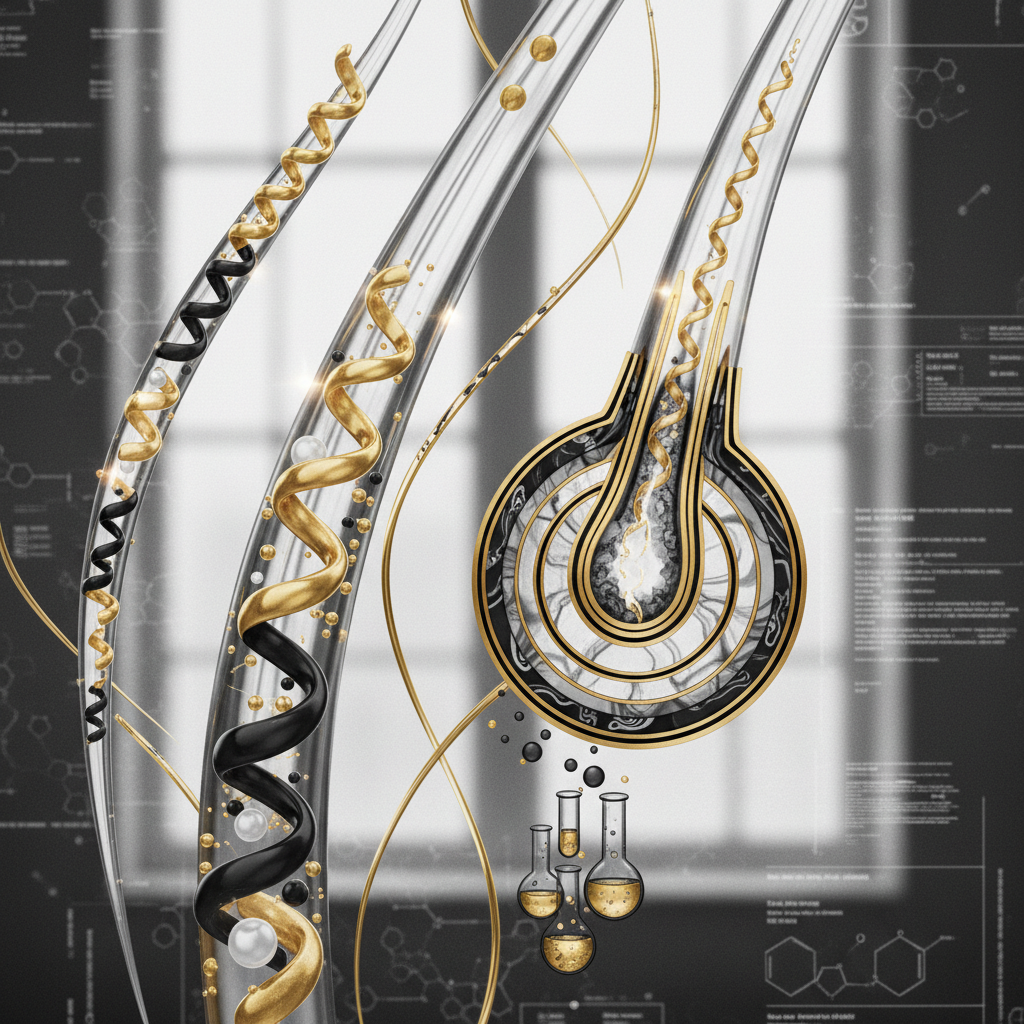
The fibre consists of three distinct concentric layers:
- The Cuticle: The outermost envelope consists of 5 to 10 overlapping scale-like cells pointing toward the tip. Each cuticle cell is about 0.3 to 0.5 micrometres thick and contains distinct sub-layers: the hydrophobic epi-cuticle (covered by the 18-methyleicosanoic acid or 18-MEA lipid layer), the densely cross-linked A-layer, the exocuticle (high cystine content), and the endocuticle (lower sulphur content, prone to swelling).
- The Cortex: Making up roughly 75 to 85 percent of the fibre's total volume, the cortex dictates mechanical strength, elasticity, and colour. It contains spindle-shaped cortical cells filled with macrofibrils. These macrofibrils consist of intermediate filaments (low-sulphur alpha-keratin helical coils) embedded in an amorphous, high-sulphur and high-glycine-tyrosine matrix. Melanin pigment granules (eumelanin and pheomelanin) also reside here.
- The Medulla: The innermost core, present primarily in coarse or terminal hairs, comprises loosely packed, porous cells with air spaces. It contributes minimally to the mechanical tensile strength of the hair fibre.
Chemically, keratin consists of 18 amino acids. Cystine is the most critical, accounting for up to 14 to 18 percent of total amino acid content in healthy hair. The oxidation of two cysteine molecules forms cystine, creating the covalent disulphide bridges that grant hair its remarkable physical resistance to degradation.
| Structural Layer | Main Component | Primary Function | Vulnerability |
|---|---|---|---|
| Epi-cuticle (18-MEA) | Fatty acids (lipids) | Hydrophobicity, lubricity, water repellency | Stripped rapidly by alkaline bleaching and oxidative dyes |
| Cuticle Scales | High-sulphur cross-linked keratin | Barrier defence, smooth texture, shine | Mechanical chipping, cuticle lifting above pH 6.0 |
| Cell Membrane Complex (CMC) | Lipids and low-sulphur proteins | Glues cuticle and cortical cells together | Dissolves or swells with strong solvents, surfactants, and chemical relaxers |
| Cortex | Intermediate filaments and matrix | Tensile strength, elasticity, pigmentation | Disulphide cleavage from perms, relaxers, and heat degradation |
| Medulla | Amorphous protein and air vacuities | Thermal insulation (minimal in humans) | Collapses or fragments, negligible impact on styling |
The molecular bond architecture
The mechanical behaviour of the hair fibre is dictated by three primary chemical bonds within the cortex:
- Disulphide bonds: Strong covalent links between adjacent cysteine amino acids. They do not break in water and require chemical reducing agents (such as thioglycolates or bisulphites) or aggressive alkaline oxidation (bleaching) to sever. When broken and not properly reformed, structural tensile strength drops permanently.
- Salt bonds (ionic linkages): Formed between the positively charged amino groups (such as lysine and arginine) and negatively charged carboxyl groups (such as aspartic and glutamic acid). These bonds are highly sensitive to pH. At hair's isoelectric point (roughly pH 3.67 to 5.5), salt linkages are at maximum density, keeping the fibre compact and resilient. Extreme alkaline or acid conditions destabilise these bonds, prompting fibre swelling.
- Hydrogen bonds: Weak physical bonds that form between adjacent polar groups (such as hydrogen and oxygen or nitrogen atoms). Although individually weak, their sheer volume accounts for roughly one-third of the fibre's temporary elasticity. Water and heat break hydrogen bonds effortlessly, which is why wetting or heat-styling allows hair to be reshaped temporarily until humidity resets it.
What the evidence does not show about hair fibre repair
Marketing often claims cosmetic treatments can permanently rebuild broken hair or revive dead fibres. Scientific reality is more measured:
- Cosmetic products cannot regenerate living tissue: Hair above the scalp surface is dead tissue without metabolic activity. Once cortical protein degrades or cuticle scales shear off, the follicle cannot send cellular repair signals to mend the shaft.
- Bond-building ingredients offer reinforcement, not total restoration: Specific cross-linking agents and dicarboxylic acids can create artificial bridges across fractured peptide chains. However, laboratory tensile testing shows these bridges do not return hair to its virgin mechanical baseline. They patch deficits rather than regenerating original biological structure.
- Moisture cannot compensate for missing protein: Applying oils or conditioners coats the surface and slows water transmission, but oil cannot replace loss of cortical keratin mass caused by chemical over-processing.
Mechanisms of structural degradation
Fibre failure occurs through identifiable chemical and physical pathways.
Oxidative damage from ultraviolet radiation and chemical bleaching removes the protective 18-MEA lipid layer from the cuticle surface. Once this lipid barrier is stripped, the fibre's contact angle decreases, shifting it from hydrophobic (water-repelling) to hydrophilic (water-absorbing). Hydrophilic hair absorbs atmospheric moisture rapidly, which swells the cortex, lifts cuticle scales, and increases inter-fibre friction.
Thermal degradation occurs when heat styling tools exceed 150 to 180 degrees Celsius. At these temperatures, alpha-helical keratins begin denaturing into disordered beta-sheet structures. At temperatures surpassing 200 degrees Celsius, moisture within the cortex can vaporise suddenly, leading to internal cavitation, commonly documented as "bubble hair".
Mechanical fatigue from brushing, detangling, and friction snaps chipped cuticle edges, exposing the delicate cortical cells underneath. Without the protective cuticle sheath, cortical macrofibrils unravel like an unbraided rope, producing split ends (trichoptilosis) or transverse fractures (trichorrhexis nodosa).
Practical steps to protect hair fibre integrity
Protecting the chemical balance of hair requires preserving cuticle integrity and keeping moisture flux within normal limits:
- Maintain an acidic surface pH: Use shampoos and conditioners formulated near the scalp and hair's natural isoelectric window (pH 4.5 to 5.5). Mildly acidic formulas prevent excessive shaft swelling and seal the cuticle layers tight against the cortex.
- Minimise wet-state mechanical stress: Hair swollen with water can stretch up to 30 percent beyond its resting length, but its yield point drops significantly. Avoid vigorous towel drying or rough brushing while hair is saturated.
- Reduce thermal exposure: Keep heated styling tools below 180 degrees Celsius, and use film-forming thermal protectants containing silicones or hydrolysed proteins that redistribute heat evenly and slow thermal conduction into the cortex.
- Replenish surface lubricity: Because stripped 18-MEA does not grow back on existing fibres, conditioning agents with fatty alcohols, cationic surfactants, and plant oils must be regularly applied to simulate the lost lipid layer, reducing comb friction.
When structural fragility points to biological causes
It is vital to distinguish cosmetic fibre breakage from systemic hair shedding or follicular hair loss.
If hairs shed with an intact white bulb at the root, the root has completed a biological growth cycle (telogen phase), which suggests shedding or alopecia rather than shaft breakage. If strands snap into short fragments without a bulb, the issue is structural fibre failure.
However, abnormal hair fragility can sometimes stem from genetic or metabolic conditions rather than cosmetic misuse. Conditions like monilethrix (beaded hair), trichothiodystrophy (sulphur-deficient brittle hair), or severe systemic nutritional deficiencies can disrupt keratin synthesis in the follicle, leaving the newly produced fibre physically compromised from the moment it emerges from the scalp.
If you experience sudden hair thinning, diffuse shedding, or structural breakage that resists gentle handling and conditioning, consult a registered trichologist, dermatologist, or general practitioner for diagnostic evaluation.
Supporting hair condition with Watermans
While hair fibres cannot metabolically repair themselves once grown, supporting the follicle environment and reducing mechanical breakage preserves the hair you have.
Watermans focuses on non-invasive scalp and hair support designed to keep the hair environment feeling balanced and clean. Watermans GrowMe Shampoo delivers a nutrient-rich wash featuring biotin, rosemary extract, and hydrolysed lupin protein that reinforces the feel of fragile hair strands while gently cleansing without aggressive alkaline disruption. Pairing it with Watermans ConditionMe Conditioner helps smooth the cuticle layer, improving surface slip and restoring manageability to lessen mechanical breakage during detangling.
Frequently asked questions about Hair Fibre Structure and Chemistry
What is the primary protein found in human hair?
Human hair is made of keratin, a fibrous, insoluble protein rich in the amino acid cystine. Keratin chains twist into alpha-helices, bundling together into intermediate filaments embedded within an amorphous matrix inside the cortex. These structures give the strand its tensile strength, flexibility, and resistance to environmental breakdown.
How does chemical bleaching alter Hair Fibre Structure and Chemistry?
Bleaching uses alkaline agents and hydrogen peroxide to penetrate the cuticle and oxidise melanin pigments in the cortex. This reaction permanently strips the 18-MEA surface lipid layer, converts cystine into cystic acid, and cleaves disulphide bonds. The fibre becomes porous, hydrophilic, physically weaker, and significantly more prone to breakage.
What is the natural pH of a hair fibre?
The isoelectric point of the hair fibre sits between pH 3.67 and pH 5.5. At this slightly acidic level, positive and negative charges on the protein's salt bonds are balanced, minimising fibre swelling and keeping cuticle scales lying flat. Products with a pH above 6.0 can cause cuticles to lift, increasing friction and fragility.
Can split ends be glued back together permanently?
No cosmetic treatment can permanently fuse split ends. Products containing polymers or cross-linking agents can temporarily bind split cortical fibres together through surface adhesion until the next wash. The only permanent solution for split ends is trimming the damaged section above the point of fracture to prevent unraveling.
Why does hair stretch more when wet?
Water breaks the weak hydrogen bonds that hold keratin's alpha-helical coils in place, allowing the protein chains to uncoil into an extended beta configuration under tension. While wet hair can stretch up to 30 percent without snapping, its wet elasticity makes it structurally vulnerable, meaning rough handling easily causes permanent deformation or breakage.
Conclusion on hair fibre integrity
A thorough grasp of Hair Fibre Structure and Chemistry clarifies why gentle handling is essential for maintaining resilient hair. Because the hair shaft is biologically non-living tissue, every chemical process, thermal pass, and abrasive brushing action creates cumulative wear on its cuticular and cortical bonds. By preserving the cuticle layer, maintaining an acidic pH balance, and treating wet hair with care, you protect the intricate keratin architecture that gives every strand its strength and natural shine.
Sources and references
- Robbins, C. R., Chemical and Physical Behavior of Human Hair, 5th edition, Springer-Verlag, 2012.
- Dawber, R., "Hair: its structure and response to cosmetic preparations", Clinics in Dermatology, 1996.
- Wolfram, L. J., "Human hair: a unique physicochemical composite", Journal of the American Academy of Dermatology, 2003.
- Swift, J. A., "The mechanics of the hair cuticle", International Journal of Cosmetic Science, 1999.
- Cruz, C. F., et al., "Human hair characteristics: physical, chemical and cosmetic aspects", Micron, 2016.