Hair Fibre Breakage Mechanics: Understanding Why Hair Snaps
9 min read ·
Understand Hair Fibre Breakage Mechanics: discover how physical stress, chemical processing, and heat cause snapping, and learn the science of protecting your lengths.
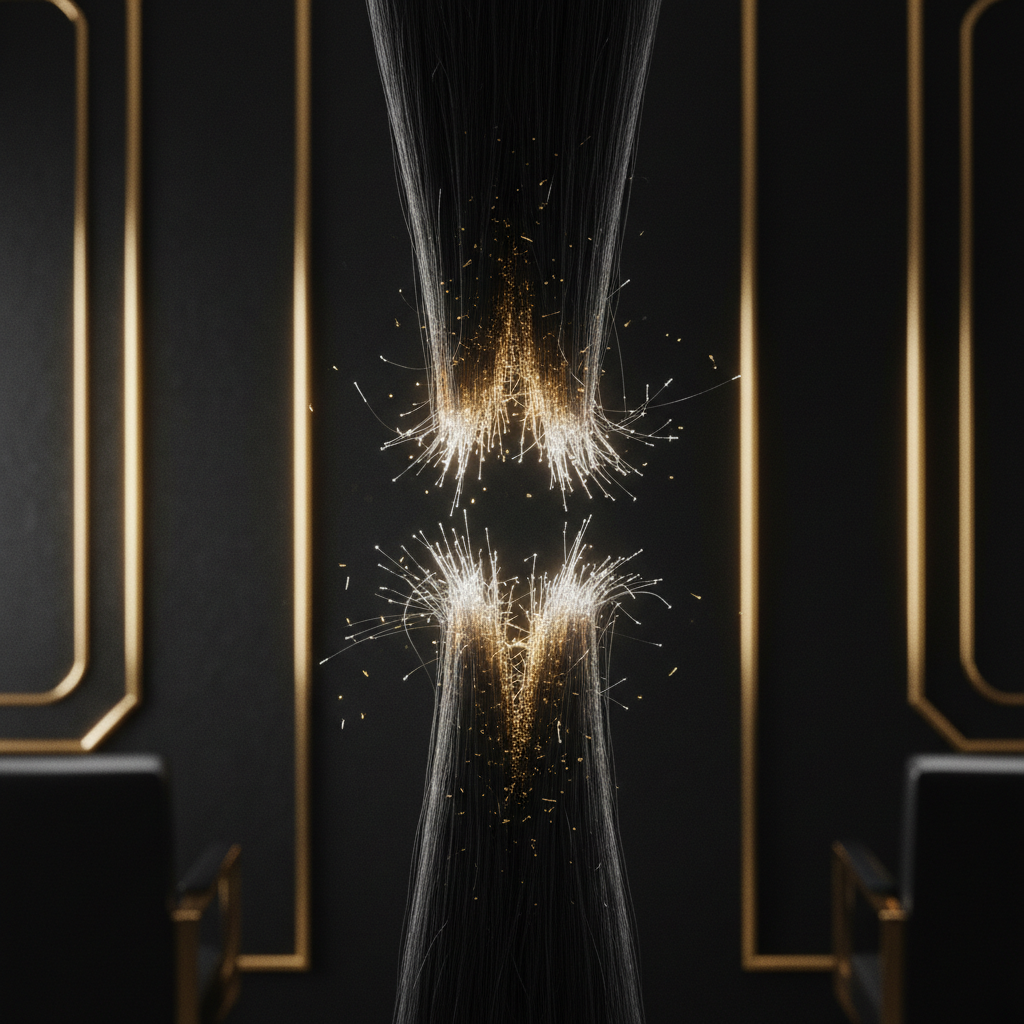
Quick answer: Hair Fibre Breakage Mechanics describes how physical stress, chemical degradation, and moisture changes cause a hair shaft to fracture and snap under tension or friction. Unlike hair shedding from the root, breakage occurs along the length of the fibre when external loads exceed the structural tensile strength of the cortical keratin matrix. While cosmetic treatments cannot biologically repair a fully severed cortex, targeted conditioning and mechanical care significantly reduce the stress thresholds that trigger fracture.
Key takeaways
- Breakage is entirely distinct from follicular hair loss; it represents mechanical failure along the hair shaft rather than shedding from the scalp.
- Healthy, virgin Caucasian and Asian hair typically withstands 1.5 to 2.2 Newtons of force and can stretch roughly 30% before snapping dry.
- Wet hair behaves differently to dry hair: its elasticity increases up to 50%, but its tensile strength drops markedly, making it vulnerable to plastic deformation and tearing.
- Repeated chemical processing (bleaching, relaxing, permanent colouring) strips protective 18-methyleicosanoic acid (18-MEA) lipids and cleaves internal disulphide bonds, lowering the failure threshold.
- Friction during wet combing, thermal denaturation above 190°C, and mechanical fatigue from daily styling create microscopic stress concentration points where cracks propagate across the cortex.
Hair Fibre Breakage Mechanics: what the evidence shows
Hair Fibre Breakage Mechanics governs how the three structural layers of a hair shaft interact under applied force. At the core, the hair cortex provides roughly 85% to 90% of a strand's total tensile strength. The cortex consists of intermediate filaments packed with fibrous keratin proteins held together by robust cystine disulphide bonds, embedded within an amorphous protein-rich matrix. Surrounding this engine room is the cuticle: 6 to 10 overlapping scales anchored by the cell membrane complex (CMC) and coated with a protective lipid monolayer known as 18-methyleicosanoic acid (18-MEA).
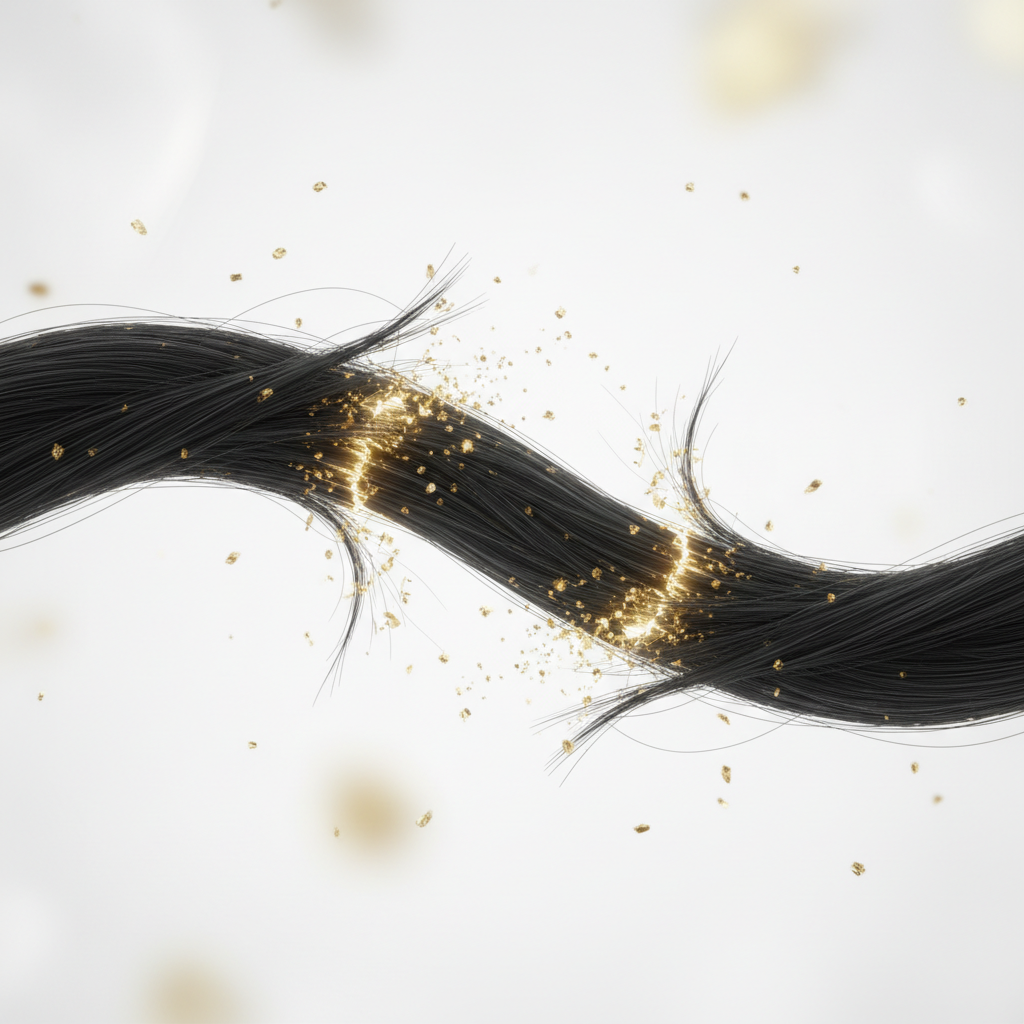
When you stretch a hair fibre, it progresses through three distinct mechanical phases:
- The Hookean (Elastic) Region (0 to 2% strain): The alpha-helical keratin coils stretch reversibly. If you release the tension here, the hair snaps back to its original length without internal damage.
- The Yield Region (2% to roughly 25-30% strain): Under continued load, the crystalline alpha-keratins unfold into beta-sheet conformations. The fibre permanently deforms; disulphide and hydrogen bonds rupture and reform in distorted configurations.
- The Post-Yield (Failure) Region (beyond 30% strain): The amorphous matrix stiffens until micro-cracks form. Once a crack penetrates the cortical cell boundaries, catastrophic fracture occurs.
Research published in the Journal of Cosmetic Science confirms that virgin, undamaged hair fibres have a tensile strength between 150 and 200 megapascals (MPa). However, oxidative bleaching breaks roughly 15% to 45% of cystine disulphide bonds, converting them to cysteic acid. This dramatic loss of internal cross-linking halves the required force to snap the shaft.
Tensile Strain Profile:
[0-2% Elastic] ---> [2-30% Yield (Alpha to Beta Transformation)] ---> [>30% Fracture]
What the evidence does not show
The science of fibre mechanics clearly refutes several persistent hair myths:
- Cosmetics cannot "heal" a snapped fibre: Once mechanical cleavage breaks the cortex, cosmetic products cannot rebuild living biological tissue. Peptides, silicones, and hydrolysed proteins deposit temporarily or form weak electrostatic cross-links, but they do not return a fractured strand to its original virgin morphology.
- Breakage does not equal alopecia: Breakage causes diffuse thinning of the hair ends, rough texture, and short, uneven strands, but it does not diminish follicular density on the scalp.
- Natural oils do not structurally rebuild disulphide bonds: Plant oils provide lubrication that decreases the coefficient of friction. They cushion the mechanical shear of brushing, but they do not chemically repair cleaved disulphide bridges inside the cortex.
The physical mechanisms of fibre failure
Fibre fracture rarely stems from a single pull. Instead, it develops through three distinct modes of mechanical breakdown:
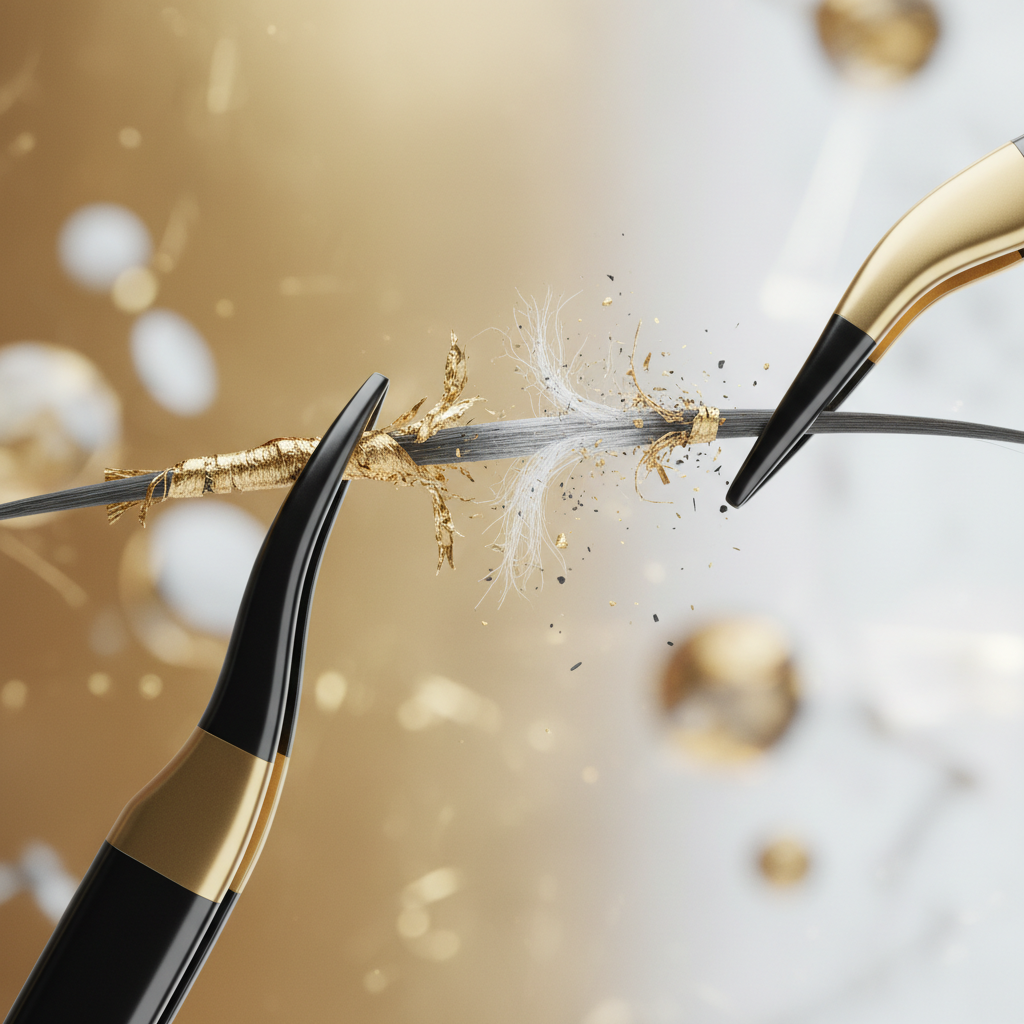
Tensile failure
Tensile failure happens when longitudinal pulling force exceeds the breaking strength of the fibre. A classic example occurs during wet de-tangling. Water disrupts the weak hydrogen bonds that stabilise the dry keratin matrix, acting as a plasticiser. While wet hair stretches further than dry hair, its yield point drops. Pulling forcefully through a stubborn wet knot easily drags the fibre past its yield point into permanent deformation and sudden snapping.
Flexural and torsional fatigue
Hair bends, twists, and rubs against itself thousands of times per week. When a fibre undergoes cyclic bending and torsion, shear stresses accumulate between adjacent cortical cells. Over time, microscopic longitudinal fissures open inside the cell membrane complex. Eventually, these sub-surface splits merge, causing the cuticle to flake off and exposing the bare cortex to transverse snapping.
Thermal denaturation
Exposing wet or damp hair to heated tools above 160°C induces rapid vaporisation of internal water, causing "bubble hair" deformities where steam pockets burst through the cortex. Beyond 190°C, dry thermal degradation decomposes the alpha-helical keratin structure itself. The cortical proteins melt into an irregular mass, creating severe stress concentration points where normal brushing causes abrupt breakage.
| Mechanism Factor | Virgin / Healthy Fibre | Chemically Treated Fibre | Heat-Damaged Fibre |
|---|---|---|---|
| Cuticle Condition | Flat, intact 18-MEA layer | Stripped, lifted, eroded scales | Scorched, bubbled, cracked |
| Cystine Disulphide Cross-links | Intact (~16-18% cystine content) | Depleted (converted to cysteic acid) | Thermally degraded |
| Break Force (Dry) | ~1.5 to 2.2 N per strand | ~0.7 to 1.1 N per strand | ~0.8 to 1.2 N per strand |
| Elastic Recovery | High (returns to resting state <2%) | Poor (enters yield phase early) | Very poor (brittle, low plasticity) |
| Coefficient of Friction | Low (glides smoothly) | High (drags, tangles easily) | High (rough, friction spikes) |
Signs to look for: identifying breakage
Because hair breakage mimics shedding at a glance, diagnosing it accurately is essential for choosing the right corrective routine:
- Absence of a white bulb: Shed hair features a small, white, rounded keratinous bulb at the proximal end, indicating natural telogen release from the follicle. Broken hair displays a blunt, frayed, or tapered end without any bulb.
- Variable strand lengths: Seeing very short, fragmented pieces (1 to 5 cm) on your shoulders, sink basin, or clothing points directly to mid-shaft fracturing.
- The "brush snap" sound: Audible popping sounds when brushing through dry or damp hair signal individual fibres reaching their ultimate tensile failure point.
- Split ends (trichoptilosis): Longitudinal splitting at the tips or along the shaft shows cuticle loss and exposed cortical macrofibrils that will soon snap completely.
- Weathering and dullness: Hair that feels coarse and velcro-like when sliding your fingers upward from tip to root indicates raised, damaged cuticle scales that invite excessive friction.
What you can do: reducing mechanical stress
Protecting hair from mechanical failure relies on reducing shear stress and maintaining fibre elasticity:
- Lower the coefficient of friction: Conditioners containing cationic surfactants (such as cetrimonium chloride or behentrimonium methosulfate) neutralise negative surface charges. This smooths raised cuticle scales and reduces the combing force needed to detangle wet hair by up to 80%.
- Detangle with care: Never rake brushes violently through wet lengths. Use a wide-tooth comb or flexible-bristle brush, starting at the tips and moving gradually upward to the roots to disperse mechanical load evenly.
- Buffer against heat: Always apply thermal protectors before blow-drying, curling, or flat-ironing. Silicones and protective polymers create an insulating film that spreads heat transfer gradually across the shaft, preventing local hot spots from burning through cortical proteins.
- Sleep on low-friction surfaces: Cotton pillowcases create high shear friction as you move in your sleep, roughing up cuticles. Using silk or satin significantly reduces nocturnal flexural fatigue.
- Balance moisture and protein: Protein-containing treatments can temporarily reinforce porous zones within damaged fibres, while emollient lipids seal moisture in, preventing the brittle dryness that triggers early fracture.
When the cause may be something else
If you observe substantial thinning but do not find snapped fragments on your clothing or pillow, your hair concerns likely stem from biological shedding rather than mechanical breakage:
- Telogen Effluvium: Sudden, excessive shedding where full-length hairs with white bulbs fall out in large numbers, often triggered by severe physical illness, hormonal shifts, nutritional deficits (such as iron or ferritin deficiency), or psychological stress.
- Androgenetic Alopecia: Gradual follicular miniaturisation, presenting as a widening parting, receding hairline, or diffuse crown thinning while the shafts themselves remain structurally sound.
- Alopecia Areata: An autoimmune disorder creating round, smooth, bald patches on the scalp.
- Trichorrhexis Nodosa: A specific structural defect characterised by microscopic nodes resembling interlocked paintbrushes along the shaft. While it results in extreme breakage, it can sometimes be congenital rather than purely cosmetic or mechanical.
Supporting hair condition with Watermans
When managing damaged lengths, maintaining a clean, balanced scalp environment ensures that new growth emerges with maximum structural potential. Watermans GrowMe Shampoo and ConditionMe Conditioner are formulated to improve the feel, slip, and visual density of hair.
ConditionMe incorporates premium conditioning agents, hydrolysed lupin protein, and natural oils that coat the fibre shaft. By dramatically reducing surface friction and smoothing lifted cuticles, it lowers the mechanical combing forces that lead to breakage. Combined with gentle, sulphate-free scalp care, this approach supports existing hair fibres against daily wear while keeping the scalp refreshed and nourished.
Frequently asked questions about Hair Fibre Breakage Mechanics
What is the primary difference between shedding and hair fibre breakage?
Shedding occurs when a hair reaches the end of its biological growth cycle and detaches completely from the follicle, showing a small, pale keratin bulb at its root. Hair breakage is purely physical: the hair fibre snaps along its shaft due to mechanical, thermal, or chemical damage, leaving a sharp, frayed edge without any root bulb.
Can chemically damaged hair ever regain its original tensile strength?
No. Once chemical treatments like bleach or chemical straighteners cleave cystine disulphide bonds, the biological matrix of the cortex is permanently altered. While bond-building treatments and hydrolysed proteins can create temporary synthetic reinforcements that raise the breaking threshold, they cannot regrow or permanently restore the native protein structure.
Why does wet hair break more easily than dry hair?
Water penetrates the hair shaft, plasticising the cortex and breaking the temporary hydrogen bonds that give dry hair its rigidity. As a result, wet hair stretches more easily, but its yield point drops significantly. Gentle pulling forces that dry hair would resist can stretch wet hair past its recovery limit, causing permanent structural tearing and snap failure.
How does Hair Fibre Breakage Mechanics apply to curly and afro hair?
Curly and afro hair types are mechanically vulnerable because their elliptical cross-sections create natural twists, bends, and uneven diameter variations along each fibre. In Hair Fibre Breakage Mechanics, these natural geometric kinks serve as stress concentration points where bending and tensile loads accumulate, making the fibre more susceptible to snapping during dry styling and combing.
Does split end trimming really stop breakage further up the shaft?
Yes. When a split end forms, the protective cuticle is gone, leaving the inner cortical macrofibrils exposed. Continued friction causes these fibres to peel apart vertically like a fraying rope. Trimming the split ends removes this unstable point of crack propagation, preventing longitudinal fractures from travelling further up the shaft.
Summary of Hair Fibre Breakage Mechanics
Hair Fibre Breakage Mechanics reveals that hair breakage is an engineering problem rather than an internal medical failure. While healthy hair possesses remarkable tensile strength, repetitive chemical processing, thermal stress, and forceful detangling wear away the protective cuticle and degrade the cortex. Protecting your hair requires lowering physical friction, respecting the vulnerable wet yield state of the fibre, and preserving internal protein integrity through intelligent daily care.
Sources and references
- Journal of Cosmetic Science: Tensile properties of human hair: effects of chemical and environmental treatments (2008).
- International Journal of Cosmetic Science: The chemical and physical properties of human hair (2012).
- Robbins, C. R.: Chemical and Physical Behavior of Human Hair, 5th Edition, Springer (2012).
- British Journal of Dermatology: Hair shaft abnormalities: structural defects and brittle hair (2015).
- Skin Pharmacology and Physiology: Hair mechanical properties and the role of the cell membrane complex (2019).