Hair Elasticity and Strength: The Complete Evidence-Based Guide
11 min read ·
Understand the science of hair elasticity and strength, how disulphide bonds protect the cortex, and practical methods to prevent mechanical fibre breakage.
Quick answer: Hair elasticity and strength determine how much mechanical stress, stretching, and daily styling your hair can withstand before snapping. Hair Elasticity and Strength rely directly on the integrity of the cortex, specifically its alpha-keratin polypeptide chains, cross-linking disulphide bonds, and internal moisture balance. Healthy wet hair can stretch up to 30 percent of its original length and recover without breaking. However, chemical processing and heat alter these internal bonds permanently, meaning cosmetic treatments can support and protect the fibre, but cannot truly restore dead biological tissue to virgin condition.
Key takeaways
- Elasticity reflects cortex health: Elasticity is the hair fibre's capacity to stretch under tension and return to its resting length without permanent deformation or snapping.
- Tensile strength resists load: Strength measures the total pulling force required to break the fibre, which is governed primarily by covalent disulphide bonds between cysteine residues.
- Water changes the mechanical dynamics: Wet hair possesses lower tensile strength but higher elasticity than dry hair because water molecules temporarily disrupt weak hydrogen bonds, making wet hair far more vulnerable to mechanical breakage.
- Damage is cumulative and irreversible: Once covalent bonds in the cortex are broken by bleach, relaxers, or temperatures above 180 degrees Celsius, cosmetic conditioners can only temporarily patch the structural defects.
- Cosmetic care prevents breakage, not hair loss: Restoring elasticity prevents hair breakage along the shaft; it does not alter follicular hair shedding or genetic thinning.
Hair Elasticity and Strength: what the evidence shows
Textile and cosmetic science evaluates human hair as an anisotropic biological composite. Hair Elasticity and Strength stem from the structural interplay between the outer cuticle and the inner cortex.
The cortex accounts for roughly 85 to 90 percent of the fibre's total mass. Inside cortical cells lie crystalline intermediate filaments (macrofibrils made of alpha-helical keratin proteins) embedded in an amorphous, high-sulphur protein matrix. This arrangement operates much like reinforced concrete: the keratin fibrils provide tensile resistance, while the sulphur-rich matrix absorbs compressive and rotational stress.
When you pull a dry, healthy hair strand, it exhibits a distinct three-phase stress-strain curve:
- The Hookean (elastic) region: When stretched up to roughly 2 to 3 percent of its resting length, the hair stretches and contracts cleanly. Hooke's law applies, meaning the internal alpha-helical keratin structures deform reversibly without damage.
- The yield region: Between roughly 3 and 25 to 30 percent elongation, mechanical tension forces the coiled alpha-keratin helices to unravel into planar beta-sheet conformations. Resistance drops, and the fibre extends with little extra force.
- The post-yield region: Beyond 30 percent elongation, the unfolded molecular chains become fully aligned, resisting further stretching until the structural disulphide bonds rupture entirely, causing the fibre to snap.
In healthy virgin hair, the force required to break a single dry strand typically ranges between 50 and 100 grams of weight (roughly 0.5 to 1.0 Newtons), depending on the fibre's cross-sectional diameter. Wet hair tells a different story. Water infiltrates the amorphous cortex, swelling the fibre by up to 15 percent in diameter. These water molecules break intermolecular hydrogen bonds, allowing the keratin chains to slide past one another more easily. Consequently, wet hair can stretch up to 30 to 50 percent before snapping, but its tensile strength drops by roughly 20 to 30 percent compared to dry hair.
What the evidence does not show
There are persistent misconceptions across the hair industry regarding how mechanical properties interact with treatments:
- Conditioners do not "rebuild" broken hair permanently: Quaternary ammonium compounds, silicones, and hydrolysed plant proteins deposit onto the cuticle and fill micro-voids in the outer cortex. They reduce surface friction and slow down moisture loss, which dramatically reduces combing breakage. However, they do not reconstitute native disulphide cross-links inside the cortex. Their structural reinforcement washes out over successive cleanses.
- High elasticity does not equal unbreakable hair: Hair with compromised cuticle layers that has been over-softened or chemically stripped can exhibit "mushy" or hyper-elastic behaviour when wet. It stretches far beyond normal limits because the internal protein matrix has eroded, but it possesses almost zero tensile strength and snaps under trivial tension.
- Fibre strength does not govern follicle retention: Hair breakage along the shaft is often confused with root-level shedding. Strengthening the hair shaft with proteins or bond builders has no direct effect on follicular cycles, telogen effluvium, or androgenetic alopecia.
Mechanisms that degrade tensile performance
To protect structural integrity, it helps to understand the distinct biochemical pathways that undermine the hair shaft.
Chemical processing
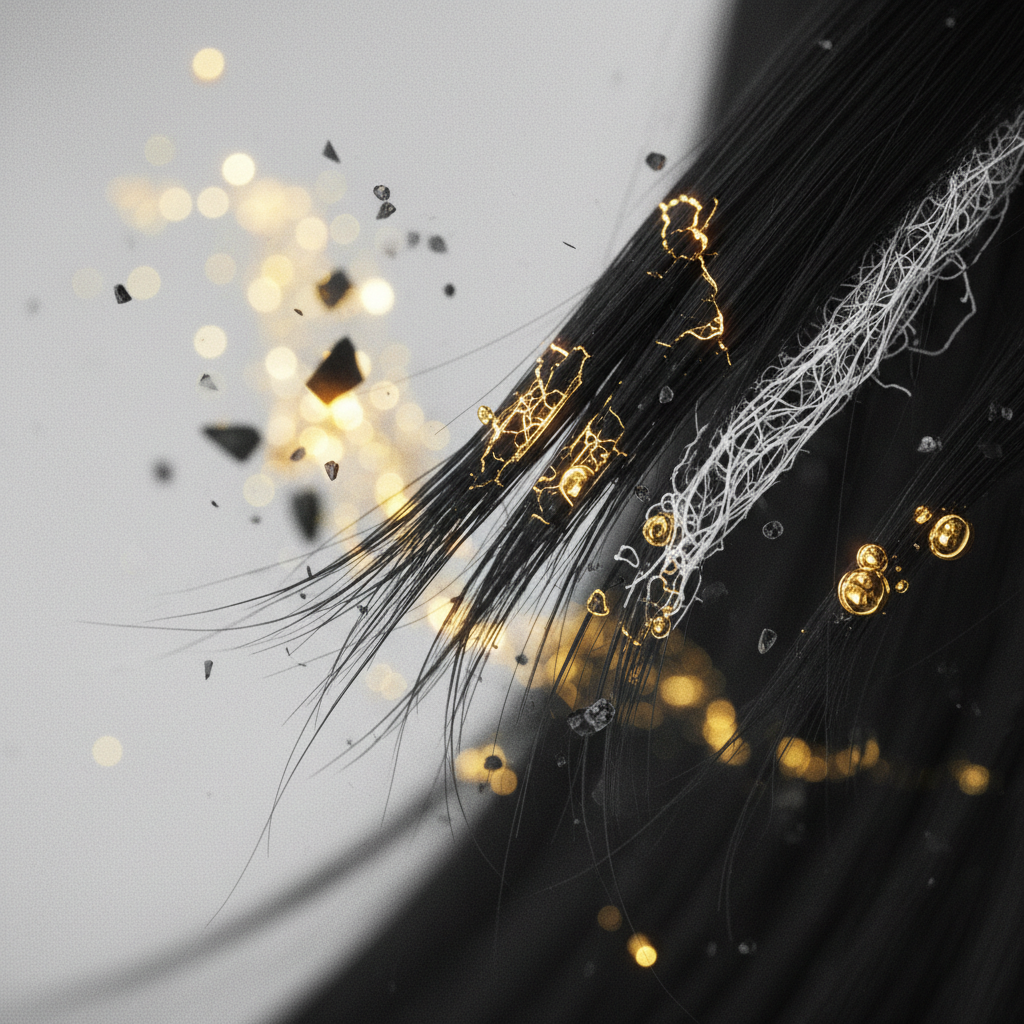
Bleaching agents, alkaline permanent dyes, and chemical relaxers break the cystine disulphide bonds that give the cortex its rigidity. Hydrogen peroxide oxidises cystine into cysteic acid residues. Because cysteic acid cannot form cross-links, each chemical treatment permanently depletes the cortex's load-bearing network. Cosmetic research shows that heavily bleached hair can lose up to 45 percent of its dry tensile strength.
Thermal denaturation
Direct heat from flat irons and curling wands alters keratin geometry. At temperatures between 140 and 160 degrees Celsius, moisture bound within the cortex rapidly evaporates. Beyond 185 to 200 degrees Celsius, alpha-keratin helices undergo irreversible thermal denaturation, melting the protein structure and generating microscopic cortical cavities known as trichorrhexis nodosa.
Environmental weathering
Ultraviolet radiation (UVA and UVB) degrades amino acids such as tryptophan, tyrosine, and cystine via photo-oxidation. Over prolonged exposure, sunlight strips the protective 18-methyleicosanoic acid (18-MEA) lipid layer from the cuticle, increasing porosity and exposing the cortex to ambient humidity swings.
Virgin Cortex (High Strength, Balanced Elasticity)
 [ Alpha-Keratin Helices ] === Disulphide Bonds === [ Matrix ]
 │
 Chemical / Thermal Stress
 ▼
Damaged Cortex (Low Strength, Erratic Elasticity)
 [ Denatured Beta-Sheets ] ··· Cysteic Acid (Broken) ··· [ Porous Voids ]
Signs of altered elasticity and strength
Assessing hair behaviour helps pinpoint whether your strands suffer from protein loss, surface lipid erosion, or moisture imbalance.
- Low elasticity (brittle snapping): The dry strand resists any stretching and breaks almost immediately upon gentle tension. This often occurs in hair subjected to excessive heat or mineral build-up, where the fibre has become rigid and dehydrated.
- Hyper-elasticity (gummy or rubbery feel): When wet, the hair stretches excessively, feels mushy between your fingertips, and fails to snap back into its original wave or straight pattern. This is a classic symptom of severe chemical oxidation (over-bleaching), where disulphide bonds and matrix proteins are heavily depleted.
- Mid-shaft split ends and fairy knots: Fissures along the shaft (trichoptilosis) indicate that the protective outer cuticle has worn away, leaving vulnerable cortical fibrils exposed to everyday friction.
Structural comparison: healthy vs damaged hair fibres
The physical differences between sound and compromised hair fibres directly dictate how you should manage them:
| Property | Healthy Virgin Hair | Chemically Bleached Hair | Thermally Damaged Hair |
|---|---|---|---|
| Cuticle Condition | 6 to 8 intact layers; hydrophobic (repels water) | Cuticle scales lifted, fragmented, or missing | Cuticle scales cracked, melted, or blistered |
| Max Wet Elasticity | Stretches 30% and recovers fully | Stretches >40% without snapping back (mushy) | Snaps abruptly at <15% elongation |
| Dry Tensile Strength | High (50 to 100g per individual strand) | Reduced by 30 to 50% | Reduced by 20 to 40% |
| Primary Chemical Flaw | None; intact disulphide cross-links | High cysteic acid content; loss of cystine | Denatured alpha-keratin; cortical micro-voids |
| Primary Vulnerability | Excessive dry tension or friction | Friction, wet detangling, alkaline solutions | Dry heat, mechanical bending, low humidity |
What you can do to preserve mechanical integrity
While you cannot biologically regenerate dead cortical cells, targeted habits can preserve existing structural bonds and mitigate surface friction.
Match treatments to your specific structural deficit
If your hair is gummy and over-stretched from bleach, prioritise small-molecule hydrolysed proteins (such as hydrolysed wheat, pea, or keratin protein). These fragments (molecular weights below 1,000 Daltons) can temporarily penetrate the porous cuticle into the outer cortex, forming temporary hydrogen and ionic bonds that provide artificial rigidity. If your hair is brittle and snaps cleanly, reduce protein treatments and apply emollient lipid conditioning agents (such as cetyl alcohol, behentrimonium methosulfate, or plant oils) to improve flexibility and lower surface friction.
Reduce wet mechanical stress
Because water weakens hydrogen cross-links, never aggressively brush or stretch hair immediately after washing. Use wide-tooth combs or flexible detangling brushes on hair coated with a high-slip conditioner. Detangle in sections, starting from the ends and working upward toward the scalp.
Cap heat tools and protect the surface
Keep direct heated styling tools below 180 degrees Celsius. Always apply a film-forming heat protectant containing ingredients like polyquaternium polymers or dimethicone. These ingredients slow the rate of heat transfer into the cortex and preserve internal moisture levels.
Support the follicle from the beginning
A healthy, fully keratinised fibre begins in an uninflamed, nourished scalp environment. While topical products can only protect existing lengths, maintaining scalp hygiene and supporting microcirculation ensures that new hair emerges with optimal density and structural development.
Thoughtful support: Watermans
When managing hair prone to brittleness and mechanical breakage, your daily cleansing routine should minimise fibre wear while fostering a healthy scalp environment. Watermans GrowMe Shampoo and ConditionMe Conditioner are formulated to respect the delicate balance of fragile lengths. By combining hydrolysed lupin protein, biotin, rosemary extract, niacinamide, and argan oil in a gentle, sulphate-free base, they cleanse without stripping the hair's protective lipid barrier. The formula lubricates the hair shaft to reduce combing friction, helping you retain existing fibre length and minimise snapping.
When the cause may be something else
If you observe a sudden drop in the volume or density of your hair rather than localized breakage, the underlying cause is rarely an issue of structural elasticity:
- Telogen effluvium: Marked by rapid, diffuse shedding across the entire scalp, typically appearing two to three months after a physiological shock, fever, surgery, or severe nutritional deficit. Shed hairs feature an intact white keratin bulb at the root.
- Androgenetic alopecia: Characterised by progressive follicular miniaturisation, presenting as widening part lines or crown thinning, rather than fibre snapping.
- Underlying medical conditions: Thyroid abnormalities (hypothyroidism or hyperthyroidism), systemic iron deficiency (ferritin below optimal clinical thresholds), or autoimmune conditions can alter the rate of hair growth and the diameter of newly produced shafts.
When to get professional advice
Consult a qualified trichologist or dermatologist if you experience sudden, widespread shedding with visible scalp patches, scalp redness, burning, flaking, or if your hair begins breaking off at the root without prior chemical or thermal exposure. A professional can use dermoscopy (trichoscopy) to distinguish between structural hair shaft disorders (such as monilethrix or trichorrhexis invaginata) and systemic hair loss conditions.
Frequently asked questions about Hair Elasticity and Strength
How do I test my Hair Elasticity and Strength at home?
Select a single shed hair strand after washing. While it is damp, hold the strand firmly between the thumb and forefinger of both hands, leaving about two inches of exposed fibre between them. Gently stretch the hair. If it extends slightly (around 20 to 30 percent) and bounces back to its original length when released, elasticity is balanced. If it stretches endlessly and feels limp or gummy, it lacks structural protein strength. If it snaps instantly with little pull, it lacks moisture and flexibility.
Can deep conditioners permanently fix damaged hair elasticity?
No. Conditioners, masks, and treatments cannot permanently repair damaged hair. Hair is non-living tissue that cannot biologically self-heal. Conditioners deposit smoothing lipids, cationic surfactants, and hydrolysed proteins that temporarily bridge micro-fissures and reduce surface friction. These deposits wash away over time, meaning you must maintain consistent care to keep damaged fibres manageable and prevent further snapping.
Why does wet hair break more easily than dry hair?
Wet hair breaks more easily because absorbed water molecules disrupt the temporary hydrogen bonds that stabilise alpha-keratin helices in the cortex. This lowers the tensile strength of the fibre by 20 to 30 percent. Even though wet hair can stretch further before failing, the actual pulling force required to cause irreversible damage is significantly lower than when the hair is dry.
Does lack of protein make hair weak?
Yes, but only in specific contexts. Severe systemic protein malnutrition can impair hair matrix cell division in the follicle, leading to narrower, structurally fragile hair shafts. Topically, chemical treatments strip protein from the cortex. However, overloading undamaged hair with intensive topical protein treatments without sufficient emollients can create a stiff, brittle fibre that snaps easily under tension.
Conclusion
Understanding Hair Elasticity and Strength allows you to make informed decisions about your daily routine and long-term chemical styling. True mechanical resilience relies on an intact cortex protected by a healthy, hydrophobic cuticle layer. While you cannot biologically rebuild severed disulphide bonds or denatured keratin, gentle detangling habits, controlled heat settings, and targeted cosmetic care can protect existing strands, preserve your length, and prevent avoidable fibre breakage.
Sources and references
- Robbins, C. R. (2012). Chemical and Physical Behavior of Human Hair (5th ed.). Springer-Verlag.
- Swift, J. A. (1999). Human hair cuticular cell-cell enzymes: an aspect of the biology of hair growth and differentiation. International Journal of Cosmetic Science, 21(4), 227-239.
- Wolfram, L. J. (2003). Human hair: a unique physicochemical composite. Journal of the American Academy of Dermatology, 48(6), S106-S114.
- Dawber, R. (1996). Hair: its structure and response to cosmetic preparations. Clinics in Dermatology, 14(1), 105-112.
- Cruz, C. F., Costa, C., Gomes, A. C., Matamá, T., & Cavaco-Paulo, A. (2016). Human hair keratin after chemical or physical treatment. Journal of Applied Polymer Science, 133(41).
Find these ingredients in Watermans products
- Niacinamide: you will find this ingredient in our Hair Mask.