The Complete Guide to Hair Elasticity and Protein Balance
9 min read ·
Discover the science of Hair Elasticity and Protein Balance. Learn how keratin structure and moisture prevent breakage, restore snap, and maintain hair health.
Quick answer: Understanding hair elasticity and protein balance is the key to preventing mechanical breakage and restoring tensile strength. Hair fibre elasticity relies on internal cortical keratin cross-linked by disulphide bonds, balanced with bound water. When hair lacks protein, it feels mushy, stretches excessively, and snaps without bouncing back. When it has excess protein without adequate moisture, it becomes brittle and stiff. The primary limitation is that topical products cannot biologically regenerate living cells; they temporarily patch structural gaps within the non-living fibre.
Key takeaways
- Healthy, undamaged wet hair can stretch up to 30% of its original length and return intact, whereas dry hair stretches roughly 15% to 20% before deforming.
- Cortical keratin proteins supply tensile strength and rigidity, while moisture provides flexibility and pliancy.
- True hair breakage occurs when structural tensile limits are exceeded; this mechanical failure must not be confused with follicle-level shedding or alopecia.
- Over-bleaching, chemical relaxing, and extreme heat degrade keratin's cystine cross-links, causing hyper-elastic, gummy strands.
- Topical hydrolysed proteins temporarily reinforce the hair cuticle and cortex, but balance with humectants and emollients is essential to prevent stiffness.
Hair Elasticity and Protein Balance: what the evidence shows
Textile and cosmetic scientists measure hair health primarily through tensile testing. The internal cortex of each hair strand accounts for roughly 85% of its total weight and consists of fibrous alpha-keratin polypeptide chains organized into intermediate filaments. These proteins are glued together by an amorphous, sulfur-rich matrix.
The relationship between hair elasticity and protein balance dictates how the fibre reacts when combed, brushed, or styled. When tensile load is applied, the coiled alpha-helices within keratin uncoil into beta-sheet structures. This physical phase change allows the strand to extend. Once tension is released, strong disulphide bonds pull the intermediate filaments back to their original shape.
Moisture acts as a plasticiser inside this matrix. Water molecules temporarily slip between keratin polypeptide chains, allowing them to slide past one another smoothly. If hair retains adequate cortical moisture and an intact protein scaffold, it maintains high elasticity. Conversely, if chemical processing oxidises cystine into cysteic acid, the internal scaffolding weakens. The strand loses its restorative snap, predisposing it to severe fatigue breakage along the hair shaft.
The mechanical difference: protein versus moisture
Hair condition often swings between two mechanical extremes. Diagnostic clarity helps determine whether the cortex requires structural reinforcement or plasticising hydration.
| Fibre state | Mechanical response | Physical feel when wet | Root cause | Primary solution |
|---|---|---|---|---|
| Balanced | Stretches up to 30% wet, returns to original length smoothly | Smooth, firm, pliant | Preserved alpha-keratin matrix and balanced bound moisture | Maintenance routines with mild surfactants and light conditioning |
| Protein deficiency | Stretches far beyond 30%, feels limp, snaps without springing back | Gummy, mushy, sticky, sponges water excessively | Cystine cleavage from bleach, relaxers, or repeated thermal oxidation | Low molecular weight hydrolysed proteins (wheat, keratin, amino acids) |
| Moisture deficiency | Minimal stretch (under 5%), snaps instantly under slight tension | Dry, rough, coarse, lacks suppleness | Depleted lipid layer (18-MEA) and low ambient hydration | Humectants (glycerin, panthenol) paired with sealing fatty alcohols |
| Protein overload | Extremely rigid, zero stretch, snaps cleanly under low load | Straw-like, brittle, stiff, dull surface | Excessive application of film-forming proteins without humectants | Clarifying wash followed by deep emollient conditioning |
The biological mechanism of hair elasticity
Hair elasticity is governed by the secondary and tertiary structural geometry of hair proteins:
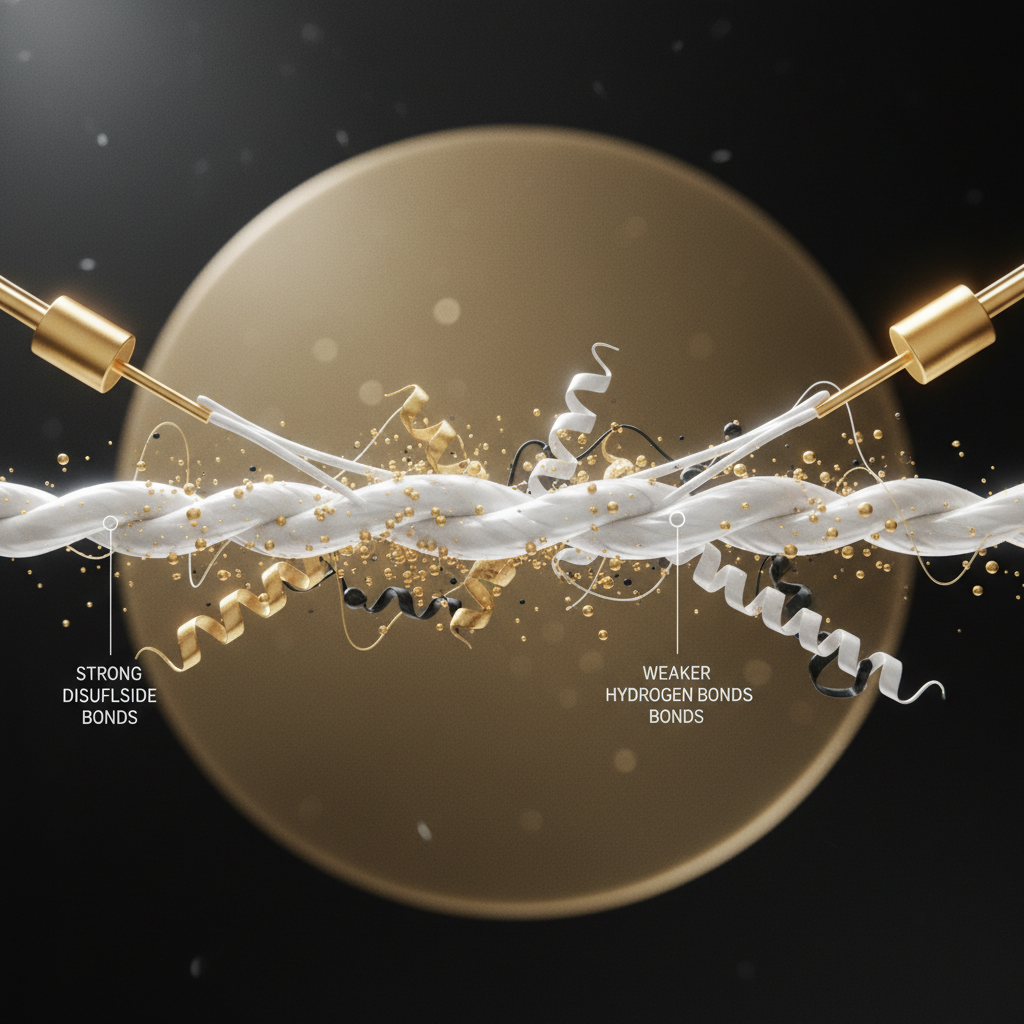
- Alpha-keratin coils: Microscopic coiled coils of protein provide the base elasticity. Under tension, hydrogen bonds break first, allowing initial extension up to roughly 2% strain.
- The yield region: As pulling continues past 2% up to roughly 25% or 30%, alpha-helical structures unfold into planar beta-sheets. Bound water molecules dictate how easily this transition occurs.
- Disulphide cross-links: The high concentration of cysteine amino acids forms covalent disulphide bonds. These act as rigid anchors. When strain is released, they supply the thermodynamic pull that refolds beta-sheets back into alpha-helices.
- The cell membrane complex (CMC): Between cuticle scales and cortical cells lies the CMC, rich in structural lipids like 18-methyleicosanoic acid (18-MEA). The CMC prevents shear stress from ripping cortical cells apart during bending.
Thermal styling tools above 185°C denature these keratin proteins irreversibly, while alkaline chemical services (bleaching, perm lotions, chemical relaxers) rupture disulphide bonds. When these anchors are lost, the hair cannot retract, leading to structural collapse.
Signs of imbalance: testing elasticity at home or in the salon
A wet tensile test reveals the structural integrity of your hair fibre:
- The wet snap test: Take a single shed strand of clean, wet hair. Secure it firmly between the thumb and forefinger of each hand, leaving a 5 cm section in the middle. Gently and steadily pull outward.
- Normal elasticity: The strand extends slightly, resists your pull with firmness, and returns to its resting length when tension is reduced.
- Low protein (high stretch, low recovery): The fibre feels unusually soft or gummy, stretching outward like soft chewing gum. It continues extending until it snaps without bouncing back.
- Low moisture (brittleness): The strand exhibits zero give. The moment minor tension is applied, it fractures cleanly with an audible snap.
Note that this test should only be performed on shed strands, never by pulling hairs directly from your scalp, which risks follicular traction damage.
What you can do to restore equilibrium
Achieving proper equilibrium requires deliberate ingredient management based on current fibre porosity and damage history.
Managing protein deficiency
If hair has been bleached, permed, or relaxed, the cortex has structural voids.
- Look for hydrolysed proteins (such as hydrolysed keratin, hydrolysed wheat protein, or silk amino acids). Intact proteins are too large to cross the cuticle, but hydrolysed fragments with molecular weights between 500 and 2,000 Daltons can penetrate the outer cortex.
- Apply a protein treatment once every two to four weeks. Always follow with a moisturising conditioner to prevent the fibres from setting into a rigid, brittle state.
Managing moisture deficiency and protein overload
If your hair feels stiff, dry, or straw-like after intensive treatments:
- Pause all products containing hydrolysed proteins, vegetable proteins, or heavy amino acid complexes.
- Wash with a gentle, sulphate-free clarifying shampoo to remove surface protein film buildup.
- Apply deep conditioning masks rich in humectants like glycerin, sodium PCA, and panthenol. These draw water back into the cortex.
- Seal the cuticle with fatty alcohols (cetyl, stearyl, or cetearyl alcohol) and natural plant oils to slow down moisture evaporation.
What the evidence does not show
Cosmetic science has clear boundaries regarding fibre repair:
- Topical treatments do not heal hair permanently: The hair shaft is non-living biological tissue (dead keratinocytes). Treatments deposit functional ingredients that temporarily patch holes, fill cracks, or create flexible surface films. They wash out over time.
- Products do not alter follicular genetics: No protein treatment changes the diameter, density, or inherent wave pattern determined by the hair follicle under the scalp.
- High elasticity does not guarantee zero breakage: Even balanced hair breaks if exposed to severe mechanical friction, tight elastane hair ties, aggressive backcombing, or unbuffered high heat.
Distinguishing fibre breakage from hair shedding and loss
It is critical to separate fibre breakage from true hair loss:
- Mechanical breakage: Manifests as short, fragmented pieces of hair with blunt or split ends, lacking a white bulb. This is driven by compromised elasticity, dryness, or over-processing.
- Telogen shedding: Normal shedding yields 50 to 100 hairs daily, each displaying a small, white keratinised bulb at the root. Diffuse, excessive shedding (telogen effluvium) stems from systemic triggers like illness, hormonal shifts, nutritional deficiencies, or severe physiological stress.
- Alopecia: Pattern thinning or patchy bald spots (androgenetic alopecia, alopecia areata) occur at the follicle level under the scalp. Shampoos and conditioning masks target fibre integrity; they do not cure follicular hair loss disorders.
If you notice widening part lines, diffuse scalp show-through, or patchy shedding, consult a qualified trichologist or dermatologist rather than relying on structural hair treatments.
Watermans: supporting complete hair and scalp wellness
While structural fibre care handles external shaft resilience, healthy hair growth begins at the follicle. Watermans approaches hair wellness by nurturing the scalp environment where new fibres form.
Formulated without harsh sulphates that strip structural lipids from fragile cuticles, Watermans GrowMe Shampoo delivers revitalising nutrients directly to the scalp. Supporting ingredients like biotin, rosemary extract, caffeine, and lupin protein help invigorate the scalp while leaving strands soft, flexible, and resilient against everyday mechanical stress. Pairing targeted external conditioning with scalp-focused nutrition ensures strands emerge strong from the root and remain balanced through the ends.
Frequently asked questions about Hair Elasticity and Protein Balance
How often should I test my hair elasticity and protein balance?
Testing your hair once a month or immediately following chemical services is ideal. Use a clean, wet shed strand to check resistance and recovery. This cadence allows you to adjust your conditioning masks and protein treatments before mechanical breakage develops along the shaft.
Can low porosity hair tolerate protein treatments?
Low porosity hair has tightly overlapping cuticle scales that resist moisture absorption. While it requires structural strength, it is easily overwhelmed by large protein molecules. If using protein, opt for light amino acids or small hydrolysed silk proteins, paired with gentle heat to help lift the cuticle slightly.
What is the quickest fix for brittle, protein-overloaded hair?
Clarify the hair using a chelating or gentle clarifying shampoo to strip away excess surface polymers. Follow immediately with a silicone-free, protein-free deep hydrating mask containing high concentrations of glycerin and fatty alcohols. Leave it on for 20 minutes under a warm shower cap to restore flexibility.
Does heat damage affect protein or moisture first?
Excess heat degrades both simultaneously. Temperatures above 150°C rapidly evaporate both free and bound water within the cortex. At temperatures exceeding 185°C to 200°C, the physical keratin protein undergoes irreversible thermal denaturation, causing microscopic bubbles (bubble hair) and fractures along the cuticular sheath.
Structural equilibrium for resilient hair
Mastering hair elasticity and protein balance transforms your approach to daily styling and maintenance. Hair is an intricate biological composite that requires both the rigid scaffolding of keratin and the pliant flexibility of bound water. By learning to interpret whether your hair lacks elasticity, needs hydrolysed protein reinforcement, or simply requires deep hydration, you can prevent preventable mechanical breakage and protect the natural integrity of your strands over time.
Sources and references
- Robbins, C. R. (2012). Chemical and Physical Behavior of Human Hair (5th ed.). Springer-Verlag New York.
- Dawber, R. (1996). Hair: Its structure and response to cosmetic preparations. Clinics in Dermatology, 14(1), 105-112.
- Cruz, C. F., et al. (2016). Human hair keratin after chemical and physical treatments: an overview. International Journal of Cosmetic Science, 38(5), 443-453.
- World Trichology Society. (2020). Hair Fibre Tensile Strength and Elasticity Diagnostics.
- Society of Cosmetic Scientists (SCS). Principles of Hair Conditioning and Cleansing Formulations.
Find these ingredients in Watermans products
- Panthenol (Provitamin B5): you will find this ingredient in our Heat Protection Spray.