Hair Cuticle Porosity: The Science of Cuticle Structure and Moisture Retention
10 min read ·
Hair Cuticle Porosity determines how moisture moves through the hair shaft. Discover how cuticle structure impacts absorption, breakage risk, and hair health.
Quick answer: Hair Cuticle Porosity refers to how easily moisture, water, and cosmetic chemicals pass through the outermost protective layer of the hair shaft. Governed by the arrangement, integrity, and lipid coating of overlapping cuticle scales, porosity dictates how hair absorbs and retains hydration. While high porosity hair absorbs water rapidly and loses it just as quickly, low porosity hair resists moisture penetration entirely. The main limitation is that porosity reflects fibre structure rather than follicle health, meaning it affects cosmetic behaviour and breakage risk, not biological hair loss.
Key takeaways
- Cuticle scales overlap like roof tiles in 5 to 10 layers, bound by a lipid-rich cell membrane complex and 18-methyleicosanoic acid (18-MEA).
- Low porosity hair features tightly packed, flat cuticle tiles that repel water, whereas high porosity hair has lifted, chipped, or missing cuticles that absorb and release water excessively.
- Chemical processing, heat styling above 180 degrees Celsius, and UV exposure artificially increase porosity by stripping surface lipids and degrading structural keratin.
- Porosity is purely a physical property of the non-living hair fibre. It influences cosmetic breakage and dryness, but never biological shedding or follicle-driven hair loss.
- Managing porosity requires tailored cosmetic routines, such as using lightweight humectants and warmth for low porosity, or protein conditioners and occlusive sealants for high porosity.
Hair Cuticle Porosity: what the evidence shows
Research in cosmetic trichology and fibre biophysics demonstrates that Hair Cuticle Porosity is governed primarily by the cuticle's chemical and structural integrity. A healthy human hair fibre is wrapped in five to ten layers of flattened, keratinised cells. In virgin, undamaged hair, these scales lie flat against the cortex. They are sealed on the exterior by an ultrathin lipid monolayer known as the F-layer, composed predominantly of 18-methyleicosanoic acid (18-MEA). This natural fatty acid layer gives virgin hair a hydrophobic, water-repelling surface.
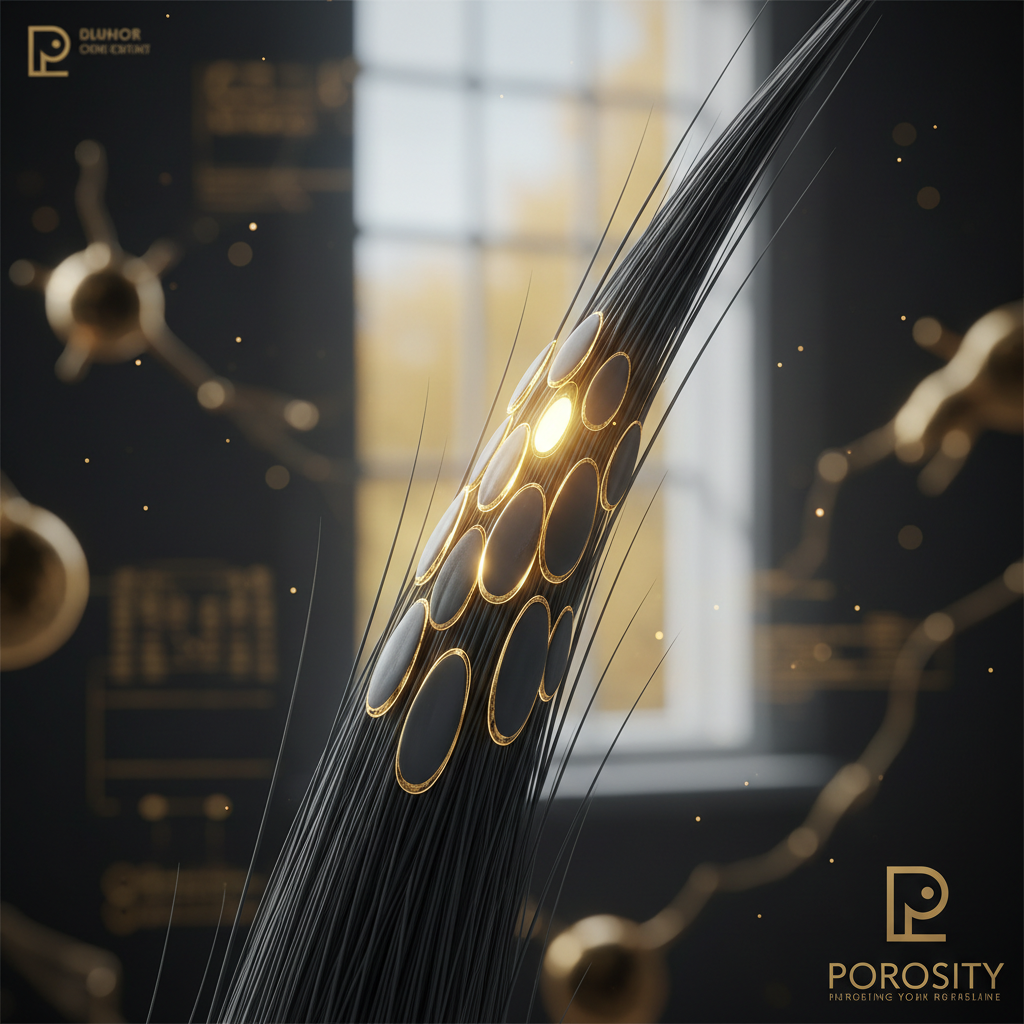
When hair scientists measure porosity, they evaluate how water vapour and liquid water interact with this outer barrier. Controlled sorption isotherm studies show that as the protective F-layer wears away through mechanical friction, bleaching, alkaline chemical treatments, or thermal styling, the hair transitions from hydrophobic to hydrophilic (water-attracting).
With the lipid seal compromised and the underlying endocuticle swollen, the cuticle scales lift or fracture. This structural shift allows external moisture and atmospheric humidity to rush into the inner cortex, while also allowing internal moisture to escape unchecked.
Laboratory analyses, including scanning electron microscopy (SEM) and gas sorption tests, demonstrate that porosity falls along a spectrum rather than rigid categories:
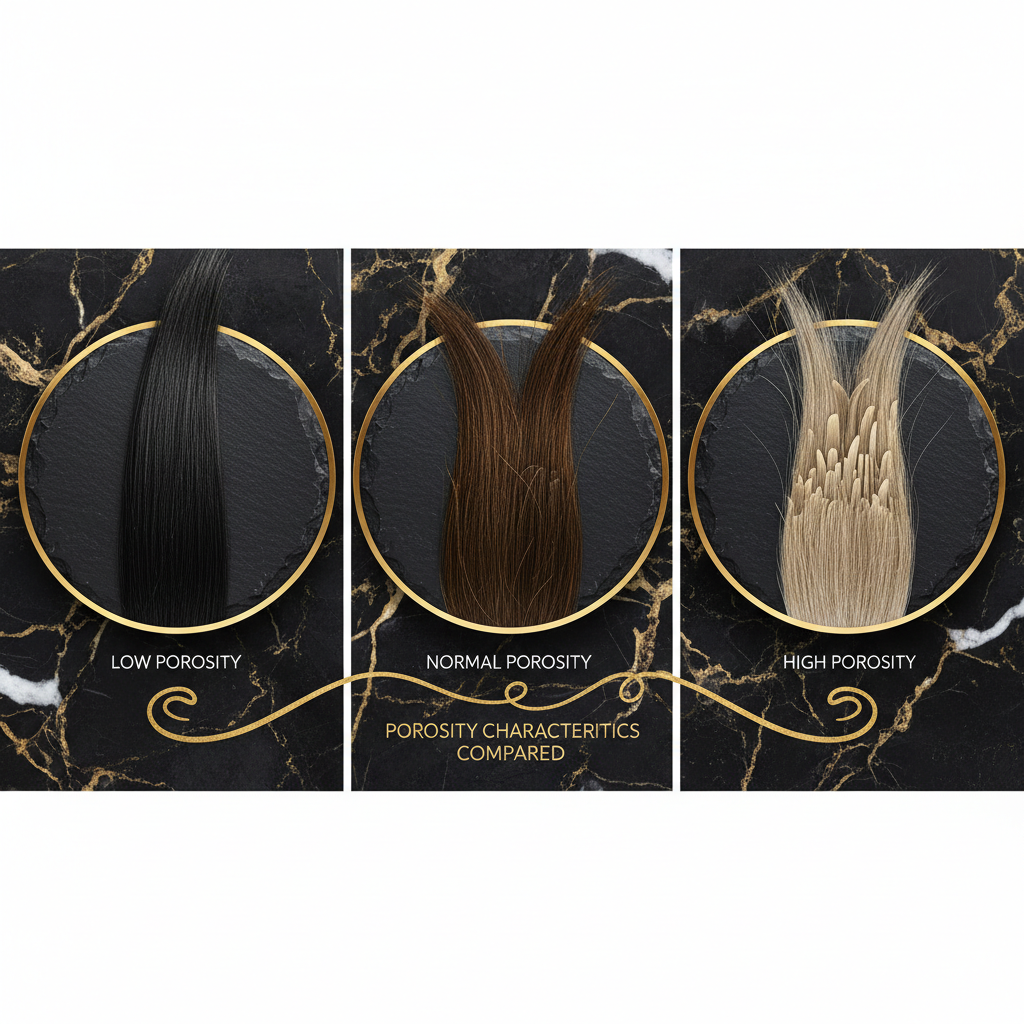
- Low porosity: The cuticle scales are tightly bound, compact, and fully coated with 18-MEA. Water beads on the surface, and cosmetic formulations struggle to penetrate the hair shaft without heat or alkaline swelling.
- Medium (normal) porosity: The cuticle arrangement allows balanced moisture absorption and retention with minimal swelling or mechanical weakness.
- High porosity: The scales are permanently raised, cracked, or completely eroded, exposing the cortex. Water enters immediately, causing rapid swelling, but evaporates quickly, leaving the fibre fragile and brittle.
The biophysical mechanism: how cuticles control porosity
To understand how porosity works, you must look at the cellular structure of the hair cuticle. Each individual cuticle cell consists of three internal layers:
- The Epicuticle: The outermost semi-permeable membrane, coated with the lipid F-layer.
- The Exocuticle: A rigid layer rich in cysteine (around 30% of total amino acids), providing mechanical strength through dense disulphide bonds.
- The Endocuticle: A softer, protein-poor layer containing only about 3% cysteine, which is highly sensitive to water absorption and swelling.
Between adjacent cuticle cells lies the Cell Membrane Complex (CMC), an adhesive matrix of intercellular lipids (ceramides, free fatty acids, and cholesterol) and structural proteins.
In healthy, low porosity hair, the high cysteine cross-linking in the exocuticle and intact lipids in the CMC prevent water from entering the vulnerable endocuticle. The fibre stays compact.
When you subject hair to an alkaline environment, such as a bleaching mixture or permanent dye with a pH between 9.0 and 11.0, the alkaline agent forces the cuticle scales to lift by breaking ionic bonds and oxidising disulphide linkages. Bleaching also completely strips the 18-MEA lipid layer.
Once the lipid shield is gone, water rapidly enters the soft endocuticle, causing it to swell dramatically. This uneven swelling stresses the outer layers, causing the cuticle edges to chip, lift, and detach. This physical disruption creates microscopic voids, permanently increasing porosity until that segment of hair is cut away.
Porosity characteristics compared
The table below outlines how different levels of cuticle porosity behave across key structural and cosmetic metrics.
| Metric | Low Porosity | Medium Porosity | High Porosity |
|---|---|---|---|
| Cuticle Structure | Compact, tightly closed, intact F-layer | Slightly raised edges, minimal lipid wear | Lifted, chipped, or missing scales; exposed cortex |
| Water Absorption Rate | Very slow; water beads on dry hair | Moderate; absorbs evenly | Rapid; saturates almost instantaneously |
| Drying Time | Very long; water stays trapped on surface | Normal, predictable drying | Paradoxically fast air-drying, yet holds onto internal wash water |
| Response to Humidity | Minimal frizz; resists ambient moisture | Predictable styling retention | Severe frizz or swelling in humid air; rapid moisture loss in dry air |
| Protein Affinity | Prone to protein overload; can feel stiff | Balanced protein and moisture uptake | Highly receptive to hydrolysed proteins and amino acids |
| Fibre Elasticity | High when healthy, but snaps if coated | Balanced tensile strength | Low; easily snaps when stretched due to cortical exposure |
What the evidence does not show
There are several persistent myths regarding hair porosity that contradict cosmetic science:
- Porosity is not an indicator of follicle health. Hair Cuticle Porosity is entirely a structural feature of the dead keratin shaft that has emerged from the scalp. It provides zero diagnostic data regarding hair follicle vitality, the dermal papilla, or hair cycle regulation.
- The "water glass float test" is unreliable. A popular home test suggests placing a shed hair strand in a glass of water to see if it sinks or floats. In reality, surface tension, natural scalp sebum, and styling product residue keep clean or dirty hair floating regardless of cuticle condition. Stylists and cosmetic scientists rely on tactile feel, water-droplet bead testing, or wet tensile testing instead.
- You cannot permanently "heal" high porosity hair. Cuticle cells do not contain living biological tissue; once the 18-MEA layer is oxidised and cuticle tiles are fractured, they cannot regenerate. Treatments containing hydrolysed proteins, silicones, and plant oils can patch the gaps and mimic the lipid barrier temporarily, but these wash out over time.
Signs of altered cuticle porosity
Recognising where your hair sits on the porosity spectrum helps you prevent cosmetic damage:
Common signs of low porosity
- Products tend to sit on the surface rather than absorbing, leading to rapid product build-up.
- Washing takes longer because water takes several minutes to fully saturate the strands.
- Hair takes hours to dry, even without styling creams.
- Deep conditioning treatments feel heavy, leaving the hair stiff or greasy.
Common signs of high porosity
- Strands tangle effortlessly and feel rough, dry, or like straw when you slide your fingers from tip to root.
- Hair absorbs water instantly in the shower but dries exceptionally fast afterwards.
- Moisture products seem to disappear without leaving lasting softness.
- Hair is prone to colour fading within two to three weeks of dyeing, as artificial pigments wash straight out through the open cuticle gaps.
What you can do: tailored hair regimens
Caring for your hair requires techniques matched to your specific cuticle condition.
Managing low porosity hair
- Use heat during conditioning: Mild warmth (such as a warm towel or shower cap) gently raises the resilient cuticles, allowing conditioning agents to penetrate the cortex.
- Prioritise humectants over heavy butters: Opt for glycerin, aloe vera, and panthenol. Avoid heavy coatings of shea butter or thick unrefined oils, which accumulate on tight cuticles and lead to dullness.
- Clarify periodically: Use a gentle clarifying shampoo once every two weeks to remove surface residue that blocks moisture.
Managing high porosity hair
- Incorporate hydrolysed proteins: Small-chain hydrolysed wheat, silk, or soy proteins temporarily fill the structural gaps in chipped cuticle layers, reducing porosity and reinforcing tensile strength.
- Seal with lipids and emollients: Layering a leave-in moisturiser under an occlusive oil or conditioning butter replicates the missing 18-MEA barrier, locking hydration inside the cortex.
- Maintain an acidic pH: Use acidic leave-in conditioners and rinses formulated at a pH of 3.5 to 5.0. Acidic formulations contract the cuticle cells, helping lifted scales lie flatter against the shaft.
- Minimise mechanical and thermal trauma: Reduce heat styling below 150 degrees Celsius, use a wide-tooth comb on wet hair, and sleep on smooth pillowcases to protect weakened fibres from shearing.
When the cause may be something else
It is common to confuse cuticle damage with systemic health conditions, or vice versa:
- Hair breakage versus hair shedding: If your hair feels dry, tangles constantly, and snaps off in short segments, you are dealing with high porosity hair breakage. If your hair is coming out from the scalp with the tiny white bulb attached, that is biological shedding (such as telogen effluvium), not a cuticle porosity issue.
- Weathering versus genetic texture: Naturally coiled and curly hair types (often classified under types 3 and 4) have natural points of elliptical torsion where cuticle scales naturally lift slightly. This is structural anatomy, not chemical damage.
- Hard water mineral build-up: If your hair suddenly feels stiff, rough, and repels moisture, it might not be low porosity; it may simply be coated in calcium and magnesium carbonates from domestic hard water. A chelating shampoo resolves this issue directly.
Supporting hair fibre integrity
A comprehensive haircare strategy targets both the external fibre and the emergence of new growth. For maintaining existing hair strands, conditioning masks with biomimetic lipids and proteins reinforce cuticle cohesion against daily wear and tear.
At the scalp level, supporting normal hair growth from the follicle outward ensures that emerging fibres possess an intact, strong cuticle envelope from day one. Formulations like Watermans Grow Me Shampoo deliver gentle, sulphate-free cleansing alongside revitalising botanical extracts, biotin, and rosemary. By cleansing the scalp without aggressively stripping natural protective lipids from the length of the hair shaft, it supports an optimal environment for hair to grow strong and resilient against everyday porosity stress.
Frequently asked questions about Hair Cuticle Porosity
What causes high Hair Cuticle Porosity?
High Hair Cuticle Porosity is primarily caused by chemical treatments like bleaching, permanent hair dyeing, and chemical relaxers, which strip the protective 18-MEA lipid layer and lift the cuticle scales. Frequent heat styling above 180 degrees Celsius, ultraviolet radiation from sunlight, mechanical friction from aggressive brushing, and environmental weathering also degrade the cuticle over time.
Can low porosity hair become high porosity over time?
Yes. Every hair strand emerges from the follicle at the scalp with low to medium porosity, protected by an intact cuticle and lipid barrier. Over months and years, normal washing, combing, sunlight, and heat styling wear down the cuticle edges. Chemical processing can instantly transform low porosity hair into high porosity hair along the treated lengths.
Does cold water close the hair cuticle?
There is little scientific evidence that a cold water rinse closes hair cuticles. Cuticle movement is primarily governed by pH and chemical bonding, not temperature. An acidic cosmetic product with a pH between 3.5 and 5.0 is far more effective at smoothing down the cuticle layer than cold water.
Can you fix high porosity hair permanently?
No, high porosity hair cannot be permanently fixed because the hair shaft is biologically non-living tissue. Once cuticle tiles are broken off or chemically degraded, they cannot regrow. However, you can manage high porosity hair cosmetically by using hydrolysed protein treatments, acidic conditioning sealants, and leave-in lipids that patch the cuticle surface until your next wash.
Conclusion
Understanding Hair Cuticle Porosity allows you to tailor your daily washing, styling, and conditioning habits to the physical realities of your hair fibre. Whether you are dealing with tight, moisture-resistant cuticles or chemically compromised, high porosity strands, matching your products to your cuticle integrity protects the hair shaft from excessive breakage. By treating the external fibre with protective lipids and supporting the scalp environment for incoming growth, you can maintain strong, healthy-looking hair throughout every stage of its life cycle.
Sources and references
- Robbins, C. R. (2012). Chemical and Physical Behavior of Human Hair (5th ed.). Springer Science & Business Media.
- Cruz, C. F., Costa, C., Gomes, A. C., Matamá, T., & Cavaco-Paulo, A. (2016). Human hair condition assessment: an overview. Journal of Materials Science: Materials in Medicine, 27(8), 121.
- Ruetsch, S. B., Kamath, Y. K., Rele, A. S., & Mohile, R. B. (2001). Secondary ion mass spectrometric investigation of penetration of coconut and mineral oils into human hair fibres: relevance to hair damage. Journal of Cosmetic Science, 52(3), 169-184.
- Swift, J. A. (1999). The mechanics of fracture of human hair. International Journal of Cosmetic Science, 21(4), 227-239.
- Evans, A. O., & Wickett, R. R. (2012). Practical Modern Hair Science. Allured Business Media.
Find these ingredients in Watermans products
- Panthenol (Provitamin B5): you will find this ingredient in our Heat Protection Spray.
- Aloe Vera: you will find this ingredient in our Curly Hair Conditioner.