Hair Breakage and Fibre Weakness: Structural Causes and Proven Solutions
8 min read ·
Learn the causes, mechanisms, and real solutions for Hair Breakage and Fibre Weakness. Discover how to protect the hair shaft and restore structural strength.
Quick answer: Hair Breakage and Fibre Weakness refers to physical fracture along the hair shaft rather than shedding from the follicle. It occurs when mechanical friction, chemical processing, thermal styling, or structural vulnerabilities degrade the protective cuticle and deplete internal keratin bonds within the cortex. While damaged fibres cannot biologically regenerate once broken, targeted cosmetic care, protein-lipid replenishment, and reduced physical stress can reinforce remaining structural integrity and prevent further breakage.
Key takeaways
- Hair breakage is a mechanical fracture along the hair shaft, entirely distinct from follicular shedding or medical hair loss.
- The primary internal cause is cortex degradation, specifically the depletion of cystine disulphide bonds and structural lipids like 18-methyleicosanoic acid (18-MEA).
- External catalysts include high-temperature styling (above 185°C), chemical bleaching, oxidative dyes, and friction from rough towel-drying or tight styling.
- Once a fibre fractures, it cannot mend living tissue; split ends and fractures must be trimmed or cosmetically sealed to halt upward splitting.
- Routine conditioning with cationic surfactants, hydrolysed proteins, and leave-in lubricants significantly restores tensile strength and surface hydrophobicity.
Hair Breakage and Fibre Weakness: what the evidence shows
Hair Breakage and Fibre Weakness is fundamentally an engineering failure of the hair fibre under tensile or frictional stress. Normal, healthy human hair is remarkably durable, with an intact outer cuticle and a densely packed cortical core rich in keratin intermediate filaments. However, repeated exposure to environmental, mechanical, and chemical stressors degrades this architecture over time.

Research in cosmetic dermatology demonstrates that healthy virgin hair can stretch roughly 30 percent of its original length in water before snapping. In contrast, chemically lightened or severely weathered hair exhibits a dramatic drop in elastic recovery and tensile strength, sometimes breaking under less than 5 to 10 percent elongation. This degradation is cumulative: older hair at the ends of long strands inevitably displays far more fibre weakness than the newly grown root zone.
What the evidence does not show
Controlled studies do not support the claim that cosmetic shampoos, serums, or masks can permanently rebuild broken hair back to a virgin state. While bond-building complexes and hydrolysed proteins temporarily patch damaged sites and improve tensile resistance, they wash out over time and cannot reverse structural cellular loss.
Furthermore, clinical evidence does not support the idea that dietary vitamins or collagen supplements will instantly cure fibre weakness on hair that has already emerged from the scalp. Nutrition influences only the emerging fibre at the follicular level; topical habits dictate the survival of existing lengths.
The biological and physical mechanism of fibre failure
To understand why hair breaks, you have to examine the structural cross-section of the hair shaft. The fibre consists of three key architectural zones:
- The Cuticle: Between 6 and 10 overlapping layers of flattened, scale-like cells coated in a hydrophobic lipid layer known as 18-methyleicosanoic acid (18-MEA). This layer prevents water logging, repels friction, and shields the interior.
- The Cortex: The structural engine of the fibre, making up around 80 to 85 percent of hair mass. It contains tightly wound alpha-helical keratin proteins cross-linked by covalent disulphide bonds, derived from the amino acid cystine.
- The Cell Membrane Complex (CMC): The intercellular cement holding cuticle and cortical cells together, composed of structural lipids and soluble proteins.
Fibre weakness begins when physical or chemical trauma strips the protective 18-MEA lipid layer, turning the hair surface hydrophilic (water-absorbing). Without this lipid coat, cuticle scales lift, snag, and eventually chip away.
When the underlying cortex is exposed, environmental water penetrates rapidly. Hair swells when wet and shrinks when dry (hygral fatigue), putting immense shear stress on internal bonds. Heat styling beyond 185°C alters the helical keratin structure, turning pliable alpha-keratin into brittle beta-keratin. When tensile strain exceeds the residual strength of these remaining bonds, the fibre snaps.
Signs of breakage versus follicular shedding
It is critical to distinguish between broken fibres and hairs that have naturally shed from the scalp. Misdiagnosing the problem can lead you to adopt the wrong corrective routine.
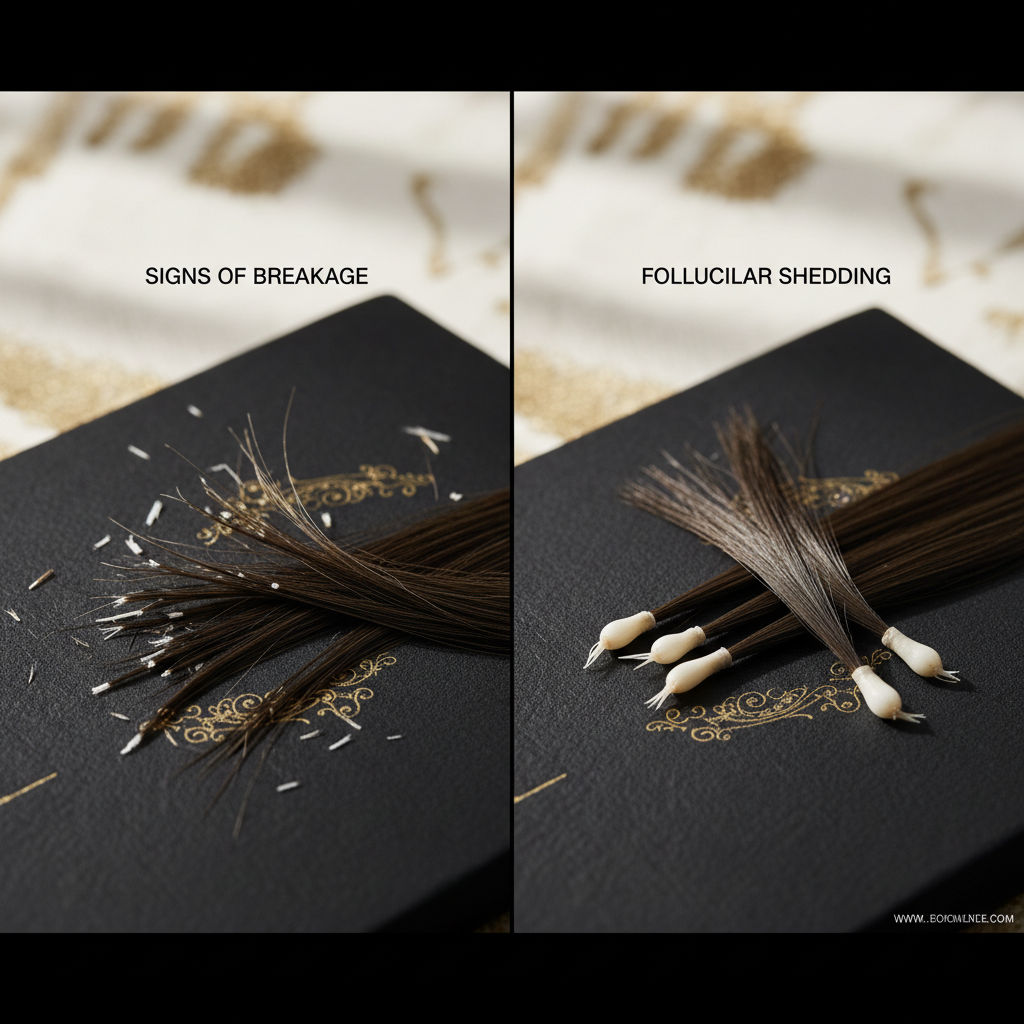
| Feature | Hair Breakage (Fibre Weakness) | Follicular Shedding (Telogen Phase) |
|---|---|---|
| Fibre Length | Short, uneven fragments with blunt or ragged ends | Full-length strand matching typical hair length |
| White Bulb | Absent; ends are fractured or split | Present; tiny white keratin bulb at the root |
| Primary Root Cause | External wear, chemical processing, friction | Hormonal shifts, stress, illness, lifecycle turnover |
| Typical Location | Mid-lengths, crown friction zones, ends | All over the scalp, falling directly from the root |
| Structural Elasticity | Low; snaps quickly when gently pulled | Normal elasticity along the length of the shaft |
| Corrective Action | Trims, protein/moisture treatments, gentler handling | Scalp support, dietary review, clinical evaluation |
What you can do to strengthen weak fibres
Restoring hair resilience requires a combined strategy: reducing physical trauma, fortifying the cortex, and resealing the surface cuticle.
- Minimise Thermal Strain: Keep hot tools below 180°C. Never apply direct heat to damp hair, as boiling trapped water creates internal cortical bubbles (bubble hair deformity), causing rapid breakage.
- Restore Hydrophobicity: Use leave-in conditioners and silicone or plant-based lipid films. These coat the strand, mimicking lost 18-MEA and reducing friction during brushing by up to 50 percent.
- Incorporate Hydrolysed Proteins: Low molecular weight proteins (such as hydrolysed wheat, lupin, or soy protein) penetrate porous cuticles to form temporary cross-links, reinforcing weak areas against everyday tension.
- Gentle Detangling Protocols: Always detangle with a wide-tooth comb or flexible-bristle brush, starting at the tips and moving up to the roots. Never brush wet curly hair without a protective slip agent or conditioner.
- Protective Night Habits: Sleeping on silk or satin pillowcases drastically lowers mechanical friction compared to coarse cotton weaves, preventing mid-shaft fracturing during sleep.
- Regular Trims: Once trichoptilosis (split ends) begins, the fracture travels upward along the shaft like a run in a stocking. Trimming split ends every 8 to 12 weeks stops vertical splitting before it ruins the hair length.
When the cause may be something else
Occasionally, acute fibre weakness is driven by underlying medical or genetic factors rather than styling damage:
- Trichorrhexis Nodosa: A condition where swollen, microscopic nodes form along the shaft, causing hair to snap under minimal tension. It can be acquired through physical trauma or linked to rare metabolic conditions like argininosuccinic aciduria.
- Monilethrix (Beaded Hair): A rare genetic disorder causing periodic thinning along the fibre, making it break within the first few centimetres of growth.
- Severe Nutrient Deficiency: Deficiencies in zinc, iron (ferritin below 30 ug/L), or systemic protein malnutrition directly disrupt keratin synthesis during the anagen phase, yielding inherently fragile fibres straight out of the follicle.
- Endocrine Disorders: Thyroid dysfunction (hypothyroidism) often produces coarse, brittle strands prone to premature snapping.
When to seek professional advice
Consult a trichologist or dermatologist if you notice sudden, diffuse breakage occurring within two centimetres of the scalp without obvious chemical or heat abuse. Similarly, if hair snap is accompanied by scalp burning, redness, flaking, or rapid hair thinning, seek clinical evaluation to rule out cicatricial alopecia, traction alopecia, or systemic nutritional disorders.
Supporting weak fibres with Watermans
When addressing fragile hair, maintaining an optimal scalp environment and reinforcing daily lengths is key. Watermans focuses on topical formulas that support resilient, fuller-looking hair without harsh sulphates that deplete natural barrier lipids. Formulas featuring hydrolysed lupin protein, biotin, rosemary, and allantoin provide external conditioning support, helping vulnerable strands retain hydration, resist mechanical brush drag, and maintain a healthier, thicker appearance.
Frequently asked questions about Hair Breakage and Fibre Weakness
Can split ends be glued back together permanently?
No cosmetic product can permanently mend a split end. Certain conditioning polymers, silicones, and hydrolysed proteins can temporarily glue split ends together until the next wash, creating a smooth visual appearance. However, the structural bond is broken; the only permanent solution is to trim the split end above the point of fracture.
How does wet hair differ from dry hair in terms of breakage?
Wet hair is substantially more vulnerable to mechanical stretching than dry hair. When saturated, water breaks weak hydrogen bonds inside the cortex, allowing the hair to stretch up to a third of its length. Brushing wet hair without slip stretches these fibres beyond their elastic limit, leading to immediate fracture and structural deformation.
Does bleach always cause Hair Breakage and Fibre Weakness?
Chemical lightening always weakens the hair to some degree because it oxidises melanin by opening the cuticle and breaking disulphide bonds within the cortex. However, severe breakage is not inevitable. Careful processing, lower peroxide volumes, bond-protecting additives, and proper post-bleach conditioning can keep fibre weakness within manageable limits.
Why does hair break unevenly around the crown or hairline?
The crown and hairline endure higher environmental and mechanical friction. The crown faces direct UV radiation and pillow friction during sleep, while the hairline undergoes mechanical stress from tight ponytails, headbands, glasses, and face washing. These localised friction zones accelerate cuticle loss, making those specific areas snap faster than the nape.
Summary
Managing Hair Breakage and Fibre Weakness requires understanding the physical boundaries of the hair shaft. Hair is a non-living, proteinaceous fibre that cannot repair itself once structurally compromised. By lowering heat thresholds, introducing protective lipid and protein layers, managing wet-comb drag, and keeping up with routine trims, you preserve cortical integrity and retain strong, unbroken lengths.
Sources and references
- British Association of Dermatologists. Hair Breakage and Structural Hair Shaft Disorders. 2022.
- Robbins, C. R. Chemical and Physical Behavior of Human Hair. 5th ed. Springer, 2012.
- Dawber, R. "Hair breakage and hair styling practices." Clinics in Dermatology, 1996.
- Cruz, C. F., et al. "Human hair characteristics and methods to assess hair strength and damage." International Journal of Cosmetic Science, 2016.
- Swift, J. A. "The mechanics of fracture of human hair." International Journal of Cosmetic Science, 1999.
Find these ingredients in Watermans products
- Biotin: you will find this ingredient in our Hair Growth Shampoo.
- Soy Amino Acids: you will find this ingredient in our Heat Protection Spray.