Hair Anatomy: Understanding the Structure and Science of Your Hair
10 min read ·
Hair Anatomy refers to the detailed structure of a hair strand and its follicle, revealing how each component contributes to hair growth, strength, and appearance. Understanding this anatomy is crucial for effective hair care and for identifying the causes of common hair concerns.
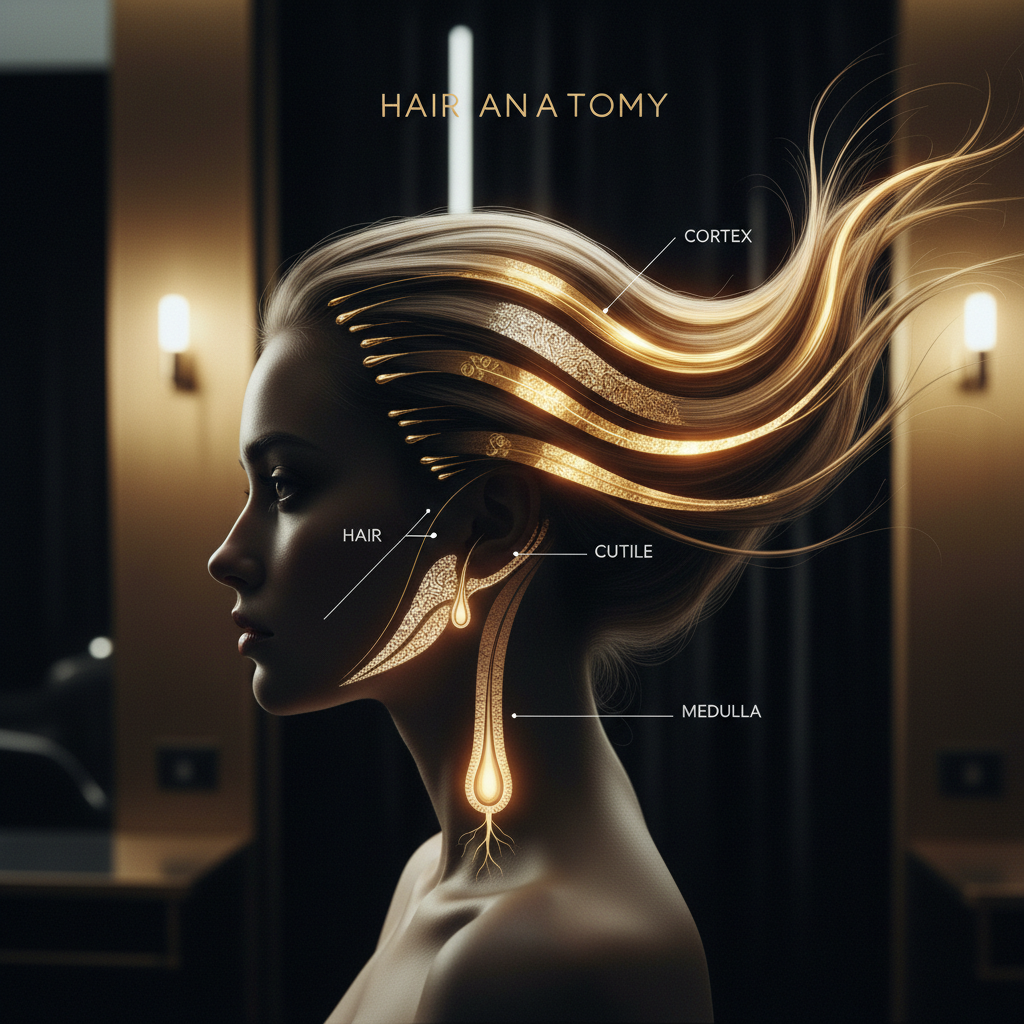
Quick answer: Hair Anatomy refers to the detailed biological structure of individual hair strands and their follicles, from their living roots beneath the skin to the visible, non-living shaft. This intricate system governs how hair grows, its strength, texture, and overall appearance. While we can deeply analyse its structure and function, the precise interplay of all factors influencing hair health is still a rich area of ongoing scientific study.
Key takeaways
- Complex Structure: Hair is a complex biological structure, originating from the follicle within the skin and extending as a visible shaft, each part playing a distinct role in its growth and characteristics.
- Keratin is Key: The visible hair shaft is primarily made of keratin protein, organised into three layers: the cuticle, cortex, and medulla, which dictate strength, elasticity, and colour.
- Growth Cycle: Hair grows in a cyclical process of anagen (growth), catagen (transition), and telogen (resting) phases, with the anagen phase determining hair's maximum length.
- Follicle Function: The hair follicle, a mini-organ embedded in the scalp, is responsible for producing the hair fibre, supplying nutrients via the dermal papilla, and secreting sebum to moisturise hair and skin.
- Beyond Cosmetics: Understanding hair anatomy helps distinguish between hair shedding, hair breakage, and hair loss (alopecia), guiding appropriate care and treatment approaches.
Hair Anatomy: what the evidence shows
Hair anatomy encompasses both the hair follicle, a dynamic structure embedded in the skin, and the hair shaft, the visible part that extends beyond the scalp. Each component has a specific role, from generating new hair cells to protecting the fibre from environmental damage. Recognising these structures helps us understand how hair grows, why it looks and feels the way it does, and how best to care for it.
The Hair Follicle: The Living Root of Hair
The hair follicle is far more than just an anchor for the hair; it's a complex, miniature organ responsible for producing the hair fibre. Each follicle operates independently, undergoing its own cycle of growth and rest. At the base of the follicle is the hair bulb, which encases the dermal papilla. This dermal papilla is a crucial cluster of connective tissue and capillaries, providing the hair bulb with the essential nutrients and oxygen needed for hair growth. Surrounding it are rapidly dividing cells called keratinocytes, which form the hair matrix. These cells continually proliferate, pushing older cells upwards. As they move away from the nutrient supply, they undergo a process called keratinisation, hardening and forming the hair shaft.
Associated with each follicle are several other vital structures:
- Sebaceous Gland: This gland produces sebum, an oily substance that lubricates the hair shaft and the skin. Sebum helps to maintain moisture, creating a protective barrier against external factors. Understanding sebum production is key to managing conditions like oily scalp or dry hair.
- Arrector Pili Muscle: A small, involuntary muscle attached to the follicle. When contracted, often due to cold or emotional responses, it pulls the hair follicle upright, leading to the phenomenon known as "goosebumps."
- Nerve Endings: Sensory nerve endings surround the hair follicle, making hair a sensitive tactile organ. This explains why we can feel even a slight breeze or touch on our hair.
The Hair Shaft: The Visible Fibre
Once the hair emerges from the scalp, it is known as the hair shaft. This visible part of the hair is primarily a non-living structure, composed predominantly of a protein called keratin. The hair shaft has three distinct concentric layers, each contributing to the hair's overall strength, texture, and appearance.
- The Cuticle: The outermost layer, the cuticle, acts as the hair's primary protective barrier. It consists of multiple layers of overlapping, flattened cells, often compared to shingles on a roof. These cells typically point towards the hair's end. When the cuticle is healthy and lies flat, it reflects light, giving hair its shine and smoothness. Damage to the cuticle, often from chemical treatments, excessive heat, or harsh mechanical styling, can cause these cells to lift, making the hair appear dull, feel rough, and become more prone to tangling and breakage. A healthy cuticle is vital for retaining moisture within the hair fibre.
- The Cortex: Beneath the protective cuticle lies the cortex, which constitutes the majority (approximately 75 to 90%) of the hair's total weight. The cortex is made up of elongated, spindle-shaped cortical cells densely packed with keratin fibres. This is also where melanin granules, the pigments responsible for natural hair colour, are stored. The specific arrangement, density, and strength of these keratin fibres, along with the bonds between them (particularly disulfide bonds), determine the hair's strength, elasticity, and texture. Chemical processes such as colouring, perming, or relaxing directly affect the cortex, altering its structure to change hair's appearance or texture.
- The Medulla: The innermost core of the hair shaft is the medulla. Its presence and size can vary significantly; fine or vellus hairs often lack a medulla entirely, while coarse hairs typically have a more prominent one. The medulla consists of loosely packed, irregularly shaped cells and air spaces. While its exact function isn't fully understood, it is thought to play a role in thermal insulation and potentially in light reflection.
Hair Growth Cycle: A Continuous Renewal Process
Hair growth is not continuous but rather a cyclical process, with each hair follicle operating independently through three main phases. Understanding this cycle is fundamental to distinguishing normal hair shedding from excessive hair loss.
- Anagen (Growth Phase): This is the active growth phase, during which cells in the hair bulb rapidly divide, continuously pushing the hair shaft outwards. The duration of the anagen phase varies greatly among individuals, typically lasting from two to seven years. This length of time dictates the maximum hair length a person can achieve. At any given moment, approximately 85 to 90% of the hairs on a healthy scalp are in the anagen phase.
- Catagen (Transition Phase): A brief transitional phase lasting about two to three weeks. During catagen, hair growth ceases, the hair follicle shrinks, and the dermal papilla detaches from the hair bulb. Only about 1 to 2% of hairs are typically in this phase.
- Telogen (Resting Phase): This phase lasts for approximately two to four months. The hair remains in the follicle but is no longer actively growing. Towards the end of the telogen phase, the old hair is shed naturally (known as normal daily hair shedding) to make way for new hair growth from the same follicle, which then re-enters a new anagen phase. Around 10 to 15% of scalp hairs are in the telogen phase at any given time. It is considered normal to shed 50 to 100 telogen hairs per day.
Chemical Composition of Hair
Hair is primarily composed of protein, with keratin making up about 65 to 95% of its dry weight. The remainder consists of water (5 to 30%), lipids (1 to 9%), pigments (primarily melanin, 0 to 1%), and trace elements (less than 1%). The keratin protein is notably rich in the amino acid cysteine, which contains sulfur atoms. These sulfur atoms form strong covalent bonds known as disulfide bonds. These bonds are crucial to hair's structural integrity, strength, and ability to hold its shape. Breaking and reforming these disulfide bonds is the fundamental principle behind many chemical hair treatments, such as permanent waves or chemical relaxers.
| Component | Approximate Percentage by Weight |
|---|---|
| Keratin | 65 to 95% |
| Water | 5 to 30% |
| Lipids | 1 to 9% |
| Melanin | 0 to 1% |
| Minerals | <1% |
Hair Characteristics and Types
Hair characteristics vary significantly among individuals, influenced by a complex interplay of genetics, ethnicity, and hormonal factors. Understanding these characteristics helps in choosing appropriate hair care.
- Texture: This refers to the circumference or thickness of an individual hair strand, commonly categorised as fine, medium, or coarse. Fine hair has a smaller diameter, making it more delicate, while coarse hair has a larger diameter, typically feeling stronger.
- Density: Hair density describes the number of individual hair strands per square inch on the scalp, ranging from sparse to very thick. This is distinct from hair texture.
- Porosity: Hair porosity is the hair's ability to absorb and retain moisture. It's largely determined by the condition of the cuticle. High porosity hair has a more open or damaged cuticle, allowing moisture to enter and leave quickly. Low porosity hair has a tightly closed cuticle, making it harder for moisture to penetrate but also to escape. You can learn more about this in "Understanding Hair Porosity: How Your Hair Absorbs and Retains Moisture."
- Elasticity: This is the hair's ability to stretch and then return to its original length without breaking. Healthy hair can stretch up to 50% when wet and return to its original state when dry. Good elasticity indicates a healthy internal structure (cortex).
- Growth Pattern: This refers to the natural direction in which hair grows from the scalp, creating patterns such as cowlicks or whorls. These patterns are genetically determined.
When to seek professional advice
While understanding hair anatomy provides a strong foundation for general hair care, certain changes may warrant professional advice. If you notice significant or sudden changes in your hair, such as unusual shedding beyond the typical 50 to 100 hairs per day, excessive hair thinning, patchiness, or persistent scalp irritation, it's advisable to consult a dermatologist or trichologist. These professionals can help diagnose underlying conditions, distinguish between hair shedding (like telogen effluvium) and genuine hair loss (alopecia), and recommend appropriate medical treatments or management strategies. Self-diagnosis and treatment of significant hair concerns can often delay effective intervention.
Frequently asked questions about Hair Anatomy
What are the main parts of Hair Anatomy?
The main parts of hair anatomy are the hair follicle, which is the living structure beneath the skin, and the hair shaft, which is the visible, non-living part. The follicle includes the hair bulb and dermal papilla, while the shaft comprises the cuticle, cortex, and sometimes a medulla. Each component is essential for hair growth and its physical characteristics.
How does understanding hair structure help with hair care?
Understanding hair structure allows for targeted hair care. Knowing about the cuticle, for instance, helps you choose products and techniques to keep it smooth and closed, reducing frizz and breakage. Recognising the cortex's role in strength guides gentle handling, especially with chemical treatments. Overall, it helps in selecting appropriate shampoos, conditioners, and styling methods based on your hair's unique needs, such as porosity or texture.
What is the role of keratin in hair?
Keratin is the primary structural protein of the hair shaft, making up most of its mass. It provides hair with its strength, flexibility, and shape. The specific arrangement and bonding of keratin proteins within the cortex determine characteristics like elasticity and resistance to damage. Without healthy keratin structures, hair can become weak, brittle, and prone to breakage.
Can hair anatomy change over time?
Yes, hair anatomy can change over time due to various factors. Hormonal shifts, ageing, nutritional deficiencies, and environmental exposures can all influence hair texture, density, and growth patterns. For example, hair often thins and becomes finer with age, and colour changes due to reduced melanin production. Understanding these potential changes can help manage hair health throughout life.
How does hair hydration relate to hair anatomy?
Hair hydration is intrinsically linked to hair anatomy, particularly the cuticle and cortex. The cuticle acts as a barrier, regulating how much moisture enters and leaves the hair. If the cuticle is damaged or raised, hair can lose moisture quickly, leading to dryness. The cortex, while largely protein, also holds some moisture. Products designed for "Hair Hydration" aim to help the cuticle retain moisture within these layers, improving flexibility and reducing breakage.
Conclusion
The intricate details of Hair Anatomy, from the dynamic hair follicle nurturing growth beneath the scalp to the protective layers of the visible hair shaft, underscore the complexity of what we often take for granted. This deep understanding is not merely academic; it is the foundation for evidence-based hair care, allowing us to distinguish between normal physiological processes like shedding and signs of potential issues such as hair damage or hair loss. By respecting the biological blueprint of hair, we can make informed choices that genuinely support its health and vitality.
Sources and references
- American Academy of Dermatology Association, "Hair loss: Diagnosis and treatment", aada.org
- National Center for Biotechnology Information (NCBI), "Anatomy, Hair", StatPearls, 2023, pubmed.ncbi.nlm.nih.gov/30020610/
- National Health Service (NHS), "Hair loss", nhs.uk
- British Association of Dermatologists, "Hair loss", bad.org.uk
- University of California, San Francisco (UCSF) Health, "Hair Anatomy and Growth", ucsfhealth.org
- Journal of Cosmetic Dermatology, "Hair structure and the many causes of hair damage", 2004
- Skin Appendage Disorders, "The Hair Follicle as a Dynamic Miniorgan", 2020
Where Watermans fits
If you want a routine built around the science above, these are the products from the range that apply here: