An Evidence-Based Guide to Follicular Inflammation Mechanisms
8 min read ·
Explore the biological pathways behind Follicular Inflammation Mechanisms, detailing how immune cascades disrupt hair cycling and scalp health.
Quick answer: Understanding Follicular Inflammation Mechanisms involves looking at how the immune system interacts with the hair follicle, triggering cellular cascades that disrupt normal growth cycles. In both scarring alopecias and non-scarring conditions, sustained micro-inflammation recruits pro-inflammatory cytokines, damages stem cell niches, and accelerates the transition from anagen into premature catagen. The main limitation in current research is determining whether inflammation is the primary driver or a secondary reaction to barrier breakdown, microbial dysbiosis, or hormonal sensitivity.
Key takeaways
- Follicular inflammation involves immune cell infiltration around the infundibulum and follicular bulge, disrupting stem cell signalling.
- Pro-inflammatory cytokines like TNF-alpha, IL-1beta, and IFN-gamma trigger premature catagen entry and halt keratinocyte proliferation.
- The hair follicle normally enjoys immune privilege, and the collapse of this protective state drives autoimmune attacks like alopecia areata.
- Chronic low-grade inflammation (micro-inflammation) plays a documented role in common pattern hair loss alongside dihydrotestosterone (DHT).
- True scarring alopecias permanently destroy the follicular stem cell niche through irreversible fibrotic tissue remodelling.
- Cosmetic haircare cannot cure clinical follicular inflammation, but gentle scalp hygiene helps maintain a healthy epidermal barrier.
Follicular Inflammation Mechanisms: what the evidence shows
Research into follicular inflammation mechanisms reveals that the hair follicle is a highly reactive immunological and metabolic hub. Inflammation within the follicular unit is not a single process. Instead, it encompasses distinct biological pathways depending on whether the trigger is autoimmune, microbial, chemical, or hormonal.
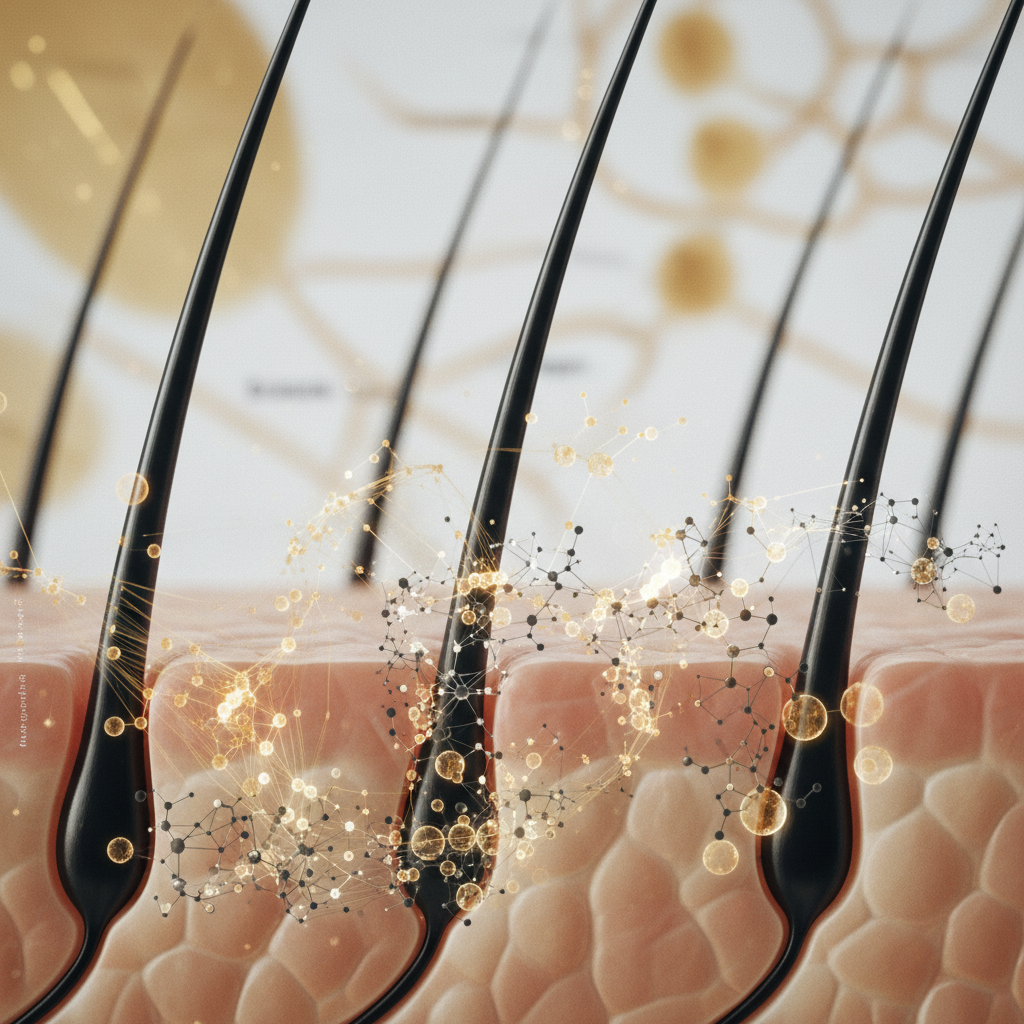
At a cellular level, inflammation typically initiates around the upper third of the follicle (the infundibulum) or deep within the stem cell reservoir (the bulge). When pattern recognition receptors, such as Toll-like receptors (TLRs), detect danger signals from damaged cells or microbial overgrowth, they alert resident immune cells. Mast cells degranulate, releasing histamine and leukotrienes. This increases local blood vessel permeability, allowing circulating T-lymphocytes, neutrophils, and macrophages to enter the perifollicular sheath.
Once these immune cells cluster around the hair unit, they secrete chemical messengers called cytokines. High concentrations of tumour necrosis factor-alpha (TNF-alpha) and interleukin-1 (IL-1) directly inhibit hair matrix cell division. In anagen (active growth), matrix cells divide rapidly to build the hair shaft. Cytokine exposure stalls this machinery, pushing the follicle into catagen (regression) long before its natural lifespan ends.
External or Internal Trigger (Sebum dysbiosis, DHT, autoantigens)
 │
 ▼
Infundibular Stress & Toll-Like Receptor Activation
 │
 ▼
Recruitment of Mast Cells, Macrophages & T-Lymphocytes
 │
 ▼
Release of Cytokines (IL-1beta, TNF-alpha, IFN-gamma)
 │
 ▼
Disruption of Hair Matrix Division & Premature Catagen Induction
 │
 ┌──────────┴──────────┐
 ▼ ▼
Non-Scarring Loss Scarring (Cicatricial) Loss
(Reversible shock/shed) (Stem cell niche destruction & fibrosis)
The collapse of hair follicle immune privilege
Under healthy physiological conditions, the lower section of an anagen hair follicle maintains an active state of immune privilege. This means the follicle downregulates major histocompatibility complex (MHC) class I and class II molecules. By hiding its antigens, the follicle avoids recognition and attack by circulating natural killer (NK) cells and auto-reactive CD8+ T-cells.
When this immune privilege collapses, the follicular inflammation mechanisms shift towards autoimmunity. Interferon-gamma (IFN-gamma) is the primary driver of this breakdown. It forces the follicular epithelium to express MHC molecules, exposing normal follicular autoantigens to the immune system.
In conditions like alopecia areata, CD8+ T-cells swarm the hair bulb, creating a classic histological pattern known as a "swarm of bees". While this immune onslaught stops hair production and causes rapid shedding, it usually spares the epithelial stem cells located higher up in the follicular bulge. As a result, the follicle retains the capacity to regrow hair once the inflammatory response settles.
Scarring versus non-scarring inflammatory pathways
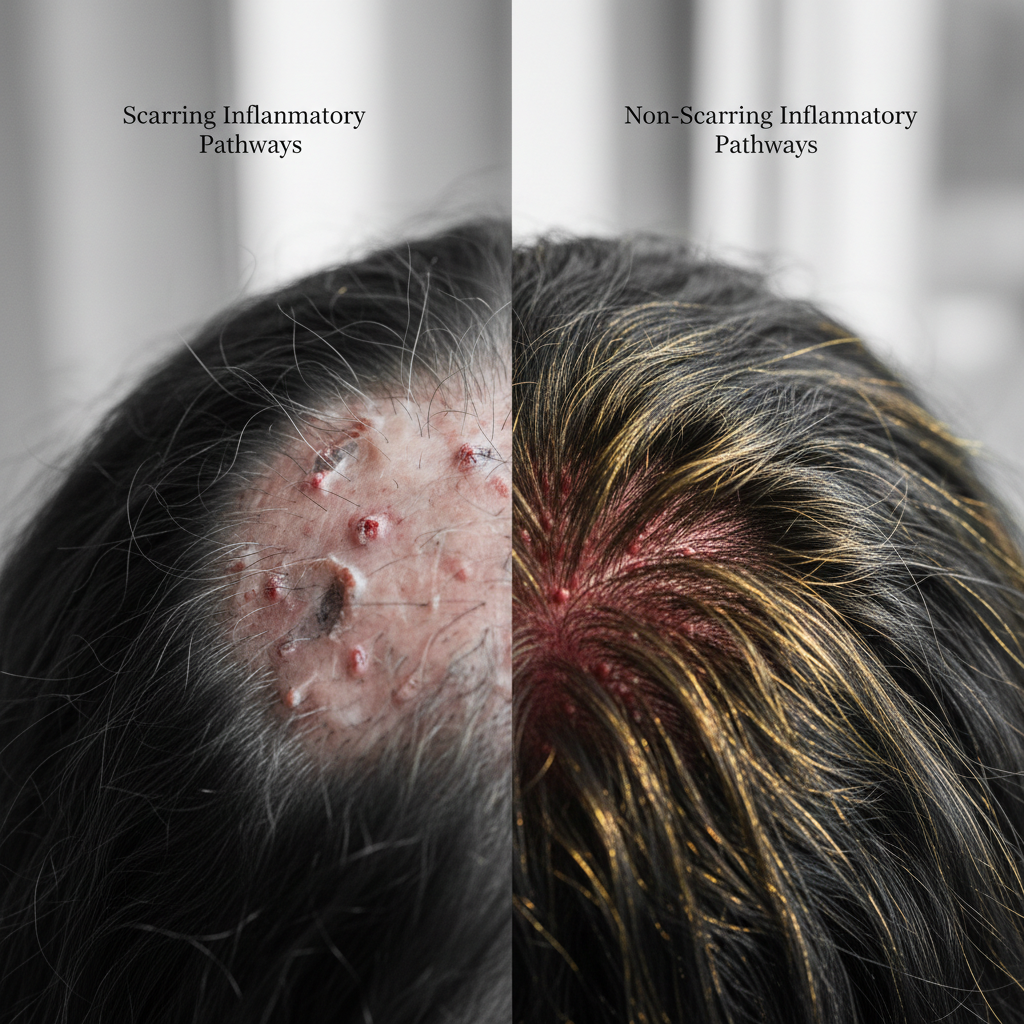
Understanding the biological site of inflammation is critical for distinguishing temporary shedding from permanent follicular loss. The following comparison outlines the primary mechanical differences between non-scarring and scarring inflammatory states:
| Biological Parameter | Non-Scarring Inflammation (e.g., Telogen Effluvium, Androgenetic) | Scarring / Cicatricial Inflammation (e.g., Lichen Planopilaris, Frontal Fibrosing) |
|---|---|---|
| Primary Anatomical Target | Follicular bulb, matrix, or mild infundibular micro-inflammation | Follicular bulge containing epithelial stem cells |
| Predominant Cell Infiltrate | Mild macrophage, mast cell, or CD4+/CD8+ T-cell presence | Dense lymphocytic or neutrophilic infiltrate |
| Stem Cell Integrity | Preserved; K15-positive stem cells remain viable | Irreversibly damaged or destroyed via apoptosis |
| Tissue Architecture | Follicle remains intact; miniaturisation or cycling shifts occur | Replaced by dense, collagenous fibrotic scar tissue |
| Regrowth Potential | Clinically possible if the underlying trigger is addressed | Irreversible; destroyed follicles cannot generate new fibres |
In primary cicatricial alopecias, the target of the inflammatory attack is the follicular bulge. This region houses the multipotent epithelial stem cells responsible for regenerating the lower hair follicle during every hair cycle. When chronic inflammation destroys these cells, fibroblast activity increases, replacing functional tissue with fibrotic collagen. Once fibrous tracts replace the follicular architecture, no new hair can emerge.
Micro-inflammation and pattern hair loss
Follicular inflammation is not restricted to obvious autoimmune diseases. Dermatologists have identified a low-grade, subclinical process termed micro-inflammation in standard androgenetic alopecia (male and female pattern hair loss).
While androgenetic alopecia is fundamentally driven by genetic sensitivity to dihydrotestosterone (DHT), tissue biopsies consistently show activated T-cells and macrophage infiltration around the upper follicular infundibulum in up to 40 percent of cases. Sebum alterations, colonisation by Malassezia yeasts, and environmental pollutants generate reactive oxygen species (ROS). These ROS induce lipid peroxidation, irritating the infundibular epithelium.
The resulting low-grade inflammation releases transforming growth factor-beta (TGF-beta) and connective tissue growth factor. Over months and years, these signals promote micro-fibrosis around the hair follicle neck. This gradual stiffening restricts follicular expansion, accelerating the miniaturisation process triggered by DHT.
Observable signs of follicular inflammation
Stylists, trichologists, and individuals can often spot early signs of inflammatory activity before severe shedding becomes apparent:
- Perifollicular erythema: Redness concentrated tightly around individual hair openings rather than dispersed evenly across the scalp.
- Perifollicular cast or scaling: Keratin and cellular debris gathering around the base of the hair shaft, forming a raised collar.
- Trichodynia: Sensations of burning, tingling, soreness, or tenderness when touching the hair or moving it across the scalp.
- Follicular pustules: Small, sterile or bacterial pustules pinpointed at the follicular ostia, indicating neutrophil recruitment.
- Loss of follicular openings: In progressive scarring disorders, the visible skin pores disappear, leaving a smooth, shiny surface.
Supportive scalp care and cosmetic management
Cosmetic products cannot alter autoimmune processes or reverse genetic miniaturisation. However, supporting the scalp's epidermal barrier plays a helpful role in reducing external irritants that provoke micro-inflammation.
Using gentle, pH-balanced cleansers (ideally between pH 4.5 and 5.5) keeps the scalp microbiome in balance. It removes oxidised sebum, micro-pollutants, and product residue that stimulate Toll-like receptors on epithelial cells. Avoid harsh physical scrubbing, excessively hot water, and tight tension styles, all of which induce mechanical micro-trauma and mast cell degranulation.
For everyday cosmetic care, Watermans Grow Me Shampoo and Condition Me Conditioner provide a soothing, nutrient-rich environment for the scalp. Formulated with revitalising natural extracts such as rosemary, biotin, and allantoin, these products are designed to gently cleanse and moisturise the scalp surface, helping to support healthier-looking, stronger-feeling hair while respecting the delicate epidermal barrier.
When to seek medical advice
Because deep follicular inflammation can lead to permanent structural damage, rapid clinical evaluation is essential if you notice warning signs.
Consult a GP or dermatologist immediately if you experience persistent scalp burning or pain, visible spreading bald patches, follicular pustules, or skin that appears smooth and shiny without visible hair pores. A dermatologist can perform a scalp biopsy or dermoscopy (trichoscopy) to evaluate the immune infiltrate and prescribe targeted medical therapies, such as topical corticosteroids, calcineurin inhibitors, or systemic immunomodulators.
Frequently asked questions about Follicular Inflammation Mechanisms
How do follicular inflammation mechanisms trigger hair shedding?
When inflammatory cytokines such as TNF-alpha and IL-1beta flood the hair bulb, they stop matrix keratinocytes from dividing. This sudden metabolic arrest terminates the active growth phase (anagen) prematurely, forcing the hair follicle into the regression phase (catagen) and shedding phase (telogen), resulting in noticeable shedding weeks later.
Can scalp inflammation cause permanent hair loss?
Yes, but only if the inflammation attacks the follicular bulge where stem cells live. In scarring conditions like lichen planopilaris, chronic inflammation destroys these stem cells, causing fibrosis and permanent hair loss. In non-scarring inflammation, the stem cells stay intact, meaning hair can potentially regrow once the underlying cause is resolved.
What causes micro-inflammation in the scalp?
Scalp micro-inflammation is often triggered by oxidised sebum, environmental pollutants, barrier disruption, and imbalances in the scalp microbiome (such as an overgrowth of Malassezia yeasts). In pattern hair loss, hormonal factors like DHT also work alongside micro-inflammation to accelerate hair follicle miniaturisation.
Does follicular inflammation always cause pain or itching?
Not always. While many people experience trichodynia (scalp pain, tenderness, or burning), low-grade micro-inflammation is frequently subclinical and symptom-free. You might not feel any itching or discomfort even as microscopic immune cascades are actively underway around the follicular infundibulum.
Can standard shampoos cure follicular inflammation?
No. Cosmetic shampoos cannot cure internal inflammatory pathways, autoimmune conditions, or scarring alopecias. Shampoos can only provide surface-level hygiene, removing oxidised oils and external pollutants to help maintain a clean, comfortable scalp environment.
Summary
Follicular Inflammation Mechanisms represent a complex biological crossroad where the immune system, external environment, and follicular genetics converge. Whether dealing with autoimmune-driven conditions like alopecia areata, permanent scarring processes, or subtle micro-inflammation accompanying pattern loss, inflammatory cytokines actively disrupt the natural hair cycle. While everyday cosmetic care helps maintain a calm, healthy surface environment, managing significant inflammatory shifts requires prompt dermatological assessment to protect the hair follicle stem cell niche from permanent damage.
Sources and references
- British Association of Dermatologists. Clinical Guidelines for the Management of Alopecia Areata.
- National Institute for Health and Care Excellence (NICE). Alopecia: Management and Diagnosis.
- Paus, R., et al. (2005). Hair follicle immune privilege revisited: the key to understanding alopecia areata. Journal of Investigative Dermatology Symposium Proceedings.
- Trüeb, R. M. (2002). Molecular mechanisms of androgenetic alopecia. Experimental Gerontology, 37(8-9), 981-990.
- Whiting, D. A. (1993). Diagnostic and predictive value of horizontal sections of scalp biopsy specimens in male pattern androgenetic alopecia. Journal of the American Academy of Dermatology, 28(5), 755-763.