Differences Between Hair Shedding and Hair Loss: A Complete Guide
9 min read ·
Understand the critical differences between hair shedding and hair loss, from normal daily cycles to follicle miniaturisation and the signs that demand action.

Quick answer: The fundamental differences between hair shedding and hair loss centre on follicle behaviour. Hair shedding (telogen effluvium) is a temporary physiological event where an intact hair fibre drops out at the end of its natural resting phase, leaving the follicle alive and ready to grow a replacement. True hair loss (alopecia) occurs when the follicle itself shrinks, scars, or stops producing hair entirely. The main limitation in self-diagnosis is that severe shedding and progressive miniaturisation can look identical in their earliest stages.
Finding excess strands on your pillow or in the shower drain can trigger immediate panic. However, your scalp sheds hair every single day as part of normal biological renewal. Knowing whether you are experiencing a temporary spike in daily shed count or a progressive condition affecting follicle function is essential for choosing the right support.
Key takeaways
- Normal physiological shedding accounts for roughly 50 to 100 telogen hairs per day.
- Shedding occurs when a hair releases from the follicle bulb; the follicle remains active and enters a new growth cycle.
- True hair loss involves follicular miniaturisation, autoimmune destruction, or structural scarring where hair stops growing altogether.
- Shed hairs display a small, white keratinised bulb at the root end, whereas snapped hairs show a blunt break along the shaft.
- Excessive shedding usually resolves on its own once physiological triggers stabilise, while hair loss typically requires targeted dermatological intervention.
Differences Between Hair Shedding and Hair Loss: what the evidence shows
Clinical dermatology draws a strict boundary between telogen shedding and genuine follicular loss. The human scalp houses roughly 100,000 hair follicles, each cycling independently through three primary phases: anagen (active growth, lasting 2 to 7 years), catagen (transition, lasting 2 to 3 weeks), and telogen (resting, lasting 2 to 4 months). At the end of telogen, the strand detaches during exogen.
In healthy individuals, approximately 85% to 90% of follicles sit in anagen, while 10% to 15% occupy telogen. Daily loss of 50 to 100 strands reflects this normal balance.
When systemic stress, illness, high fever, nutritional deficiencies, or hormonal fluctuations occur, up to 30% or more of anagen hairs can prematurely shift into telogen. Two to three months after the trigger, those hairs detach in large numbers. This condition is termed telogen effluvium. The hair density across the entire scalp decreases temporarily, but the underlying follicles remain completely intact, healthy, and capable of generating new fibres.
True hair loss, medically classified under various alopecias, operates differently. In androgenetic alopecia (pattern hair loss), dihydrotestosterone (DHT) binds to receptors in genetically susceptible hair follicles. Over successive growth cycles, DHT shortens the anagen phase and miniaturises the follicle. The resulting hair shafts grow progressively thinner, shorter, and less pigmented until the follicle produces only microscopic vellus hair or stops producing entirely. In scarring (cicatricial) alopecias, inflammation destroys the hair follicle stem cells in the bulge region, replacing the follicle with fibrous tissue and causing permanent, irreversible loss.
| Feature | Hair Shedding (Telogen Effluvium) | Hair Loss (Androgenetic Alopecia) | Hair Breakage (Fibre Damage) |
|---|---|---|---|
| Primary Site | Follicle exit point | Follicle structure and matrix | Hair shaft between scalp and tip |
| Follicle Status | Healthy, active, temporarily resting | Miniaturising or permanently inactive | Completely unaffected |
| Appearance of Strand | Full-length strand with white bulb | Very thin, short, wispy strands | Fragmented, uneven lengths, no bulb |
| Distribution | Diffuse thinning across entire scalp | Patterned (crown, temples, part line) | Localised to heat- or chemical-damaged zones |
| Reversibility | Highly reversible once trigger clears | Progressive; requires ongoing management | Reversible with mechanical care and trims |
| Onset Speed | Sudden (2 to 3 months post-event) | Gradual over months or years | Variable depending on styling practices |
What the evidence does not show
Controlled clinical research does not show that daily shampooing causes hair loss or increases shedding. Washing simply dislodges hairs that have already detached from the dermal papilla and are resting loosely inside the follicular canal. Skipping wash days does not save hair; it merely allows shed strands to accumulate, creating the illusion of heavy loss during the next wash.
The evidence also refutes the idea that topical cosmetic shampoos can cure genetic pattern hair loss. Shampoos, scalp serums, and conditioners work on the scalp surface and cuticle layer. While they can optimise the scalp environment, remove sebum, and reduce mechanical breakage, they cannot alter internal genetic signalling pathways or reverse end-stage follicular scarring.
Finally, clinical trials do not support the assumption that hair breakage is a form of hair loss. Snapping a strand through heat styling or bleach damage leaves the follicle beneath the skin completely undisturbed. Calling fibre breakage "hair loss" leads people to pursue medical treatments for what is fundamentally a mechanical and cosmetic problem.
The biological mechanisms behind each condition
Understanding the cellular mechanics helps clarify the distinct nature of each process.
The shedding mechanism
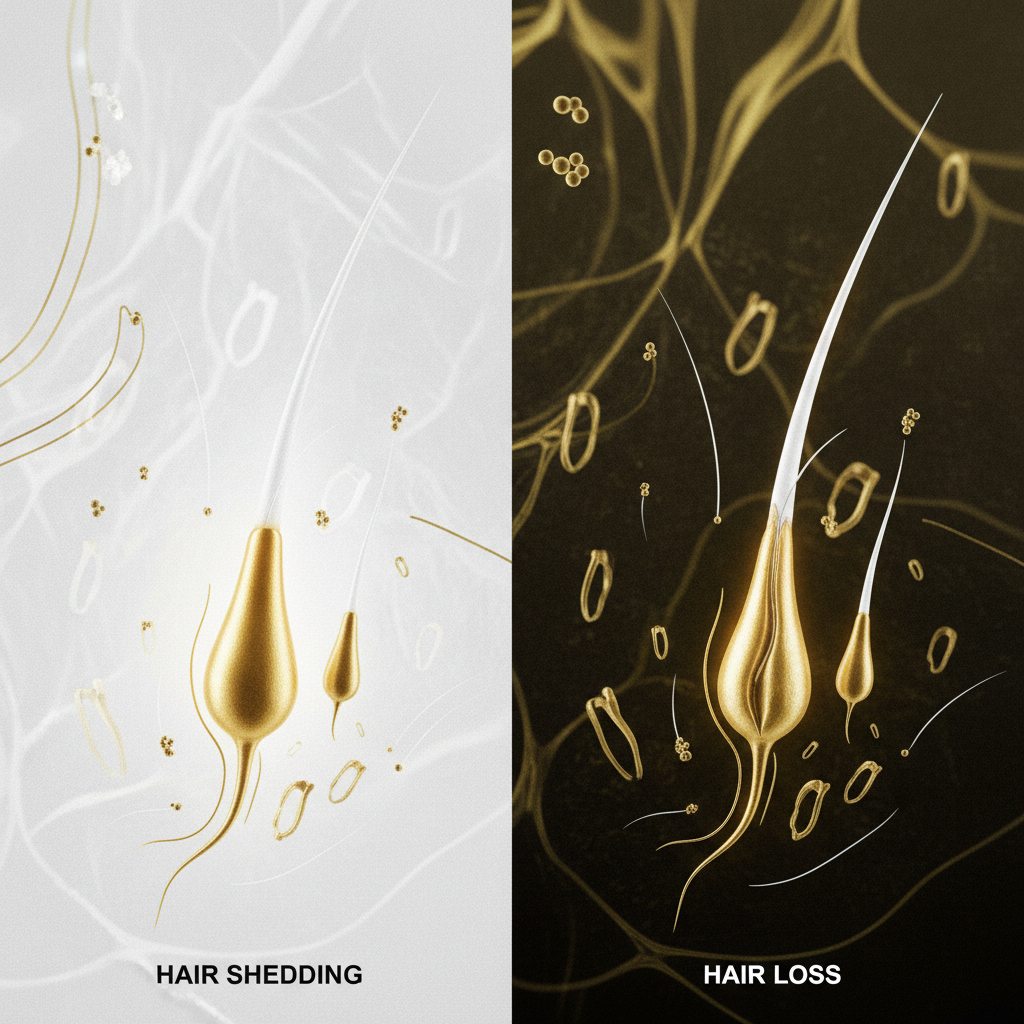
Hair shedding is governed by the follicular clock. When the body faces a physiological shock, such as childbirth, rapid weight loss, severe infection, or emotional trauma, cellular resources redirect toward vital organs. Keratinocyte proliferation in the hair matrix halts prematurely.
The hair bulb detaches from the dermal papilla, forms a club hair with a hardened keratinised base, and rests. When the follicle eventually re-enters anagen, the emerging new hair shaft pushes the old club hair out of the ostium. Shedding is therefore a paradoxical sign that a new hair cycle is starting underneath.
The hair loss mechanism
Pattern hair loss relies on enzymatic activity and genetics. The enzyme 5-alpha reductase converts circulating testosterone into dihydrotestosterone (DHT). In DHT-sensitive scalp zones, this hormone alters gene expression within dermal papilla cells.
The dermal papilla shrinks in volume, extracellular matrix proteins decrease, and blood flow through the microvasculature diminishes. With each shortened anagen cycle, the duration of growth falls from years down to months, while the telogen phase lengthens. Unlike shedding, the hair does not simply fall out in abundance; it withers slowly until the scalp becomes visible.
Signs to look for: how to identify your situation
Examine the physical evidence carefully before jumping to conclusions.
- Inspect the ends of shed strands: Gather a few fallen hairs from your brush or pillow. Look closely at the roots. If you see a tiny, rounded, white or clear nodule (a club root), the hair was shed from the follicle. If there is no bulb and the strand is shorter than your typical length, the hair has snapped due to shaft fragility.
- Track the pattern of thinning: Diffuse shedding causes a reduction in overall ponytail circumference without distinct bald patches. In contrast, female pattern hair loss reveals a gradual widening of the central parting (the Christmas tree pattern), while male pattern hair loss shows recession at the temples and vertex thinning.
- Assess the timeline: Shedding spikes abruptly roughly 60 to 90 days after a major trigger event. Pattern hair loss develops quietly over several years.
- Perform a gentle pull test: Grasp approximately 50 to 60 hairs between your thumb and forefinger close to the scalp and pull firmly but gently away. If more than 5 or 6 hairs slide out painlessly with bulbs attached, active telogen shedding is likely present.
What you can do to support healthy hair
When managing temporary shedding, your goal is to correct systemic triggers and support normal follicular cycling. Ensure your diet provides adequate protein, zinc, and iron, as low serum ferritin levels directly impair follicular matrix proliferation. Manage baseline stress, allow your sleep architecture to stabilise, and avoid extreme caloric deficits.
Supporting the scalp environment with targeted topical care provides cosmetic and structural advantages. Watermans offers products formulated to invigorate the scalp surface, clear sebum accumulation, and support stronger-feeling hair fibres. The Watermans Grow Me range delivers caffeine, biotin, argan oil, and rosemary extract directly to the scalp during cleansing. While these cosmetic formulations do not treat or cure medical alopecias, keeping the scalp clean, balanced, and free from inflammatory scale creates ideal conditions for emerging hairs.
To minimise concurrent hair breakage, reduce your reliance on chemical processing, lower heated styling tool temperatures below 185°C, and detangle wet hair gently with a wide-tooth comb.
When the cause may be something else
Thinning is not always a binary choice between telogen effluvium and genetic alopecia. Other clinical presentations include:
- Alopecia Areata: An autoimmune disorder where T-lymphocytes target anagen hair bulbs, causing smooth, round, well-demarcated patches of complete bareness.
- Traction Alopecia: Mechanical tension from tight ponytails, braids, or extensions that physically pulls the follicle out of alignment, leading to localised inflammation and eventual scarring along the hairline.
- Trichorrhexis Nodosa: A structural defect of the hair shaft where nodes form along the strand, causing it to snap under minimal tension. This is often mistaken for rapid shedding.
- Thyroid Dysfunction: Both hypothyroidism and hyperthyroidism disrupt the metabolic rate of follicular cells, causing diffuse thinning that mimics shedding.
When to seek professional medical advice
Consult a GP, dermatologist, or qualified trichologist if you notice any of the following symptoms:
- Sudden, patchy, circular bald spots appearing over days or weeks.
- Shedding that persists at high volume for longer than six months (chronic telogen effluvium).
- Scalp symptoms including intense burning, pain, itching, redness, or scaling.
- Visible scarring, pustules, or shiny skin where follicular openings have vanished.
- Shedding accompanied by unexplained weight changes, joint pain, heavy menstrual cycles, or profound fatigue.
A specialist can conduct a dermoscopic examination (trichoscopy), perform a scalp biopsy, or request targeted blood panels to assess ferritin, thyroid-stimulating hormone, and vitamin D levels.
Frequently asked questions about Differences Between Hair Shedding and Hair Loss
What are the main differences between hair shedding and hair loss?
The primary differences between hair shedding and hair loss lie in follicle activity. Hair shedding is the temporary release of resting hairs from active, healthy follicles, usually triggered by stress, illness, or diet. Hair loss refers to follicle miniaturisation or scarring, where follicles stop producing viable hair fibres over time.
How many shed hairs per day is considered normal?
Dermatologists consider shedding 50 to 100 strands per day normal for a healthy adult. This natural turnover reflects the regular transition of hair follicles from the resting telogen phase into the shedding exogen phase before a new hair begins growing.
Can excessive hair shedding turn into permanent hair loss?
No. Standard telogen effluvium does not destroy hair follicles or transform into permanent baldness. However, severe shedding can unmask underlying, pre-existing androgenetic alopecia in genetically susceptible individuals, making prior pattern thinning more noticeable.
How can I tell if my hair is shedding or breaking?
Look at the fallen strand against a dark background. If it has a tiny white bulb at one end and matches your full hair length, it shed from the follicle. If it lacks a bulb and is shorter than your normal length, it broke along the shaft.
How long does an episode of telogen shedding typically last?
Acute telogen shedding typically lasts between three and six months. Once the underlying trigger resolves, shedding slows back to baseline levels, and new hairs emerge from the follicles over the subsequent six to twelve months.
Moving forward with clarity
Recognising the differences between hair shedding and hair loss allows you to respond with practical solutions rather than worry. Shedding is usually a temporary physiological recalibration that runs its course as your body recovers, whereas true hair loss requires early, sustained medical strategy to preserve follicle density. Pay attention to the patterns on your scalp, examine fallen strands for roots versus snapped edges, and seek professional guidance whenever shedding persists or scalp irritation arises.
Sources and references
- British Association of Dermatologists. Telogen Effluvium: Patient Information Leaflet. 2021.
- National Institute for Health and Care Excellence (NICE). Alopecia androgenetica: Clinical Knowledge Summary. 2022.
- Journal of the American Academy of Dermatology. Telogen effluvium: A review. 2020. DOI: 10.1016/j.jaad.2020.04.148.
- NHS. Hair loss. 2023.
- American Academy of Dermatology Association. Do you have hair loss or hair shedding? 2022.
Find these ingredients in Watermans products
- Biotin: you will find this ingredient in our Hair Growth Shampoo.
- Zinc: you will find this ingredient in our Hair Vitamins.