DHT and the Follicular Cycle: The Biology of Hair Miniaturisation
8 min read ·
Discover how DHT and the follicular cycle interact, driving miniaturisation, shortening anagen, and altering hair density in androgen-sensitive follicles.

Quick answer: The biological relationship between DHT and the follicular cycle dictates how genetically sensitive hair follicles transform over time. Dihydrotestosterone (DHT) binds to androgen receptors in the dermal papilla, progressively shortening the active growth phase (anagen) and lengthening the resting phase (kenogen). This process, known as follicular miniaturisation, causes thick terminal hairs to degrade into fine vellus strands. However, DHT sensitivity is dictated primarily by genetics and local receptor density, meaning systemic DHT levels alone do not predict hair loss severity.
Key takeaways
- DHT (dihydrotestosterone) is an androgen synthesised from testosterone by the intracellular enzyme 5-alpha reductase.
- In genetically predisposed follicles, DHT shortens the anagen (growth) phase from years down to months.
- Miniaturisation is a structural decline where each successive hair cycle produces a thinner, shorter, and less pigmented fibre.
- Androgenetic alopecia is driven by receptor sensitivity and local enzymatic activity, not necessarily elevated blood androgen levels.
- Non-androgen conditions like telogen effluvium and mechanical breakage are frequently confused with DHT-mediated loss but follow distinct biological pathways.
- Clinical management focuses on enzyme inhibition, receptor competition, and prolonging anagen signalling before follicles reach irreversible senescence.
DHT and the follicular cycle: what the evidence shows
The relationship between DHT and the follicular cycle sits at the centre of androgenetic alopecia (pattern hair loss) in both men and women. In a healthy scalp, a hair follicle moves through distinct phases: anagen (active growth lasting 2 to 7 years), catagen (a 2 to 3 week regression phase), and telogen (a resting phase lasting 2 to 4 months), followed by shedding (exogen).

When DHT interacts with genetically susceptible follicles, this orderly timeline breaks down. Circulating testosterone enters the dermal papilla cell, where the enzyme 5-alpha reductase (specifically the Type II isoenzyme located within the inner root sheath and dermal papilla) converts it into dihydrotestosterone. DHT binds to the androgen receptor with approximately five times greater affinity than testosterone itself.
Once bound, the androgen-receptor complex translocates to the cell nucleus, altering gene transcription. This pathway upregulates inhibitory cytokines, notably transforming growth factor-beta (TGF-beta 1 and TGF-beta 2) and Dickkopf-related protein 1 (DKK-1). These signalling molecules suppress follicular epithelial cell proliferation and prematurely trigger catagen. As a result, the anagen phase shortens drastically. Over several cycles, a follicle that previously produced a robust terminal hair fibre only has time to produce a short, fine, minimally pigmented vellus hair.
Additionally, the lag phase between the shedding of an old hair (exogen) and the emergence of a new anagen hair (sometimes termed kenogen) becomes significantly prolonged. The follicle remains empty for longer stretches, creating the visible appearance of diffuse thinning across the scalp.
What the evidence does not show
Scientific literature clarifies several common misconceptions surrounding DHT:
- DHT does not act as a toxic sludge or external residue. DHT operates inside the cells of the dermal papilla and hair follicle sheath. It cannot be simply "washed off" the surface of the scalp with standard cleansing.
- High circulating DHT does not always mean baldness. Men with high serum DHT can retain full heads of hair if their follicles lack high androgen receptor density or genetic sensitivity. Conversely, individuals with low or normal circulating levels can experience aggressive pattern thinning due to receptor hypersensitivity.
- DHT does not cause immediate follicular death. Miniaturisation is an incremental, multi-year process. Follicles do not vanish overnight; they gradually downscale. They can remain dormant in a vellus state for years before eventual apoptosis (programmed cell death) makes regeneration exceptionally difficult.
Follicular phases under normal conditions vs DHT influence
| Metric / Phase | Normal Follicular Cycle | DHT-Influenced Cycle |
|---|---|---|
| Anagen Duration | 2 to 7 years | Weeks to a few months |
| Catagen Onset | Regulated by physiological cell age | Prematurely triggered by TGF-beta and DKK-1 |
| Kenogen (Empty Phase) | Brief or non-existent | Prolonged; follicle remains empty for months |
| Fibre Calibre | 60 to 90 micrometres (terminal hair) | Under 30 micrometres (vellus hair) |
| Dermal Papilla Volume | Robust, rich vascular network | Progressively depleted extracellular matrix |
| Scalp Distribution | Uniform across entire cranium | Patterned (fronto-temporal, vertex, mid-scalp) |
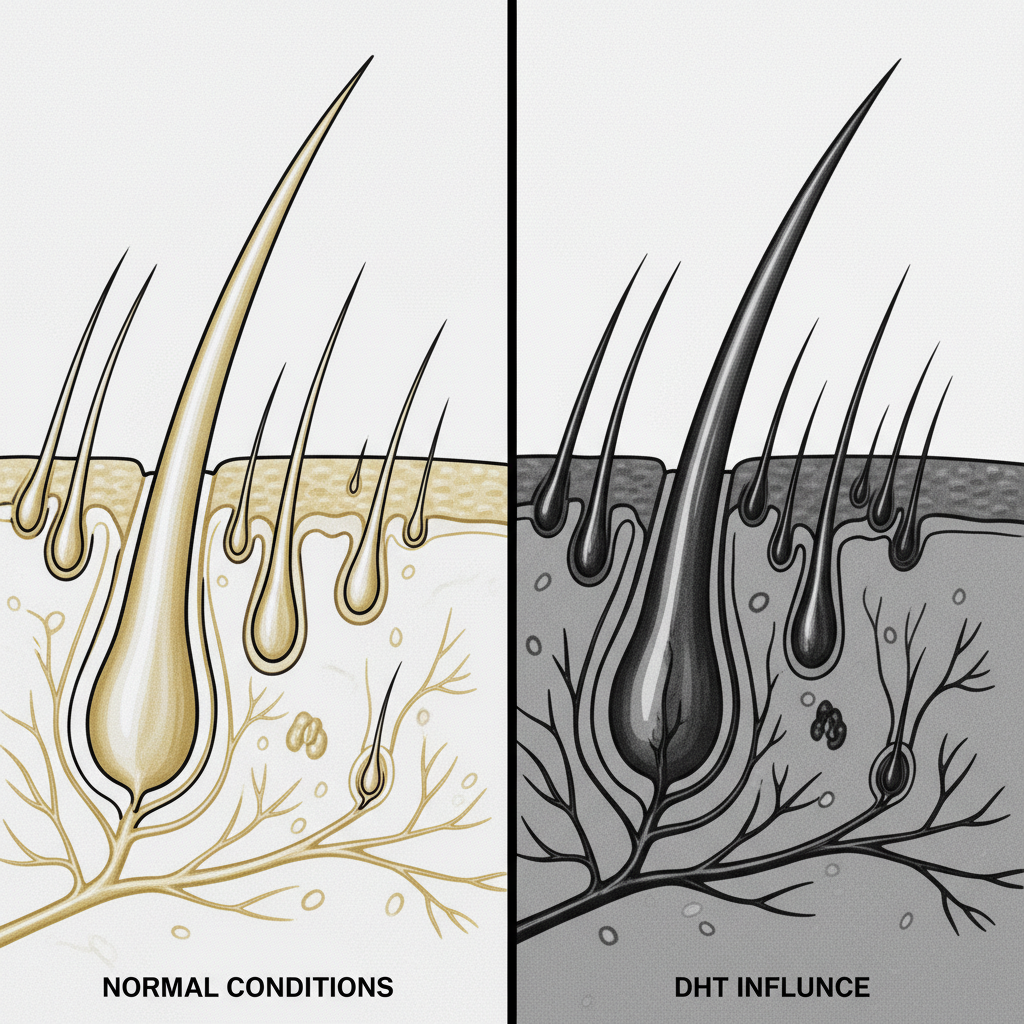
The cellular mechanism of miniaturisation
Follicular miniaturisation is structural remodelling driven by biochemical signalling. When DHT activates dermal papilla androgen receptors, it disrupts the Wnt/beta-catenin pathway. The Wnt signalling cascade is vital for keeping hair follicles in anagen and maintaining stem cell activity in the follicular bulge.
By inducing DKK-1, DHT neutralises Wnt signalling. Consequently:
- Vascular supply diminishes. Vascular endothelial growth factor (VEGF) synthesis declines, reducing local capillary perfusion to the hair bulb.
- Matrix cell division slows. The matrix cells surrounding the dermal papilla divide fewer times during each growth window, yielding a fibre with a smaller cross-sectional diameter.
- Connective tissue changes. Perifollicular fibrosis often develops around miniaturising follicles. Chronic, low-grade inflammation within the upper follicle causes collagen deposition, stiffening the tissue and limiting future follicular expansion.
Recognising the signs: androgenetic loss vs other shedding
Understanding the role of DHT and the follicular cycle helps distinguish pattern loss from other conditions:
- Progressive diameter variation (Anisotrichosis): If you examine the scalp under magnification, pattern thinning exhibits hairs of widely varying diameters growing right next to each other. Diffuse shedders typically show uniform fibre thickness.
- Patterned distribution: DHT-sensitive receptors concentrate in the frontal hairline, temples, and crown. Follicles on the occipital scalp (the back of the head) generally express lower levels of androgen receptors and 5-alpha reductase, making them resistant to miniaturisation.
- Absence of rapid shedding: Androgenetic loss does not typically cause clumps of hair to fall out in the shower. Instead, hairs shed at a steady rate, but return smaller and thinner until they become virtually invisible.
When the cause is something else
Not all thinning involves DHT:
- Telogen Effluvium: A physiological shock (illness, rapid weight loss, severe stress, childbirth) forces a large percentage of anagen follicles prematurely into telogen. The result is sudden, diffuse shedding 2 to 3 months later across the entire scalp, not isolated to the crown or temples.
- Hair Fibre Breakage: Mechanical friction, high-heat styling tools, bleaching, and chemical relaxers damage the keratin structure of the hair shaft. Breakage occurs along the fibre length, leaving the follicle intact and healthy. This is not hair loss; it is fibre degradation.
- Nutritional and Endocrine Deficits: Iron deficiency (low ferritin), thyroid dysfunction (hypo- or hyperthyroidism), and vitamin D deficiencies can perturb follicle cycling without androgen involvement.
Cosmetic support and scalp care
Cosmetic and topical interventions cannot alter systemic genetics or reverse medical conditions, but they can support an optimal environment for hair maintenance.
Topical products formulated with caffeine, rosemary extract, niacinamide, and specific botanical oils are widely used to invigorate the scalp. Caffeine, for example, has been shown in published in vitro studies to penetrate the follicular infundibulum and counteract testosterone-induced growth suppression at a cellular level.
Maintaining a clean scalp environment with balanced pH (between 4.5 and 5.5) keeps the microbiome stable and prevents sebum accumulation from harbouring secondary microbial irritants that drive perifollicular inflammation.
Watermans approaches this through topical formulations designed to revitalise the scalp surface. The Watermans Grow Me range delivers caffeine, rosemary, biotin, and lupin protein directly to the scalp during regular washing. While cosmetic products do not treat medical androgenetic alopecia, maintaining clean follicles and delivering topical energising compounds supports a favourable scalp environment for fuller-looking, stronger-feeling hair.
When to seek medical advice
Because miniaturisation causes structural changes over time, early identification matters. If you notice receding temples, visible widening of your central parting, or gradual scalp exposure on the vertex, consult a registered trichologist or a dermatologist.
A specialist uses dermoscopy to quantify the ratio of vellus to terminal hairs. If progressive pattern loss is confirmed, medical options like pharmaceutical 5-alpha reductase inhibitors (which suppress DHT synthesis) or topical vasodilators (which stimulate microcirculation and extend anagen) can be prescribed.
Frequently asked questions about DHT and the follicular cycle
Can DHT be removed completely from the scalp?
No. DHT is an internal, naturally occurring steroid hormone synthesised inside tissue cells. It cannot be washed away with surfactants. Effective management focuses on modulating 5-alpha reductase activity internally or applying topical formulations that support scalp microcirculation and follicular nourishment.
Does DHT affect all hair follicles in the human body?
Curiously, no. While DHT causes scalp follicles on the crown and temples to miniaturise, it has the opposite effect on facial, chest, and body hair. In those areas, DHT stimulates dermal papilla activity, promoting the transition of fine vellus hairs into thick terminal fibres.
How quickly does DHT shrink a hair follicle?
The interaction between DHT and the follicular cycle is a gradual process that spans several years. It takes multiple successive cycles for a terminal follicle to miniaturise down to a vellus state, with anagen phases growing progressively shorter with each turn of the cycle.
Can a miniaturised hair follicle be restored?
If a follicle has only partially miniaturised and still produces a thin fibre, clinical interventions and supportive scalp care can often help enlarge the bulb and extend anagen. However, if the follicle has remained dormant for many years and undergone advanced fibrosis or apoptosis, biological reactivation becomes unlikely.
The balance of hormones and hair growth
Navigating the dynamics of DHT and the follicular cycle comes down to understanding genetic receptor sensitivity rather than viewing hormones as outright enemies. DHT performs critical physiological roles throughout the human body, but its local interaction with scalp androgen receptors progressively dismantles healthy hair cycling in susceptible individuals. By identifying pattern thinning early, distinguishing it from general shedding or breakage, and adopting an evidence-led strategy encompassing medical treatments and dedicated scalp care, you can preserve follicular vitality and sustain healthy hair density for longer.
Sources and references
- British Association of Dermatologists. Androgenetic Alopecia Guidelines, 2018.
- Inui, S., & Itami, S. "Molecular basis of androgenetic alopecia: From androgen to paracrine mediators." Journal of Dermatological Science, 2013.
- Fischer, T. W., et al. "Differential effects of caffeine on hair shaft elongation, matrix and outer root sheath keratinocyte proliferation and transforming growth factor-beta2/insulin-like growth factor-1-mediated regulation of the hair cycle in male and female human hair follicles in vitro." British Journal of Dermatology, 2014.
- Trueb, R. M. "Molecular mechanisms of androgenetic alopecia." Experimental Gerontology, 2002.
- National Institute for Health and Care Excellence (NICE). Alopecia, androgenetic - Clinical Knowledge Summaries, 2021.
Find these ingredients in Watermans products
- Biotin: you will find this ingredient in our Hair Growth Shampoo.
- Vitamin D: you will find this ingredient in our Hair Vitamins.
- Niacinamide: you will find this ingredient in our Hair Mask.