The Role of DHT in Follicle Miniaturisation: Mechanisms and Evidence
9 min read ·
Explore the biological mechanism behind The Role of DHT in Follicle Miniaturisation, how androgens shorten the growth cycle, and ways to protect your hair.

Quick answer: The Role of DHT in Follicle Miniaturisation centres on dihydrotestosterone binding to androgen receptors in genetically susceptible hair follicles. This hormone-receptor complex alters cellular signalling, shortens the active growth (anagen) phase, and shrinks the physical size of the dermal papilla over successive hair cycles. Thick terminal hairs progressively transform into fine, wispy vellus hairs. However, DHT does not cause universal baldness; miniaturisation requires an underlying genetic sensitivity in the target follicle, meaning circulating androgen levels alone do not predict hair loss.
Key takeaways
- Dihydrotestosterone (DHT) is a potent androgen synthesised locally from testosterone by the intracellular enzyme 5-alpha reductase.
- In androgenetic alopecia, miniaturisation occurs because sensitive follicles exhibit higher densities of androgen receptors and elevated local 5-alpha reductase activity.
- DHT binding shortens the anagen (growth) phase from years down to months, while extending the kenogen (empty follicle) phase.
- Miniaturised follicles produce shorter, finer, and less pigmented hairs, eventually creating the visual appearance of thinning or bald patches.
- Cosmetic scalp treatments support hair condition and reduce breakage, but reversing advanced follicular miniaturisation requires targeted, evidence-based dermatological interventions.
The Role of DHT in Follicle Miniaturisation: what the evidence shows
The Role of DHT in Follicle Miniaturisation represents the primary biological mechanism behind pattern hair loss (androgenetic alopecia) in both men and women. Circulating testosterone converts into dihydrotestosterone via the enzyme 5-alpha reductase (5AR), which exists in two main isoenzymes within human tissue. Type II 5AR is heavily concentrated in the outer root sheath and dermal papilla of scalp hair follicles, particularly along the frontal hairline, temples, and crown.
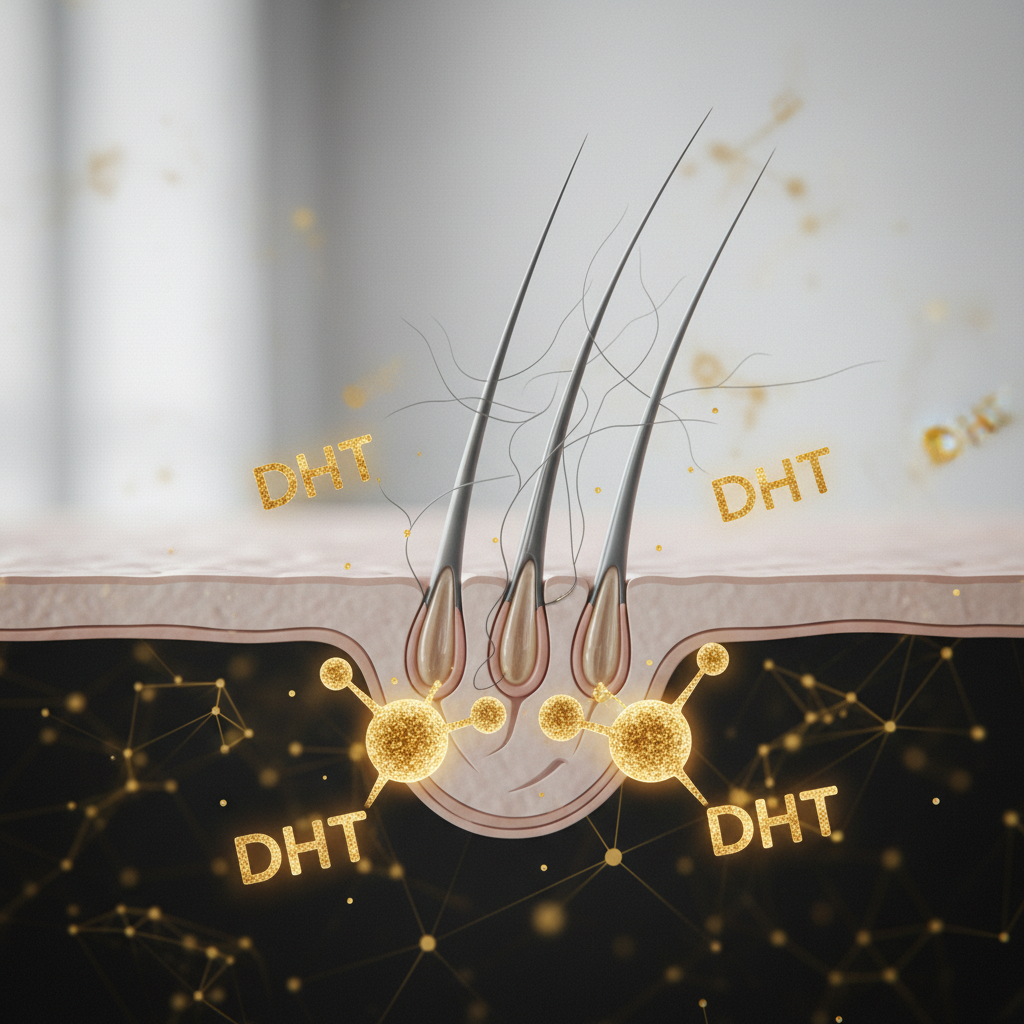
DHT possesses approximately two to five times higher binding affinity for androgen receptors than testosterone, alongside a vastly slower dissociation rate. When DHT binds to these receptors inside dermal papilla cells, it triggers gene transcription pathways that release inhibitory signalling molecules. Foremost among these is transforming growth factor-beta (TGF-beta 1 and TGF-beta 2) and dickkopf-1 (DKK-1), which actively suppress keratinocyte proliferation and downregulate the Wnt/beta-catenin signalling pathway essential for healthy follicle cycling.
Over repeated hair cycles, this suppression causes structural regression. The dermal papilla decreases in volume, the follicular capillary network contracts, and the matrix cell population shrinks. As a direct consequence, the follicle produces a hair shaft that is significantly reduced in diameter, tensile strength, and pigmentation.
| Feature | Healthy Terminal Follicle | Miniaturised Follicle |
|---|---|---|
| Anagen (Growth) Duration | 2 to 7 years | Several months to 1 year |
| Shaft Diameter | 60 to 100 micrometres | Under 30 micrometres |
| Root Depth | Deep dermis / subcutis | Upper to mid-dermis |
| Dermal Papilla Volume | Full, highly vascularised | Shrunken, reduced microvasculature |
| Pigmentation | Fully pigmented | Hypopigmented or unpigmented |
| Visual Appearance | Thick, dense coverage | Fine, wispy, transparent vellus hair |
What the evidence does not show
Scientific research does not show that DHT is a toxic metabolic waste product or that people experiencing pattern hair loss possess pathologically high systemic testosterone. Blood tests in men with androgenetic alopecia frequently return completely normal serum androgen levels. Miniaturisation is driven by local tissue sensitivity and receptor density, not by a hormonal surplus poisoning the blood.
Furthermore, DHT does not kill follicles overnight. Miniaturisation is a slow, multi-year process occurring across several follicular turnover cycles. The follicle remains anatomically present and alive for years, resting in an extended latent phase known as kenogen, rather than vanishing entirely from the scalp.
Finally, evidence does not show that external factors like hard water, sebum build-up, or wearing tight hats produce DHT-driven miniaturisation. While scalp inflammation and harsh handling can cause surface breakage or exacerbate shedding, they do not trigger the genetic cascade of androgen-mediated follicular regression.
The biological mechanism step by step
Understanding the biological sequence clarifies why hair changes its texture before disappearing visually:
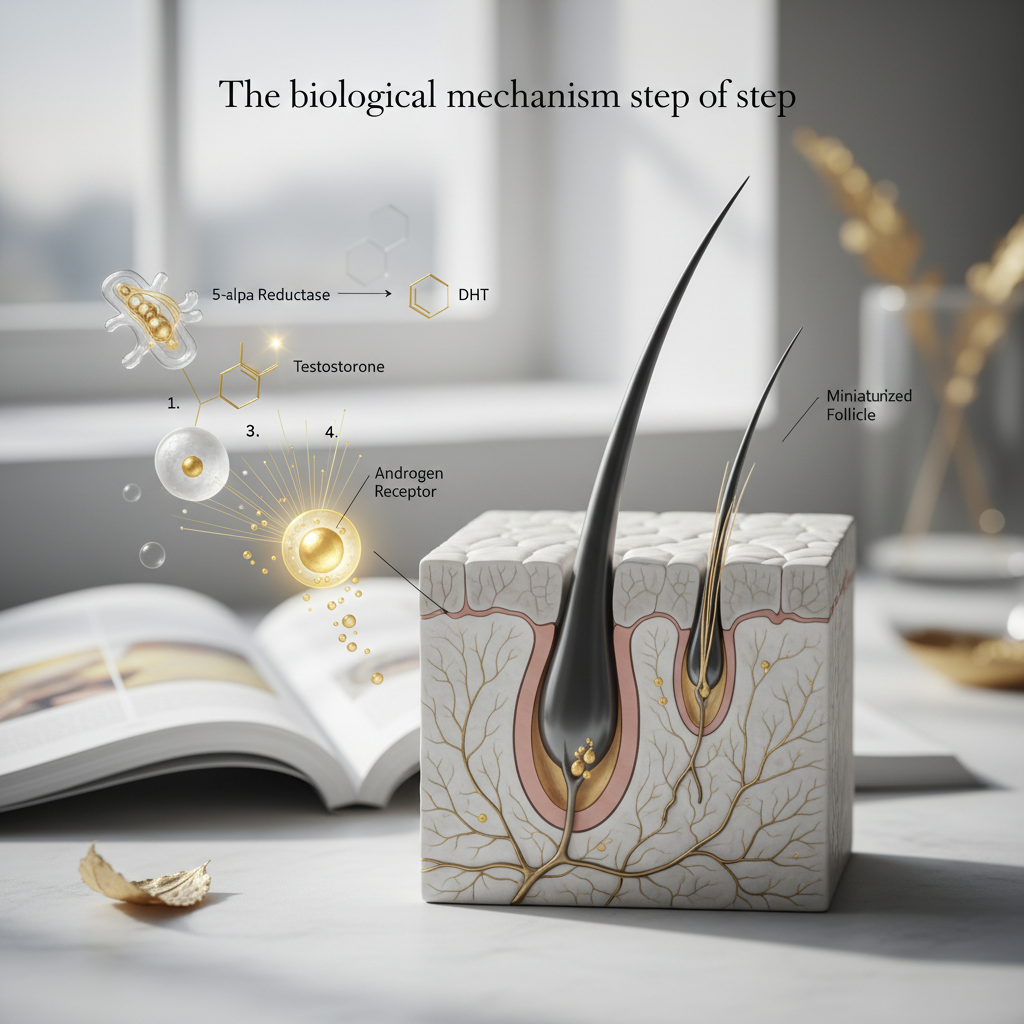
- Conversion: Testosterone enters the dermal papilla cell via passive diffusion, where the intracellular enzyme 5-alpha reductase converts it into DHT.
- Receptor activation: DHT binds to the cytosolic androgen receptor (AR). The receptor sheds chaperone heat shock proteins, homodimerises, and translocates into the cell nucleus.
- Paracrine signalling: In the nucleus, the DHT-AR complex alters gene expression, prompting the overproduction of paracrine inhibitory factors like TGF-beta 1, TGF-beta 2, and DKK-1.
- Premature catagen: These inhibitory signals force the growing hair prematurely out of anagen and into catagen (the regression phase), cutting off the nutrient supply from the dermal papilla.
- Stem cell arrest: The transit-amplifying cells derived from the hair follicle stem cell niche in the bulge receive signals to limit division, resulting in a physically smaller matrix bulb during the subsequent cycle.
- Cycle truncation: With each subsequent cycle, anagen becomes progressively shorter, shrinking the hair shaft diameter from terminal dimensions (greater than 60 micrometres) to vellus dimensions (under 30 micrometres).
Identifying the signs of follicle miniaturisation
Because miniaturisation is progressive, identifying it early provides the best opportunity for clinical intervention:
- Change in hair texture: Hairs at the crown, parting line, or temples feel noticeably softer, thinner, and less substantial than hair at the back of the head (the occipital zone, which is naturally DHT-resistant).
- Increased shedding of short, fine hairs: Finding shed hairs that are shorter than your general hair length and significantly thinner indicates a prematurely terminated anagen cycle.
- Loss of styling volume: Ponytails feel thinner at the base, or hair lies flatter against the scalp despite using volumising products.
- Widening part or visible scalp: As terminal hairs convert to translucent vellus hairs, light reflects off the scalp more readily under direct illumination.
When the cause may be something else
Miniaturisation driven by DHT must be distinguished from other types of hair shedding and structural damage:
- Telogen effluvium: Characterised by sudden, diffuse shedding across the entire scalp, typically appearing two to three months after a physiological stressor (such as illness, childbirth, severe caloric restriction, or thyroid dysfunction). In telogen effluvium, shed hairs are full-thickness terminal hairs with an intact bulb, not miniaturised strands.
- Alopecia areata: An autoimmune condition causing rapid, patchy shedding in circular or oval patterns, characterised by distinct "exclamation mark" hairs under dermoscopy rather than progressive diameter reduction.
- Traction alopecia: Mechanical tension from tight braiding, weaves, or heavy extensions damages the follicle physically, leading to hair loss concentrated along the hairline borders without androgen mediation.
- Hair fibre breakage: Snapping along the hair shaft caused by chemical processing, thermal styling, or harsh bleaching. Breakage leaves no bulb on the fallen strand and does not involve the follicle.
What you can do: clinical and cosmetic care
Managing hair affected by androgenetic alopecia requires a clear separation between medical treatments that address DHT and cosmetic care that preserves existing hair fibres.
Medical and clinical approaches
To alter the underlying biological process, clinical guidelines (such as those from NICE and the British Association of Dermatologists) recognise specific pharmaceutical pathways. Systemic 5-alpha reductase inhibitors block the enzymatic conversion of testosterone to DHT, reducing tissue DHT levels significantly. Topical vasodilators stimulate microcirculation, extend the anagen phase, and promote follicle enlargement independently of the androgen pathway. Any pharmaceutical approach requires consultation with a registered GP or dermatologist to weigh benefits against potential contraindications.
Cosmetic support and scalp care
Cosmetic scalp products cannot cure androgenetic alopecia or replace medical treatments, but they play an essential role in keeping the scalp environment receptive and the hair fibre intact.
Watermans focuses on non-medicinal scalp care designed to support healthy-looking hair. Watermans GrowMe Shampoo and ConditionMe Conditioner deliver nutrient-rich cosmetic formulations containing caffeine, biotin, rosemary, and hydrolysed lupin protein. While topical cosmetics do not act as pharmaceutical DHT inhibitors, maintaining a balanced, clean scalp environment free from oxidised sebum and micro-inflammation supports optimal conditions for growing fibres, while conditioning ingredients reduce physical breakage along fragile, thinning shafts.
When to seek professional advice
Consult a GP, a board-certified dermatologist, or an accredited trichologist (registered with the Institute of Trichologists) if you observe:
- Rapid, patchy shedding or sudden hair fall over a matter of weeks.
- Scalp tenderness, burning, severe itching, scaling, or pustules.
- Thinning accompanied by menstrual irregularities, severe adult acne, or unexpected facial hair growth (which can indicate polycystic ovary syndrome or broader endocrine imbalances).
- Progressive thinning that causes emotional distress, so you can explore early clinical interventions before follicles enter prolonged dormancy.
Frequently asked questions about The Role of DHT in Follicle Miniaturisation
What triggers the conversion of testosterone into DHT in the scalp?
The conversion is catalysed by the enzyme 5-alpha reductase (specifically the Type II isoenzyme), which resides inside the hair follicle's outer root sheath and dermal papilla. When circulating testosterone diffuses into these target cells, the enzyme chemically reduces the double bond at the carbon 4-5 position, creating dihydrotestosterone. Local genetics determine how much enzyme your follicles produce.
Does high DHT mean you will definitely go bald?
No. High systemic DHT levels do not automatically trigger baldness. For thinning to occur, your hair follicles must possess an inherited genetic susceptibility, specifically high densities of androgen receptors with elevated sensitivity. Men with normal or relatively low DHT levels can still experience significant thinning if their follicles are genetically sensitive, while individuals with high androgen levels may maintain full hair if their follicles lack these receptors.
Can miniaturised hair follicles ever recover?
Partially miniaturised follicles can often be revived and returned to producing thicker terminal hairs using clinically approved medical treatments such as 5-alpha reductase inhibitors or topical vasodilators. However, recovery depends on how far the process has advanced. Once a follicle has remained deeply miniaturised or dormant in the kenogen phase for many years, the dermal papilla matrix permanently atrophies, making full regeneration unlikely.
What is the exact Role of DHT in Follicle Miniaturisation for women?
The Role of DHT in Follicle Miniaturisation in female pattern hair loss is complex. While DHT binds to follicle receptors similarly to men, women typically produce much lower total circulating androgens and possess higher levels of the enzyme aromatase, which converts androgens into estrogens. Miniaturisation in women often presents as diffuse thinning across the mid-scalp and vertex, frequently involving altered androgen-to-estrogen ratios alongside genetic receptor sensitivity.
How does hair breakage differ from DHT miniaturisation?
Hair breakage occurs when mechanical friction, heat damage, or chemical treatments fracture the hair shaft along its length, leaving the root unaffected in the scalp. In contrast, DHT miniaturisation is a biological malfunction of the follicle itself, producing progressively thinner, weaker strands at the root level over successive growth cycles.
Summary
The Role of DHT in Follicle Miniaturisation is the cornerstone mechanism governing androgenetic alopecia. Through the enzymatic action of 5-alpha reductase, local DHT binds to sensitive follicular androgen receptors, triggering biochemical signals that shorten anagen, reduce papilla volume, and taper hair diameter. Distinguishing true miniaturisation from shedding conditions like telogen effluvium or physical hair breakage is vital for choosing the right strategy. While medical options target the enzymatic and receptor cascades, maintaining a nourished scalp with gentle, high-performance formulations helps protect existing strands from daily stress.
Sources and references
- British Association of Dermatologists. (2022). Androgenetic Alopecia: Patient Information Leaflet. BAD Guidelines.
- National Institute for Health and Care Excellence (NICE). (2021). Alopecia, androgenetic - male and female. Clinical Knowledge Summaries.
- Inui, S., & Itami, S. (2011). Molecular basis of androgenetic alopecia: From androgen to paracrine mediators. Journal of Dermatological Science, 64(1), 1-6.
- Randall, V. A. (2008). Androgens and hair growth. Dermatologic Therapy, 21(5), 314-328.
- Kaufman, K. D. (2002). Androgens and alopecia. Molecular and Cellular Endocrinology, 198(1-2), 89-95.
- Trueb, R. M. (2002). Molecular mechanisms of androgenetic alopecia. Experimental Gerontology, 37(8-9), 981-990.