Curly Hair Maintenance: The Complete Evidence-Based Guide
9 min read ·
Master curly hair maintenance with this science-backed guide to moisture retention, low-friction detangling, and protecting fragile curl patterns from mechanical breakage.

Quick answer: Successful Curly Hair Maintenance relies on preserving structural moisture, minimising mechanical friction, and balancing internal hydration with protein integrity. Because the curved geometry of curly fibres impedes the transit of natural scalp sebum down the hair shaft, curls are biologically prone to dehydration, tangling, and mechanical breakage. A targeted routine requires gentle cleansing at a balanced pH of 4.5 to 5.5, consistent detangling while wet with slip, and lipid barrier protection. However, topical care cannot alter your follicle's genetically determined curvature.
Key takeaways
- Curly hair fibres have an elliptical cross-section, which creates natural structural weak points along the curve.
- Natural sebum struggles to travel down spiral hair shafts, leaving mid-lengths and ends inherently prone to dryness.
- Maintaining an acidic cuticle pH (between 4.5 and 5.5) keeps the outer scales smooth, locking in moisture and reducing frizz.
- True hair shedding (from the follicle) must be distinguished from mechanical breakage (shaft snapping caused by improper handling).
- Protective nighttime routines using silk or satin significantly reduce cuticle erosion caused by pillow friction.
Curly Hair Maintenance: what the evidence shows
Research in cosmetic dermatology shows that curly hair requires a fundamentally different care protocol than straight hair due to its unique structural biology. The primary objective of Curly Hair Maintenance is protecting the integrity of the hair cuticle while providing supplemental lubrication that the scalp's natural sebum cannot deliver.
Peer-reviewed studies published in the International Journal of Cosmetic Science reveal that the curvature of a hair fibre correlates directly with the asymmetry of its hair follicle. In straight hair, the follicle is cylindrical and symmetric, allowing sebum to travel freely down the smooth shaft. In curly and coily patterns, the follicle is curved, producing an elliptical, ribbon-like hair strand. This geometry creates two primary challenges: natural oils pool at the scalp rather than coating the length, and every bend along the spiral acts as a mechanical stress point where the cuticle layers lift and shear easily under friction.
Effective maintenance therefore relies on three scientific pillars:
- Mild surfactants: Cleansing without stripping structural lipids from the cell membrane complex.
- Emollient and humectant layering: Depositing water into the cortex and sealing it with natural plant oils or conditioning agents.
- Low-friction styling: Handling the hair almost exclusively when lubricated by conditioner to avoid snapping the cortex.
Biological mechanisms of the curl pattern
To manage curls successfully, you must understand how the fibre behaves at a microscopic level.
Elliptical geometry and cuticle vulnerability
Under scanning electron microscopy, straight hair appears round in cross-section, whereas wavy, curly, and coily fibres display an oval or flattened shape. The cuticle cells on the outer edge of these elliptical curves experience constant tensile strain. Over time, friction from cotton pillowcases, vigorous towel-drying, and dry brushing lifts these protective scales. Once the cuticle lifts, internal water evaporates from the cortex, leaving the strand brittle and susceptible to snapping.
Protein and moisture balance
The hair shaft consists of roughly 85% to 90% keratin protein, 8% to 10% water, and a small fraction of structural lipids. Keratin provides tensile strength through disulfide, hydrogen, and salt bonds. Hydrogen bonds break easily when exposed to water, allowing curly hair to stretch when wet and contract into tight curls as it dries.
If curls absorb too much water without adequate lipid sealing, they enter a state known as hygral fatigue. The fibre swells repeatedly, weakening the inner cortex. Conversely, an over-application of heavy protein treatments without adequate water leads to stiff, brittle hair that breaks under minimal tension. Balanced maintenance keeps both elements in equilibrium.
Comparing curl types and maintenance requirements
Different curl patterns face distinct challenges depending on the tightness of their spiral and their fibre diameter.
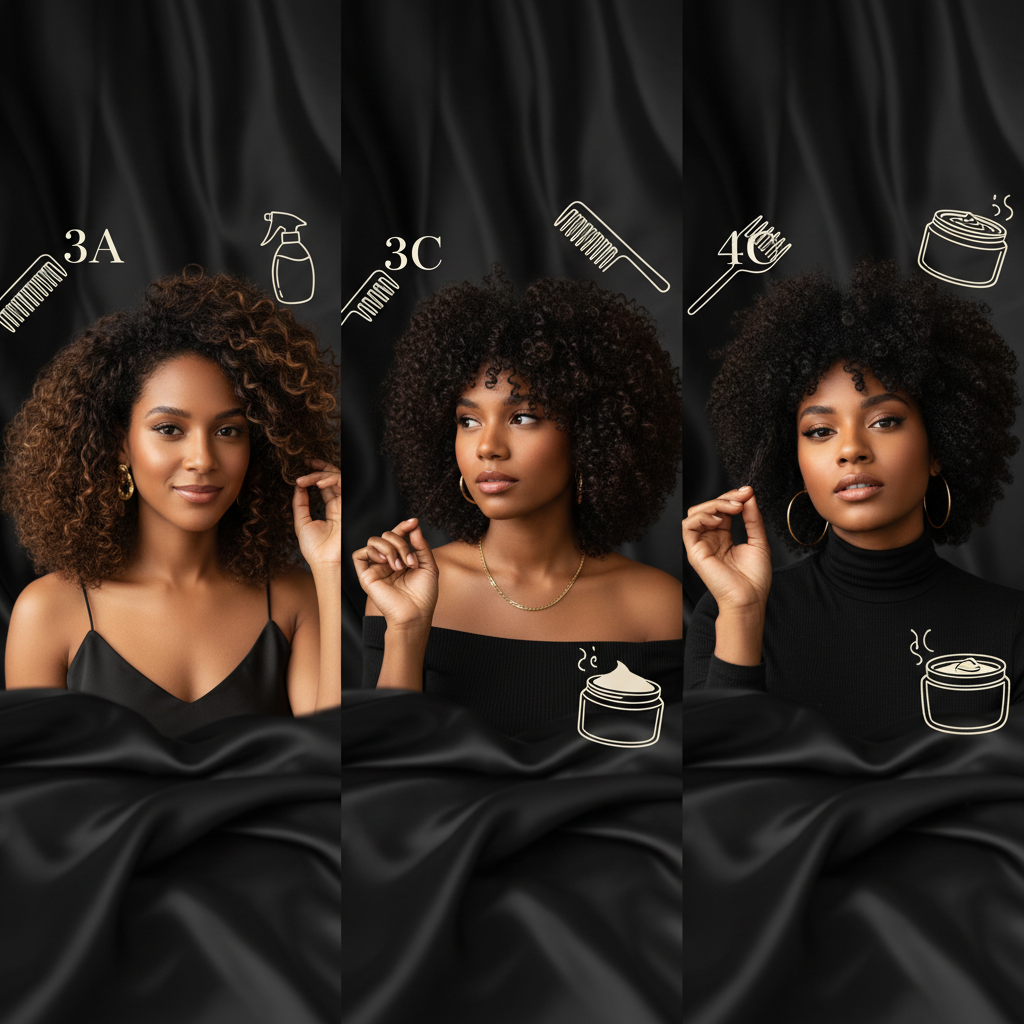
| Characteristic | Wavy (Type 2) | Curly (Type 3) | Coily / Kinky (Type 4) |
|---|---|---|---|
| Fibre cross-section | Slightly oval | Clearly elliptical | Flat, ribbon-like |
| Sebum distribution | Moderate | Low | Very low |
| Primary vulnerability | Product build-up, loss of bounce | Mid-shaft frizz, mechanical breakage | Severe dryness, knotting, snapping |
| Cleansing frequency | Every 2 to 3 days | Every 4 to 7 days | Every 7 to 10 days |
| Optimal formulation | Lightweight humectants, light lotions | Cream conditioners, medium oils | Heavy butters, rich lipid creams |
| Detangling method | Wide-tooth comb with light slip | Wide-tooth comb or flexible brush wet | Fingers or wide-tooth comb soaked in conditioner |
What the evidence does not show
There is no scientific evidence that topical products, natural oils, or cleansing routines can change your genetic curl pattern. While heat damage or chemical relaxers can permanently disrupt disulfide bonds and loosen curls, no topical lotion can permanently tighten or reshape your hair follicle.
Additionally, evidence does not show that "training" your curls by twisting them while wet alters how your hair grows from the scalp. Curls emerge based on the shape of the dermal papilla underneath your skin. Finally, while social media often claims that all silicones or sulphates permanently ruin curls, cosmetic science confirms that mild, water-soluble conditioning agents and occasional clarifying washes are often necessary to clear mineral deposits and prevent scalp inflammation.
Signs of poor maintenance versus deeper issues
It is crucial to distinguish between cosmetic damage and physiological scalp conditions.
- Mechanical breakage: If you notice short, jagged hair pieces without a white bulb falling out when you comb, your hair is snapping along the shaft. This points directly to friction, dryness, or excessive heat.
- Follicular shedding: If you shed full-length hairs with a small white bulb at the root, this is normal telogen effluvium shedding (typically 50 to 100 hairs daily). Because curly hair traps shed fibres within its coils, you may see what looks like an alarming clump of hair on wash day. If you only wash your hair once every five days, seeing 300 to 400 shed hairs during that single wash is mathematically normal.
- Scalp inflammation: Flaking accompanied by redness, burning, or itchiness indicates a scalp condition like seborrhoeic dermatitis, not merely "dry scalp". Piling heavy oils onto an inflamed scalp can feed Malassezia yeasts and worsen the problem.
What you can do: an evidence-based curl routine
A sustainable routine for curly hair focuses on hydration retention, minimal manipulation, and cuticle smoothing.
1. Cleanse gently at the correct pH
Standard alkaline soaps disrupt the scalp's natural acid mantle (pH 4.5 to 5.5), causing the hair cuticle to flare open and tangle. Choose sulphate-free, amphoteric, or non-ionic surfactant cleansers formulated at an acidic pH. Wash the scalp thoroughly, allowing the suds to run down the lengths rather than scrubbing the ends aggressively.
2. Detangle only when wet with high slip
Never brush curly hair when it is completely dry. Dry brushing creates immense frictional drag, pulling cuticles off the cortex and snapping curls. Apply a generous amount of rinse-out conditioner containing fatty alcohols (such as cetyl or stearyl alcohol) to create lubricity, then detangle gently using your fingers or a flexible wide-tooth comb, starting at the tips and moving upward toward the roots.
3. Lock in moisture with the LOC or LGO method
To prevent rapid moisture loss:
- Liquid (L): Apply water or a water-based leave-in conditioner to damp hair.
- Oil (O): Apply a small amount of plant-derived oil (such as argan or jojoba) to coat the shaft.
- Cream (C): Finish with a styling cream or gel that forms a flexible cast, holding the curl clump together as it air-dries or is diffused on low heat.
4. Protect hair overnight
Cotton is an absorbent, high-friction fabric that wicks moisture from hair and snags cuticles as you toss and turn. Sleeping on a smooth silk or satin pillowcase, or wrapping your curls in a satin bonnet, preserves moisture levels and reduces morning tangling.
Watermans: supporting scalp and fibre health
While daily curl styling relies on moisture and gentle handling, the foundation of every healthy curl pattern begins at the follicle. Watermans focuses on nurturing the scalp environment where hair fibres are formed. Products formulated with targeted botanical extracts, caffeine, biotin, and rosemary provide a clean, invigorated scalp surface free from heavy build-up. A balanced, non-greasy scalp formulation supports the hair growth cycle, ensuring that new curls emerge resilient and ready to withstand daily styling.
Frequently asked questions about Curly Hair Maintenance
How often should I wash my hair for proper Curly Hair Maintenance?
Most people with curly hair benefit from washing every 4 to 7 days. Coarser, tighter curl patterns may only need washing every 7 to 10 days, while finer waves may require cleansing every 2 to 3 days. The goal is to remove sebum, environmental debris, and product build-up without stripping the hair shaft of protective moisture.
Can I brush my curls every day?
No. Daily dry brushing is one of the leading causes of mechanical breakage in curly hair. Brushing separates curl clumps, creates static frizz, and snaps fragile bends along the fibre. Restrict thorough detangling to wash days when your hair is soaked and coated with a high-slip conditioner.
Why do my curls feel dry even after moisturising?
Your hair may have high porosity, or you might be experiencing mineral build-up from hard water. If your cuticle layer is damaged, moisture enters easily but evaporates immediately. Ensure you seal water-based products with a lipid-rich cream or oil, and consider using a chelating shampoo once a month to clear mineral deposits.
Is hair shedding on wash day normal for curls?
Yes. Humans naturally shed between 50 and 100 hairs per day. While straight hair sheds freely onto clothing throughout the day, curly hair traps these detached strands within the curl matrix. When you detangle on wash day, days worth of naturally shed hairs release all at once, which can look substantial but is usually normal.
Does cutting curly hair while wet or dry matter?
Both techniques have scientific merit. A dry cut allows the stylist to see how your individual curl patterns fall naturally, respecting curl shrinkage. A wet cut provides uniform tension and precise geometric lines. Many curly specialists prefer cutting dry to honour the natural spring factor of the curls.
Maintaining healthy curls for the long term
Consistent Curly Hair Maintenance is a practice of patience, hydration, and friction reduction. By understanding the unique anatomical weak points created by your hair's elliptical shape, you can work with your natural texture rather than fighting against it. Protect your cuticles with balanced conditioning, handle your strands gently when wet, and maintain a clean, nourishing scalp environment to ensure your curls remain resilient, defined, and healthy.
Sources and references
- International Journal of Cosmetic Science, The physical and chemical properties of curly hair, 2007.
- Journal of the American Academy of Dermatology, Hair breakage: microscopic morphology and clinical presentation, 2010.
- British Association of Dermatologists, Hair hygiene and care recommendations, 2021.
- National Institute for Health and Care Excellence (NICE), Alopecia and hair loss guidelines, 2022.
Find these ingredients in Watermans products
- Biotin: you will find this ingredient in our Hair Growth Shampoo.