Chemical Damage from Bleaching and Relaxers: Causes, Science, and Solutions
9 min read ·
Chemical damage from bleaching and relaxers permanently weakens the hair shaft. Learn the science of oxidation and lanthionisation, and how to stop breakage.

Quick answer: Chemical Damage from Bleaching and Relaxers occurs when high-alkalinity treatments break down the hair shaft's protective cuticle and internal structural bonds to alter pigment or curl patterns. While bleaches oxidise melanin and deplete cystine bonds, chemical relaxers cleave disulfide bonds to form irreversible lanthionine links. The primary limitation of any restorative treatment is that severe chemical damage permanently degrades the hair fibre; severed keratin networks cannot truly regenerate, meaning care strategies focus on preventing breakage and protecting new growth.
Key takeaways
- Bleaches and relaxers employ extreme pH environments (pH 9 to 14) that force the cuticle open and compromise the fibre's lipid barrier.
- Bleaching oxidises structural proteins alongside melanin, converting vital cystine into cysteic acid and leaving the hair porous and brittle.
- Hydroxide relaxers strip roughly one third of natural disulfide bonds through lanthionisation, permanently reducing the tensile strength of the hair shaft.
- Chemical damage manifests primarily as mid-shaft fibre breakage, split ends, and extreme moisture loss, rather than true follicular shedding at the root.
- Combining bleaching and relaxing on the same hair section creates compounding structural failure and dramatically elevates the risk of severe breakage.
- True chemical damage is irreversible; topical bond-builders and protein conditioners can temporarily reinforce weak zones, but only new growth replaces destroyed structure.
Chemical Damage from Bleaching and Relaxers: what the evidence shows
Scientific research into cosmetic chemistry shows that Chemical Damage from Bleaching and Relaxers fundamentally alters the hair fibre's mechanical and chemical architecture. Intact human hair possesses a natural isoelectric point around pH 3.67 to 5.5. At this slightly acidic level, the overlapping cuticle scales lie compact and flat, sealing in internal moisture and guarding the cortex.
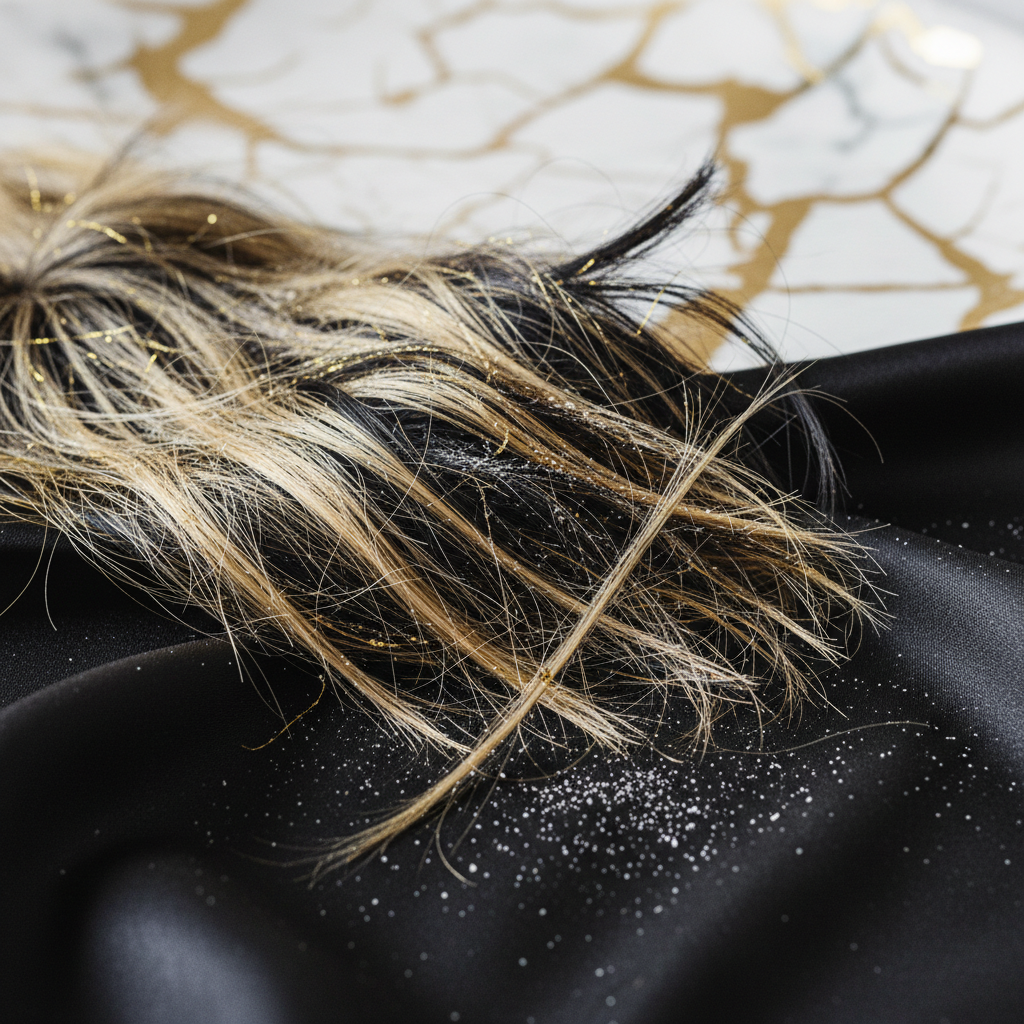
Chemical processing strips away this natural defence. Bleaching powders use persulphate salts combined with hydrogen peroxide in an alkaline ammonia base (typically pH 9 to 11). Relaxers push alkaline exposure even further, using hydroxide formulations (such as sodium, calcium, or lithium hydroxide) that reach an extreme pH of 12 to 14, or ammonium thioglycolate formulations around pH 9 to 9.5.
At these alkaline extremes, hair fibres swell rapidly. The 18-methyleicosanoic acid (18-MEA) lipid layer that coats the outer cuticle is stripped away. Once this hydrophobic barrier disappears, the hair turns hydrophilic, absorbing atmospheric humidity rapidly and tangling easily while losing internal elasticity. Studies consistently show that bleached and relaxed hair exhibits reduced wet and dry tensile strength, meaning significantly less mechanical force is needed to snap the fibre during routine styling.
Mechanisms of chemical breakdown: oxidation versus lanthionisation
The molecular damage caused by bleaching differs distinctly from the damage caused by relaxing, though both compromise keratin integrity.
Bleach-induced oxidation
Hair bleach relies on oxidative agents to dissolve natural melanin granules housed in the cortex. However, melanin represents less than 3 percent of the hair's mass; the remaining structure consists predominantly of keratin proteins rich in the amino acid cystine. During oxidation, the peroxide and persulphate agents break the disulfide bonds (-S-S-) linking keratin chains and oxidise them into cysteic acid residues. This reaction:
- Weakens the cross-linked matrix of the cortex.
- Creates micro-voids and structural porosity throughout the shaft.
- Leaves the fibre prone to hygral fatigue, where hair swells and contracts unstably when exposed to water.
Relaxer-induced lanthionisation
Relaxers alter the physical shape of tightly coiled hair by permanently breaking disulfide cross-links. In hydroxide relaxers, hydroxide ions attack cystine units via an elimination-addition mechanism. This converts cystine into lanthionine, a process known as lanthionisation.
Unlike the reversible reduction seen in traditional perms, lanthionine formation is chemically irreversible. Hydroxide relaxers permanently destroy roughly 30 to 35 percent of the original cystine content. While this allows the hair to settle into a straight geometry, it leaves the cortex structurally weakened. When left on too long or overlapped onto previously relaxed hair, the cortex undergoes extensive protein degradation, leading to immediate or delayed fracture.
How bleaching and relaxers compare
The following table contrasts the primary chemical characteristics and mechanical outcomes of both processes:
| Feature | Hair Bleaching | Hydroxide Relaxers |
|---|---|---|
| Typical working pH | pH 9.0 to 11.0 | pH 12.0 to 14.0 |
| Primary active chemical | Persulphate salts and hydrogen peroxide | Sodium, calcium, or lithium hydroxide |
| Main chemical reaction | Oxidation of cystine to cysteic acid | Conversion of cystine to lanthionine |
| Cuticle impact | Strips 18-MEA; lifts and chips cuticle scales | Massive swelling; degrades cuticle margins |
| Internal structural loss | High porosity, hollowed cortex, reduced wet elasticity | Loss of cross-linking, brittle dry tensile strength |
| Primary styling risk | Gummy, snapping hair when wet; split ends | Snapping at line of demarcation; catastrophic breakage if overlapped |
Visible signs of severe chemical damage
Distinguishing chemical trauma from regular wear and tear helps stylists and individuals adjust their regimens before catastrophic breakage occurs. Look for these clinical markers:
- High wet elasticity and "gummy" texture: When bleached hair loses its internal protein framework, it stretches abnormally when wet without springing back, snapping under the slightest tension.
- Breakage at the line of demarcation: On relaxed hair, the sharp junction between untreated new growth and chemically altered hair represents a severe mechanical weak point. Snapping frequently occurs here during detangling.
- Loss of natural curl rebound: Bleach-damaged curls appear loose, limp, and frizzy, failing to form cohesive clumps due to cuticle abrasion and protein loss.
- Extreme porosity and flash-drying: Damaged fibres soak up water instantly yet dry out almost immediately, leaving hair feeling brittle, rough, and straw-like.
- Split ends travelling upwards: Untreated cuticle erosion allows the exposed cortex to unravel into multiple vertical splits along the shaft.
What you can do to manage chemically damaged hair
Cosmetic products cannot reconnect severed lanthionine bonds or reverse cysteic acid formation. However, targeted regimens can significantly reduce fibre breakage and coat exposed cortex layers.
- Incorporate low-molecular-weight bond builders: Products formulated with dicarboxylic acids (such as maleic acid) or specific amino acid complexes penetrate the cortex to create temporary cross-links, reinforcing weak areas.
- Balance protein and moisture: Hydrolysed keratin, wheat protein, and silk proteins adhere to chipped cuticle edges, temporarily filling porous gaps. Follow protein treatments with emollient fatty alcohols and ceramides to restore suppleness.
- Minimise heat and friction: Chemically weakened hair has a lower thermal degradation threshold. Keep heated styling tools below 150 degrees Celsius, always use a heat protectant, and sleep on silk or satin pillowcases to reduce mechanical friction.
- Never overlap chemical treatments: When touching up roots, stylists must apply relaxer or bleach strictly to new growth. Overlapping onto previously processed sections compounds structural loss and almost inevitably triggers breakage.
- Space treatments appropriately: Give hair at least 8 to 12 weeks between relaxer touch-ups to ensure sufficient new growth is visible, reducing the risk of accidental product overlap.
When breakage is mistaken for hair loss
A common misconception is that chemical processing causes hair loss. Hair loss, or alopecia, originates inside the hair follicle beneath the scalp surface. Shedding occurs when a hair bulb detaches from its dermal papilla and falls out with its white root intact.
Chemical damage causes hair breakage along the shaft. The hair snaps off mid-strand, leaving fragments on your clothes or in your brush without a bulb attached.
The only exception occurs when chemical relaxers or bleaches cause severe chemical burns on the scalp. If high-alkalinity pastes contact the skin for extended periods, they can cause acute dermatitis, scalp ulceration, and in severe cases, scarring alopecia (cicatricial alopecia). If you experience burning, weeping sores, or sudden circular patches of bald, smooth skin after a salon appointment, consult a dermatologist immediately.
Supporting hair health from the roots with Watermans
While damaged lengths require careful physical handling and conditioning, supporting the scalp environment ensures that new hair grows through strong and resilient. Watermans focuses on scalp and follicle nourishment, providing an optimal foundation for your ongoing hair cycle.
Using gentle, sulphate-free formulas like Watermans GrowMe Shampoo helps cleanse the scalp without stripping delicate, chemically treated fibres. Packed with biotin, rosemary extract, caffeine, and hydrolysed lupin protein, it invigorates the scalp barrier and ensures emerging new growth has the nutrient-rich foundation it needs to thrive alongside your restorative hair routine.
Frequently asked questions about Chemical Damage from Bleaching and Relaxers
Can chemical damage from bleaching and relaxers be reversed permanently?
No. Severely damaged hair fibres cannot be regenerated because hair is non-living tissue. Once bleach oxidises cystine into cysteic acid or relaxers form permanent lanthionine bonds, the internal protein architecture is permanently altered. While bond-building treatments and deep conditioners can temporarily patch cracks and improve tensile strength, the only permanent cure is cutting off the damaged lengths over time.
Can I bleach my hair if it has already been relaxed?
Cosmetic chemists strongly advise against applying bleach over hair that has already undergone hydroxide relaxing. Relaxers strip up to a third of the hair's disulfide cross-links, leaving the cortex structurally fragile. Adding an oxidising bleach destroys the remaining cystine network, frequently resulting in catastrophic fibre disintegration and snapping at the boundary line.
How do I know if my hair is shedding or breaking?
Check the ends of the fallen strands. If the strand has a tiny, white bulb at one tip, it has shed naturally from the hair follicle at the root. If the strand has blunt, split, or uneven ends without a white bulb, it is fibre breakage caused by mechanical tension or chemical damage.
How long should I wait between bleach sessions to minimise damage?
Stylists recommend waiting at least 4 to 6 weeks between bleaching sessions. This interval allows you to perform intensive conditioning treatments to reinforce the cuticle, reassess the fibre's tensile strength, and avoid overlapping high-strength lighteners on fragile, pre-lightened sections.
Can relaxers cause permanent baldness?
Under normal conditions, relaxers only affect the hair shaft outside the follicle. However, if a high-alkalinity relaxer (pH 12 to 14) is left on the scalp too long, it can cause severe chemical burns. Deep chemical injury can destroy underlying hair follicles, leading to permanent scarring alopecia. Any application causing intense scalp pain should be rinsed out immediately.
Moving forward from chemical damage
Navigating Chemical Damage from Bleaching and Relaxers requires patience, gentle handling, and realistic expectations. Because the internal keratin structure cannot truly rebuild itself once subjected to heavy oxidation or lanthionisation, the priority must shift from "fixing" damaged hair to preserving its existing integrity. By adopting protein-rich conditioning therapies, avoiding redundant chemical processing, and nurturing new growth at the scalp level, you can protect your hair from progressive breakage and restore its natural vitality over time.
Sources and references
- Journal of Cosmetic Science: "Chemical and physical changes in hair caused by bleaching", Robbins, C. R., 2002.
- International Journal of Cosmetic Science: "Hair breakage in normal and weathered hair", Evans, T. A., 2017.
- British Association of Dermatologists: "Hair breakage and cosmetic hair treatments", Clinical Guidelines, 2020.
- Dermatologic Clinics: "Hair cosmetics: An overview", D'Souza, P. And Rathi, S. K., 2015.
- International Journal of Trichology: "Shampoos and Conditioners: What Every Dermatologist Should Know", Gavazzoni Dias, M. F., 2015.