The Biological and Mechanical Causes of Hair Breakage and Fibre Snapping
9 min read ·
Discover the primary causes of hair breakage and fibre snapping, from heat and chemical wear to mechanical friction, and learn how to restore your hair's tensile strength.
Quick answer: Investigating the Causes of Hair Breakage and Fibre Snapping reveals that physical trauma, chemical processing, thermal stress, and environmental wear erode the protective outer cuticle, exposing the delicate cortical keratin fibres beneath. Unlike follicular shedding where hair departs from the scalp with its white bulb intact, breakage occurs along the length of the shaft. While targeted cosmetic conditioning and altered styling habits significantly restore tensile resilience and reduce snapping, cosmetic treatments cannot biologically weld a split or severely fractured cortex permanently back together.
Key takeaways
- Hair breakage is a structural failure of the hair shaft, entirely distinct from shedding at the follicle.
- The cortex supplies over 85 percent of a hair fibre's mechanical strength, shielded by 6 to 10 layers of overlapping cuticle scales.
- Chemical treatments like bleaching, permanent waving, and alkaline relaxers break disulfide bonds, drastically lowering tensile strength.
- Wet hair can stretch by 30 to 50 percent, but its wet elasticity lowers its yield point, making aggressive wet brushing a frequent trigger for mechanical fracture.
- While hydrolysed proteins and conditioning lipids reinforce damaged fibres cosmetically, severed or split ends require physical trimming to prevent progressive peeling.
Causes of Hair Breakage and Fibre Snapping: what the evidence shows
Understanding the true Causes of Hair Breakage and Fibre Snapping requires examining the cellular architecture of human hair. Each fibre features three concentric zones: the central medulla (often absent in fine hair), the thick intermediate cortex, and the outer protective cuticle. The cortex consists of intermediate filament proteins packed with keratin and rich in cystine amino acids, which form robust covalent disulfide bonds.

Fibre snapping occurs when mechanical load surpasses the fibre's ultimate tensile strength. Research demonstrates that healthy, virgin Caucasian and Asian hair fibres typically withstand loads between 50 and 100 grams of tension before snapping. Afro-textured hair exhibits natural geometric variations along the shaft (elliptical cross-sections and torsion twists) that create internal stress concentration points, lowering its breaking threshold under tension even when unchemicalised.
The primary structural drivers of fibre snapping include:
- Chemical degradation: Bleaching (alkaline hydrogen peroxide) oxidises cystine into cysteic acid, dissolving melanin but simultaneously cleaving structural disulfide bonds. High-pH relaxers (sodium hydroxide, guanidine hydroxide) convert disulfide bonds into lanthionine bonds, permanently reducing elastic recovery.
- Thermal denaturation: Styling tools operating above 185°C cause thermal degradation of keratin. Above 215°C, alpha-keratin transitions irreversibly into beta-keratin, leading to structural blistering, moisture flash-boiling, and longitudinal cracking along the shaft.
- Mechanical friction and tensile fatigue: Vigorous backcombing, coarse towel drying, elastic bands with metal clasps, and unlubricated detangling physically strip away the 18-methyleicosanoic acid (18-MEA) lipid layer that keeps cuticles hydrophobic and smooth.
- Photochemical wear: Prolonged ultraviolet (UVB and UVA) radiation degrades tryptophan and cystine residues, producing free radicals that weaken the outer cortex and dry out the fibre.
Cuticle Layer (18-MEA Lipid Coat)
 │
 ▼ [Stripped by bleach, heat, friction]
Exposed Cortex (Disulfide Bonds & Keratin Filaments)
 │
 ▼ [Cystine oxidation & mechanical load]
Micro-fractures & Trichorrhexis Nodosa
 │
 ▼ [Exceeds tensile yield point]
Fibre Snapping (Transverse or Longitudinal Break)
Hair breakage versus shedding: spotting the difference
It is crucial to distinguish mechanical snapping from biological shedding. Confusing the two often leads people to buy follicular supplements for what is actually an external styling injury, or conversely, relying on deep conditioners when dealing with an underlying medical effluvium.
| Diagnostic Marker | Fibre Breakage | Follicular Shedding (Telogen Effluvium) |
|---|---|---|
| Visible Root Bulb | Absent; ends appear blunt, frayed, or snapped | Present; tiny white, rounded keratin bulb at root |
| Length of Shed Strands | Irregular short segments, fractured pieces | Full length of your typical hair growth cycle |
| Primary Location | Mid-lengths, ends, crown, and hairline stress points | Diffuse loss across the entire scalp |
| Scalp Health Connection | Usually unrelated to scalp biology | Directly related to follicular cycling and systemic health |
| Tensile Resistance | Extremely low; strands snap easily when gently pulled | Normal fibre elasticity along the shaft |
| Corrective Action | Mechanical protection, trim, restorative conditioning | Medical evaluation, nutritional review, dermatological care |
Biological mechanisms: what happens when a fibre snaps
Under a scanning electron microscope, intact hair resembles a smooth pinecone with tightly overlapping cuticle scales. Once external wear removes the hydrophobic 18-MEA fatty layer, cuticle edges lift and chip. This exposes the underlying cortex to the environment.
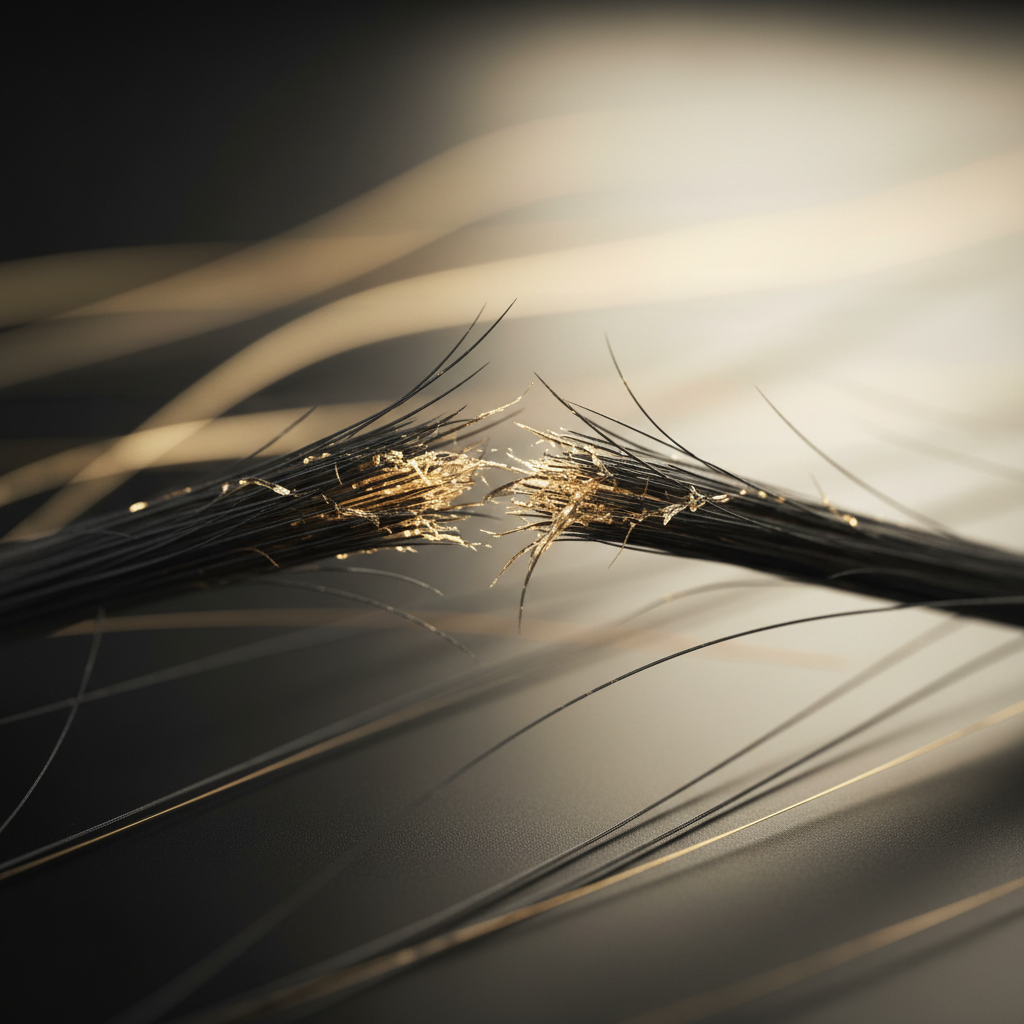
Without the cuticle's protective envelope, the parallel macrofibrils within the cortex begin to unravel. The most common manifestation of severe structural trauma is trichorrhexis nodosa. In this condition, the cortex splits into brush-like swellings along the shaft. When mechanical tension (such as a comb passing through a knot) reaches this weak node, the fibre fractures abruptly, leaving a brush-like fringe at the break point.
Similarly, trichoptilosis (classic split ends) occurs when the shaft fractures longitudinally at the tip. If left untrimmed, the longitudinal split can migrate upwards along the hair shaft like a run in a pair of tights, multiplying the likelihood of catastrophic mid-shaft snapping during future styling sessions.
What the evidence does not show
Popular hair forums often circulate myths regarding hair breakage. Peer-reviewed cosmetic chemistry clarifies these misconceptions:
- Conditioners cannot "mend" broken bonds permanently: Products formulated to build or mend bonds introduce temporary ionic cross-links or polymer coatings. While they measurably increase tensile strength and elasticity while on the fibre, they wash out over time and cannot biologically reverse structural cortex degradation.
- Natural oils do not repair protein loss: Pure plant oils (like argan or coconut oil) offer excellent surface lubrication and reduce hygral fatigue (the swelling and deswelling of the cortex during washing). However, they contain zero structural proteins and cannot replace cleaved disulfide bridges.
- Breakage is rarely caused by dietary deficiencies alone: While extreme malnutrition or severe iron deficiency can yield structurally defective hair fibres, more than 90 percent of fibre snapping seen in modern salons stems from cumulative topical, thermal, and mechanical damage rather than poor nutrition.
Actionable steps to prevent fibre snapping
Mitigating breakage involves minimising friction, preserving the fibre's remaining lipid content, and using appropriate cosmetic buffers against environmental wear.
Optimise your detangling protocol
Hair fibres have high plasticity when wet. Water breaks the hydrogen bonds that give dry hair its temporary shape, allowing the fibre to stretch significantly more under lower loads. Avoid brushing soaking-wet hair with rigid bristles. Instead, apply a slippery leave-in conditioner or detangling spray and use a flexible wide-tooth comb or detangling brush, working methodically from the ends upward toward the roots.
Lower tool temperatures
Never apply heated styling irons to damp hair; the trapped moisture turns instantly to steam within the cortex, generating gas pockets known as bubble hair that snap on contact. Keep irons below 180°C. Always coat dry fibres with a heat protectant containing silicones, polyquaterniums, or hydrolysed wheat proteins, which disperse thermal energy across the surface rather than concentrating it in the cortex.
Balance protein and moisture in your routine
Highly porous, bleached, or relaxed hair benefits from hydrolysed keratin, silk, or plant proteins with molecular weights between 500 and 2,000 Daltons. These peptides fit into structural defects on the cuticle surface, temporarily reinforcing weak zones. Alternate these treatments with fatty alcohols (cetyl and stearyl alcohol) and biomimetic ceramides to keep the cortex pliable.
Reduce overnight friction
Cotton pillowcases act as mechanical abrasives, pulling moisture from hair fibres and creating static tangles through nocturnal movement. Switching to a smooth silk or satin pillowcase or wrapping hair in a satin bonnet significantly reduces friction and prevents morning breakage.
The Watermans perspective on hair strength
Maintaining resilient hair requires a holistic approach that bridges scalp health and fibre integrity. While structural snapping happens along the dead keratin shaft, the quality of the fibre produced in the follicle sets the baseline for its future durability.
Watermans focuses on nurturing a balanced scalp environment, supporting the emergence of robust, vibrant strands from the root. Incorporating targeted, nourishing formulas like the Watermans Grow Me range delivers essential conditioning agents, revitalising botanicals, and fortifying compounds directly to the hair and scalp. By supporting the scalp foundation and following gentle mechanical care routines, you provide your hair with the optimal environment to thrive without premature wear.
Frequently asked questions about Causes of Hair Breakage and Fibre Snapping
How can I tell if my hair is breaking or shedding?
Inspect the strands that come out during washing or styling. If you see a tiny, firm, white bulb at one end, the hair shed naturally from the follicle. If there is no bulb, if the strand is shorter than your general hair length, or if the ends look jagged or frayed, you are dealing with hair breakage.
What are the main chemical Causes of Hair Breakage and Fibre Snapping?
The most aggressive chemical triggers are excessive bleaching, high-lift colourants, permanent waves, and alkaline chemical relaxers. These processes alter the hair's natural pH (around 4.5 to 5.5) up to 9.0 to 12.0 to swell the cuticle, permanently oxidising cystine disulfide bonds and leaving the internal cortex porous and structurally compromised.
Can split ends travel up the hair shaft and cause snapping?
Yes. When a split end (trichoptilosis) forms, the protective cuticle is completely missing at that point. As the strand experiences everyday friction, the exposed cortical fibres peel apart longitudinally, migrating several centimetres up the shaft. This dramatically weakens the fibre, causing it to snap mid-length during brushing.
Why does afro-textured hair snap more easily than straight hair?
Afro hair features elliptical cross-sections with natural bends, curves, and twists along the shaft. Each curl crest creates an inherent structural stress point where mechanical tension concentrates. Furthermore, natural scalp sebum struggles to travel down tight coils, leaving the mid-lengths and ends drier and more vulnerable to friction-induced snapping.
Does hard water directly cause hair fibre to snap?
Hard water does not snap hair on its own, but mineral ions like calcium and magnesium deposit onto the hair shaft. These minerals crystallise under the cuticle scales, making the fibre feel stiff, dry, and rough. This heightened friction makes the hair significantly harder to detangle, indirectly leading to mechanical snapping.
Supporting fibre integrity and long-term retention
Addressing the true Causes of Hair Breakage and Fibre Snapping demands an honest assessment of your daily physical and chemical styling habits. Because the hair shaft is biologically non-living tissue, it possesses no metabolic capacity to repair itself; every bout of bleach, pass of a flat iron, or aggressive tug with a dry brush causes permanent, cumulative wear.
By respecting the mechanical limits of your hair fibre, substituting aggressive practices with protective styling, ensuring consistent lubrication, and removing irreversibly split ends with regular trims, you can protect the structural core of your hair and enjoy healthy, resilient lengths.
Sources and references
- Robbins, C. R. (2012). Chemical and Physical Behavior of Human Hair. 5th edition. Springer-Verlag New York.
- Dawber, R. (1996). Hair: Its structure and response to cosmetic preparations. Clinics in Dermatology, 14(1), 105-112.
- Cruz, C. F., Costa, C., Gomes, A. C., & Cavaco-Paulo, A. (2016). Human hair characteristics and methods to investigate hair physical properties. Cosmetics, 3(3), 26.
- Swift, J. A. (1999). The mechanics of fracture of human hair. International Journal of Cosmetic Science, 21(4), 227-239.
- Sinclair, R. D. (2007). Healthy hair: what is it? Journal of Investigative Dermatology Symposium Proceedings, 12(2), 2-5.