Afro Hair Breakage: Causes, Mechanical Weakness, and Prevention
9 min read ·
Afro Hair Breakage occurs when coiled strands snap along the shaft. Learn the mechanical causes, key signs, and proven ways to retain length and protect your hair.
Quick answer: Afro Hair Breakage occurs when tightly coiled hair fibres snap along the shaft rather than shedding naturally from the follicle. Because afro-textured hair has an elliptical cross-section, sharp curvature twists, and fewer cuticle layers at stress points, it possesses lower tensile strength than straight hair types. Preventing breakage requires targeted moisture retention, gentle low-manipulation handling, and protein balancing. However, cosmetic adjustments cannot repair a snapped hair shaft; once structural failure occurs, trimming the damaged ends remains the only permanent fix.
Key takeaways
- Afro hair fibres possess an elliptical shape with natural torsion points along the coil that create vulnerable mechanical weak spots.
- Breakage is distinct from shedding: broken hairs are short, jagged fragments without a white follicular root bulb.
- Chemical treatments, extreme heat, and aggressive dry detangling drastically increase structural fracture rates.
- Balanced moisture and lubricating lipid layers lower friction, which significantly reduces combing-induced breakage.
- Severe fibre loss that originates at the scalp, or sudden thinning, requires clinical trichological assessment rather than deep conditioning.
Afro Hair Breakage: what the evidence shows
Research published in the Journal of the American Academy of Dermatology and the International Journal of Dermatology confirms that afro-textured hair is the most mechanically fragile human hair type. The elliptical, ribbon-like cross-section produces sharp coils and kinks. At every bend or twist along the shaft, the outer cuticle layer is naturally thinner and unevenly distributed.
These twist points experience concentrated shear stress whenever you comb, brush, or style your hair. Mechanical tests demonstrate that afro hair fibres snap under significantly less tensile force than Asian or Caucasian hair fibres. This structural reality means that routine grooming practices that straight hair tolerates without issue can easily cause snapping in afro hair.
Furthermore, sebum produced by the sebaceous glands struggles to travel down the tight spiral pattern. As a result, the mid-lengths and ends remain prone to chronic lipid depletion and moisture loss, accelerating cuticle lifting, knotting, and eventual fracture.
What the evidence does not show
Controlled scientific studies do not show that afro hair grows slower from the scalp than other hair types. On average, human scalp hair grows between 0.8 and 1.2 centimetres per month across all biological backgrounds. The widespread belief that afro hair cannot grow long is rooted in the rate of Afro Hair Breakage outpacing or matching the natural growth rate, concealing true length retention.
The evidence also refutes the idea that heavy greases or petroleum-based pomades strengthen the internal cortex. While occlusive petrolatum films prevent trans-epidermal moisture loss, they do not deliver hydration on their own, nor do they rebuild broken disulphide or hydrogen bonds inside the cortex.
The mechanical and chemical mechanisms behind the snap
To understand how breakage happens, you have to look at the structural components of the hair shaft:
1. Geometric stress concentration
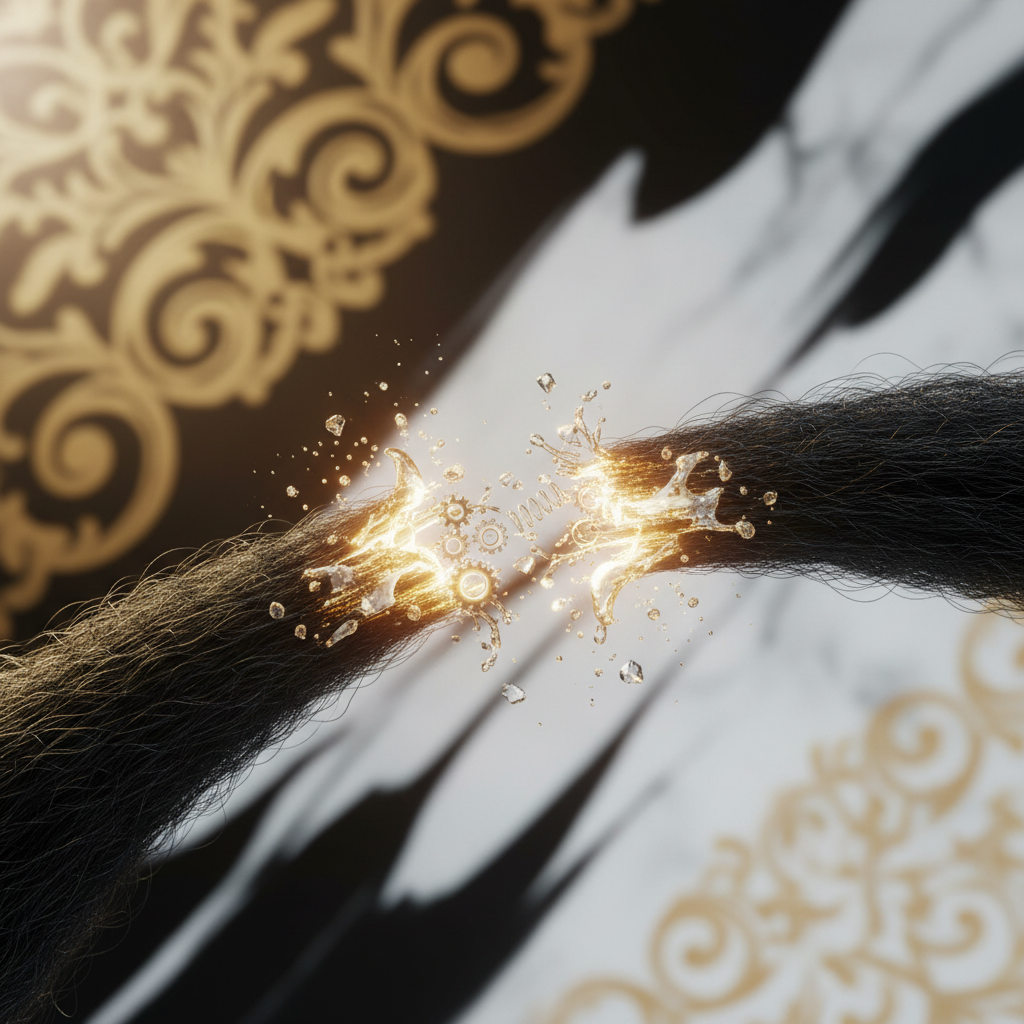
Straight hair fibres display a uniform, circular cross-section that distributes tension evenly. Afro hair features an irregular, kidney-bean or flattened oval shape. When pulled or stretched, mechanical strain concentrates at the narrowest axis of the curve, leading to spontaneous micro-fractures.
2. Cuticle weathering and lifted scales
A healthy hair shaft features roughly 6 to 10 overlapping cuticle layers. Along the outer curvature of afro curls, these cuticles are naturally thinner and easily worn away by friction. Once cuticles lift or erode, the internal cortex is exposed to ambient environmental dryness, chemical damage, and UV degradation.
3. Chemical alteration and moisture depletion
Relaxers, bleaching agents, and permanent dyes attack the fibre directly. Relaxers break and reform internal disulphide bonds to straighten the hair, reducing tensile strength by 30 to 50 percent. When wet, afro hair swells; when dry, it contracts rapidly. Frequent shifts between swelling and contracting weaken the internal protein matrix, creating longitudinal splits known as trichoptilosis or transverse fractures known as trichorrhexis nodosa.
| Cause of Fibre Failure | Underlying Mechanism | Primary Visual Presentation | Best Intervention Strategy |
|---|---|---|---|
| Mechanical Traction / Combing | Exceeds tensile threshold at coil torsion points | Short, clean snap fragments; no bulb attached | Finger detangling with slip-heavy conditioners; wide-tooth tools |
| Chemical Over-Processing | Disulphide bond cleavage from relaxers/bleach | Spongy wet feel, extreme mid-shaft breakage | Protein-balancing treatments, bonded plexes, chemical cessation |
| Heat Degradation | Keratin denaturation (>180°C) and water flash-boil | Bubble hair formation, singed ends, brittle snapping | Temperature caps (under 160°C), thermal protectants, diffuse drying |
| Moisture / Lipid Deficit | Depleted 18-MEA layer and elevated friction | Rough texture, single-strand knots (fairy knots) | Film-forming humectants, leave-in lipid emulsions, light oils |
Identifying the signs of fibre breakage
Distinguishing between natural hair shedding and physical fibre breakage is essential for choosing the right solution:
- Missing bulb: Run the detached hair between your fingertips. A shed hair features a small, firm, white or clear bulb at the root end. A broken hair has blunt, jagged, or split ends on both sides and no root bulb.
- Uneven length fragments: Shed hairs usually match your overall hair length. Broken hairs typically measure between 0.5 and 5 centimetres in length, often found littered across your shoulders, bathroom counters, or styling tools.
- Single-strand knots (trichonodosis): Tight coils can wrap around themselves, creating microscopic knots along the shaft. These friction points snag neighbouring hairs, snapping during gentle combing.
- Loss of elasticity: Take a single wet shed hair and gently stretch it. Healthy hair can stretch up to 30 percent of its length and bounce back. Brittle hair snaps immediately upon tension without stretching.
Practical steps to prevent breakage
Preserving afro hair requires a routine designed to minimise friction and maintain structural elasticity.
Detangle exclusively when lubricated
Never detangle afro hair while dry. Dry fibres lack elasticity and snap easily. Apply a water-based leave-in product or slip-rich rinse-out conditioner containing cetearyl alcohol, behentrimonium methosulfate, or plant seed oils before styling. Use your fingers first to separate knots, followed by a wide-tooth comb or flexible-bristle detangling brush, working steadily from tips to roots.
Moderate your wash-day manipulation
Wash your hair in sections (four to six twists or braids) to stop it from tangling into mats in the shower. Use a sulphate-free or mild amphoteric cleanser with a balanced pH of 4.5 to 5.5 to cleanse without forcing cuticle scales open.
Minimise direct heat
Flat irons and blow dryers operating above 180°C cause the moisture inside the cortex to boil, creating microscopic bubbles that shatter the hair shaft. Air dry whenever possible, use hooded dryers, or stretch the hair using heatless methods such as banding, threading, or large twists. If using heat tools, keep temperatures below 160°C and always apply a silicone- or polymer-based thermal protectant.
Adopt low-manipulation and protective styles
Styles like two-strand twists, flat twists, and cornrows keep the ends tucked away and reduce daily friction against clothing. However, ensure tension on the scalp remains minimal. Avoid keeping protective styles in place for longer than 6 to 8 weeks, as shed hairs can become trapped and form severe matted knots that snap during takedown.
Support with Frojus and Watermans
For afro and curly textures, specialised formulas make a real difference to mechanical resistance. The Frojus range is formulated specifically for afro, curly, and wavy hair, providing deep slip and lipid-rich hydration that helps coils glide past each other without catching or snapping.
Alongside your moisture routine, maintaining a balanced scalp environment supports healthy growth. Watermans offers botanical, biotin-infused formulas that help keep the scalp clean and the hair looking and feeling fuller. While no shampoo or topical cosmetic can repair a hair fibre once it has snapped, supporting your hair with fortifying care helps defend against daily environmental and mechanical stress.
When the cause may be something else
If you notice significant thinning that begins directly at the scalp rather than along the mid-lengths, the problem is not mechanical breakage:
- Telogen Effluvium: Marked by a sudden, uniform increase in hairs shedding with bulbs attached, often triggered by severe physiological stress, illness, rapid weight loss, or hormonal changes two to three months prior.
- Traction Alopecia: Gradual recession or thinning along the hairline and temples caused by excessive mechanical pulling from tight braids, weaves, or heavy locs.
- Central Centrifugal Cicatricial Alopecia (CCCA): A scarring alopecia common in individuals of African descent that typically begins at the crown and spreads outward. It damages the follicle irreversibly and requires prompt medical attention.
When to see a doctor or trichologist
Book an appointment with a board-certified dermatologist or registered trichologist if you notice:
- Visible patches of smooth, bald scalp.
- Persistent itching, burning, soreness, or flaking on the scalp.
- Hair coming out in large clumps with intact root bulbs.
- Thinning along the temples or crown that does not improve after adopting low-tension styles.
Frequently asked questions about Afro Hair Breakage
How can you tell the difference between shedding and Afro Hair Breakage?
Shedding is a natural part of the hair cycle where 50 to 100 hairs leave the scalp daily; these hairs are full-length and feature a white bulb at the root. Afro Hair Breakage consists of shorter, irregular fragments of varying lengths that snap along the shaft and do not have a bulb.
Can deep conditioners repair broken afro hair?
No cosmetic treatment can truly fuse a fractured hair shaft back together. Deep conditioners, hydrolysed proteins, and bond-building products temporarily patch microscopic fissures and smooth down cuticles, which improves elasticity and prevents further snapping. However, existing splits and fractured ends must be trimmed away with sharp shears.
How often should afro hair be trimmed to stop breakage?
Trimming every 10 to 14 weeks is ideal for most afro hair types. Regular dustings or trims remove split ends and single-strand knots before they travel up the shaft and cause deeper structural failure.
Does protective styling always prevent breakage?
Not necessarily. While protective styling shields hair from daily friction, styles installed with excessive tension cause traction damage. Leaving styles in too long also leads to severe matting at the roots, which causes significant breakage when you try to untangle and take them down.
A balanced approach to afro hair resilience
Managing Afro Hair Breakage comes down to understanding the structural needs of the hair fibre and adjusting your routine to match. Afro coils naturally require extra care, deliberate lubrication, and gentle handling to counteract their mechanical weak points. By supporting your strands with moisture-rich products, limiting high heat and chemical stress, and detangling gently, you give your hair the best chance to retain its length and stay resilient.
Sources and references
- American Academy of Dermatology (AAD): African American hair: Tips for everyday care, 2022.
- Journal of the American Academy of Dermatology: Hair breakage in normal and weathered hair, 2008. DOI: 10.1016/j.jaad.2007.12.018.
- International Journal of Cosmetic Science: Physical and mechanical properties of curly, afro-textured hair, 2017.
- British Association of Dermatologists: Traction Alopecia Patient Information Leaflet, 2020.
- National Institute for Health and Care Excellence (NICE): Alopecia: Clinical knowledge summary, 2021.