UV Damage and Hair: The Science of Sun-Induced Fibre Breakdown
9 min read ·
Understand how sunlight degrades hair proteins, strips protective lipids, and causes colour fade, along with evidence-based strategies to protect your strands.
Quick answer: Sunlight alters the physical and chemical structure of hair fibres through photolytic degradation. When considering UV Damage and Hair, solar radiation targets both the cuticular surface and the inner cortex, degrading structural keratin proteins, oxidising lipid layers, and bleaching natural melanin pigments. This process leads to dry, brittle strands, colour fading, and split ends. However, because hair fibres are biologically non-living tissue, UV rays cannot cause cellular mutations in the shaft itself, meaning damage cannot be biologically repaired, only cosmetically managed or prevented.
Key takeaways
- Ultraviolet A (UVA) radiation degrades hair colour pigments, while Ultraviolet B (UVB) radiation primarily attacks the protein structure of the hair shaft.
- Photochemical degradation breaks disulphide bonds within keratin, reducing the tensile strength of the fibre and causing mechanical brittleness.
- Sun exposure strips 18-methyleicosanoic acid (18-MEA), the protective lipid barrier of the cuticle, drastically increasing hair porosity and moisture loss.
- Hair fibres are dead tissue; once structural keratin is broken down by radiation, it cannot biologically heal or regenerate.
- Scalp tissue remains vulnerable to cellular photoageing, sunburn, and skin cancers, requiring direct physical or chemical UV protection.
UV Damage and Hair: what the evidence shows
Research demonstrates that solar radiation exerts a profound degrading effect across all layers of the human hair fibre. Sunlight encompasses ultraviolet radiation spanning wavelengths from 290 to 400 nanometres. UVB radiation (290 to 320 nm) accounts for the bulk of photochemical protein loss, while UVA radiation (320 to 400 nm) initiates free radical cascades that break down both synthetic dyes and natural melanin.
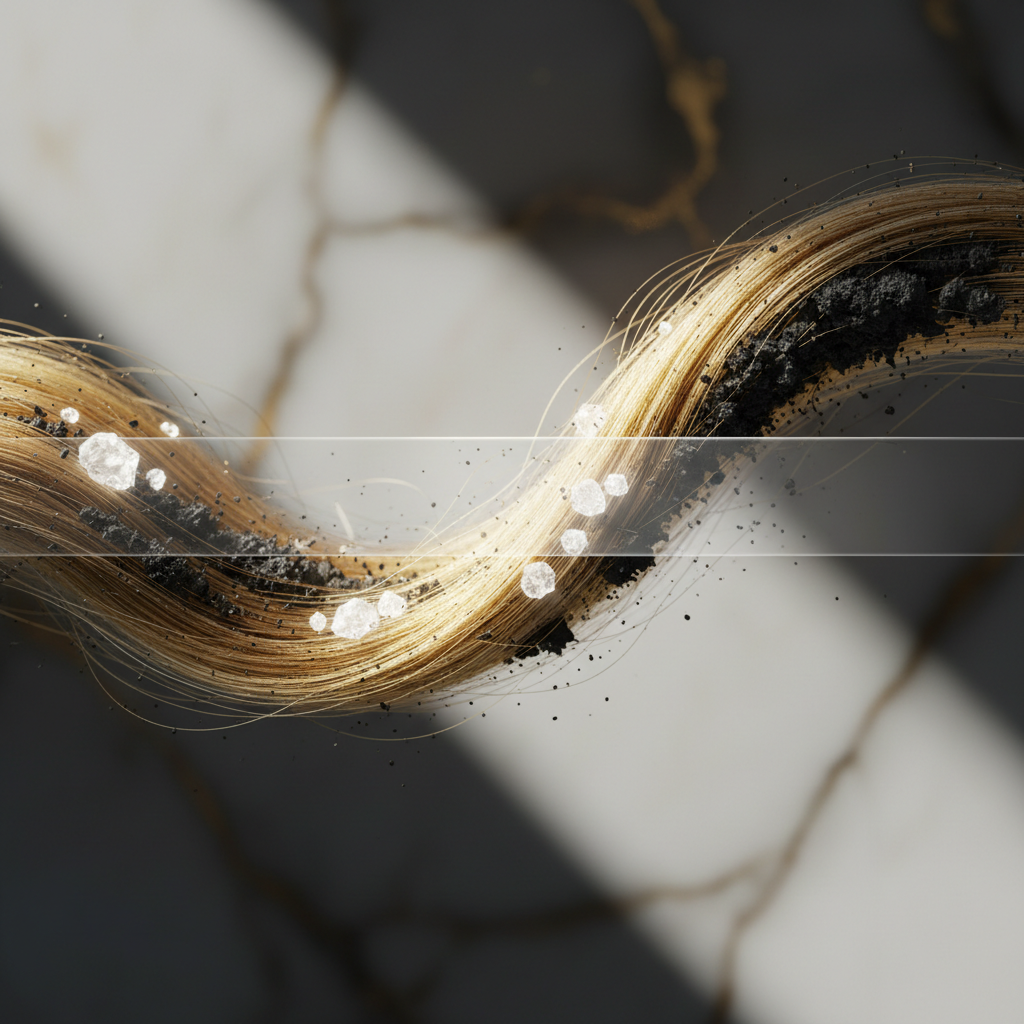
Studies published in the Journal of Cosmetic Science and the International Journal of Trichology show that prolonged exposure to sunlight depletes essential amino acids in hair. The amino acids cystine, tyrosine, and tryptophan are particularly vulnerable to photo-oxidation. When cystine breaks down, the disulphide cross-links that give keratin its elasticity and strength decompose into cysteic acid. This shift leaves the fibre structurally compromised, highly porous, and prone to breakage under ordinary grooming tensions.
Furthermore, solar radiation generates reactive oxygen species (ROS) inside the fibre. These free radicals target the intercellular cement, degrading the lipids that hold cuticle scales flat. As the cuticle lifts and flakes away, the fragile inner cortex becomes directly exposed to environmental friction, heat, and humidity.
The mechanism: how sunlight degrades the fibre
The degradation of hair under solar radiation follows a sequential pathway from the exterior surface into the deep cortex:
- Lipid ablation: The outermost protective layer of the hair cuticle is a monomolecular layer of fatty acids, predominantly 18-methyleicosanoic acid (18-MEA). Solar radiation cleaves the covalent bonds anchoring this lipid layer. Without it, the hair changes from a hydrophobic (water-repelling) surface to a hydrophilic (water-absorbing) surface, making it swell excessively when wet and dry out rapidly.
- Cuticle erosion: As UVB rays break peptide bonds within the overlapping cuticular cells, the margins of the scales lift, curl, and eventually fracture. This increases friction between adjacent hairs, producing tangles, rough texture, and visible dullness.
- Cortex oxidation: Once the protective cuticle is thinned or compromised, radiation penetrates the cortex. UVA radiation oxidises melanin granules. In dark hair, eumelanin breaks down into lighter pyrrolic compounds. In lighter hair, pheomelanin produces free radicals that accelerate protein loss, often yielding an unwanted brassy yellow tone.
- Disulphide bond cleavage: High-energy photons break the disulphide bonds between keratin chains. The resulting reduction in mechanical tensile strength means the fibre can no longer tolerate normal brushing forces, leading to transverse snapping along the shaft.
| Hair Component | Primary UV Type | Chemical / Physical Consequence | Observable Signs |
|---|---|---|---|
| Cuticle Lipids (18-MEA) | UVA & UVB | Lipid peroxidation and ester bond cleavage | High porosity, chronic frizz, static electricity |
| Cuticle Scales | UVB | Keratin degradation, lifting, micro-fissuring | Rough texture, loss of shine, comb resistance |
| Keratin Cortex | UVB | Disulphide bond breakdown into cysteic acid | Snapping fibres, split ends, loss of elasticity |
| Melanin Granules | UVA | Photobleaching and melanin oxidation | Colour fade, brassiness, bleaching of natural shade |
| Scalp Epithelium | UVA & UVB | DNA damage, cellular inflammation, photoageing | Redness, flaking, tenderness, follicular stress |
What the evidence does not show
It is critical to separate established photobiology from widespread commercial claims:
- UV does not cause traditional genetic hair loss: Radiation breaks the hair shaft, which causes mechanical breakage. It does not initiate androgenetic alopecia (pattern baldness). While severe sunburn on an exposed scalp can trigger temporary telogen effluvium due to localised acute inflammation, routine sun exposure does not shut down healthy follicles.
- Sunlight cannot be "undone" by deep conditioning: Hair masks and bond builders can temporarily coat the cuticle or deposit synthetic polymers inside gaps in the cortex, but they do not reverse photochemical oxidation. The loss of original cystine cross-links is permanent for that section of the fibre until it is trimmed away.
- Dark hair is not completely immune: While higher concentrations of eumelanin offer natural photoprotection by absorbing and dissipating radiation, dark hair still suffers significant protein and lipid degradation under intense UVB exposure. Melanin sacrifices itself to protect keratin, but its protective capacity has finite limits.
The signs of solar hair damage
Recognising sun damage early helps prevent secondary mechanical breakage:
- Colour drift: Natural hair becomes lighter or brassy at the crown and exposed outer canopy, while coloured hair experiences rapid oxidation and tone distortion.
- Dry, straw-like tactile feel: The loss of 18-MEA causes hair to lose its natural slip and suppleness, feeling coarse even immediately after washing.
- Elevated porosity: Damaged hair absorbs water instantly in the shower, takes unusually long to dry, and swells unpredictably in humid air.
- Loss of mechanical elasticity: When gently stretched while damp, the hair snaps cleanly rather than stretching and returning to its original length.
- Extreme tangling: Flaking cuticle margins snag against adjacent fibres, producing persistent knotting at the ends and mid-lengths.
Practical strategies for sun protection
Minimising sun damage requires combining physical shielding with targeted cosmetic protection:
- Physical coverage: Wide-brimmed hats made of closely woven fabric provide the only true complete block against both UVA and UVB rays for both the hair canopy and the scalp.
- UV-absorbing leave-in products: Formulations containing cinnamidopropyltrimonium chloride, benzophenone derivatives, or polyquaternium UV filters deposit a protective shield on the fibre surface, attenuating photon penetration.
- Antioxidant application: Topical antioxidants, such as vitamin E (tocopherol), polyphenols, and green tea extracts, help neutralise solar-generated reactive oxygen species before they can oxidise cortical proteins.
- Lipid replenishment: Using conditioning agents containing biomimetic fatty acids, hydrolysed proteins, and plant-derived oils helps replenish the lubricating hydrophobic barrier lost through photo-oxidation.
- Minimising compounding stressors: Avoid combining heavy sun exposure with salt water, chlorine, or chemical processing, as these elements dramatically accelerate solar bond cleavage.
When the cause may be something else
If your hair is dry, snapping, or shedding, sunlight may not be the primary culprit:
- Thermal heat damage: Daily use of flat irons or curling wands above 185°C produces structural blistering and protein denaturation that closely mimics UV degradation.
- Chemical processing: Bleaching, perming, and permanent colouring directly strip the 18-MEA layer and sever disulphide bonds via concentrated chemical oxidation rather than light.
- Hard water buildup: Mineral deposits (calcium, magnesium, iron) can make hair feel crunchy and unmanageable, an effect frequently misattributed to sun exposure during summer holidays.
- Follicular shedding: If you are noticing an increased count of full-length hairs shedding from the root (with a small white bulb attached), this indicates telogen effluvium or another systemic shedding process, not shaft breakage from sunlight.
When to seek professional advice
Consult a qualified trichologist or dermatologist if you observe:
- Burning, peeling, persistent red patches, or changing moles along the scalp part line.
- Sudden, excessive hair shedding from the root that persists for more than eight weeks.
- Localised patches of hair thinning or distinct circular bald areas on the scalp.
- Unexplained scalp pain, tenderness, or persistent itching following sun exposure.
For severe mechanical snapping, a professional stylist can perform a strand test, trim damaged ends before splits migrate up the shaft, and recommend structural salon treatments.
Supporting hair vitality with Watermans
Maintaining resilient hair through high-exposure seasons requires sensible care for both the scalp environment and the hair fibre. Watermans Grow Me Shampoo and Condition Me Conditioner provide a targeted, sulphate-free approach to routine maintenance. Formulated with hydrolysed lupin protein, niacinamide, biotin, and natural botanical oils, the system helps replenish lost surface moisture, smooth lifted cuticles, and improve combability across sun-stressed hair. While topical cosmetics do not replace physical sun hats during peak UV hours, regular nourishment helps maintain the appearance of strength, body, and lustre in hair exposed to seasonal environmental wear.
Frequently asked questions about UV Damage and Hair
Can UV damage cause hair to fall out from the roots?
No, solar radiation does not cause standard hair loss or miniaturise the follicles. However, excessive UV Damage and Hair breakage often go hand in hand. High sun exposure degrades cortical proteins, leading the shaft to snap along its length. If the scalp itself suffers severe sunburn, the resulting cutaneous inflammation can occasionally induce temporary telogen effluvium shedding several weeks later.
Does naturally dark hair need sun protection?
Yes. Although eumelanin in dark hair absorbs a portion of UV radiation and acts as a natural photoprotective filter, the hair's outer cuticle lipids and keratin structures remain fully vulnerable. Dark hair exposed to intense sunlight still loses its 18-MEA lipid layer, becomes dry, and develops mechanical weakness.
Can split ends caused by the sun be repaired?
No cosmetic product can permanently mend split ends. Sunlight degrades the protein matrix holding the fibre together, causing the cortex to unravel. While conditioning agents, silicones, and hydrolysed proteins can temporarily glue split ends flat for cosmetic smoothness, the only permanent remedy is trimming away the fractured ends.
How does sea water interact with sun damage?
Salt water significantly amplifies sun damage. Salt crystals left on drying hair act as microscopic lenses, concentrating light onto the fibre. Furthermore, the osmotic pressure of salt water pulls moisture out of the cortex, leaving the strand dehydrated and far more susceptible to photochemical bond breakdown.
What is the difference between UVA and UVB damage to hair?
UVB radiation has higher energy and shorter wavelengths, causing direct cleavage of peptide bonds and disulphide links in keratin, which destroys tensile strength. UVA radiation penetrates deeper, oxidising hair pigments, generating destructive free radicals, and causing noticeable colour fading and brassiness.
Protecting your hair from solar exposure
Understanding the physical dynamics of UV Damage and Hair allows you to protect your hair proactively rather than attempting to manage irreversible fibre damage later. Because the hair shaft cannot regenerate, guarding its structural integrity requires preventative measures: physical shade, leave-in protective films, and gentle handling. By shielding your strands from prolonged radiation and keeping the cuticle nourished with restorative lipids and proteins, you can preserve natural colour, retain tensile strength, and enjoy healthy-looking hair throughout every season.
Sources and references
- International Journal of Cosmetic Science, "Photodegradation of human hair: a review," 2008.
- Journal of Photochemistry and Photobiology B: Biology, "Effects of ultraviolet radiation on the hair shaft," 2004.
- International Journal of Trichology, "UV damage to hair: mechanism and prevention," 2011.
- British Journal of Dermatology, "Photochemical degradation of hair keratins," 2002.
- Society of Cosmetic Chemists, "The role of 18-MEA in hair fibre hydrophobicity and surface protection," 2010.
Find these ingredients in Watermans products
- Vitamin E: you will find this ingredient in our Hair Vitamins.
- Niacinamide: you will find this ingredient in our Hair Mask.