PH Balanced Shampoos: Scalp Barrier and Fibre Protection
9 min read ·
Understand how pH balanced shampoos work to protect the hair cuticle, preserve the scalp acid mantle, and minimise everyday fibre breakage.
Quick answer: pH Balanced Shampoos are hair cleansers formulated within the mildly acidic range of pH 4.5 to 5.5, closely matching the natural physiological level of the scalp and hair fibre. They preserve the scalp acid mantle and keep the hair cuticle compacted, which minimises swelling, frizz, and fibre friction. However, while a balanced pH reduces mechanical breakage and soothes irritation, it cannot alter genetic hair loss, treat underlying alopecia, or repair previously severed keratin bonds.
Key takeaways
- The natural surface of human scalp skin sits at roughly pH 5.5, while the hair shaft itself is slightly more acidic at around pH 3.67.
- Alkaline cleansers (pH above 7.0) disrupt the scalp microbiome and force the hair shaft to swell, elevating cuticles and driving mechanical breakage.
- True pH Balanced Shampoos target a range of pH 4.5 to 5.5, preventing excessive electrical friction between individual strands.
- Cosmetic labelling can be misleading: an item marked "gentle" or "natural" may still test at pH 7.0 or higher unless explicitly calibrated.
- A correct pH environment protects existing hair structure and scalp comfort, but it does not resolve hormonal thinning or internal nutrient deficiencies.
pH Balanced Shampoos: what the evidence shows
Research shows that formulation pH directly influences hair shaft integrity and scalp barrier function. Human sebum, sweat, and microbial metabolites form a thin film called the acid mantle, maintaining a baseline scalp pH between 4.5 and 5.5. This mild acidity regulates microbial populations (such as Malassezia yeasts) and supports enzymatic processes that maintain epidermal lipid barriers.
When you use alkaline cleansers, the hair fibre behaves like a porous sponge. Water alone sits at a neutral pH 7.0, which already prompts mild cuticular swelling. Traditional soap bars or unbuffered surfactants often reach pH 8.0 to 10.0. In an alkaline environment, the keratin fibres carry an increased negative electrical charge. This change creates two immediate physical problems:
- Cuticle flaring: The overlapping scale-like cells of the hair cuticle lift away from the shaft, increasing friction between neighbouring strands and making the fibre prone to snagging and snapping during combing.
- Acid mantle degradation: Scalp enzymes responsible for lipid synthesis fail to function optimally, causing moisture loss, micro-inflammation, and irritation.
A landmark study published in the International Journal of Trichology (2014) analysed 123 commercially available cleansers. The authors found that only 38 percent of popular shampoos maintained a pH of 5.5 or lower, while 61 percent had a pH higher than 5.5. Crucially, 75 percent of "salon" shampoos respected the physiological range, compared to just 38 percent of mass-market formulas. The authors concluded that alkaline shampoos increase friction, hair tangling, and mechanical damage, advising that cleansers should maintain a pH at or below 5.5.
What the evidence does not show
It is vital to separate cosmetic fibre preservation from medical hair biology. Advertising often exaggerates what acidic cleansers can achieve.
- They do not cure alopecia: Follicular hair loss, such as androgenetic alopecia or alopecia areata, occurs deep within the dermal papilla. Modulating external surface acidity does not alter systemic hormones, dihydrotestosterone (DHT) binding, or auto-immune targeting.
- They do not regenerate severed cortex bonds: Once the internal disulphide bridges of the hair shaft break through excessive bleaching, heat styling, or physical trauma, an acidic wash will smooth the outer cuticle scales down, but it cannot fuse the internal cortex back together.
- They do not eliminate genuine medical scalp conditions alone: While acidic formulations assist in preventing fungal flare-ups, established seborrhoeic dermatitis or scalp psoriasis generally demands active pharmacological ingredients, such as ketoconazole or coal tar, rather than pH adjustments by themselves.
Mechanisms: how pH impacts the hair fibre and scalp
Understanding the physical chemistry of the hair explains why pH control matters so much.
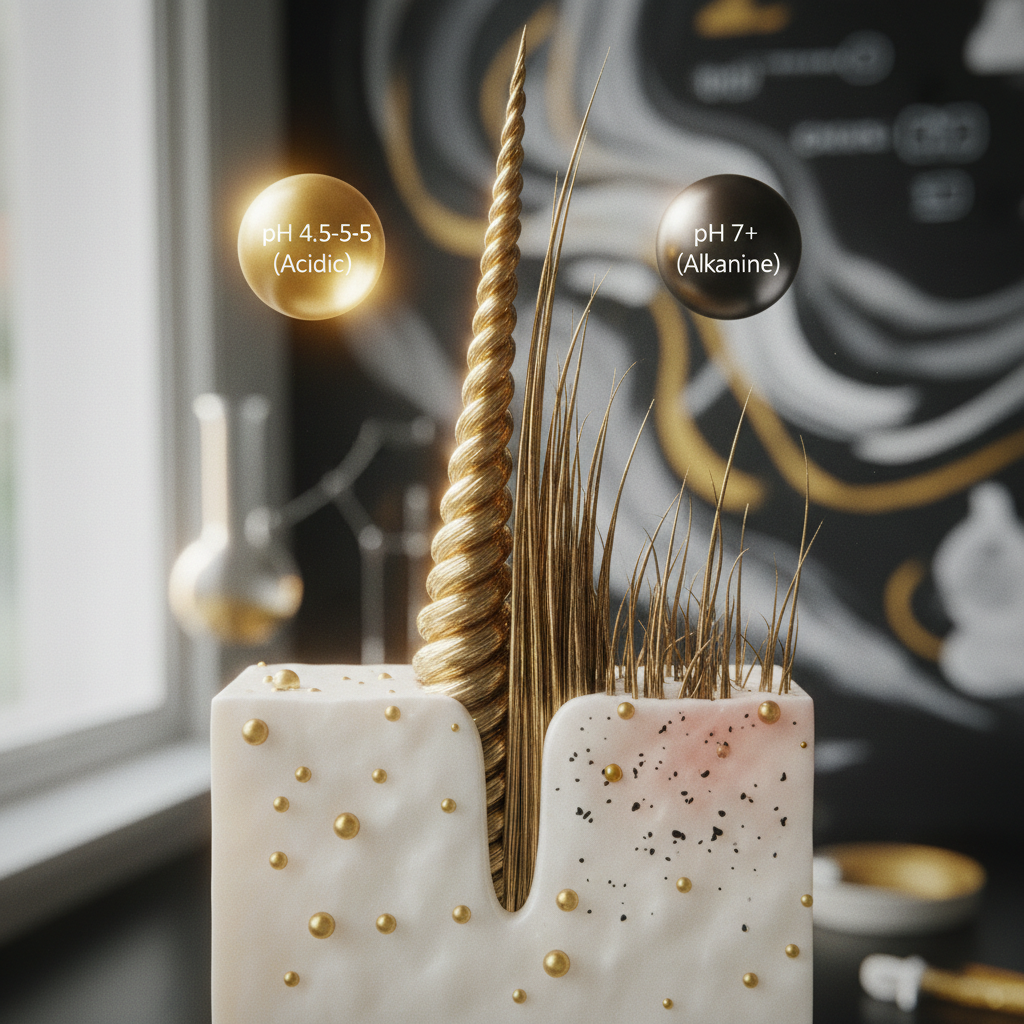
Acidic (pH 4.0 - 5.5) Alkaline (pH 7.5 - 10.0)
+-------------------------------+ +-------------------------------+
| Cuticle flat and tightly | | Cuticle flared, lifted |
| sealed against the shaft | | and exposed to friction |
| Low negative surface charge | | High negative charge |
| Minimal fibre swelling | | Substantial cortex swelling|
| Smooth, light-reflective | | Frizzy, dull, snag-prone |
+-------------------------------+ +-------------------------------+
The isoelectric point of hair keratin lies at roughly pH 3.67. At this exact point, the positive and negative electrical charges on the hair protein balance each other out, resulting in net-zero charge. At zero charge, swelling is at its absolute minimum. However, because skin requires a slightly higher pH (around 5.5) to maintain its enzymatic barrier, cosmetic chemists formulate balanced cleansers between pH 4.5 and 5.5.
Within this window, hair fibres exhibit minimal electrostatic repulsion. Cuticles lie flat against the cortex, locking natural moisture inside and creating a smooth, uniform surface that bounces light cleanly. Conversely, elevating the pH above 6.0 strips away the outer f-layer (a protective layer of 18-methyleicosanoic acid), leaving the structural core vulnerable to atmospheric humidity and surface abrasion.
Comparing cleanser pH ranges and their physical effects
| Product Type | Typical pH Range | Cuticle Response | Scalp Impact | Structural Outcome |
|---|---|---|---|---|
| pH Balanced Shampoos | 4.5 to 5.5 | Remains closed, flat, and compact | Preserves acid mantle and lipid barrier | Reduces breakage, retains colour, controls frizz |
| Standard Mass Cleansers | 6.0 to 7.5 | Mild to moderate cuticle flaring | Temporary barrier disruption | Higher friction, moderate tangling, gradual dryness |
| Traditional Solid Soaps | 8.5 to 10.0 | Severe cuticle lifting and cortex swelling | Strips natural sebum; elevates barrier pH | Pronounced breakage, rough texture, matte appearance |
| Clarifying Shampoos | 6.5 to 8.0 | Wide cuticle opening to strip residue | Can cause transient dryness | Removes buildup; requires immediate acidic conditioning |
Signs you are using an alkaline shampoo
You can often identify a poorly calibrated cleanser by watching how your hair and scalp behave immediately after washing and drying.
- Immediate mid-length tangling: If wet hair feels like rough felt or mats together before you apply conditioner, the cuticle scales are flaring outward.
- Frizz despite conditioning: Hair that dries into an unruly halo even in moderate humidity often indicates cuticle damage driven by wash-induced swelling.
- Scalp tightness and itchiness: When an alkaline surfactant strips the skin lipids, the epidermal water barrier fails, creating a taut, dry sensation within hours of washing.
- Rapid colour fade: For colour-treated hair, open cuticles provide an easy exit path for artificial dye molecules, washing pigment down the drain much faster than anticipated.
What you can do to restore balance
Adopting an acidic cleansing routine is straightforward once you know how to navigate cosmetic labels.
- Check product claims carefully: Look for explicit declarations such as "pH 5.0" or "pH balanced" rather than vague phrases like "dermatologist tested" or "organic."
- Buffer post-chemical services: If you regularly colour, bleach, or chemically straighten your hair, your fibres have undergone an alkaline process (often pH 9.0 or higher). Using acidic cleansers afterwards is critical to help cuticles reseal.
- Avoid raw cold-process soap bars: Do not confuse solid syndet (synthetic detergent) bars with saponified soap bars. True saponified oils have an alkaline pH of 8.5 or higher and should not be used on the hair or scalp.
- Follow with an acidic conditioner: Conditioners are almost universally formulated at lower pH levels (around 3.5 to 4.5) using cationic surfactants. These neutralise remaining negative surface charges and coat the fibre with a fine protective lipid layer.
When hair breakage has another cause
While alkaline products drive mechanical breakage, they do not explain every hair problem. If your hair is coming out from the roots rather than snapping midway along the shaft, the root cause lies elsewhere.
- Telogen effluvium: A temporary condition characterised by widespread shedding three months after a physiological shock, severe illness, rapid weight loss, or high fever.
- Hormonal thinning: Androgenetic alopecia leads to follicular miniaturisation at the crown and hairline due to genetic sensitivity to dihydrotestosterone.
- Internal deficiencies: Low serum ferritin (iron storage), vitamin D deficiency, and thyroid dysregulation directly disrupt the follicular growth cycle.
Watermans: focused approach to scalp and hair health
A healthy scalp environment is the foundation for optimal hair appearance. Watermans develops hair formulations that respect the physiological realities of both the scalp skin barrier and the keratin fibre. Products like Watermans Grow Me Shampoo incorporate balanced cleansing mechanics alongside biotin, caffeine, argan oil, and rosemary extract. This guarantees that while cuticles remain protected against mechanical friction and cuticle lifting, the scalp receives targeted cosmetic support to foster fuller-looking, thicker-feeling hair.
When to seek professional advice
Consult a GP or a registered trichologist if you notice rapid, patchy shedding, distinct circular bald spots, or excessive scalp scaling accompanied by pain, burning, or bleeding. An acidic shampoo supports surface hair hygiene and strand resilience, but it cannot resolve medical skin conditions or systemic internal disruptions.
Frequently asked questions about pH Balanced Shampoos
What is the ideal pH for hair cleansers?
The ideal target for cleansers lies between pH 4.5 and 5.5. This range matches the natural acidity of the scalp and prevents the hair shaft from swelling excessively. Shampoos formulated within this boundary help keep cuticles flat and minimise mechanical friction during routine washing.
Can pH Balanced Shampoos treat hair loss?
No, these formulas cannot cure systemic or genetic hair loss. While pH Balanced Shampoos reduce fibre breakage by preventing cuticle flare, they do not act on the internal hair follicle or alter systemic hormones. Their role is strictly cosmetic and preventative against mechanical shaft damage.
How do I know if my shampoo is acidic?
Unless the manufacturer states the pH on the packaging, it is difficult to tell simply by touch or scent. True soap bars are inherently alkaline, whereas liquid cleansers rely on surfactant chemistry that can be adjusted. You can test your hair products at home using digital laboratory pH meters or high-precision calibrated litmus strips.
Can water pH counteract a balanced shampoo?
Municipal tap water typically sits between pH 6.5 and 8.5 to prevent pipe corrosion. While water alone initiates mild cuticle swelling, the concentrated buffering agents inside a well-designed shampoo temporarily adjust the wash water on the hair surface, preserving the fibre's acidic state throughout cleansing.
Summary: protecting the hair barrier
Maintaining the delicate acidic balance of the scalp and hair fibre is one of the simplest ways to prevent everyday fibre wear, cuticular lifting, and barrier irritation. By using pH Balanced Shampoos alongside supportive conditioning, you keep cuticle scales tightly aligned, defend the scalp's microbiome, and minimise the day-to-day snapping that robs hair of its natural fullness and shine.
Sources and references
- Gavazzoni Dias, M. F., et al. (2014). The Shampoo pH can Affect the Hair: Myth or Reality? International Journal of Trichology, 6(3), 88 to 99.
- Ali, S. M., & Yosipovitch, G. (2013). Skin pH: From Basic Science to Basic Skin Care. Acta Dermato-Venereologica, 93(3), 261 to 267.
- Robbins, C. R. (2012). Chemical and Physical Behavior of Human Hair (5th ed.). Springer-Verlag.
- Lambers, H., et al. (2006). Natural skin surface pH is on average below 5, which is beneficial for its resident flora. International Journal of Cosmetic Science, 28(5), 359 to 370.
Find these ingredients in Watermans products
- Vitamin D: you will find this ingredient in our Hair Vitamins.