Understanding Hair Elasticity: The Complete Scientific Guide
8 min read ·
Understanding Hair Elasticity helps you identify hair health and prevent breakage. Learn the science of keratin stretch, the wet strand test, and how to protect hair.
Quick answer: Understanding Hair Elasticity is essential for diagnosing hair health because it measures how far a single strand can stretch before returning to its original length without breaking. Healthy wet hair stretches by roughly 30 to 50 percent of its resting length due to the coiled alpha-keratin structure within the cortex. However, high elasticity cannot protect against severe mechanical shear, nor can cosmetic treatments permanently reconstruct destroyed covalent bonds once cortex proteins are stripped away.
Key takeaways
- Hair elasticity measures the fibre's mechanical resilience, governed by alpha-keratin chains and disulfide bonds in the cortex.
- Healthy, hydrated hair stretches up to 30 percent when dry and 50 percent when wet before snapping.
- Poor elasticity causes mechanical breakage along the shaft; this is completely distinct from follicular hair loss or shedding.
- Chemical processing (bleaching, relaxing) and heat styling degrade the cross-linked protein matrix, reducing stretch capacity.
- Cosmetic protein conditioners and lipids temporarily reinforce the fibre, but degraded disulfide bonds cannot be rebuilt via standard washing.
Understanding Hair Elasticity: what the evidence shows
Understanding Hair Elasticity requires looking beneath the protective cuticle scales into the fibrous cortex, which forms around 85 to 90 percent of the hair fibre's total mass. Research published in the Journal of Cosmetic Science and materials engineering literature confirms that hair is a biological composite material.
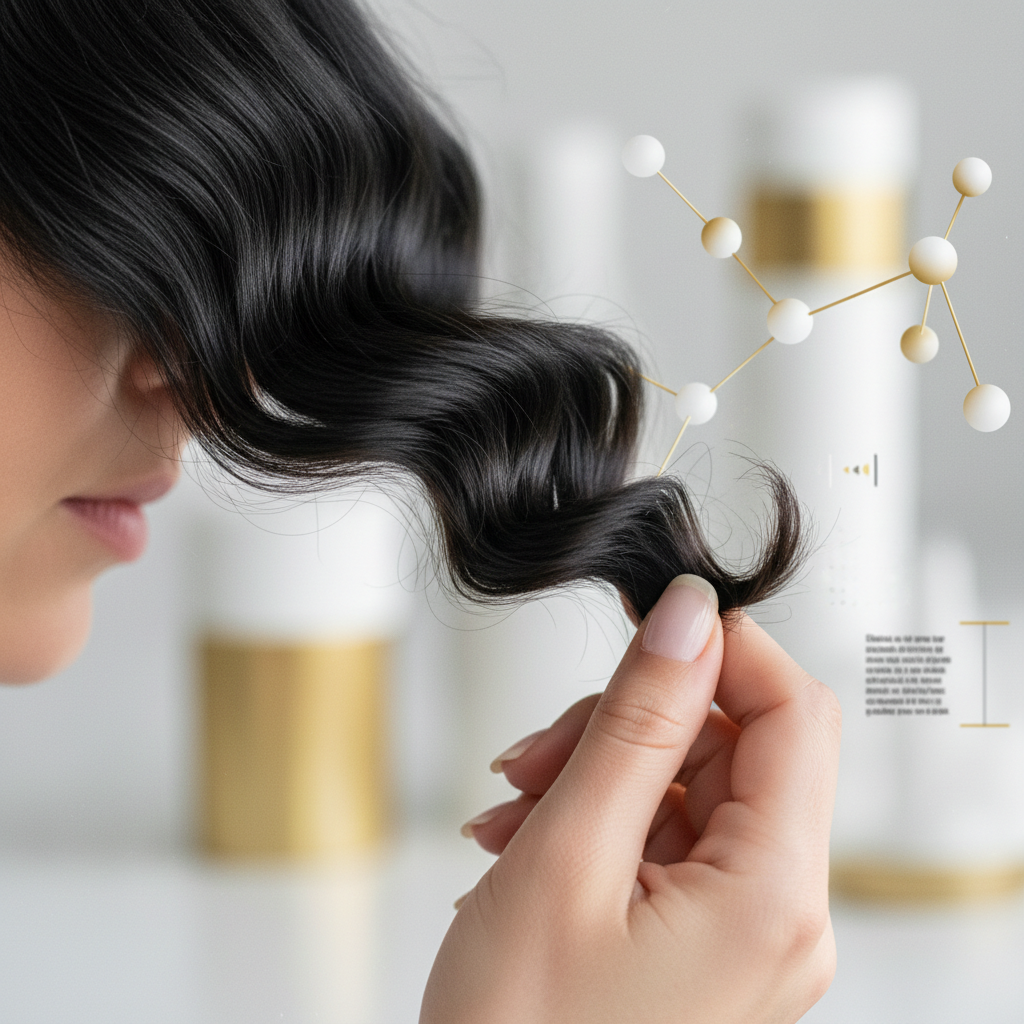
Inside the cortex, polypeptide chains form alpha-helices. These helical intermediate filaments are embedded inside an amorphous matrix high in sulfur-rich proteins. When you pull a healthy hair strand, the hydrogen bonds within the alpha-keratin coils yield first, allowing the protein chain to unravel into an extended beta-sheet structure. When tension releases, the elastic matrix draws the keratin back into its coiled state.
Covalent disulfide bonds, formed between cysteine residues, provide the structural memory for this return. Healthy wet hair typically tolerates a 30 to 50 percent elongation before permanent plastic deformation occurs. If the matrix and disulfide bridges are intact, the strand snaps back without snapping off.
What the evidence does not show
There are persistent myths surrounding hair elasticity in consumer haircare:
- Elasticity is not an indicator of follicular hair loss: Poor elasticity leads directly to hair breakage (mid-shaft fracturing). It has zero correlation with androgenetic alopecia, telogen effluvium, or autoimmune hair disorders, which take place inside the scalp follicle.
- Topical products cannot permanently "heal" broken keratin: Hydrolysed proteins and bond-building cosmetics patch weakened areas or form temporary ionic bridges. They cannot regrow lost biological cortex architecture.
- "Protein overload" is rarely true excess protein: Stylists often describe brittle, snapping hair as having "too much protein". Cosmetic scientists attribute this stiffness to dehydration, an excess of film-forming polymers, or cuticle surface friction rather than a biological surplus of keratin within the cortex.
Biological and chemical mechanisms of stretch
The tensile behaviour of human hair divides into three distinct phases during mechanical stress:
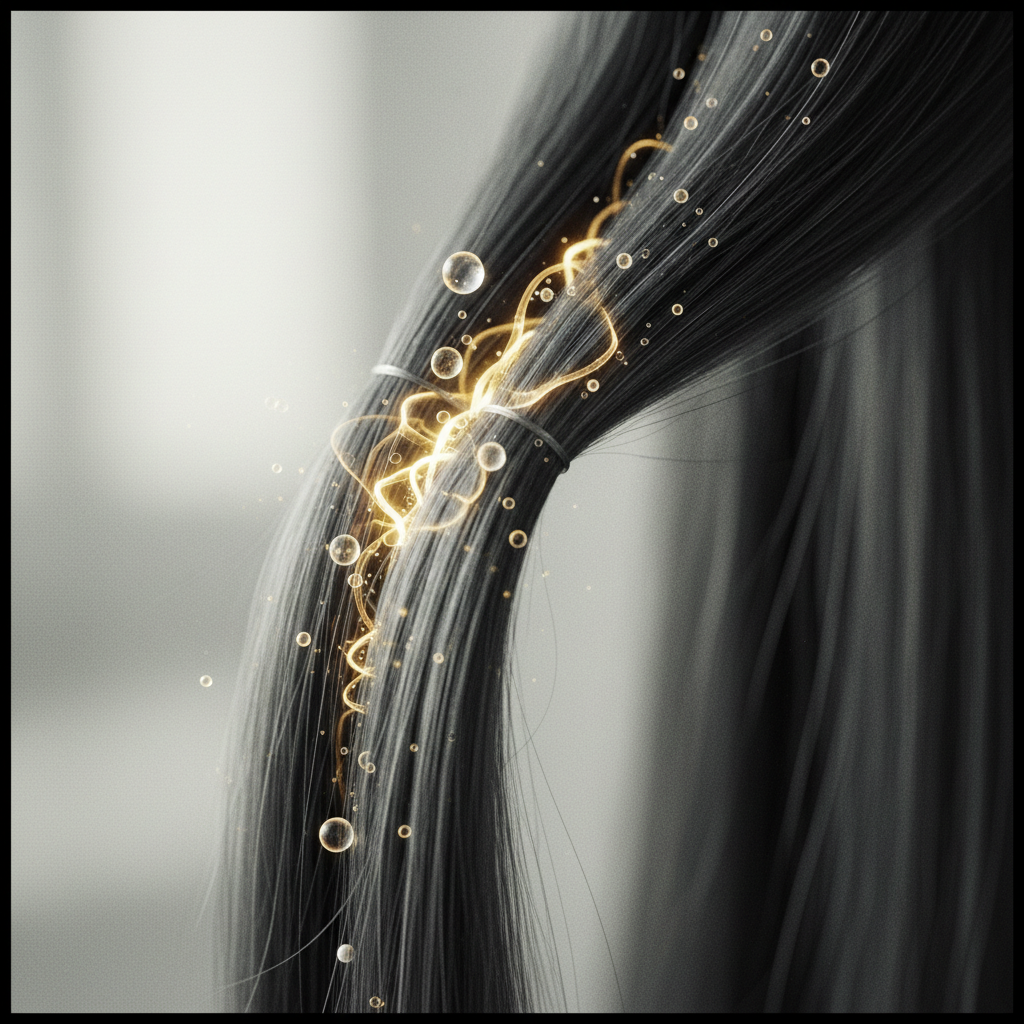
- The Hookean (Elastic) Region: When stretched up to roughly 2 to 3 percent elongation, the stress-strain curve is linear. Intermolecular bonds resist stretching, and recovery is 100 percent complete once tension ceases.
- The Yield Region: Between roughly 3 and 25 to 30 percent stretch, the alpha-helical coils unravel into beta-sheets under relatively constant force. The hydrogen bonds break and reform dynamically.
- The Post-Yield Region: Beyond 30 percent elongation, stretching stresses the covalent disulfide bonds directly. If pulled further, the covalent bonds rupture permanently, culminating in total tensile failure (fibre breakage).
Water plays a massive role in this mechanism. Water molecules penetrate the cortex and disrupt interchain hydrogen bonds, effectively plasticising the fibre. This is why wet hair stretches significantly further than dry hair, but it also means wet hair has a lower yield point, making it far more vulnerable to aggressive brushing.
| Elasticity level | Wet stretch capability | Physical behaviour under tension | Primary underlying condition |
|---|---|---|---|
| High (Normal) | 30% to 50% | Stretches smoothly and retracts to original length | Intact cortex matrix, balanced moisture, sealed cuticle |
| Medium | 15% to 30% | Stretches slightly; sluggish return to original length | Mild heat damage, moderate UV exposure, superficial weathering |
| Low / Brittle | Under 15% | Snaps almost immediately under slight tension | Severe chemical processing (bleach, relaxers), extreme heat damage |
| Gummy / Spongy | Over 50% (no return) | Stretches excessively like chewing gum, deforms, then breaks | High internal cortical damage; severe degradation of disulfide cross-links |
Signs of abnormal hair elasticity
Spotting poor elasticity early allows you to adjust styling techniques before widespread breakage occurs. Watch for these mechanical signs:
- The wet stretch test failure: Take a single strand of clean, wet hair, hold it between your thumb and forefinger on each hand, and pull gently. If it snaps instantly without any stretch, the fibre lacks hydration or has severe internal brittleness. If it stretches out indefinitely without bouncing back, the internal protein matrix is compromised.
- Micro-breakage during detangling: Short pieces of hair without a white follicular bulb appearing on your shoulders or in the sink indicate mid-shaft fracture driven by poor elasticity.
- Rough, tangling ends: When the cuticle is stripped, cortex exposure makes fibres cling to one another. The resulting friction increases tensile strain during ordinary brushing, snapping low-elasticity strands.
How to support and protect hair elasticity
While you cannot biologically regrow damaged hair shafts, you can manage the mechanical properties of existing fibres through proper cosmetic care and physical handling:
- Optimise pH with acidic conditioning: The natural isoelectric point of human hair sits at roughly pH 3.67. Shampoos and conditioners formulated between pH 4.5 and 5.5 help keep the cuticle flat and reduce negative surface charge, preserving the internal moisture required for natural stretch.
- Use hydrolysed vegetable and wheat proteins: Small peptides (molecular weight under 1,500 Daltons) can penetrate past the cuticle into the outer cortex, temporarily reinforcing weak structural points.
- Apply penetrating natural oils: Non-polar oils containing triglycerides, such as coconut or argan oil, reduce water absorption cycling (hygral fatigue), which prevents cortex swelling and mechanical stress.
- Eliminate aggressive wet brushing: Never pull a fine-tooth comb through wet, vulnerable hair. Use wide-tooth combs or flexible-bristle detanglers, starting at the ends and working upward toward the scalp.
- Minimise heat above 180 degrees Celsius: Temperatures exceeding 180°C permanently degrade tryptophan and cysteine within the cortex, melting the alpha-helices and permanently destroying elasticity.
When breakage is mistaken for shedding
A crucial distinction in trichology is the difference between hair breakage and follicular shedding. If you notice an increased accumulation of hair, examine the ends of the fallen strands.
A strand that has shed normally from the follicle displays a distinct, tiny white bulb (the keratinised club root) at one end. This indicates the hair reached the end of its telogen cycle.
If the fallen pieces have no bulb, have uneven or frayed ends, or are significantly shorter than your overall hair length, you are dealing with fibre breakage caused by low elasticity. Hair loss treatments targeting follicle biology will not fix fibre breakage, just as deep conditioners cannot resolve hormonal shedding.
Where Watermans fits into your routine
When dealing with hair that snaps easily, supporting the overall strength of emerging hair is just as vital as protecting older lengths. Watermans focuses on providing high-quality scalp and haircare formulations designed to cultivate an optimal growth environment.
Watermans GrowMe Shampoo is formulated with hydrolysed lupin protein, biotin, rosemary, and caffeine, delivering an invigorating, scalp-focused cleanse without harsh stripping agents. Complementing this, Watermans ConditionMe Conditioner works to seal down the cuticle surface with replenishing emollients, improving slip, reducing detangling friction, and helping hair fibres withstand daily mechanical tension.
Frequently asked questions about Understanding Hair Elasticity
What is the most reliable method for Understanding Hair Elasticity at home?
The most reliable method for Understanding Hair Elasticity at home is the wet strand test. Wet a shed hair strand, grasp both ends securely, and gently extend it. If it stretches roughly one-third of its length and bounces back, elasticity is sound. If it snaps immediately or deforms like chewed gum, the cortex is compromised.
Can deep conditioners permanently restore hair elasticity?
Deep conditioners cannot permanently rebuild broken cortex bonds. They coat the cuticle, reduce surface friction, and temporarily plasticise the inner fibre with moisture and conditioning agents. These benefits wash out over time, meaning consistent conditioning is required to maintain mechanical flexibility.
Why does bleaching ruin hair elasticity?
Bleaching requires alkaline agents to swell the cuticle, followed by oxidisers that dissolve melanin. This process oxidises the cystine residues within keratin into cysteic acid, permanently destroying the covalent disulfide bonds that provide structural tensile memory.
Does high hair elasticity prevent split ends?
High hair elasticity reduces the likelihood of split ends by allowing fibres to absorb styling stress without snapping. However, repeated friction, UV light, and heat will eventually wear away protective cuticle layers, making split ends possible even on relatively elastic hair.
Maintaining resilient hair
Gaining a grounded perspective on Understanding Hair Elasticity enables you to protect your hair against premature mechanical breakage. Elasticity is determined by the biological state of the cortex, influenced by disulfide bond integrity and proper hydration. While degraded internal bonds cannot be biologically resurrected, adopting acidic, nourishing haircare, gentle detangling techniques, and protective conditioning will preserve your hair's structural resilience for the long term.
Sources and references
- Journal of Cosmetic Science, "Mechanical and Structural Properties of Human Hair", 2007.
- International Journal of Cosmetic Science, "Tensile properties of human hair fibres and their relation to chemical treatments", 2011.
- Robbins, C. R., Chemical and Physical Behavior of Human Hair, 5th ed., Springer-Verlag, 2012.
- Skin Appendage Disorders, "Hair Shaft Damage from Heat and Cosmetic Treatments", 2019.
- British Association of Dermatologists, "Hair Breakage and Structural Shaft Anomalies", 2022.