Understanding Hair Disulphide Bonds: The Architecture of Hair Strength
11 min read ·
Understanding Hair Disulphide Bonds is essential for protecting hair strength, curl pattern, and elasticity against chemical damage and breakage.
Quick answer: Understanding Hair Disulphide Bonds is essential for maintaining hair strength, elasticity, and shape, as these covalent sulphur cross-links hold the internal keratin cortex together. Accounting for hair's mechanical toughness, they remain stable in water but break under alkaline chemical services like bleaching, perming, and relaxing. The main limitation is biological: once broken, disulphide bonds cannot naturally regenerate in dead hair fibre, meaning bond-building treatments can only create synthetic bridges or reform a fraction of the native links.
Key takeaways
- Disulphide bonds are covalent chemical links formed between the sulphur atoms of two cysteine amino acid residues within the hair cortex.
- They account for hair's permanent shape, wet tensile strength, and resistance to environmental degradation.
- Unlike weak hydrogen and salt bonds, disulphide bonds do not break simply by getting hair wet or applying moderate heat.
- Chemical processing (bleaching, tinting, permanent waving, chemical relaxing) and extreme UV or thermal exposure permanently cleave these bonds into cysteic acid residues.
- Modern bond-building cosmetics provide temporary synthetic cross-links to reinforce compromised fibre, but they do not fully restore pristine, virgin hair architecture.
Understanding Hair Disulphide Bonds: what the evidence shows
Human hair is roughly 65 to 95 percent protein by weight, predominantly composed of fibrous keratin chains arranged in crystalline microfibrils embedded in an amorphous protein matrix. Understanding Hair Disulphide Bonds requires looking directly at the chemical architecture of this cortex. Keratin has an unusually high concentration of cysteine, a sulphur-containing amino acid that makes up roughly 15 to 18 percent of the total amino acid profile in healthy hair.
When two cysteine residues align within adjacent polypeptide chains, their respective thiol (or sulfhydryl, -SH) groups oxidise to form a single cystine molecule connected by a covalent disulphide cross-link (-S-S-). This bond holds an immense bond energy of approximately 250 kilojoules per mole. This covalent strength is what prevents your hair from dissolving in water, snapping under minor physical tension, or losing its natural curl pattern when washed.
Cosmetic chemistry categorises the structural bonds of hair into three distinct groups:
- Hydrogen bonds: Weak physical bonds formed between polar groups in adjacent protein chains. They break instantly in water and reform as hair dries, allowing temporary styling with blow-dryers and rollers.
- Salt (ionic) bonds: Electrostatic attractions between negatively charged acidic side chains and positively charged basic side chains. They depend heavily on pH and are weakest at extreme acidic or alkaline levels, staying most stable around hair's isoelectric point (pH 3.67).
- Disulphide bonds: Strong, permanent covalent bonds that are completely unaffected by water or normal daily washing. They maintain the permanent curl, coil, or straightness dictated by the geometry of the hair follicle.
Because disulphide bonds sit primarily inside the cortex, any chemical capable of altering them must penetrate through the protective cuticular layers. When alkaline chemicals swell the cuticle scales and enter the cortex, reducing agents or strong oxidisers sever these sulphur bridges.
The mechanism: how disulphide bonds break and reform
The breaking of disulphide bonds follows predictable chemical pathways depending on the process applied to the hair fibre.
Alkaline reduction (perms and relaxers)
In chemical waving or straightening, reducing agents such as ammonium thioglycolate or sodium hydroxide donate electrons and hydrogen atoms to the disulphide bridge. This reduces the cystine unit into two separate cysteine residues with free thiol (-SH) groups:
K-S-S-K + 2R-SH ⇌ 2K-SH + R-S-S-R (where K represents the keratin backbone)
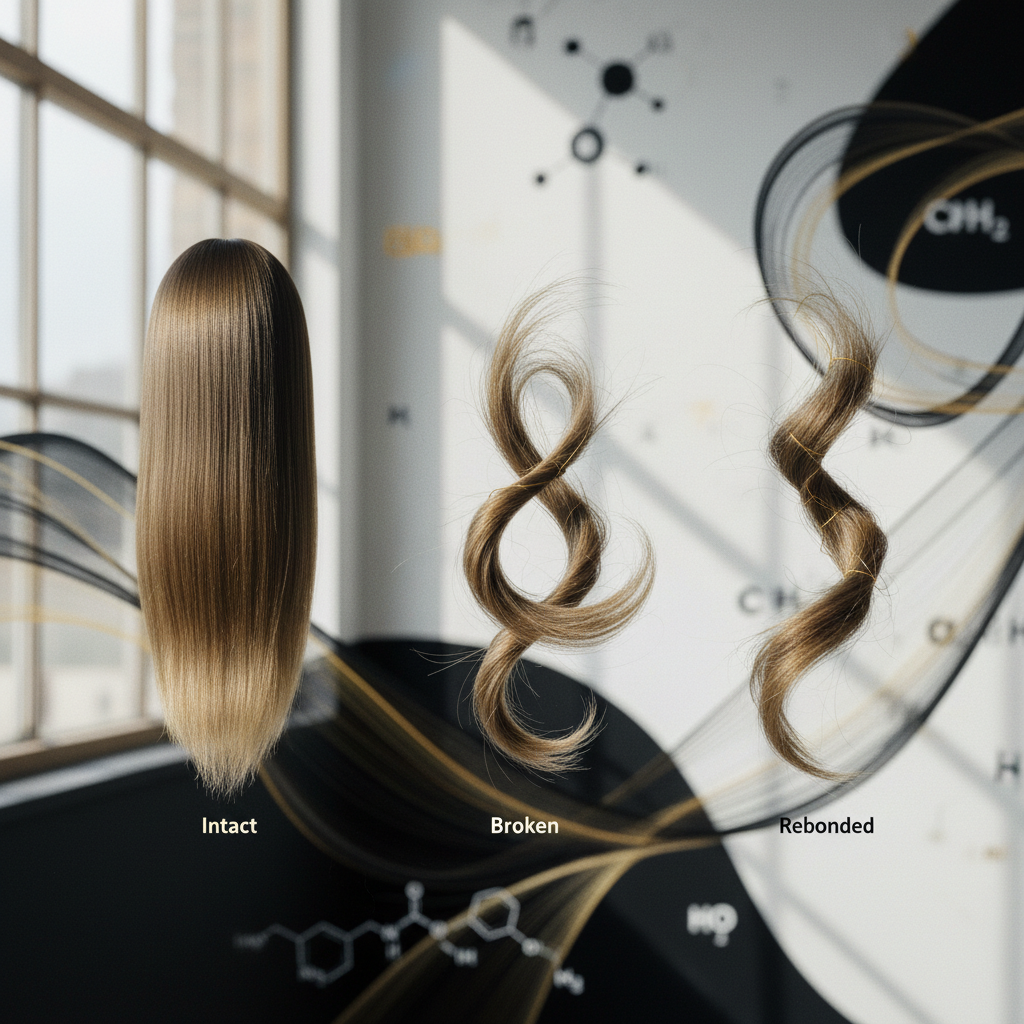
Once the bonds are broken, the hair softens and yields to mechanical reshaping around a perm rod or smoothing board. A neutralising oxidiser, typically a dilute solution of hydrogen peroxide (around 1.5 to 2.5 percent, buffered to an acidic pH), is then applied to pull hydrogen away and reform new disulphide links in their altered physical positions. However, research indicates this reforming process is never 100 percent efficient; roughly 10 to 20 percent of broken bonds fail to reconnect, leaving free thiols or converting into permanent mixed disulphides.
Oxidation (bleaching and lifting)
Bleaching involves alkaline hydrogen peroxide and persulphate salts operating at a high pH (typically between 9.0 and 11.0). While designed to oxidise and disperse melanin granules, these aggressive oxidisers indiscriminately attack disulphide bonds.
Instead of cleanly cleaving the bond into reconstructible thiol units, severe oxidation irreversibly oxidises the sulphur atoms through several intermediate stages (sulphenic, sulphinic acid) until they become cysteic acid (-SO3H). Cysteic acid residues carry a strong negative charge, repelling neighbouring protein chains and permanently eliminating the site where a disulphide bond once lived.
Intact Cystine (-S-S-)
 ↓ (Alkaline Bleaching / High Oxidation)
Intermediate Sulphur Radicals
 ↓
Cysteic Acid (-SO3H) [Irreversible Loss of Structural Strength]
Comparing structural bonds in human hair
| Bond Type | Bond Classification | Energy Level | What Breaks It | How It Reconnects | Role in Hair Behaviour |
|---|---|---|---|---|---|
| Disulphide Bonds | Covalent cross-link | ~250 kJ/mol | Strong oxidisers (bleach), reducing agents (perms), UV radiation, extreme heat (>220°C) | Chemical neutralisation (partial) or synthetic cosmetic linkers | Dictates permanent shape, tensile elasticity, and wet strength |
| Hydrogen Bonds | Physical / Intermolecular | ~10 to 40 kJ/mol | Water, humidity, perspiration | Drying, cooling, water evaporation | Allows temporary heat styling and blow-outs |
| Salt (Ionic) Bonds | Electrostatic | ~20 to 50 kJ/mol | Shifts in pH below 3.0 or above 6.0 | Restoring hair to its isoelectric zone (pH 3.67 to 5.5) | Regulates cuticle flattening and fibre swell |
What the evidence does not show
There is no scientific evidence that topical shampoos, oils, or deep conditioning masks made from natural plant lipids can rebuild or fuse broken disulphide bonds. Plant oils (such as argan, coconut, or jojoba oil) act as emollients and lubricants. They reduce surface friction, fill gaps along damaged cuticles, and limit moisture loss, but they possess neither the functional chemistry nor the penetrative molecular weight to form covalent sulphur links in the cortex.
Furthermore, no product can convert cysteic acid back into cysteine. When marketing materials claim a formula "permanently heals 100 percent of chemical damage", the claim conflicts with fundamental protein chemistry. Bond-building actives create synthetic or secondary bivalent bridges across severed protein chains, which significantly improves mechanical resistance and reduces tensile breakage, but they do not biologically resurrect the native protein architecture.
Finally, internal disulphide bond breakdown must never be confused with genetic hair loss or telogen shedding. Disulphide loss causes hair breakage along the shaft (fractured ends and frayed fibres), not shedding from the follicle base.
Signs of depleted disulphide bonds
Severed disulphide networks reveal themselves through distinct physical changes in how the hair fibre behaves under mechanical stress:
- Loss of natural curl definition: Wavy, curly, or coily hair appears limp, stretched, or unevenly straight along over-processed zones.
- Excessive wet elasticity (the gummy feeling): When wet, hair with compromised disulphide bonds stretches abnormally far without bouncing back, feeling mushy, sticky, or gummy between the fingers.
- Snapping under light tension: Once dry, hair snaps cleanly mid-shaft during gentle detangling or combing.
- Increased porosity and rapid water absorption: The fibre takes in water instantly, swells dramatically, and stays wet for prolonged periods because the disordered internal cortex cannot regulate its moisture matrix.
- Chemical sponginess: When processing colour or bleach, previously compromised sections lightened unevenly or heat up due to high porosity and structural collapse.
What you can do to preserve and reinforce structural bonds
Preserving disulphide bonds requires a combined strategy of chemical caution during salon services and topical structural support at home.
1. Control exposure during chemical services
- Track processing time and volume: Never leave bleach on the hair longer than necessary, and avoid high-volume developers (such as 40 volume / 12 percent) when lower volumes with steady timing preserve substantially more cysteine.
- Avoid repeated overlapping: Lightening or chemically smoothing previously processed lengths directly drives cysteine into irreversible cysteic acid. Keep applications strictly to virgin regrowth.
- Buffer with cosmetic bond protectors: Incorporating dicarboxylic or bivalent bond-building ingredients into lightening mixtures helps mitigate free-radical degradation of structural proteins during the oxidation process.
2. Manage thermal and mechanical damage
- Keep hot tool temperatures below 185°C. Keratin begins thermal denaturation above 150°C, and structural degradation accelerates dramatically past 215°C, where cystine decomposes directly.
- Avoid aggressive brushing while hair is wet. Wet hair relies primarily on its disulphide bonds for strength because its hydrogen bonds are already broken by water. If disulphide bonds are also chemically compromised, mechanical tension easily snaps the fibre.
3. Maintain the cuticle envelope
While disulphide bonds reside inside the cortex, the outer cuticle acts as a physical shield. Using acid-balanced cleansers and conditioning rinses (pH 4.5 to 5.5) keeps cuticle scales compact, preventing external oxidisers, environmental pollutants, and UV light from eroding the interior protein chains.
When breakage stems from another issue
If you notice excessive short, broken hairs along your sink or shoulders, do not automatically assume depleted disulphide bonds from chemical processing are the sole culprit.
Severe mechanical abrasion (such as tight elastic ties or rough towel-drying) creates longitudinal splits and trichorrhexis nodosa (nodes of frayed cortex) without any chemical bond cleavage. Similarly, rare congenital structural disorders, like trichothiodystrophy, involve an inherited metabolic deficiency in sulphur, causing naturally low-cysteine hair that breaks under minimal handling from birth.
If shedding involves hairs coming out with their white bulb attached from the root, this is follicular shedding (such as telogen effluvium or androgenetic alopecia), which has no connection to disulphide bonds or shaft damage.
When to seek professional advice
Consult a qualified trichologist or experienced colourist if your hair shows extreme chemical breakage that continues despite reducing thermal styling and stopping at-home chemical treatments. A professional can perform a wet tensile stretch test, assess damage via digital trichoscopy, and formulate an in-salon restructuring plan.
If your hair texture has changed suddenly without any history of colouring, perming, or high heat, visit a dermatologist or GP to rule out underlying systemic conditions, thyroid abnormalities, or nutritional deficiencies.
The Watermans perspective on structural hair care
At Watermans, our approach centres on protecting the hair fibre you have while optimising the environment for the hair you grow. While cosmetic bond rebuilders target internal cortical links severed by chemical salon services, daily hair strength depends equally on a calm, nourished scalp and an intact external cuticle.
Formulated with gentle, non-stripping cleansers, caffeine, biotin, and restorative botanicals, our products are engineered to support scalp vitality and improve the physical resilience of hair lengths without exposing vulnerable protein bonds to harsh, over-cleansing surfactants. Protecting the outer surface prevents premature wear, leaving your natural disulphide network shielded against daily environmental strain.
Frequently asked questions about Understanding Hair Disulphide Bonds
Can natural oils rebuild broken disulphide bonds?
No, natural oils cannot rebuild disulphide bonds. Oils such as coconut, argan, and olive consist of fatty acids and triglycerides that lubricate the cuticle and reduce moisture evaporation. They lack the reactive chemical groups required to bridge or reform severed sulphur atoms within the cortex. Understanding Hair Disulphide Bonds clarifies that only specific reactive chemistries can form cross-links inside the cortex.
Why does bleaching destroy disulphide bonds faster than perming?
Perming employs reducing agents designed to temporarily open disulphide bonds so an oxidiser can reconnect them in a new alignment. Bleaching, however, relies on aggressive oxidation at high pH to destroy melanin. This violent oxidative process permanently converts cysteine into cysteic acid, completely stripping the sulphur atoms of their ability to bond with other proteins ever again.
Do disulphide bonds ever break from hot water alone?
No. Normal hot water breaks temporary hydrogen bonds, causing the hair to swell and become pliable, but it lacks the thermal energy and chemical potential to break covalent disulphide bonds. Disulphide links withstand water temperatures well beyond what human skin can tolerate; they only begin thermal decomposition at dry temperatures exceeding 215°C to 220°C.
How does hair porosity relate to disulphide bonds?
When disulphide bonds break, the cortex loses its tight structural density, and the cuticle layers frequently lift or erode. This creates microscopic gaps throughout the shaft, resulting in high porosity. The hair absorbs water rapidly because there is little resistance, but it dries out just as quickly because it can no longer maintain structural balance.
Is cysteic acid completely bad for the hair?
Cysteic acid is the direct chemical marker of permanent protein damage. Its presence reduces the net tensile strength of the hair and imparts a negative charge that repels conditioning lipids, leading to dryness, dullness, and mechanical fragility. Minimising cysteic acid formation is the primary goal of modern low-damage bleaching techniques.
A balanced approach to structural hair health
Mastering the science behind Understanding Hair Disulphide Bonds transforms how you manage daily styling, chemical processing, and long-term hair maintenance. Because these covalent sulphur cross-links do not regenerate naturally once severed, preservation must always take priority over repair. Treating hair gently during chemical services, managing heat exposure, and supporting the external cuticle ensures that your internal protein scaffold remains resilient, elastic, and strong over time.
Sources and references
- Robbins, C. R. (2012). Chemical and Physical Behavior of Human Hair (5th ed.). Springer-Verlag.
- Swift, J. A. (1999). The mechanics of fracture of human hair. International Journal of Cosmetic Science, 21(4), 227-239.
- Wolfram, L. J. (2003). Human hair: A unique physicochemical composite. Journal of the American Academy of Dermatology, 48(6), S106-S114.
- Cruz, C. F., Fernandes, M. M., & Cavaco-Paulo, A. (2016). Keratin-based materials for cosmetic applications. Applied Microbiology and Biotechnology, 100(11), 4785-4801.
- Society of Cosmetic Scientists (SCS). Principles of Hair Science and Chemical Services, educational resource materials.
Find these ingredients in Watermans products
- Biotin: you will find this ingredient in our Hair Growth Shampoo.