Understanding Hair Cuticle Health: The Complete Scientific Guide
10 min read ·
Understanding hair cuticle health is vital for preventing breakage, taming frizz, and protecting the hair shaft. Learn the science of cuticle structure and care.
Quick answer: Understanding hair cuticle health is the foundation of preventing mechanical breakage, frizz, and moisture loss. The cuticle is the outermost protective shield of the hair shaft, made of 6 to 10 overlapping cellular layers rich in keratin and lipids. While intact cuticles keep hair smooth and resilient, damaged cuticles cannot biologically regenerate because hair is non-living tissue. Understanding hair cuticle health means knowing how to preserve this barrier through balanced pH, controlled heat, and lipid-replenishing conditioning.
Key takeaways
- The hair cuticle consists of 6 to 10 overlapping, flattened scale-like cells that protect the delicate inner cortex.
- A naturally hydrophobic lipid layer, known as 18-methyl eicosanoic acid (18-MEA), coats healthy cuticles to repel water and reduce friction.
- Hair fibres have an isoelectric point around pH 3.67, while typical hair operates best near pH 4.5 to 5.5; alkaline products cause cuticle swelling and edge lifting.
- Cuticle cells are non-living; once chipped, stripped, or weathered away, they cannot be biologically regenerated or repaired.
- Effective haircare focuses on preventive preservation, temporary mechanical sealing, and using cosmetic conditioning agents to smooth raised scale edges.
Understanding hair cuticle health: what the evidence shows
Understanding hair cuticle health begins with examining the microscopic architecture of the human hair shaft. Human hair consists of three distinct anatomical regions: the central medulla, the structural cortex, and the outer protective cuticle. The cuticle accounts for roughly 10% to 15% of the total fibre weight, yet it dictates nearly all surface properties, including shine, tactile smoothness, combability, and resistance to environmental stress.
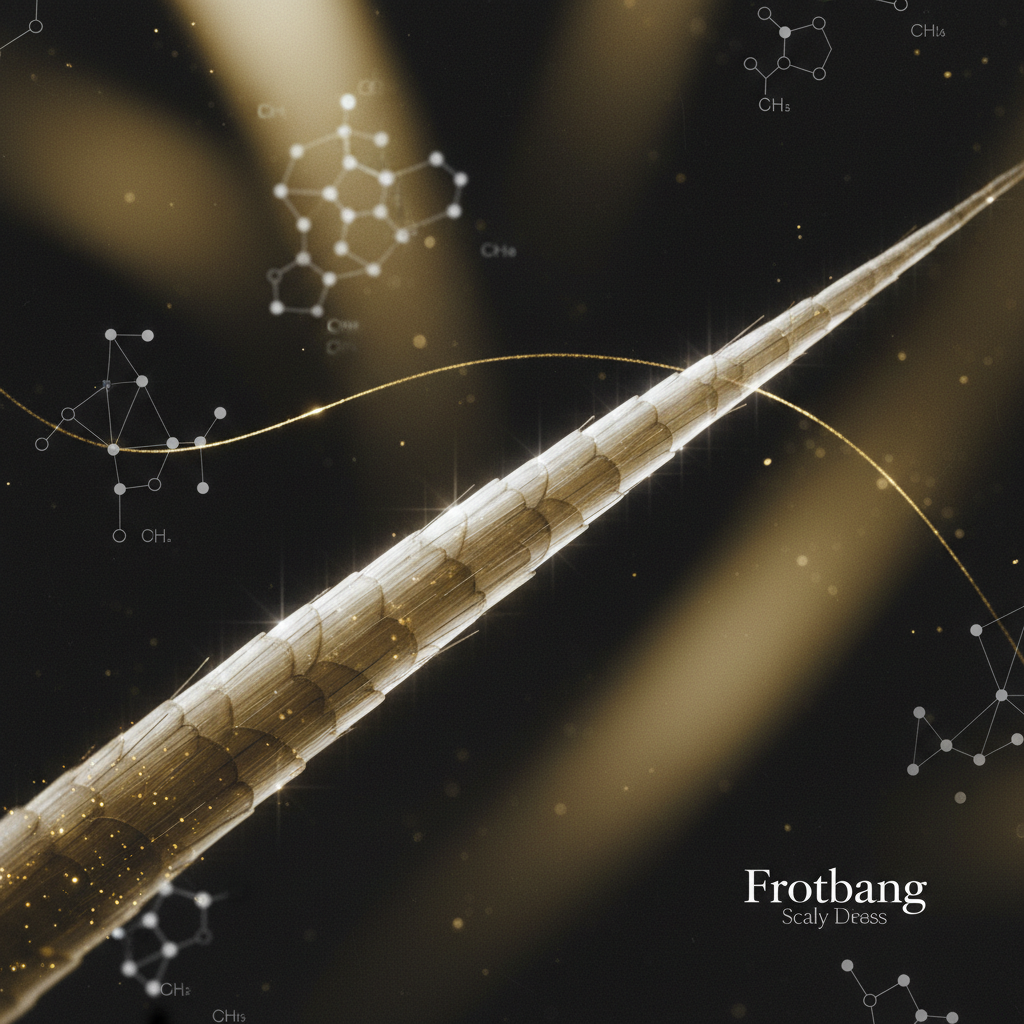
Under scanning electron microscopy, a healthy cuticle resembles shingles on a roof, pointing downward from root to tip. Each individual cuticle cell is roughly 0.3 to 0.5 micrometres thick and about 35 to 45 micrometres long. A single hair strand features between 6 and 10 overlapping layers of these hardened, transparent scales.
Chemically, each cuticle cell features a multi-layered internal structure:
- The Epicuticle: The outermost semi-permeable membrane, roughly 5 to 7 nanometres thick, covered by a covalently bonded monolayer of fatty acids, predominantly 18-methyl eicosanoic acid (18-MEA).
- The A-Layer: A rigid, highly cross-linked sub-layer containing over 30% cystine, providing extreme chemical resistance.
- The Exocuticle: A cystine-rich layer (around 15% cystine) that supplies physical rigidity.
- The Endocuticle: The innermost sub-layer, containing very little cystine (roughly 3%), which makes it soft, swellable, and vulnerable to moisture penetration.
When 18-MEA is intact, hair is naturally hydrophobic. Water beads on its surface, and wet friction remains low. When chemical processing (such as bleaching, permanent dyeing, or chemical straightening) or excessive thermal styling removes this lipid barrier, the fibre becomes hydrophilic. Water penetrates rapidly into the endocuticle, causing uneven swelling, raised edges, friction spikes, and subsequent fibre breakage.
What the evidence does not show
Scientific research reveals several widespread myths regarding cuticle function:
- Cuticles do not "open and close" like biological pores: Cuticle scales do not possess muscles or cellular mechanisms to flex open and shut. They lift mechanically or physically swell when exposed to alkaline pH or excessive moisture, and they lie flatter when dried or exposed to an acidic pH environment.
- Cuticles cannot heal: Hair emerging past the scalp surface is non-viable tissue (dead keratinised cells). No oil, serum, mask, or botanical extract can permanently rebuild a broken or abraded cuticle scale. Treatments offer cosmetic adhesion, temporary patch repairs, and friction reduction, but they do not reverse cellular loss.
- Cuticle damage does not equal follicular hair loss: Damage to the cuticle causes fibre breakage along the shaft. It does not cause hair shedding from the follicle (telogen effluvium) or genetic hair thinning (androgenetic alopecia). Conflating shaft breakage with root shedding leads to incorrect treatments.
Cuticle health comparison across hair states
Understanding hair cuticle health requires comparing how different structural conditions alter physical performance:
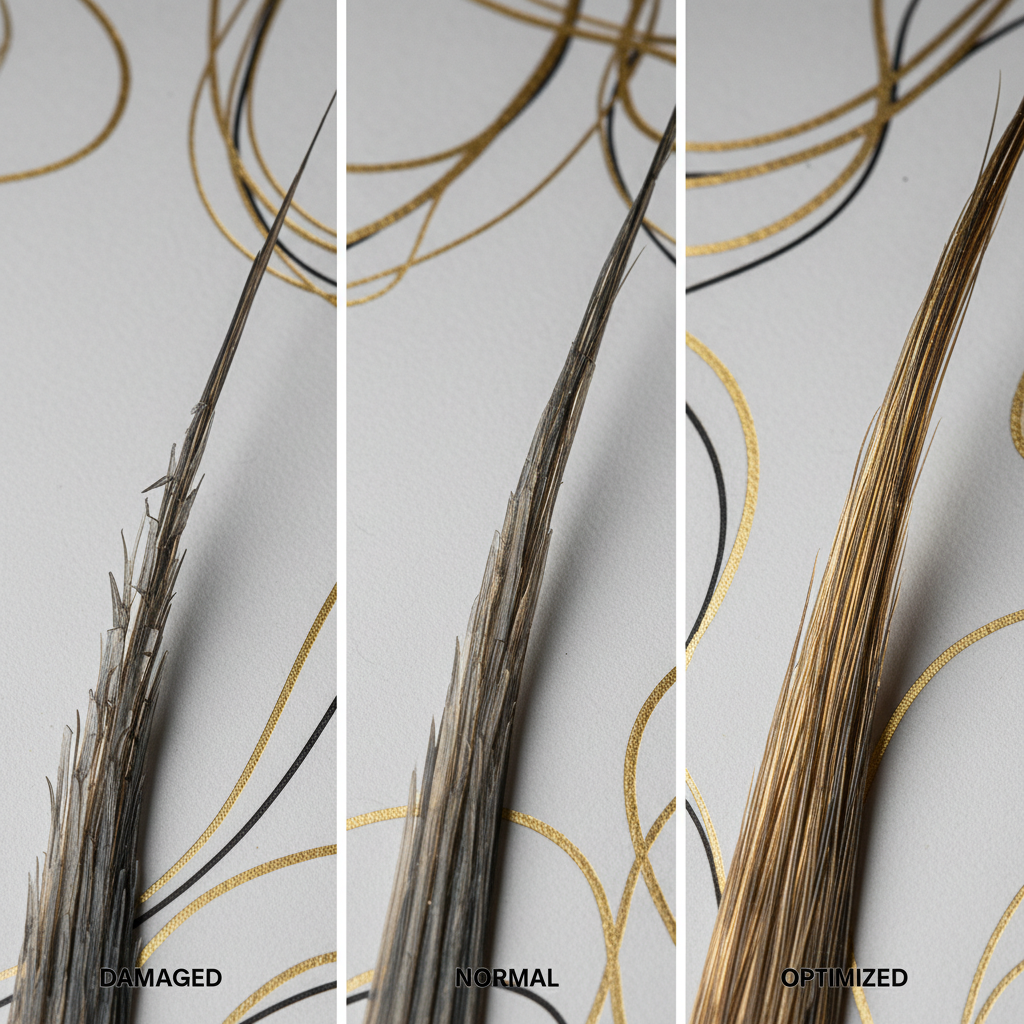
| Property | Healthy Cuticle | Weathered Cuticle | Chemically Damaged Cuticle |
|---|---|---|---|
| Microscopic Appearance | Uniform, tightly overlapping scales pointing root to tip | Frayed edges, minor chipping near distal ends | Multiple missing layers, cracked exocuticle, exposed cortex |
| Surface Wetting | Hydrophobic (repels water droplets) | Moderately hydrophilic (absorbs water slowly) | Strongly hydrophilic (absorbs water immediately) |
| Lipid Barrier (18-MEA) | Intact and covalently bound | Partially depleted by mechanical friction | Completely stripped by oxidation or alkaline agents |
| Optimal pH Response | Flattens smoothly between pH 4.5 and 5.5 | Swells moderately in water | Swells rapidly, prone to endocuticle dissolution |
| Tactile Texture | Silky, slippery, minimal wet or dry comb drag | Slight drag, minor tangling at ends | Rough, rasping texture, high tangling, prone to breakage |
The mechanisms of cuticle damage
Cuticle degradation occurs through four distinct pathways, often acting in concert over months and years:
1. Chemical lifting and lipid stripping
Alkaline chemical services, such as bleaching (pH 9.0 to 11.0) and permanent relaxers (pH 12.0 to 14.0), break the disulfide bonds inside the A-layer and exocuticle. Crucially, the alkaline oxidation involved in bleaching cleaves the thioester bonds anchoring 18-MEA to the epicuticle. Without this lipid layer, the cuticle loses its natural lubrication and water resistance.
2. Thermal denaturation and bubbling
Direct heat styling above 180 degrees Celsius degrades keratin and can cause rapid vaporisation of water trapped within the cortex and endocuticle. This creates microscopic steam pockets within the fibre, a phenomenon documented in trichology as "bubble hair." The cuticle scales directly over these pockets crack and flake off.
3. Mechanical abrasion and friction
Everyday grooming causes mechanical erosion. Brushing wet hair, which exhibits up to 30% lower tensile strength than dry hair, stretches the fibre and forces cuticle edges to catch against one another. Over time, the distal ends of the hair lose their outer 3 to 5 cuticle layers simply from rubbing against clothing, pillows, and hairbrushes.
4. Hygral fatigue
When the protective lipid shield is gone, repeated cycles of wetting and drying force the hair shaft to repeatedly swell and contract. The endocuticle absorbs water and expands, but the rigid exocuticle cannot expand at the same rate. This differential stress weakens the cell membrane complex holding adjacent cuticle scales together, leading to scale detachment.
Recognising the signs of compromised cuticles
Visual inspection and simple tactile tests can identify cuticle degradation before it causes widespread fibre breakage:
- Loss of natural specular reflection (shine): A flat, aligned cuticle reflects light like a mirror. When scales are chipped, lifted, or missing, light scatters diffusely, making hair look dull.
- High wet friction: If wet hair feels squeaky, grabby, or gummy between your fingers, the hydrophobic 18-MEA layer has been compromised.
- Chronic knotting and tangling: Lifted cuticle edges act like microscopic barbs, catching on adjacent strands and creating stubborn knots during washing or styling.
- Porosity changes: Healthy hair absorbs moisture gradually. Damaged hair with open or missing cuticles absorbs water almost instantaneously and takes an unusually long time to dry because water gets trapped deep in the porous cortex.
- Split ends (trichoptilosis): Once the cuticle completely wears away at the tip, the parallel cortical fibres separate, causing the hair to unravel into split ends.
Practical steps to protect your hair cuticles
Protecting the cuticle relies on minimising friction, balancing pH, and replacing lost surface lubricity:
- Maintain an acidic pH profile: Use cleansing and conditioning products formulated within the physiological pH range of hair (pH 4.5 to 5.5). Mildly acidic environments help contract the swollen cuticle layers and keep scale edges flat against the shaft.
- Apply protective heat barriers: Never use hot tools without a thermal protectant. Silicones (such as dimethicone and amodimethicone) and polyquaternium polymers form a protective film over the scales, distributing heat evenly and slowing thermal transfer.
- Introduce fatty acids and cationic conditioners: Cationic surfactants (like behentrimonium chloride) adhere to the negatively charged, damaged sites on lifted cuticles. Fatty alcohols (such as cetyl and stearyl alcohol) restore slip, substituting for depleted 18-MEA.
- Minimise wet mechanical strain: Detangle hair only when coated with a slippery conditioner, using a wide-tooth comb or flexible-bristle brush, starting at the tips and working upward toward the scalp.
- Protect against nocturnal friction: Cotton pillowcases create high friction that chips raised cuticles during sleep. Switching to silk or satin pillowcases significantly reduces mechanical drag.
Supporting cuticle integrity with Watermans
When managing hair fibre condition, a healthy scalp environment provides the foundation for strong cuticle formation during initial keratinisation inside the follicle. Watermans GrowMe Shampoo and ConditionMe Conditioner are formulated to support the hair and scalp ecosystem.
Watermans GrowMe Shampoo is formulated with biotin, rosemary extract, caffeine, niacinamide, and argan oil, providing a clarifying yet gentle cleanse that leaves the hair and scalp feeling refreshed without stripping natural surface moisture. Following with Watermans ConditionMe Conditioner provides essential surface smoothing. Formulated with cholesterol, shea butter, and hydrolysed lupin protein, it coats the hair fibre, helping to smooth raised cuticle edges, improve wet slip, and reduce mechanical breakage during detangling. These cosmetic treatments improve the feel, shine, and manageability of hair lengths while keeping the scalp balanced.
When the cause may be something else
It is vital to distinguish between cuticle degradation and internal follicular disorders:
- Excessive daily shedding: If you are finding full strands with white bulbs intact on your pillow, in the shower drain, or coming out in clumps, this indicates telogen effluvium or follicular shedding, not cuticle wear.
- Diffuse thinning or widening part lines: Gradual reduction in hair density on the crown or temples is characteristic of androgenetic alopecia, driven by genetics and hormonal sensitivity, which has no connection to cuticle condition.
- Patchy hair loss: Smooth, circular patches of missing hair suggest alopecia areata, an autoimmune condition requiring medical evaluation.
- Inherited structural defects: Rare genetic conditions such as trichorrhexis nodosa or monilethrix cause structural weaknesses within the hair shaft independent of external grooming damage.
When to seek professional advice
Consult a registered trichologist or a consultant dermatologist if you experience sudden, unexplained hair shedding exceeding 100 strands per day, noticeable scalp inflammation, redness, scaling, or persistent tenderness. If structural breakage persists despite gentle handling and the elimination of chemical and thermal tools, an expert can evaluate your hair shafts under light microscopy to check for internal structural anomalies.
Frequently asked questions about Understanding Hair Cuticle Health
Can split ends be glued back together permanently?
No. Split ends occur when the protective cuticle layers have completely worn away, leaving the inner cortical fibres exposed and frayed. While cosmetic serums containing polymers or silicones can temporarily stick split ends together until your next wash, the only permanent remedy for split ends is trimming them off.
Does cold water close the hair cuticle?
Understanding hair cuticle health clarifies that cuticles lack living cells or muscles, meaning cold water cannot actively "close" them. While cold water will not swell cuticles as much as hot water, it has a negligible effect on smoothing scales. Surface smoothness is primarily determined by product pH, conditioning agents, and mechanical drying techniques.
How does hair bleaching damage the cuticle?
Bleaching uses an alkaline agent to swell the cuticle scales, forcing them open so hydrogen peroxide can penetrate into the cortex to dissolve melanin pigments. This process strips the 18-MEA lipid layer from the epicuticle and breaks cross-linked cystine bonds in the exocuticle, often leaving scales permanently raised, chipped, or missing.
Why does high humidity make hair frizz if the cuticles are damaged?
When the cuticle is weathered or stripped of its hydrophobic lipid coating, ambient moisture easily penetrates the endocuticle and cortex. This water disrupts temporary hydrogen bonds between keratin chains, causing the hair shaft to swell unevenly and buckle outward, which shows up visually as frizz.
Managing hair cuticle condition for long-term strength
Understanding hair cuticle health empowers you to protect your hair from preventable daily damage. Because the hair cuticle is a non-living structure that cannot biologically heal once formed, your primary goal must always be preservation. By keeping styling temperatures controlled, respecting the natural acidic pH of the fibre, detangling gently, and using conditioning formulations that coat lifted edges, you maintain the hydrophobic shield that keeps hair feeling smooth, soft, and strong.
Sources and references
- Robbins, C. R. (2012). Chemical and Physical Behavior of Human Hair (5th ed.). Springer-Verlag Berlin Heidelberg.
- Dawber, R. (1996). Hair: its structure and response to cosmetic preparations. Clinics in Dermatology, 14(1), 105-112.
- Swift, J. A. (1999). The mechanics of the hair cuticle. International Journal of Cosmetic Science, 21(4), 227-239.
- Evans, A. O., & Wickett, R. R. (2012). Practical modern hair science. Allured Business Media.
- Cruz, C. F., Costa, C., Gomes, A. C., Matamá, T., & Cavaco-Paulo, A. (2016). Human hair characteristics and methods to assess hair quality. International Journal of Trichology, 8(3), 115-123.
Find these ingredients in Watermans products
- Shea Butter: you will find this ingredient in our Curly Hair Conditioner.