Treating Hygral Fatigue: Scientific Causes, Signs, and Practical Solutions
8 min read ·
Learn the science of treating hygral fatigue, repairing moisture-damaged hair fibres, and restoring structural protein balance for stronger hair.
Quick answer: Successfully treating hygral fatigue requires halting the cycle of excessive water absorption that weakens the hair shaft. Because water causes hair fibres to swell and contract repeatedly, cuticle cells lift, crack, and lose structural integrity. Treating hygral fatigue involves reducing wash frequency, applying penetrating oils before shampooing, rebalancing hair with hydrolysed proteins, and keeping products close to hair's natural pH of 4.5 to 5.5. However, severely degraded fibres cannot truly fuse back together, meaning mechanical prevention is paramount.
Key takeaways
- Hygral fatigue is structural damage caused by repeated swelling and deswelling of the hair cortex from excessive moisture.
- It is distinct from follicular hair shedding and alopecia; hygral fatigue manifests purely as hair shaft weakness and mid-strand breakage.
- Over-conditioned, moisture-saturated hair feels mushy, limp, and excessively stretchy when wet, snapping without returning to shape.
- Penetrating lipids, such as pure coconut oil, reduce moisture-induced swelling when applied as a pre-shampoo treatment.
- Formulations buffered to an acidic pH (between 3.5 and 5.5) contract the cuticle scales and minimise water uptake.
Treating Hygral Fatigue: what the evidence shows
Treating hygral fatigue effectively depends on understanding how water alters keratin. Hair is naturally hygroscopic, meaning it readily absorbs water from its environment. Normal, healthy hair can absorb roughly 30% of its dry weight in water under standard conditions, and up to 45% when fully submerged.
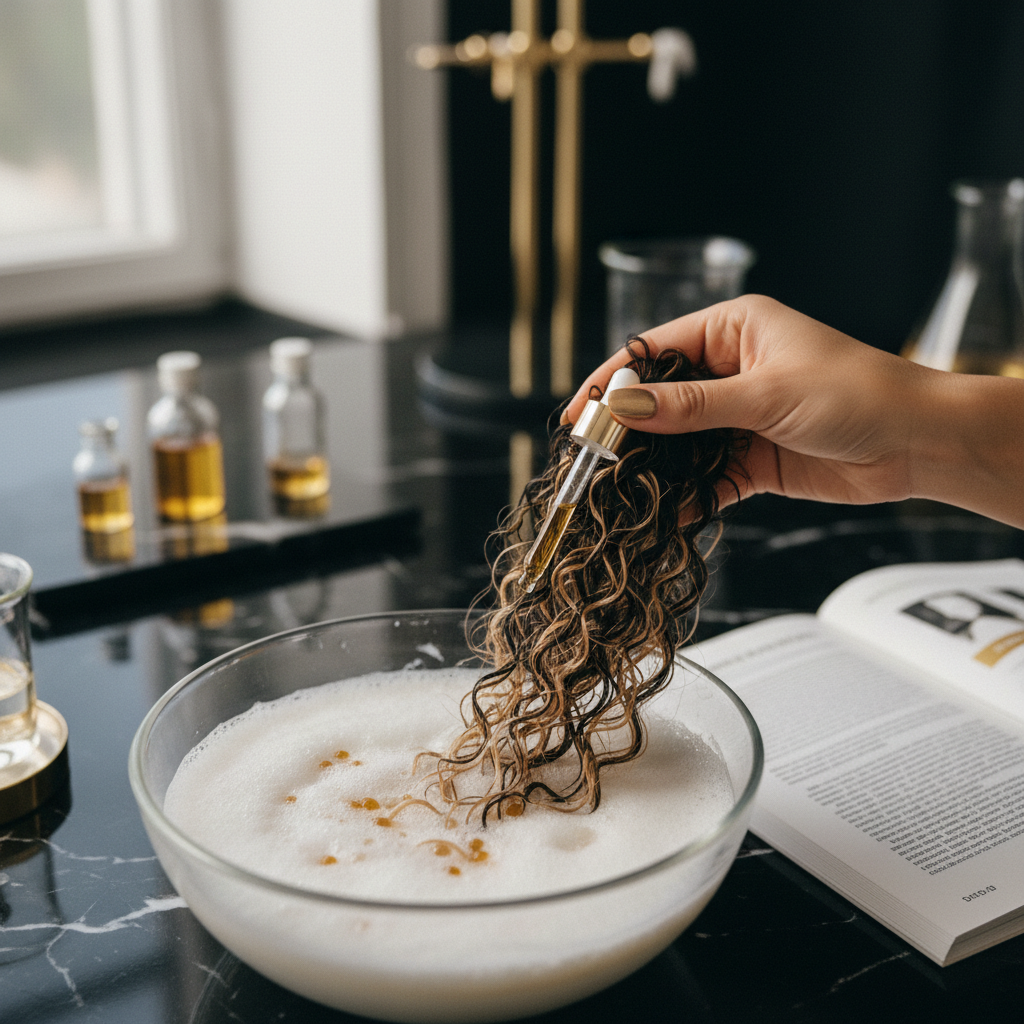
When water enters the fibre, it penetrates past the outer cuticle layer into the cortex. Here, water molecules disrupt temporary hydrogen bonds within the helical keratin proteins, causing the fibre to swell significantly in diameter (often by 15% to 20%) while lengthening by only 1% to 2%.
If hair is washed constantly, soaked for prolonged periods (such as overnight deep conditioning), or stripped of its protective 18-methyleicosanoic acid (18-MEA) lipid layer, this swelling becomes uncontrolled. The repeated expansion and contraction puts massive mechanical stress on the endocuticle and cell membrane complex. Treating hygral fatigue requires active intervention to reduce this internal hydraulic pressure, restore structural rigidity, and seal the outer envelope against moisture overload.
What the evidence does not show
Controlled cosmetic science does not support several common assumptions regarding over-moisturised hair:
- It does not show that hair can heal permanently. Once the cell membrane complex between cuticle scales dissolves or fractures, topical treatments act as temporary patches or barrier films. They do not regenerate living biological tissue.
- It does not show that all oils prevent hygral fatigue. Non-polar mineral oils and large-chain silicone polymers sit on the fibre surface. While they slow external water entry slightly, only low-molecular-weight, polar vegetable oils (such as coconut oil) penetrate the cortex to actively limit internal swelling.
- It does not show that hygral fatigue causes hair loss from the root. Hygral fatigue is entirely a hair fibre condition. It causes breakage along the shaft, never follicular shedding or telogen effluvium.
Signs of hygral fatigue versus protein deficiency
Distinguishing moisture overload from other types of fibre stress prevents counterproductive routines. The table below outlines how hygral fatigue compares to normal hair and protein-deficient hair.
| Characteristic | Healthy Hair | Hygral Fatigue (Moisture Overload) | Protein-Deficient Hair |
|---|---|---|---|
| Wet Texture | Firm, smooth, slight slip | Mushy, gummy, limp, excessively soft | Rough, brittle, tangles easily |
| Elasticity | Stretches 20% to 30% wet, returns to length | Stretches far beyond normal, then snaps without bouncing back | Snaps almost immediately under low tension |
| Porosity | Normal (compact cuticle) | High porosity (lifted, damaged cuticle) | Variable (often chemical damage) |
| Dry Appearance | Defined, natural shine | Dull, frizzy, lack of curl or wave definition | Frizzy, flyaways, split ends |
| Primary Need | Maintenance | Structural reinforcement and drying control | Hydrolysed protein and barrier conditioning |
The underlying mechanism: why water damages hair
To treat hygral fatigue, you must understand the cuticle architecture. The outer surface of virgin hair is covered by a mono-molecular layer of fatty acids, primarily 18-MEA, chemically bound to the protein surface. This layer makes virgin hair hydrophobic (water-repelling).
When hair undergoes chemical treatments (bleaching, permanent waving, high-lift dyes) or intense mechanical weathering, this lipid layer is stripped. The hair turns hydrophilic (water-loving). Without its protective hydrophobic barrier, water floods the cortex unrestricted.
Inside the cortex, keratin intermediate filaments are embedded in an amorphous, high-sulfur protein matrix. When water floods this matrix, it pushes the filaments apart. Upon drying, the matrix contracts. Repeating this process daily, or multiple times a day, exerts cyclic mechanical strain. Eventually, the cell membrane complex shears, cuticle scales chip away, and the hair loses its tensile modulus (its internal stiffness).
Practical steps for treating hygral fatigue
If you have diagnosed hygral fatigue in your hair or a client's hair, adjust your haircare regimen using the following steps:
1. Apply a penetrating pre-shampoo oil
Studies in cosmetic dermatology show that coconut oil has a high affinity for hair proteins and a low molecular weight, allowing it to penetrate inside the hair shaft. When applied before washing, it occupies spaces within the cortex, physically limiting the amount of water the fibre can absorb during wetting. Leave it on dry hair for 30 to 60 minutes before cleansing.
2. Introduce hydrolysed proteins
Because water softens hair by weakening hydrogen bonds, you must introduce structural reinforcement. Hydrolysed wheat protein, hydrolysed keratin, and silk amino acids have molecular weights small enough to enter outer cuticle gaps or deposit along the fibre surface. They increase the stiffness of water-softened fibres and temper excessive elasticity.
3. Manage product pH
The natural isoelectric point of hair keratin sits around pH 3.67, and the hair shaft is happiest between pH 4.5 and 5.5. Alkaline products (pH above 7.0) force cuticle scales open, inviting rapid water uptake. Use shampoos and conditioners buffered to an acidic pH (between 4.0 and 5.5) to keep the cuticular scales flattened and tightly sealed.
4. Eliminate prolonged wetness
Stop overnight deep conditioning, multi-hour "wet plopping", and daily saturation. Hair is at its most fragile when wet. Once washed and conditioned, gently squeeze excess moisture out with a microfibre towel or cotton T-shirt (avoiding vigorous friction), apply a heat protectant, and dry hair with a diffuser or hair dryer on a warm, controlled setting. Ambient air-drying for six to eight hours extends the duration of cortex swelling unnecessarily.
When the cause may be something else
Before radically altering your routine, rule out alternative sources of structural compromise:
- Bleach or relaxer degradation (cysteic acid formation): Chemical processing oxidises disulfide bonds into cysteic acid, causing high porosity and structural collapse that mimics hygral fatigue, even if water exposure is low.
- Hard water build-up: Minerals like calcium and magnesium bind to the hair shaft, creating a brittle, dry coating that masks whether the hair is over-moisturised or under-conditioned. A chelating wash clarifies this.
- Heat fatigue: Regular exposure to high temperatures (above 185°C) degrades alpha-keratin into beta-keratin, permanently weakening the hair's mechanical strength.
When to seek professional advice
If breakage continues despite protein balancing and reduced water exposure, consult a qualified trichologist or experienced colourist. A professional can examine your hair under a digital trichoscope to measure cuticle damage, determine whether breakage stems from root-level telogen shedding or mid-shaft fractures, and design a balanced salon regimen to preserve remaining fibre strength.
Supporting hair vitality with Watermans
When managing damaged, fragile hair fibres, balancing structural strength with gentle scalp care is critical. Watermans Grow Me Shampoo provides a balanced formulation free from harsh sulfates, ensuring the hair fibre is gently cleansed without excessively stripping natural surface lipids. Incorporating complementary hydrolysed proteins and conditioning actives, the Watermans system helps preserve the scalp barrier and fortify delicate, breakage-prone lengths, giving hair a fuller, stronger appearance.
Frequently asked questions about Treating Hygral Fatigue
Can olaplex or bond builders fix hygral fatigue?
Bond builders target broken disulfide bonds, which are covalent sulfur linkages commonly destroyed by bleach, colour, or heat. While restoring disulfide bonds increases the hair's internal strength, treating hygral fatigue also requires physical management of water absorption. Bond repair helps fortify the cortex, but you must pair it with penetrating oils, protein treatments, and acidic conditioners to stop excessive water swelling.
How long does Treating Hygral Fatigue take to show results?
Treating hygral fatigue usually yields visible improvements within two to four weeks of a corrected routine. By eliminating excessive soaking, applying pre-shampoo oils, and using hydrolysed protein treatments, hair will quickly regain its natural elasticity and lose its mushy wet texture. However, severely split ends cannot re-fuse and must be trimmed.
Should I completely stop conditioning my hair?
No. Treating hygral fatigue does not require abandoning conditioners entirely. Hair still requires conditioning agents, like fatty alcohols and cationic surfactants, to lubricate the cuticle, prevent static, and reduce detangling friction. Instead, switch from heavy, moisture-trapping "hydrating" masks to balanced, protein-enriched rinse-out conditioners applied for only two to five minutes.
Does hygral fatigue affect all hair types equally?
No. Naturally curly, coily, and afro-textured hair types (Type 3 and Type 4), as well as chemically lightened hair, are significantly more susceptible. These hair types naturally feature higher porosity and irregular cuticle geometries along twists in the shaft, making it easier for water to rush into the cortex and disrupt structural bonds.
Conclusion
Successfully treating hygral fatigue is a matter of restoring physical balance between water and structural protein. Water is necessary for hair flexibility, but uncontrolled hydration weakens the keratin matrix and causes mid-shaft breakage. By implementing pre-shampoo oil barriers, keeping products at an acidic pH, reinforcing the fibre with hydrolysed proteins, and reducing prolonged drying times, you halt cyclic cuticle strain. Treat your hair fibre like a delicate fabric: protect its outer layer, regulate its water intake, and preserve its natural mechanical strength.
Sources and references
- Robbins, C. R. (2012). Chemical and Physical Behavior of Human Hair. 5th ed. Springer-Verlag.
- Ruetsch, S. B., Kamath, Y. K., Rele, A. S., & Mohile, R. B. (2001). Secondary ion mass spectrometric investigation of penetration of coconut and mineral oils into human hair fibres: relevance to hair damage. Journal of Cosmetic Science, 52(3), 169-184.
- Rele, A. S., & Mohile, R. B. (2003). Effect of mineral oil, sunflower oil, and coconut oil on prevention of hair damage. Journal of Cosmetic Science, 54(2), 175-192.
- Evans, A. O., & Wickett, R. R. (2012). Practical Modern Hair Science. Allured Business Media.
- Gavazzoni Dias, M. F. (2015). Hair cosmetics: an overview. International Journal of Trichology, 7(1), 2-15.