Type 4 Hair Moisture Retention: The Complete Guide to Lasting Hydration
9 min read ·
Master Type 4 hair moisture retention. Understand coil anatomy, balance porosity, prevent breakage, and lock in lasting hydration with proven scientific techniques.
Quick answer: Effective Type 4 Hair Moisture Retention requires hydrating the internal cortex with water or water-based humectants, then slowing evaporation using emollients and occlusives. Because Type 4 coils have an elliptical cross-section, numerous curvature torsion points, and fewer cuticle scale layers at the twists, natural sebum cannot travel down the shaft. The main limitation is environmental: no cosmetic regimen stops trans-epidermal or fibre water loss permanently, meaning moisture retention is an ongoing management cycle rather than a permanent fix.
Key takeaways
- Structural geometry drives dryness: Tight coils feature elliptical fibres and frequent twist points that shed cuticle cells easily, making them porous and prone to rapid evaporation.
- Water is the only true hydrator: Oils, butters, and silicones do not moisturise hair fibres; they act as sealants and lubricants to retard evaporation.
- Porosity dictates technique: High porosity fibres require richer occlusives and film-forming proteins, whereas low porosity coils need heat and lighter humectants to let water penetrate.
- Breakage is not hair loss: Chronic dehydration causes fibre snapping along the hair shaft (mechanical breakage), which should never be confused with follicular shedding or alopecia.
- pH balance preserves the barrier: Formulations kept at the natural cuticle isoelectric point (pH 4.5 to 5.5) smooth cuticles and help lock in water.
Type 4 Hair Moisture Retention: what the evidence shows
Scientific evaluation of Afro-textured fibres shows that Type 4 Hair Moisture Retention is fundamentally governed by hair fibre architecture and lipid distribution. Research published in the International Journal of Cosmetic Science confirms that coiled hair fibres possess an asymmetrical bulb and an uneven distribution of cortical cells. This forces the strand into tight bends and helical patterns.
At every twist point along a Type 4 strand, the outer cuticle layer is thinner and subject to higher mechanical stress. Human sebum produced by the sebaceous glands struggles to negotiate these tight corkscrew coils. While a straight Caucasian or Asian hair fibre (Type 1 or 2) benefits from seamless sebum migration from scalp to tip within 24 to 48 hours, sebum on Type 4 hair remains concentrated near the first two inches of the root.
Consequently, the mid-lengths and ends suffer from chronic dryness. Biophysical testing demonstrates that untreated Afro-textured hair does not necessarily contain less water by baseline weight than straight hair when placed in identical relative humidity. However, its rate of moisture loss (desorption) is significantly faster once exposed to dry ambient air. Without artificial barrier protection, water leaves the cortex within hours, leaving the protein matrix brittle.
What the evidence does not show
The science does not support several persistent myths surrounding Type 4 hair care:
- Oils do not hydrate: Vegetable oils, mineral oils, and raw butters contain zero water. Applying heavy grease directly to dry strands seals out moisture rather than putting it in.
- Drinking extra water does not moisturise dead fibre: While systemic hydration is vital for cellular division within the living follicle, ingested water does not travel to fully cornified, non-living hair lengths. External hydration is required.
- Products cannot permanently alter porosity: Genetic porosity is determined by internal cortical packing and cuticle structure, while acquired porosity results from mechanical or chemical cuticle removal. Conditioners temporarily fill gaps, but wash out over time.
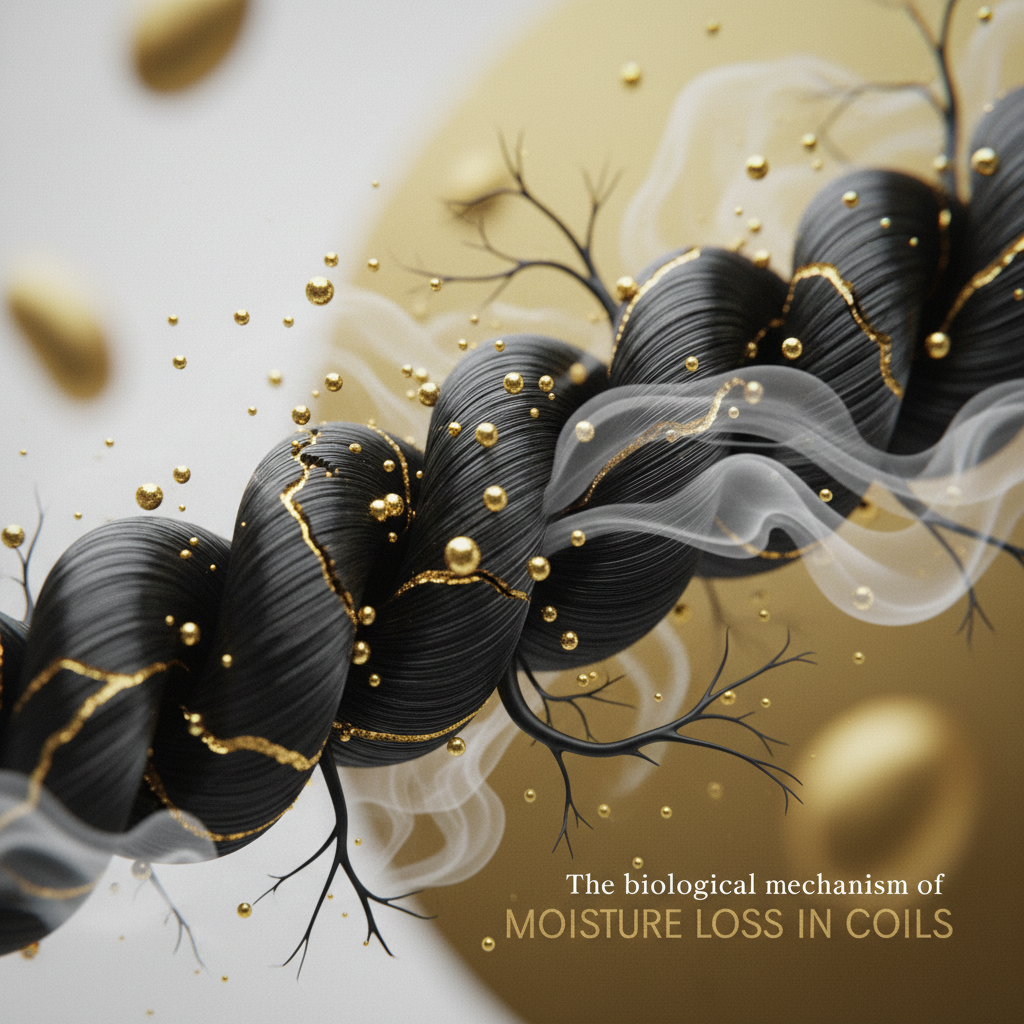
The biological mechanism of moisture loss in coils
Moisture management in coiled hair centres on the delicate equilibrium between internal relative humidity and atmospheric conditions.
External Hydration (Water/Humectants)
 │
 ▼
Cuticle Penetration (Aided by mild heat / low pH)
 │
 ▼
Cortex Hydrogen Bonding (Keratin matrix absorbs water)
 │
 ▼
Lipid / Occlusive Seal (Oils/butters slow evaporation)
The cortex comprises parallel keratin intermediate filaments held together by disulphide, salt, and hydrogen bonds. Water molecules easily break and reform hydrogen bonds within this matrix. When hair is damp, water acts as a plasticiser, increasing fibre elasticity from roughly 1 to 2 percent up to 30 percent elongation before snapping.
However, ambient air with relative humidity below 50 percent extracts unbound water molecules from the cortex via simple diffusion. Because Type 4 cuticles often display natural fissures near curvature peaks, water vaporises quickly. When the internal moisture drops below roughly 8 to 10 percent of the fibre's weight, keratin chains stiffen, leaving the strand vulnerable to snapping during basic manipulation.
Porosity and moisture retention comparison
How you manage moisture depends entirely on your hair's cuticle condition. The table below outlines how cuticle architecture changes product performance.
| Porosity Level | Cuticle Condition | Water Absorption Rate | Evaporation Rate | Recommended Strategy |
|---|---|---|---|---|
| Low Porosity | Tightly overlapping, flat cuticle scales | Very slow (resists wetting) | Very slow once absorbed | Use indirect heat, steam, and light humectants (glycerin, aloe vera). Avoid heavy raw butters. |
| Medium Porosity | Uniformly layered, slightly raised edges | Moderate and steady | Balanced | Standard balance of water-based leave-in conditioners and light plant oils (argan, jojoba). |
| High Porosity | Lifted, chipped, or missing cuticle scales | Instant (wets immediately) | Extremely fast (dries in minutes) | Layer thicker occlusives (shea butter), film-forming proteins, and acidic rinses (pH 4.0 to 5.0). |
Signs of moisture deficiency in Type 4 hair
Recognising chronic dehydration early prevents irreversible structural damage:
- Loss of mechanical elasticity: Dry hair snaps under minimal tension rather than stretching slightly and springing back.
- Velcro-like ends: Dehydrated cuticles lift away from the shaft, catching on adjacent strands and forming single-strand knots (trichonodosis).
- Dull, matte appearance: Intact, well-moisturised cuticles lie flat and reflect light evenly. Dehydrated, lifted cuticles scatter light, causing the hair to look ashen or dull.
- Audible crunching: Dry coils make a distinct rustling, brittle sound when handled or compressed.
What you can do: actionable retention strategies
Maximising moisture involves a systematic approach: introduce water, balance it with humectants, and seal the outer perimeter.
1. Employ the LOC or LGO technique
Layering remains the most reliable cosmetic method to slow water evaporation:
- Liquid/Leave-in (L): Always start on freshly washed, clean, damp hair. Use water or water-based leave-in sprays with humectants like panthenol or glycerin.
- Oil (O): Apply a small amount of penetrating or coating oil (such as jojoba or squalane) to lubricate the cuticle gaps.
- Cream (C): Finish with a lipid-dense butter or emollient cream containing shea butter or cetyl alcohol to provide an occlusive shield against dry air.
2. Control wash-day pH
Alkaline environments (pH above 7.0) force cuticles to swell and lift, speeding up moisture loss. Ensure all cleansers, deep conditioners, and leave-in products sit between pH 4.5 and 5.5 to maintain the hair's natural isoelectric point and keep the cuticle compact.
3. Incorporate low-tension protective styling
Exposing hair ends to open air increases the rate of evaporation. Tucking ends away into twists, braids, or buns reduces overall surface area exposure, shielding vulnerable mid-lengths from wind, dry air, and friction against fabrics.
4. Minimise direct heat tools
Flat irons and blow-dryers without diffusers strip constitutional water from inside the cortex, causing rapid bubble hair deformities or cracked cuticles. Air drying inside twists or hooded drying on low heat preserves baseline hydration far better.
When the cause may be something else
If your hair breaks continuously despite careful moisturising, dehydration might not be the real culprit:
- Protein/moisture imbalance: Overusing hydrolysed protein treatments without sufficient emollients makes fibres rigid, causing brittle snapping that mimics dehydration.
- Acquired chemical damage: Relaxers, texturisers, or bleach permanently disrupt internal disulphide bonds, leaving the cortex porous. No topical product can rebuild fully destroyed bonds.
- Hard water mineral buildup: Calcium and magnesium ions dissolved in hard water (above 180 mg/L) bind to hair proteins, forming an impermeable, crusty film that blocks water absorption.
When to seek professional advice
Consult a qualified trichologist or dermatologist if:
- You observe excessive root shedding (white bulbs attached to the root) exceeding 100 to 150 hairs daily, which suggests telogen effluvium or follicular alopecia rather than breakage.
- The scalp exhibits inflammation, stubborn flaking, erythema, or pain alongside dry strands.
- Sudden, patchy hair thinning develops across the crown, temples, or hairline.
Specialised care: Watermans and textured hair
For those addressing fibre brittleness alongside scalp maintenance, clean scalp hygiene is the first step toward moisture balance. While rich occlusives are necessary along Type 4 hair shafts, heavy oils should not be left to build up on the scalp skin, where they can feed Malassezia yeast and disrupt the skin barrier.
Watermans Grow Me Shampoo and Condition Me Conditioner provide a balanced, revitalising scalp and hair system. Free from harsh, stripping sulphates, the formulas clean without dehydrating fragile curls, delivering nourishing ingredients including biotin, rosemary, and hydrolysed lupin protein. For coiled hair, pairing a clarifying, circulation-supportive scalp regimen with targeted, lipid-rich sealants on the lengths supports both strong follicular output and reduced mechanical breakage.
Frequently asked questions about Type 4 Hair Moisture Retention
How often should I moisturise Type 4 hair?
Most Type 4 hair requires re-moisturising every 2 to 4 days, depending on environmental humidity, porosity, and whether the hair is in a protective style. Lightly misting with a water-based leave-in followed by a thin layer of oil or butter restores lost hydration without causing product buildup.
Why does my Type 4 hair feel dry immediately after washing?
This usually indicates low porosity hair or mineral buildup from hard water. If cuticles are tightly packed, cool water cannot easily penetrate the cortex without gentle heat. Alternatively, hard water minerals form a film that repels moisture. Using a chelating shampoo helps clear this barrier.
Is deep conditioning essential for Type 4 Hair Moisture Retention?
Yes. Deep conditioners are formulated with higher concentrations of cationic surfactants, fatty alcohols, and humectants that bind to negative charges on the hair shaft. Leaving a deep treatment on with gentle heat for 15 to 20 minutes softens the keratin matrix and significantly enhances moisture retention.
Can coconut oil moisturise dry 4C hair?
Coconut oil does not provide moisture because it contains no water. However, it is one of the few plant oils with a low molecular weight and linear structure capable of penetrating into the cortex. It reduces protein loss, but must always be applied to damp, hydrated hair to lock water in.
Supporting lifelong hair health
Mastering Type 4 Hair Moisture Retention requires understanding how unique coil geometry interacts with surrounding air. Rather than chasing heavy greases to cure dryness, focus on genuine hydration: let water enter the cortex, balance cuticle pH, and lock it in with balanced emollients. Consistent, gentle handling and protective routines will preserve your hair's natural elasticity, shine, and structural strength for years to come.
Sources and references
- International Journal of Cosmetic Science: Comparative physical and chemical properties of hair from various ethnic origins, 2005.
- Journal of the American Academy of Dermatology: Hair cosmetics: An overview, 2015.
- British Journal of Dermatology: Structural and mechanical differences in human hair fibres, 2007.
- Society of Cosmetic Chemists: The Chemical and Physical Behaviour of Human Hair, Clarence R. Robbins, 5th Edition, Springer, 2012.
Find these ingredients in Watermans products
- Panthenol (Provitamin B5): you will find this ingredient in our Heat Protection Spray.
- Aloe Vera: you will find this ingredient in our Curly Hair Conditioner.