Thermal Protectants Mechanism: How Hair Heat Protection Really Works
8 min read ·
Learn the science behind the Thermal Protectants Mechanism, how polymers insulate hair fibres from high heat, and why no formula provides complete thermal immunity.

Quick answer: The Thermal Protectants Mechanism relies on depositing polymers, silicones, and hydrolysed proteins across the hair shaft to slow heat transfer, lower surface friction, and seal the protective cuticle. By evening out hot spots and preserving moisture, these formulations reduce protein denaturation and lipid loss caused by heated styling tools up to 230°C. However, their main limitation is that no thermal protectant provides total immunity; they mitigate structural stress rather than eliminate thermal degradation entirely.
Understanding how styling tools alter hair fibre architecture helps stylists and consumers protect hair health while achieving desired styles.
Key takeaways
- Heat styling without protection denatures alpha-keratin into disordered beta-keratin, causing irreversible fibre weakening.
- The primary mechanism involves creating a low-thermal-conductivity barrier that distributes heat evenly across the cuticle.
- Conditioning agents and specialised polymers reduce friction, preventing mechanical shear while running hot irons down the hair shaft.
- Protectants seal in internal water while preventing flash-boiling ("bubble hair"), which occurs when trapped free water expands violently.
- No cosmetic formulation blocks 100% of heat damage; heat reduction and exposure time management remain vital.
Thermal Protectants Mechanism: what the evidence shows
Scientific research using differential scanning calorimetry (DSC) and scanning electron microscopy (SEM) demonstrates that thermal protectants significantly preserve hair integrity during heat application. Heated styling tools frequently operate between 150°C and 230°C. At these temperatures, unprotected hair undergoes thermal decomposition: the 18-methyleicosanoic acid (18-MEA) lipid layer strips away, and structural keratin proteins denature.
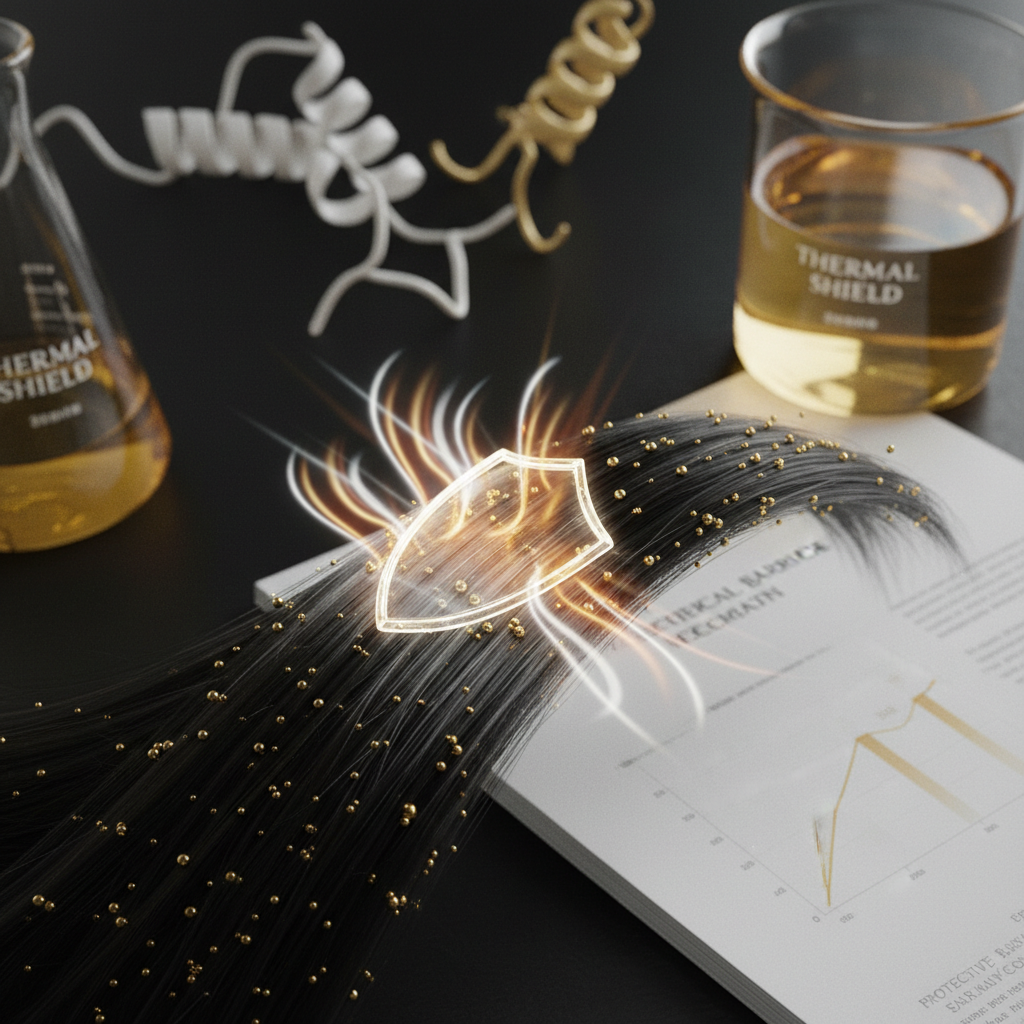
The Thermal Protectants Mechanism operates through several distinct physicochemical actions working concurrently:
- Thermal insulation and heat dissipation: Polymers with low thermal conductivity, such as dimethicone, amodimethicone, and polyquaternium compounds, coat the cuticular surface. This film buffers the hair shaft, slowing the rate of heat penetration into the cortex and spreading high temperatures evenly to prevent localised scorching.
- Moisture retention and bubble hair prevention: When damp hair meets tools heated above 100°C, internal free water vaporises rapidly. The expanding steam can produce microscopic vacuoles inside the cortex, known clinically as bubble hair deformity. Protectants regulate moisture loss, allowing gradual evaporation without explosive vapour pressure.
- Friction reduction: Heated flat iron plates exert severe shear forces against cuticular scales. Silicones and conditioning agents smooth surface irregularities, reducing the coefficient of dynamic friction so tools glide effortlessly, curbing physical cuticular chipping.
- Protein cross-linking support: Hydrolysed wheat, soy, or keratin proteins penetrate micro-fissures in damaged cuticle layers. When exposed to heat, some active polymers form light cross-links across the surface, temporarily reinforcing the cuticle sheath.
Heated Tool Surface (180°C - 230°C)
 │
 ▼
┌─────────────────────────────────────────┐
│ Polymer / Silicone Protective Film │ ◄── Dampens heat transfer, lowers friction
└─────────────────────────────────────────┘
 │ (Diffused, slowed heat)
 ▼
┌─────────────────────────────────────────┐
│ Cuticle (Hydrophobic F-layer / 18-MEA)│ ◄── Retains lipid integrity
└─────────────────────────────────────────┘
 │
 ▼
┌─────────────────────────────────────────┐
│ Cortex (Alpha-Keratin Intermediate │ ◄── Moisture balance preserved;
│ Filaments & Melanin Granules) │ prevents "bubble hair"
└─────────────────────────────────────────┘
What the evidence does not show
Cosmetic science clearly outlines the protective boundaries of these products. Evidence does not show that thermal protectants can:
- Provide complete thermal immunity: Studies indicate that protectants typically reduce heat-induced damage by roughly 30% to 60%, depending on the ingredient system and temperature. They do not make hair impervious to 230°C plates.
- Permanently repair split ends: While film-formers can temporarily glue frayed ends together until the next wash, they cannot biological knit severed keratin fibrils back together.
- Reverse previous heat degradation: Once alpha-helical keratin melts into amorphous forms, cosmetic products cannot restore the native crystalline protein structure.
- Protect hair when applied unevenly: Thermal protectants rely on uniform surface coverage. Patchy application leaves unprotected sections fully vulnerable to thermal shocks.
How different protectant ingredients compare
Different classes of ingredients contribute distinct benefits to the overall protective matrix. The table below outlines how common active agents function on the hair fibre.
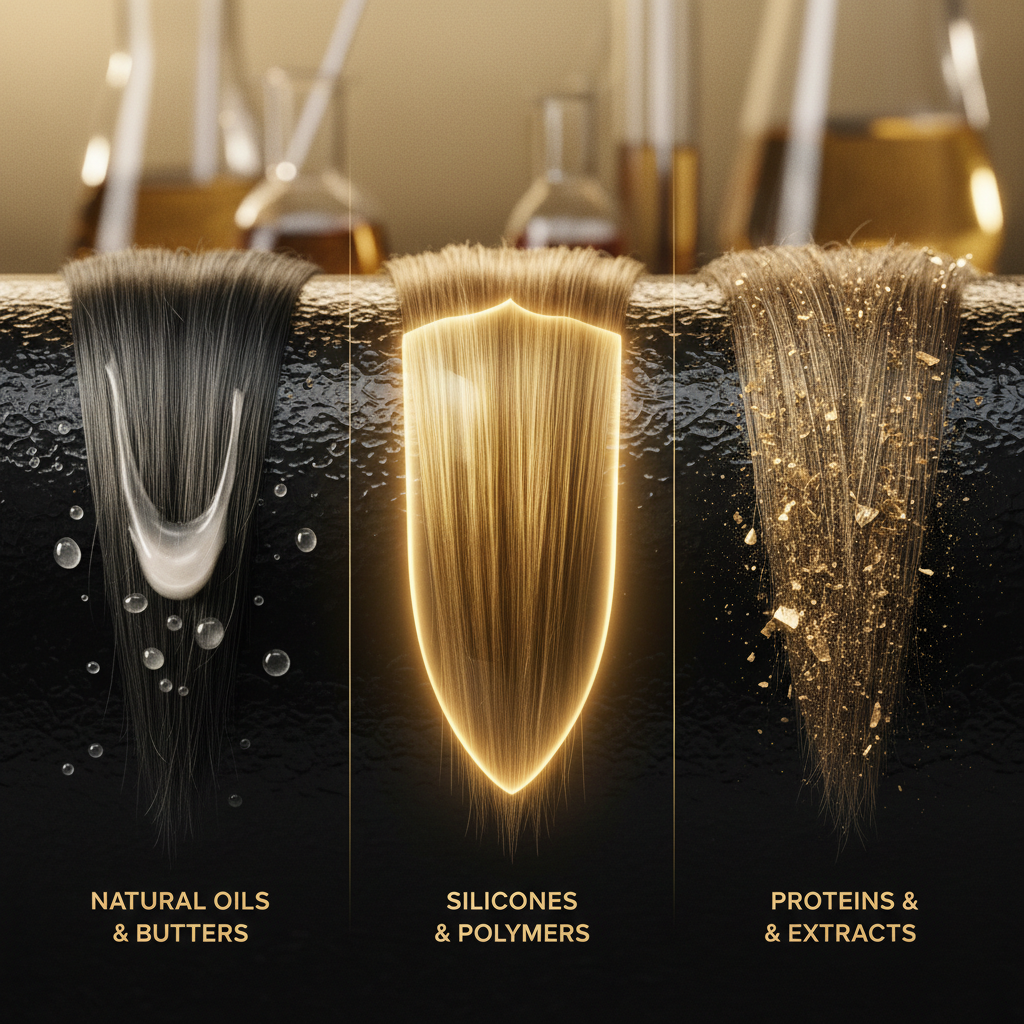
| Ingredient Class | Typical Examples | Primary Mode of Action | Best Suited For |
|---|---|---|---|
| Volatile Silicones | Cyclopentasiloxane, Disiloxane | Even spreading agent; evaporates leaving an ultra-light barrier | Fine hair; blow-drying |
| Non-Volatile Silicones | Dimethicone, Dimethiconol | Low thermal conductivity; substantial friction reduction | Thick, coarse hair; flat irons |
| Cationic Silicones | Amodimethicone | Selectively binds to negatively charged (damaged) areas | Porous, bleached, or chemically treated hair |
| Quaternary Polymers | Polyquaternium-55, Polyquaternium-4 | Forms a flexible film; boosts heat-set hold and tensile strength | Styling sprays, curl retention |
| Hydrolysed Proteins | Hydrolysed wheat or silk protein | Penetrates minor gaps; buffers cuticle against moisture shock | Weakened, chemically compromised hair |
Signs of thermal damage to watch for
Thermal damage degrades hair physically and chemically. Because this damage represents fibre breakage rather than follicular hair loss or shedding, it responds differently to treatment. Common indicators include:
- Rough, catching texture: The loss of 18-MEA and lifted cuticular scales make the hair feel dry and raspy to the touch.
- Trichorrhexis nodosa: The formation of microscopic nodes along the shaft where the cortex has shredded, looking like two paintbrushes pushed together under magnification.
- Premature colour fading: Oxidative degradation of artificial and natural melanin pigments caused by iron temperatures exceeding 180°C.
- Reduced elasticity: The hair snaps abruptly when gently stretched damp, indicating cortical protein denaturation.
- Loss of natural curl pattern: The internal disulphide and hydrogen bond network shifts permanently, leaving curly hair limp or unevenly straight.
Practical steps for effective heat protection
To maximise the efficacy of thermal protectants, follow these evidence-backed application methods:
- Apply to clean, damp hair: Distributing protectants on damp hair allows emulsions to disperse evenly along the length of each strand before styling begins.
- Comb through thoroughly: Finger application leaves gaps. Use a wide-tooth comb to ensure every fibre receives adequate coating.
- Respect moisture thresholds: Never apply flat irons or curling tongs to wet or noticeably damp hair. Ensure hair is completely dry before introducing hot iron plates to eliminate steam blister formation.
- Control tool temperatures: Keep irons below 185°C whenever possible. Keratin transition begins rapidly between 190°C and 230°C.
- Match the product base to the tool: Lightweight sprays containing volatile silicones or hydrolysed proteins work well for blow-drying. Richer creams or serums containing non-volatile silicones perform better for high-heat straightening irons.
When fibre breakage is mistaken for hair loss
It is crucial to distinguish structural hair breakage from shedding or systemic hair loss. Thermal damage causes the hair fibre to snap along its length. If you notice short, jagged pieces of hair on your shoulders or bathroom counter without a small white bulb at the root, you are experiencing breakage from heat stress or mechanical tension.
Conversely, shedding involves the entire hair strand falling from the follicle, bulb intact, commonly driven by hormonal shifts, nutritional deficiencies, or telogen effluvium. True hair loss, such as androgenetic alopecia or scarring alopecias, occurs at the follicle level under the scalp. Heat styling products and hot tools affect only the non-living fibre; they do not cause follicular miniaturisation. If your hair is coming out from the roots in excessive amounts, consult a trichologist or dermatologist rather than changing your heat protectant.
Supporting hair health with Watermans
While hot tools subject hair shafts to significant physical stress, maintaining resilient, fuller-looking hair requires a dual approach: shielding the external fibre and maintaining a clean, nourished scalp environment.
Watermans focuses on non-invasive, high-performance hair and scalp care. Products like Watermans Grow Me Shampoo and Condition Me Conditioner supply strengthening ingredients, including hydrolysed lupin protein, biotin, caffeine, and argan oil. These formulas reinforce hair's surface feel, boost manageability, and improve the appearance of strands subject to routine heat styling, while promoting an optimal environment for natural hair growth at the scalp.
Frequently asked questions about Thermal Protectants Mechanism
How does the Thermal Protectants Mechanism prevent heat damage?
The Thermal Protectants Mechanism works by depositing a thin barrier of low-conductivity polymers and silicones over the hair shaft. This layer buffers heat transfer, smooths cuticular friction, slows down moisture loss, and prevents the rapid water boiling that causes internal cortex fractures.
Can a thermal protectant completely prevent hair breakage?
No, thermal protectants cannot prevent 100% of damage. They typically reduce heat stress by roughly 30% to 60%. If styling tools are kept at excessively high temperatures or held on the hair for too long, heat will penetrate the protective barrier and denature the inner keratin.
Do natural oils like coconut or argan oil work as heat protectants?
Pure plant oils are generally ineffective as primary heat protectants against hot irons. Many natural oils have low smoke points and conduct heat directly into the hair without forming an insulating polymeric film. Some oils can even scorch hair fibres if heated above their smoke threshold.
Should I apply heat protectant before or after blow-drying?
Apply your base protectant to damp hair before blow-drying to shield strands from hot airflow. If you intend to follow blow-drying with a high-heat flat iron or curling wand, lightly mist a dry-use thermal protectant across dry sections before ironing.
Conclusion
Understanding the Thermal Protectants Mechanism clarifies why these formulations are indispensable for modern heated styling. By creating an insulating, low-friction barrier across the cuticular sheath, protectants prevent severe protein degradation, preserve essential moisture balance, and dramatically reduce everyday fibre breakage. While no cosmetic product offers complete thermal immunity against extreme styling temperatures, combining a high-quality thermal protectant with disciplined temperature controls will keep your hair looking smooth, glossy, and structurally resilient over the long term.
Sources and references
- Journal of Cosmetic Science: "Thermal analysis of human hair and the protection provided by styling products" (2011).
- International Journal of Cosmetic Science: "Heat-induced damage to human hair and its prevention by cosmetic treatments" (2014).
- Society of Cosmetic Chemists: "The effects of heat styling tools on hair fibre structure and properties" (2018).
- British Association of Dermatologists: "Hair breakage and acquired hair shaft disorders" (2020).