Telogen Effluvium Guide: Evidence, Triggers, and Recovery
9 min read ·
Understand hair shedding with this Telogen Effluvium Guide, covering causes, timelines, diagnostics, and evidence-based steps for follicular recovery.

Quick answer: This Telogen Effluvium Guide explains the temporary, diffuse hair shedding triggered when physiological stress, illness, or hormonal shifts prematurely push anagen follicles into their resting phase. Telogen effluvium is distinct from permanent hair loss or fibre breakage, presenting as excessive shedding across the entire scalp roughly two to three months after a trigger. The primary limitation is that no topical cosmetic can instantly halt the cycle; resolution requires resolving the underlying physical cause and allowing natural follicular recovery over several months.
Key takeaways
- Telogen effluvium is a reactive, diffuse shedding process, not permanent follicle miniaturisation or breakage along the hair shaft.
- A triggering event (such as high fever, severe illness, rapid weight loss, or childbirth) typically occurs two to three months before excessive shedding begins.
- Under normal conditions, roughly 85 to 90 percent of scalp hairs are growing (anagen) and 10 to 15 percent are resting (telogen); in acute effluvium, up to 30 to 50 percent shift into telogen.
- Diagnosis relies on clinical history, shedding patterns, and a positive hair pull test displaying club hairs with white bulbs.
- Recovery is usually spontaneous once the systemic cause is addressed, with visible regrowth taking three to six months.
Telogen Effluvium Guide: what the evidence shows
Clinical dermatology categorises telogen effluvium as a self-limiting disturbance of the hair cycle. Human hair follicles cycle independently through three main phases: anagen (active growth, lasting two to seven years), catagen (brief regression, lasting two to three weeks), and telogen (resting, lasting roughly 100 days or three months). At the end of telogen, the old club hair is shed (exogen) as a new anagen fibre emerges underneath.

Under baseline conditions, a healthy scalp sheds approximately 50 to 100 club hairs per day. During telogen effluvium, an acute physiological shock disrupts cellular proliferation within the hair matrix. This synchronises a large cohort of anagen hairs, shunting them abruptly into catagen and subsequently into telogen. Because the telogen phase naturally spans roughly two to three months, shedding does not occur at the moment of trauma. Instead, patients experience a dramatic, diffuse loss of hair weeks later, frequently collecting handfuls during washing or brushing.
Published clinical data show that acute telogen effluvium typically runs its course in under six months, provided the triggering event has ceased. However, if an underlying metabolic, nutritional, or systemic issue persists (such as ongoing thyroid dysregulation or chronic ferritin depletion), the condition can transition into chronic telogen effluvium, lasting longer than six months with fluctuating intensity.
What the evidence does not show
There is no scientific evidence that topical shampoos, scalp serums, or cosmetic hair treatments can reverse or freeze the telogen phase once follicles have entered it. After a hair follicle transitions into catagen and telogen, the internal biological clock must run its course; the resting hair will inevitably shed.
Furthermore, clinical research does not support the claim that telogen effluvium destroys the follicular stem cell niche. Unlike scarring alopecias (such as lichen planopilaris or frontal fibrosing alopecia), the stem cells in the follicular bulge remain undamaged. The follicle retains its full architecture and capacity to produce healthy terminal fibres. Cosmetic products that claim to "cure" shedding within days are misrepresenting normal follicle kinetics.
Mechanisms and primary physiological triggers
The hair follicle matrix contains some of the most rapidly dividing cells in the human body. Because of this high metabolic demand, it is exquisitely sensitive to systemic distress, nutritional deficits, and circulating endocrine signals.
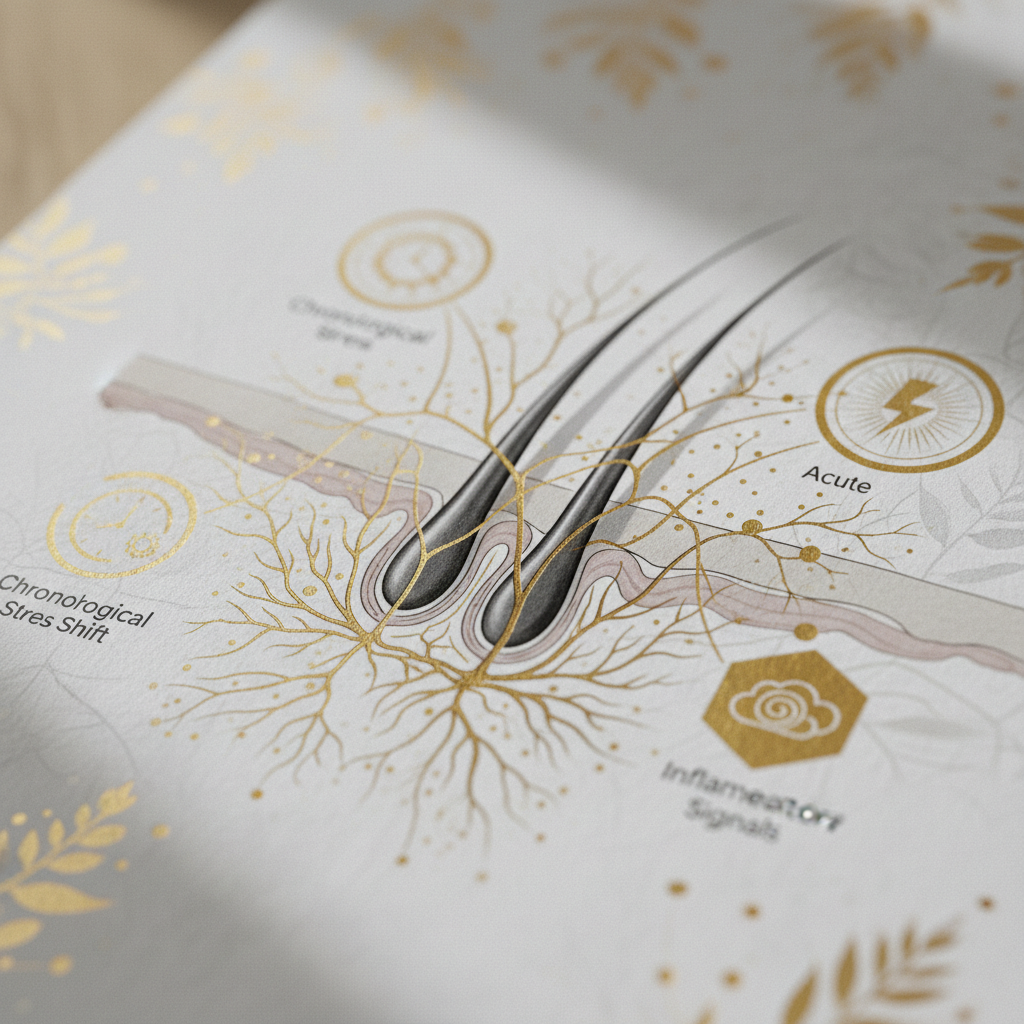
Common verified triggers include:
- Systemic illness and febrile episodes: Severe infections, high fevers, or major surgical interventions divert metabolic resources away from non-vital tissues such as hair follicles.
- Parturition (postpartum effluvium): High circulating oestrogen levels during pregnancy prolong anagen, keeping follicles from entering telogen. Postpartum, the sudden drop in oestrogen synchronises vast numbers of follicles into telogen simultaneously, leading to pronounced shedding around two to four months after delivery.
- Nutritional deprivation and rapid weight loss: Acute calorie restriction, bariatric surgery, or severe protein deficiency deprive matrix keratinocytes of essential building blocks. Ferritin (stored iron) levels below 30 to 50 ug/L are widely noted in clinical literature as a perpetuating factor.
- Endocrine shifts: Hypothyroidism and hyperthyroidism disrupt normal hair cycling, as thyroid hormones directly regulate anagen initiation.
- Psychological trauma: Severe acute stress triggers the release of substance P, cortisol, and neurotrophic factors that promote local follicular inflammation and catagen transition.
Clinical signs: how to identify telogen effluvium
Telogen effluvium presents with specific physical characteristics that differentiate it from other hair complaints. Stylists and individuals can look for several objective indicators:
- Diffuse reduction in volume: Shedding occurs evenly across the entire scalp, including the parietal and occipital regions, rather than concentrating solely at the vertex or temples.
- Intact club hair morphology: Shed hairs feature a small, solid, white or translucent bulb at the proximal end without a surrounding gelatinous sheath.
- Absence of scalp inflammation: The scalp skin appears normal, without erythema, scaling, pustules, or follicular scarring.
- Positive hair pull test: A clinician gently grasps roughly 50 to 60 hairs between thumb and forefinger and applies light traction from the base to the tip. If more than 10 percent (six or more hairs) extract easily without pain, it indicates active shedding.
- Emerging fringe of regrowth: As shedding abates, short, upright hairs of uniform calibre begin to sprout across the scalp, often noticed as a halo of short flyaways along the hairline.
| Characteristic | Telogen Effluvium | Androgenetic Alopecia | Hair Fibre Breakage |
|---|---|---|---|
| Primary Issue | Hair shedding from follicle | Follicular miniaturisation | Structural snapping of shaft |
| Onset | Sudden (2 to 3 months post-event) | Gradual, progressive over years | Progressive with mechanical/chemical stress |
| Distribution | Diffuse across entire scalp | Patterned (crown, vertex, temples) | Localised to treated or stressed zones |
| Shed Fibre Appearance | Full length with white club bulb | Miniaturised, short, thin hairs | Shorter fragments without a bulb |
| Potential for Recovery | High (spontaneous after trigger resolves) | Requires ongoing medical therapy | High (adjust haircare practices) |
Differentiating shedding from breakage and alopecia
Accurate assessment is essential because mistaking fibre breakage for telogen effluvium leads to unnecessary medical anxiety, while mistaking androgenetic alopecia for telogen effluvium delays evidence-based medical management.
Hair breakage occurs along the shaft due to mechanical trauma, heat tools, high pH chemical processing, or environmental weathering. When breakage happens, the root remains anchored in the scalp; the shed pieces have blunt, fractured ends and vary in length. In contrast, telogen effluvium sheds full-length hairs with intact roots.
Androgenetic alopecia involves the androgen-mediated miniaturisation of genetically susceptible follicles. It produces a gradual widening of the central part or recession of the temples, where terminal hairs are progressively replaced by finer, shorter vellus-like hairs. However, an episode of telogen effluvium can unmask underlying androgenetic alopecia by accelerating the shed of already-weakened follicles.
Evidence-based management and recovery
Because acute telogen effluvium is self-limiting, the primary clinical objective is removing the precipitating trigger and supporting the scalp environment during the regrowth phase.
- Targeted blood screening: If shedding persists past three to four months, medical professionals typically request serum ferritin, complete blood count, thyroid-stimulating hormone (TSH), vitamin D, and zinc levels. Correcting deficiencies restores optimal metabolic substrate to the matrix.
- Minimising cosmetic stress: While washing and brushing do not cause telogen effluvium, aggressive detangling or high-tension styling can mechanically snap hairs or dislodge loosened telogen fibres prematurely. Using gentle, pH-balanced (pH 4.5 to 5.5) cleansers and wide-tooth combs minimises unnecessary friction.
- Nutritional adequacy: Ensure sufficient daily protein intake (roughly 0.8 to 1.2 grams per kilogram of body weight) to supply the sulfur-containing amino acids (cysteine and methionine) essential for keratin synthesis.
- Patience with biological timelines: Anagen regrowth proceeds at approximately 1 to 1.25 centimetres per month. Visible density recovery inevitably lags several months behind the cessation of active shedding.
The role of cosmetic scalp support: Watermans
While cosmetic products do not treat medical conditions, maintaining a clean, balanced scalp environment supports the natural appearance of new hair as it emerges. Watermans designs formulations such as Grow Me Shampoo and Condition Me Conditioner with an emphasis on scalp health and cosmetic fibre thickness. Formulated with ingredients like biotin, rosemary, caffeine, niacinamide, and argan oil, these products help cleanse the follicle opening, improve moisture retention, and reduce mechanical breakage on newly sprouted regrowth. This ensures that emerging hair remains pliable and resilient as it regains normal density.
When to seek medical advice
You should arrange an evaluation with a general practitioner or consultant dermatologist if shedding is accompanied by visible circular bald patches, burning, itching, tenderness, or scale on the scalp. Similarly, if diffuse shedding persists beyond six continuous months without improvement, an assessment is required to investigate chronic telogen effluvium, systemic autoimmune disorders, or underlying nutritional malabsorption.
Frequently asked questions about Telogen Effluvium Guide
How long does telogen effluvium typically last?
Acute telogen effluvium generally lasts between three and six months. Shedding typically peaks around six to eight weeks after onset before tapering off, provided the initiating physiological or emotional stressor has resolved. Full cosmetic density recovery takes an additional six to nine months as the new anagen hairs grow out.
Can a Telogen Effluvium Guide help stop shedding immediately?
No guide or product can stop shedding immediately because the hairs being shed entered the resting phase two to three months before falling out. Once anagen terminates and the follicle enters catagen, exogen shedding is biologically inevitable. Interventions focus on preventing new follicles from shifting prematurely.
Does telogen effluvium cause permanent baldness?
Telogen effluvium does not cause permanent baldness. The stem cells within the follicular bulge remain undamaged throughout the shedding cycle. Unless accompanied by a scarring condition or advanced androgenetic alopecia, follicles re-enter the anagen phase and produce normal terminal hairs once physiological equilibrium is restored.
Can washing my hair make telogen effluvium worse?
Washing does not worsen telogen effluvium. The hairs that come out in the shower were already resting in the follicle and detached from their blood supply; the physical act of washing simply dislodges hairs that were destined to fall out within hours or days. Reducing washing frequency often leads to alarming boluses of accumulated shed hair.
Recovery and long-term outlook
Navigating sudden, diffuse shedding can be distressing, but this Telogen Effluvium Guide highlights that the condition is fundamentally a temporary and reversible physiological response. The human hair follicle is resilient; once internal triggers are identified and addressed, the follicular cycle resets, transitioning from resting dormancy back into robust active growth. Prioritising balanced nutrition, monitoring systemic health with a medical professional, and handling emerging fibres with gentle cosmetic care will ensure the best possible environment for full recovery.
Sources and references
- British Association of Dermatologists. "Telogen Effluvium: An Information Leaflet." 2021.
- National Institute for Health and Care Excellence (NICE). "Alopecia: Diagnosis and Management." Clinical Knowledge Summaries, 2023.
- Asghar, F., et al. "Telogen Effluvium: A Review of the Etiology and Pathogenesis." Cureus, 2020.
- Malkud, S. "Telogen Effluvium: A Review." Journal of Clinical and Diagnostic Research, 2015.
- Harrison, S., and Sinclair, R. "Telogen effluvium." Clinical and Experimental Dermatology, 2002.
Find these ingredients in Watermans products
- Zinc: you will find this ingredient in our Hair Vitamins.
- Niacinamide: you will find this ingredient in our Hair Mask.