Sulphate-Free Shampoo Benefits: Evidence, Mechanisms, and Guide
9 min read ·
Explore the real Sulphate-Free Shampoo Benefits: learn how gentle cleansers protect the scalp barrier, preserve cuticle lipids, and extend hair colour life.

Quick answer: Real Sulphate-Free Shampoo Benefits centre on reduced barrier disruption, lower lipid depletion from the hair shaft, and superior colour retention compared to harsh anionic detergents. By replacing aggressive surfactants like sodium lauryl sulphate (SLS) with gentler cleansing agents, these formulas help maintain the scalp acid mantle and preserve fragile cuticle scales. However, the main limitation is that sulphate-free shampoos cannot treat genetic alopecia, and people with very oily scalps or heavy product build-up may require periodic clarifying.
Key takeaways
- Traditional sulphates strip essential sebaceous lipids and structural 18-MEA from the hair cuticle, accelerating fibre friction and breakage.
- Sulphate-free cleansers rely on milder surfactants (such as glucosides, betaines, and isethionates) that clean without destabilising the scalp skin barrier.
- Chemically treated, bleached, and dyed hair shows significantly reduced colour fade when washed with sulphate-free formulations.
- People with sensitive scalps, contact dermatitis, or dry, curly hair types benefit most from omitting sulphates.
- Sulphate-free shampoos do not cure genetic hair loss, and they may require a second lather to remove persistent silicones or sebum.
Sulphate-Free Shampoo Benefits: what the evidence shows
The primary Sulphate-Free Shampoo Benefits documented in cosmetic chemistry stem from the preservation of the hair fibre's outermost protective layer. Hair cuticles are covered by a thin lipid monolayer composed primarily of 18-methyleicosanoic acid (18-MEA). Strong anionic surfactants, particularly sodium lauryl sulphate (SLS) and sodium laureth sulphate (SLES), possess high critical micelle concentrations and aggressive cleansing actions. While they produce dense foam, they simultaneously strip these natural protective lipids away.
When 18-MEA is depleted, the hair shaft becomes hydrophilic, absorbing excess water during washing and swelling excessively. This swelling lifts the cuticle scales, leading to friction, tangle formation, and subsequent mechanical breakage during brushing. Research published in the International Journal of Trichology and cosmetic dermatology literature demonstrates that milder non-ionic and amphoteric surfactants preserve surface hydrophobicity far better than standard sulphate detergents.
For coloured or highlighted hair, the physical mechanism is equally clear. Every time the hair cuticle swells under harsh surfactants and alkaline pH, artificial pigment molecules escape from the cortex. By reducing cuticle swelling and limiting aggressive surfactant penetration, sulphate-free cleansers slow colour wash-out, extending the vibrancy of salon colour.
On the scalp, sulphate-free formulas protect the epidermal barrier. The stratum corneum maintains an acidic pH between 4.5 and 5.5. Harsh sulphates can bind to skin proteins (keratin), causing protein denaturation, trans-epidermal water loss (TEWL), and persistent irritation. Switching to a gentler surfactant system helps keep the scalp barrier intact, reducing itching and flaking caused by barrier disruption.
What the evidence does not show
It is critical to distinguish between marketing claims and biological reality. Removing sulphates from a shampoo formulation provides genuine cosmetic advantages, but it does not alter underlying medical conditions.
Sulphate-free shampoos do not cure or reverse pattern hair loss (androgenetic alopecia), nor do they correct autoimmune conditions like alopecia areata. Hair thinning driven by dihydrotestosterone (DHT), hormonal fluctuations, or nutritional deficiencies occurs beneath the skin within the follicle bulb. A wash-off surfactant cannot resolve follicular miniaturisation on its own.
Furthermore, sulphates are not inherently toxic, carcinogenic, or systematically damaging to every human being. In individuals with high sebum production or those who work in dusty environments, mild sulphates provide efficient cleansing that prevents follicular occlusion and seborrhoeic build-up. Going sulphate-free is an individual choice based on hair porosity, scalp health, and styling habits, not a universal medical mandate.
How surfactants work: the cleansing mechanism
To understand why mild cleansers perform differently, you need to look at how surfactants interact with water and oil. A surfactant molecule has two ends: a hydrophilic (water-attracting) head and a lipophilic (oil-attracting) tail.
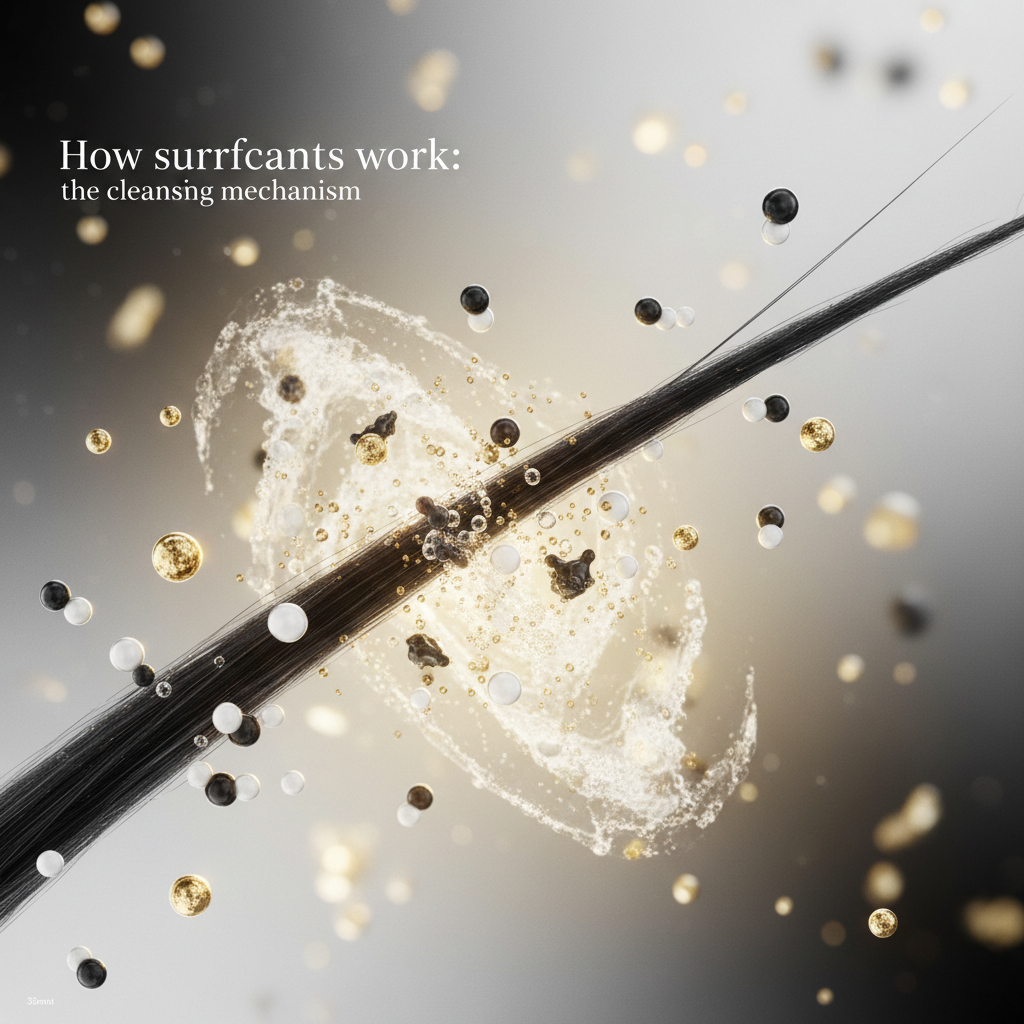
During washing, the lipophilic tails attach to sebum, sweat, styling polymers, and debris. The hydrophilic heads point outwards into the rinse water, forming microscopic spheres called micelles. When you rinse your hair, these micelles carry the trapped oils down the drain.
The difference lies in charge and molecular size:
- Strong Anionics (SLS, ALS): Small molecules with strong negative charges. They penetrate deep into the cuticle layers and stratum corneum, removing excess lipid structures alongside surface grime.
- Amphoteric Surfactants (Cocamidopropyl Betaine): Molecules carrying both positive and negative charges depending on pH. They are gentler, produce stable foam, and soften the harshness of other cleansing agents.
- Non-Ionic Surfactants (Decyl Glucoside, Lauryl Glucoside): Molecules with no electrical charge. Derived from plant sugars, they lift grease without disrupting protein bonds or stripping moisture.
- Mild Anionics (Sodium Cocoyl Isethionate, Disodium Laureth Sulfosuccinate): Larger molecular structures that clean thoroughly without penetrating the skin barrier.
Surfactant Action on Hair Shaft:
[Harsh Sulphate] --> Strips 18-MEA lipid layer --> Cuticle lifts --> Fibre breakage
[Sulphate-Free] --> Removes surface dirt/oil --> Lipid layer intact --> Smooth cuticle
Comparing standard vs sulphate-free cleansers
The table below contrasts standard sulphate-based shampoos with modern sulphate-free alternatives across key functional properties.
| Characteristic | Standard Sulphate Shampoos | Sulphate-Free Shampoos |
|---|---|---|
| Primary Surfactants | Sodium Lauryl Sulphate, Ammonium Lauryl Sulphate | Decyl Glucoside, Sodium Cocoyl Isethionate, Betaines |
| Lather Profile | Dense, rapid, voluminous foam | Creamier, lower lather; often requires more water |
| Scalp Barrier Impact | Higher risk of protein denaturation and dryness | Low barrier disruption; preserves acid mantle |
| 18-MEA Lipid Retention | Low; removes structural cuticle lipids quickly | High; maintains natural cuticle hydrophobicity |
| Colour Retention | Shorter duration; faster artificial pigment loss | Longer duration; minimal cuticle lifting |
| Best Suited For | High sebum output, non-coloured fine hair | Curly, dry, bleached, coloured, or sensitive scalp |
| Cleansing Power | High; strips stubborn heavy silicones effortlessly | Moderate to high; may require double cleansing |
Signs you should switch to a sulphate-free formula
You do not need to wait for severe hair damage to review your cleansing routine. Several everyday hair and scalp signals suggest that your current detergent is too harsh:
- Immediate scalp tightness: If your scalp feels taut, itchy, or dry within an hour of showering, your barrier lipids are being stripped.
- Frizzy, rough texture when wet: When wet hair feels straw-like or tangles instantly under running water, the protective lipid layer has been compromised.
- Accelerated colour fade: If your hair dye loses its tone within three to four washes, strong surfactants are likely lifting your cuticles.
- Excess mechanical breakage: Short snapped hairs on your brush or clothes (without a white bulb at the root) indicate brittle hair shafts weakened by chronic cuticle erosion.
- Rebound greasiness: An excessively stripped scalp sometimes overcompensates by producing more sebum rapidly, creating an uncomfortable cycle of daily washing.
How to get the best results without sulphates
Because sulphate-free formulations behave differently from traditional shampoos, adjusting your washing technique ensures a thorough clean without frustration.
- Drench the hair thoroughly: Mild surfactants require plenty of water to activate. Ensure your hair is soaking wet for at least 60 seconds before applying product.
- Emulsify in your hands first: Rub the shampoo between your wet palms for five seconds before touching your scalp. This disperses the gentle surfactants evenly.
- Double cleanse: If your hair does not lather on the first pass, do not dump more product on your head. Rinse out the initial wash (which breaks down surface oils) and apply a smaller amount for the second wash. It will produce a rich, creamy foam.
- Target the roots, spare the ends: Massage your scalp with your fingertips to lift dead skin and sebum. Allow the lather to run through the mid-lengths and ends as you rinse rather than scrubbing fragile ends directly.
- Clarify periodically if needed: If you use heavy waxes, butters, or non-water-soluble styling products, wash with a clarifying formula once every two to four weeks to prevent residue accumulation.
When hair issues are caused by something else
While choosing the right cleanser improves hair manageability and scalp comfort, hair changes are not always surfactant-related.
If you notice excessive shedding where full-length strands come out with a tiny white bulb on the end, you are experiencing hair shedding (such as telogen effluvium), not breakage. This is triggered by physiological stress, illness, rapid weight loss, or iron deficiency, not your shampoo.
Similarly, progressive widening of your parting or a receding hairline indicates follicular miniaturisation (androgenetic alopecia). No topical surfactant adjustment can counter the underlying genetic sensitivity to dihydrotestosterone.
Chronic scalp issues like thick, adherent greasy scales, red plaques, or pustules may indicate seborrhoeic dermatitis, psoriasis, or folliculitis. These conditions require targeted antifungal or anti-inflammatory management rather than cosmetic shampoo changes alone.
Watermans approaches to balanced scalp care
Formulating effective haircare requires balancing gentle cleansing with scalp vitality. Watermans incorporates this philosophy by designing hair wash routines that avoid harsh, drying detergents, ensuring the scalp environment remains balanced, clean, and nourished. By pairing mild cleansing agents with targeted botanical extracts, caffeine, and strengthening proteins, Watermans focuses on maintaining cuticle integrity and supporting stronger-feeling, fuller-looking hair without unnecessary barrier stress.
Frequently asked questions about Sulphate-Free Shampoo Benefits
What are the main Sulphate-Free Shampoo Benefits for coloured hair?
The biggest advantage is preservation of pigment. Sulphates strip the protective 18-MEA lipid layer from cuticles, causing the hair shaft to swell in water and release colour molecules. Sulphate-free shampoos clean gently without forcing the cuticle open, helping salon colour and gloss treatments last significantly longer.
Can sulphate-free shampoo cause build-up on the scalp?
It can if you use heavy styling products or wash infrequently. Mild surfactants may take longer to dissolve heavy non-water-soluble silicones and thick waxes. If you notice a film on your scalp, simply double cleanse or use a clarifying wash once every fortnight.
Does switching to sulphate-free shampoo stop hair loss?
No. Sulphate-free shampoo reduces hair breakage along the shaft by preserving cuticle smoothness, but it cannot stop hormonal, genetic, or nutritional hair loss at the follicle level. Breakage involves snapped hair fibres, whereas true hair loss occurs beneath the scalp.
Why does sulphate-free shampoo lather less than regular shampoo?
Sulphates produce large, airy bubbles very quickly because of their chemical surface tension properties. Sulphate-free alternatives rely on glucosides or betaines that create micro-lather. The lower foam level cleans just as effectively, but requires more water and physical scalp massage to distribute.
Is sulphate-free shampoo suitable for oily hair?
Yes, but you may need to adjust your technique. Those with oily hair should double cleanse: the first wash breaks down surface sebum, and the second creates a richer lather to thoroughly lift excess oils without triggering rebound dryness.
Final thoughts on Sulphate-Free Shampoo Benefits
Understanding the real Sulphate-Free Shampoo Benefits allows you to make informed decisions based on fibre biology rather than marketing hype. By stepping away from aggressive detergents, you protect the scalp's natural lipid barrier, minimise structural cuticle damage, and prevent premature colour fading. While mild cleansers will not cure medical scalp disorders or reverse genetic thinning, they provide a gentler, more protective foundation for hair strength, elasticity, and overall hair condition.
Sources and references
- International Journal of Trichology, "Shampoos and Conditioners: What a Dermatologist Should Know?", 2015.
- Journal of Cosmetic Dermatology, "Surfactant-induced changes in hair fibre structure and properties", 2018.
- British Association of Dermatologists, "Contact Dermatitis and Scalp Reactions to Surfactants", 2020.
- Robbins, C. R., Chemical and Physical Behavior of Human Hair, 5th Edition, Springer, 2012.