Sulfate Free Shampoos Truth: Evidence, Myths, and Scalp Health
9 min read ·
Discover the Sulfate Free Shampoos Truth: learn how surfactants work, separate marketing myths from cosmetic science, and find the right cleanser for your hair.
Quick answer: Uncovering the Sulfate Free Shampoos Truth reveals that sulfates are neither toxic nor inherently damaging, but rather powerful anionic cleansing agents. Sulfate-free formulas use milder surfactants that clean the scalp with less lipid extraction, making them gentler on sensitive skin, dry curl patterns, and chemically dyed fibres. However, their primary limitation is reduced degreasing power, which can lead to product residue, scalp sebum accumulation, and impaired styling performance if you regularly use heavy silicones or suffer from seborrhoeic dermatitis.
Key takeaways
- Sulfates such as Sodium Lauryl Sulfate (SLS) and Sodium Laureth Sulfate (SLES) are effective, thoroughly tested surfactants, not carcinogens or health hazards.
- Sulfate-free shampoos rely on alternative surfactants (such as glucosides, betaines, and isethionates) that preserve more of the hair cuticle's lipid barrier and reduce artificial colour wash-out.
- People with coarse curls, chemically lightened hair, dry scalps, or contact dermatitis gain the most noticeable benefit from omitting sulfates.
- Fine, oily, or product-heavy hair types often experience buildup, flat roots, and scalp congestion when switching entirely to gentle, sulfate-free cleansers.
- Balancing surfactant strength with your individual scalp sebum production and styling habits matters more than following rigid ingredient bans.
Sulfate Free Shampoos Truth: what the evidence shows
Understanding the Sulfate Free Shampoos Truth requires looking closely at cosmetic chemistry rather than clean-beauty marketing claims. Sulfates are synthetic detergents formed via the reaction of sulfuric acid with fatty alcohols. When added to water, they create microscopic structures called micelles. These micelles grab hydrophobic sebum, sweat, airborne pollutants, and styling residues, allowing them to rinse cleanly down the drain.
Peer-reviewed cosmetic science consistently shows that sulfates are exceptionally capable detergents. Sodium Lauryl Sulfate (SLS) has a small molecular size that allows it to penetrate the outer layer of the skin (the stratum corneum) relatively quickly, where it can temporarily disrupt intercellular lipids. For this reason, dermatologists frequently use SLS as a baseline control irritant in patch testing. In contrast, Sodium Laureth Sulfate (SLES) undergoes an extra process called ethoxylation, creating a larger molecule that cleans thoroughly with significantly lower irritation potential.
The clinical truth is that neither compound damages internal systemic health or causes medical alopecia. Cosmetic safety assessments conducted by the Cosmetic Ingredient Review (CIR) expert panel have repeatedly confirmed that sulfates are safe for use in rinse-off cosmetic formulations when properly buffered.
However, because sulfates strip natural surface lipids (18-methyl eicosanoic acid, or 18-MEA) from the hair cuticle, they increase the negative electrical charge of the hair shaft. This process raises friction between neighbouring fibres, leading to mechanical roughness, cuticle uplift, and accelerated wash-out of artificial dye pigments. Sulfate-free surfactants reduce this lipid depletion, keeping the hair softer to the touch and preserving salon colour for longer periods.
What the evidence does not show
The rise of the sulfate-free movement generated widespread misinformation across salon culture and social media. Scientific testing firmly refutes several common myths:
- Sulfates do not cause follicular hair loss: True hair loss (such as androgenetic alopecia or telogen effluvium) happens beneath the scalp surface within the follicle. Sulfates work entirely on the surface. They do not shut down follicle activity or stunt hair growth cycles.
- Sulfates are not carcinogenic: Extensive reviews by independent health agencies, including the World Health Organization (WHO) and the US Food and Drug Administration (FDA), confirm there is no link between surfactant use in personal care products and cancer risk.
- Sulfate-free does not automatically mean natural or chemical-free: Alternative surfactants such as Sodium Cocoyl Isethionate, Cocamidopropyl Betaine, and Decyl Glucoside are synthesized through industrial chemical reactions, often derived from coconut or palm oils combined with synthetic reagents.
- Sulfate-free does not guarantee zero irritation: Many alternative surfactant systems require higher total concentrations or specific secondary preservatives that can trigger allergic contact dermatitis in sensitive individuals.
The mechanism: how surfactants interact with hair and scalp
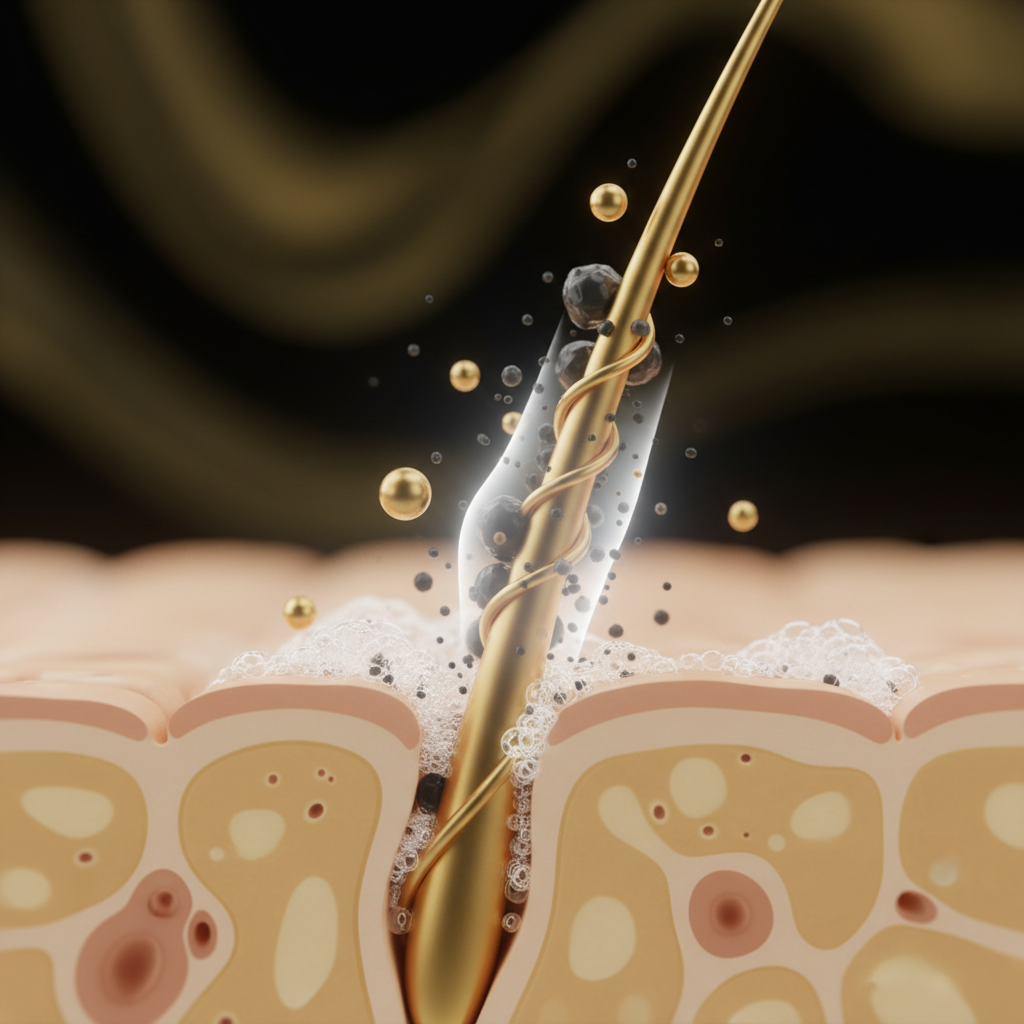
Every surfactant molecule contains two distinct ends: a hydrophilic (water-loving) head and a lipophilic (oil-loving) tail. The electrical charge of the hydrophilic head determines how aggressive the surfactant behaves on keratin fibres and epidermal skin cells.
Surfactant Action on Hair Shaft:

SULFATE (Strong Anionic):
[Water] <-- [Strong Negative Head] === [Lipophilic Tail] --> [Binds Sebum & 18-MEA Lipids]
Result: Strips total oil, swells cuticle, lifts 18-MEA barrier, leaves high negative charge.

SULFATE-FREE (Mild Anionic / Amphoteric / Non-Ionic):
[Water] <-- [Bulky / Neutral Head] === [Lipophilic Tail] --> [Binds Excess Surface Oil]
Result: Leaves natural lipid layer intact, maintains lower cuticle swelling, gentler rinse.
When you massage a standard sulfate shampoo into wet hair, the strong anionic charge repels the naturally negative charge of the keratin fibre. This ionic repulsion forces the outer cuticle scales to swell and lift slightly. While this allows deep clearing of styling polymer buildup, it also removes the vital 18-MEA protective fatty acid layer bonded to the cuticle exterior.
Sulfate-free formulas solve this by pairing gentler surfactants together:
- Amphoteric surfactants (e.g., Cocamidopropyl Betaine): Carry both positive and negative charges depending on pH, dramatically lowering overall irritation.
- Non-ionic surfactants (e.g., Decyl Glucoside, Lauryl Glucoside): Carry no electrical charge, producing exceptionally gentle cleansing that does not disturb cuticle alignment.
- Mild anionic alternatives (e.g., Sodium Lauroyl Methyl Isethionate, Disodium Laureth Sulfosuccinate): Feature larger, bulkier chemical structures that cannot penetrate the stratum corneum easily, preserving scalp moisture.
Comparing traditional sulfates and sulfate-free alternatives
| Surfactant Type | Common Ingredient Names | Cleansing Power | Irritation Potential | Cuticle Swelling & Colour Fade | Best Suited For |
|---|---|---|---|---|---|
| Primary Sulfates | Sodium Lauryl Sulfate, Ammonium Lauryl Sulfate | Very High (10/10) | Moderate to High | High (rapid colour washout) | Heavy product users, high sebum, clarifies well |
| Ethoxylated Sulfates | Sodium Laureth Sulfate, Ammonium Laureth Sulfate | High (8/10) | Low to Moderate | Moderate | Normal to oily scalps, budget-conscious routines |
| Isethionates & Taurates | Sodium Cocoyl Isethionate, Sodium Methyl Cocoyl Taurate | Moderate to High (7/10) | Low | Low | Colour-treated hair, daily washers, balanced scalps |
| Betaines & Sultaines | Cocamidopropyl Betaine, Cocamidopropyl Hydroxysultaine | Mild to Moderate (5/10) | Very Low | Minimal | Sensitive skin, infant care, dry or fragile hair |
| Glucosides | Decyl Glucoside, Coco-Glucoside | Mild (4/10) | Very Low | Minimal | Highly sensitive scalps, tightly coiled textures |
Signs you should switch to a sulfate-free shampoo
Knowing the Sulfate Free Shampoos Truth helps you identify whether your current cleanser is actively compromising your hair fibre integrity or scalp comfort:
- Rapid colour loss: Permanent, semi-permanent, or toner dyes wash out within three to four washes, revealing brassy undertones prematurely.
- Mid-shaft fibre breakage: Your hair snaps easily during routine styling. The loss of protective surface lipids leaves cuticle edges jagged, causing hairs to catch and break against one another.
- Persistent post-wash tightness: Your scalp feels uncomfortably taut, itchy, or parched within thirty minutes of stepping out of the shower.
- Frizz in humid environments: High cuticle damage from harsh washing creates a porous fibre that drinks atmospheric moisture, expanding unevenly into frizz.
- Loss of curl definition: Naturally curly, coily, or wavy hair patterns require internal hydration to maintain their shape. Excessively stripped curls lose elasticity and look stringy.
When a sulfate-free shampoo is not enough
While sulfate-free cleansers are an excellent tool, they are not universally superior. In certain situations, switching entirely to mild formulas creates distinct problems:
- Seborrhoeic dermatitis and dandruff: An overgrowth of the yeast Malassezia feeds on unremoved scalp sebum. Milder sulfate-free cleansers often fail to remove adequate oil, leading to flaking, inflammation, and worsening scalp itching.
- Heavy silicone buildup: Insoluble silicones (such as non-functionalised Dimethicone or Dimethiconol) require stronger detergency to budge. Continued use of mild cleansers over heavy silicones leads to heavy, limp strands that resist moisture absorption.
- Excessively hard water: Hard water contains dissolved calcium and magnesium (often exceeding 180 mg/L). Mild surfactants struggle to foam or rinse cleanly in mineral-dense water, forming insoluble curds that coat the scalp.
In these circumstances, rotating in an occasional clarifying wash or using a targeted scalp treatment keeps both hair fibres and follicle environments clean.
The Watermans perspective: balanced botanical cleansing
A well-formulated cleanser does not require harsh primary sulfates to deliver clean hair and a refreshed scalp. Watermans focuses on purposeful formulation, combining gentle, high-performance cleansing bases with active natural botanicals.
By avoiding harsh, stripping sulfates and instead prioritizing follicle-supporting ingredients like biotin, rosemary, caffeine, and argan oil, the formula preserves the hair cuticle's structural integrity while creating an optimal, balanced environment for stronger-feeling hair. This balanced cleansing approach ensures hair retains moisture and vitality without leaving behind suffocating buildup.
When to seek professional advice
If your scalp shows signs of continuous irritation, severe scaling, burning sensations, or sudden patchy hair shedding, do not rely solely on switching shampoo ingredients. These symptoms usually point to underlying conditions like scalp psoriasis, severe contact dermatitis, or an autoimmune reaction.
Consult a registered trichologist, dermatologist, or your GP. A clinical expert can run a scalp scrape, review your medical history, or carry out patch testing to isolate true allergens versus simple surfactant sensitivity.
Frequently asked questions about Sulfate Free Shampoos Truth
What is the most important Sulfate Free Shampoos Truth to understand?
The main Sulfate Free Shampoos Truth is that sulfates are safe, effective cleaners rather than toxic chemicals, but they can be unnecessarily harsh on dry, curly, or colour-treated hair. Sulfate-free formulas use milder detergency to protect the hair fibre's outer cuticle and reduce scalp moisture loss, though they may struggle to clear heavy product buildup.
Do sulfate-free shampoos prevent hair loss?
No. Sulfate-free shampoos do not prevent or treat medical hair loss (such as androgenetic alopecia). They reduce hair breakage by leaving natural cuticle lipids intact, which keeps individual fibres stronger and less prone to snapping, but they have no direct effect on hair follicle cycles beneath the skin.
Why does my hair feel greasy after using sulfate-free shampoo?
Gentle surfactants do not strip sebum as aggressively as SLS or SLES. If you have an oily scalp, wash infrequently, or use products containing insoluble silicones and heavy waxes, a mild sulfate-free shampoo may leave behind residue that makes your roots feel heavy or flat.
Do sulfate-free shampoos lather less than traditional options?
Yes, generally. Traditional sulfates generate dense, voluminous flash foam very quickly. Alternative surfactants (like glucosides or isethionates) produce a softer, finer lather and require more water friction during application to spread evenly through the hair.
Can using a sulfate-free shampoo trigger dandruff?
Indirectly, yes. If your scalp naturally produces high amounts of sebum, a mild sulfate-free cleanser might leave enough oil behind to feed Malassezia yeast. This yeast overgrowth triggers inflammation, rapid epidermal cell turnover, and visible dandruff flakes.
Demystifying your hair cleansing choices
Navigating the Sulfate Free Shampoos Truth boils down to assessing your unique hair type, styling products, and scalp biology. Sulfates are neither dangerous villains nor essential heroes; they are simply strong detergents designed for deep oil removal. If your priority is preserving salon colour, nurturing delicate curls, or preventing cuticle roughness, reaching for a well-balanced sulfate-free formula is a sound, evidence-based choice. Match your cleansing strength to your hair's genuine needs, and your scalp barrier and hair condition will reflect the balance.
Sources and references
- Cosmetic Ingredient Review (CIR) Expert Panel. "Final Report on the Safety Assessment of Sodium Lauryl Sulfate and Ammonium Lauryl Sulfate." International Journal of Toxicology, 1983.
- Robbins, Clarence R. Chemical and Physical Behavior of Human Hair. 5th ed., Springer, 2012.
- D'Souza, Paschal, and Sanjay K. Rathi. "Shampoo and Conditioners: What a Dermatologist Should Know?" Indian Journal of Dermatology, vol. 60, no. 3, 2015, pp. 248 to 254.
- US Food and Drug Administration (FDA). "Cosmetics Safety Q&A: Shampoos and Cleansers." 2022.
- British Association of Dermatologists (BAD). "Contact Dermatitis and Cosmetic Ingredients." Patient Information Leaflet, 2021.
Find these ingredients in Watermans products
- Biotin: you will find this ingredient in our Hair Growth Shampoo.