Sulfate Free Hair Care: Mechanisms, Evidence, and Routine Guidance
9 min read ·
A clinical guide to Sulfate Free Hair Care: understand surfactant chemistry, scalp barrier preservation, cuticle protection, and how to choose the right cleansing routine.
Quick answer: Sulfate Free Hair Care refers to cleansers formulated without harsh anionic surfactants such as sodium lauryl sulfate (SLS) and sodium laureth sulfate (SLES). Instead, these formulas rely on gentler cleansing agents that lift excess sebum and dirt without stripping the hair fibre of essential natural lipids or destabilising the scalp moisture barrier. The main limitation is that sulfate-free formulas cleanse more mildly, meaning they may take longer to remove heavy water-insoluble silicones or significant scalp oil buildup.
Key takeaways
- Sulfates are potent anionic surfactants designed to bind oil and water, but they can aggressively strip the protective f-layer (18-methyleicosanoic acid) of the hair cuticles.
- Sulfate Free Hair Care helps maintain cosmetic colour vibrancy, reduces cuticle friction, and supports natural moisture retention in dry, textured, or chemically processed hair.
- Gentler alternative surfactants include cocamidopropyl betaine, sodium cocoyl isethionate, and glucoside compounds derived from coconut or glucose.
- Switching to a sulfate-free routine will not prevent or treat genetic hair loss, because androgenetic alopecia is driven by follicular sensitivity to dihydrotestosterone (DHT), not surface detergents.
- Those who regularly use heavy, non-water-soluble styling waxes or heavy dimethicones may require occasional clarifying washes to prevent cosmetic buildup.
Sulfate Free Hair Care: what the evidence shows
Dermatological and cosmetic chemistry research demonstrates that the primary benefit of Sulfate Free Hair Care lies in surface barrier preservation. Traditional cleansing formulations rely heavily on alkyl sulfates, such as sodium lauryl sulfate (SLS), which possess a high critical micelle concentration. When massaged into the hair and scalp, these surfactants rapidly emulsify sebum, but their small molecular size allows them to penetrate into the outer layers of the stratum corneum and inner hair cortex.
Research published in the International Journal of Trichology and dermatology literature confirms that SLS can denature structural keratin proteins and disrupt intercellular lipid bilayers in the scalp skin. This disruption increases transepidermal water loss (TEWL), leading to erythema, itching, and flaking. On the hair shaft itself, strong anionic detergents elevate the hair cuticle, increasing friction between adjacent fibres. This cuticle lifting accelerates colour fade in dyed hair, as water-soluble dye molecules wash out more freely through swollen cuticles.
By contrast, sulfate-free cleansers deploy larger, amphoteric or non-ionic surfactant molecules such as decyl glucoside, coco-glucoside, and disodium laureth sulfosuccinate. These agents have larger molecular weights and lower irritation potentials. Because they do not penetrate the stratum corneum or aggressively deplete intercellular ceramides, they preserve the hydrophobic outer lipid envelope of the hair fibre, leaving hair feeling smoother and less prone to mechanical breakage during brushing.
What the evidence does not show: common myths
Despite popular marketing claims, clinical evidence does not support every assertion made about Sulfate Free Hair Care.
First, sulfates do not cause systemic toxicity or cancer. Thorough safety reviews conducted by the Cosmetic Ingredient Review (CIR) Expert Panel and regulatory authorities like the European Commission have repeatedly confirmed that sulfates are safe for cosmetic rinse-off use. The issue with sulfates is surface irritation and fibre drying, not systemic organ toxicity.
Second, sulfates do not cause pattern hair loss. Alopecia areata, telogen effluvium, and androgenetic alopecia occur within the dermal papilla beneath the scalp surface. While aggressive surfactants can cause superficial scalp dermatitis that triggers transient shedding if left inflamed, they do not trigger genetic miniaturisation of follicles.
Finally, sulfate-free shampoos are not entirely chemistry-free. To clean effectively, any cleanser must contain surface-active molecules. A product labelled sulfate-free merely replaces one class of surfactant with another, gentler class.
The cleaning mechanism: sulfates vs gentler surfactants
Every shampoo relies on surfactants to clean. Surfactants have a hydrophilic (water-loving) head and a lipophilic (oil-loving) tail. When mixed with water, they self-assemble into spherical structures called micelles. The lipophilic tails encapsulate dirt, oil, and product residue, while the hydrophilic heads remain suspended in the rinse water, allowing the trapped grime to wash away cleanly down the drain.
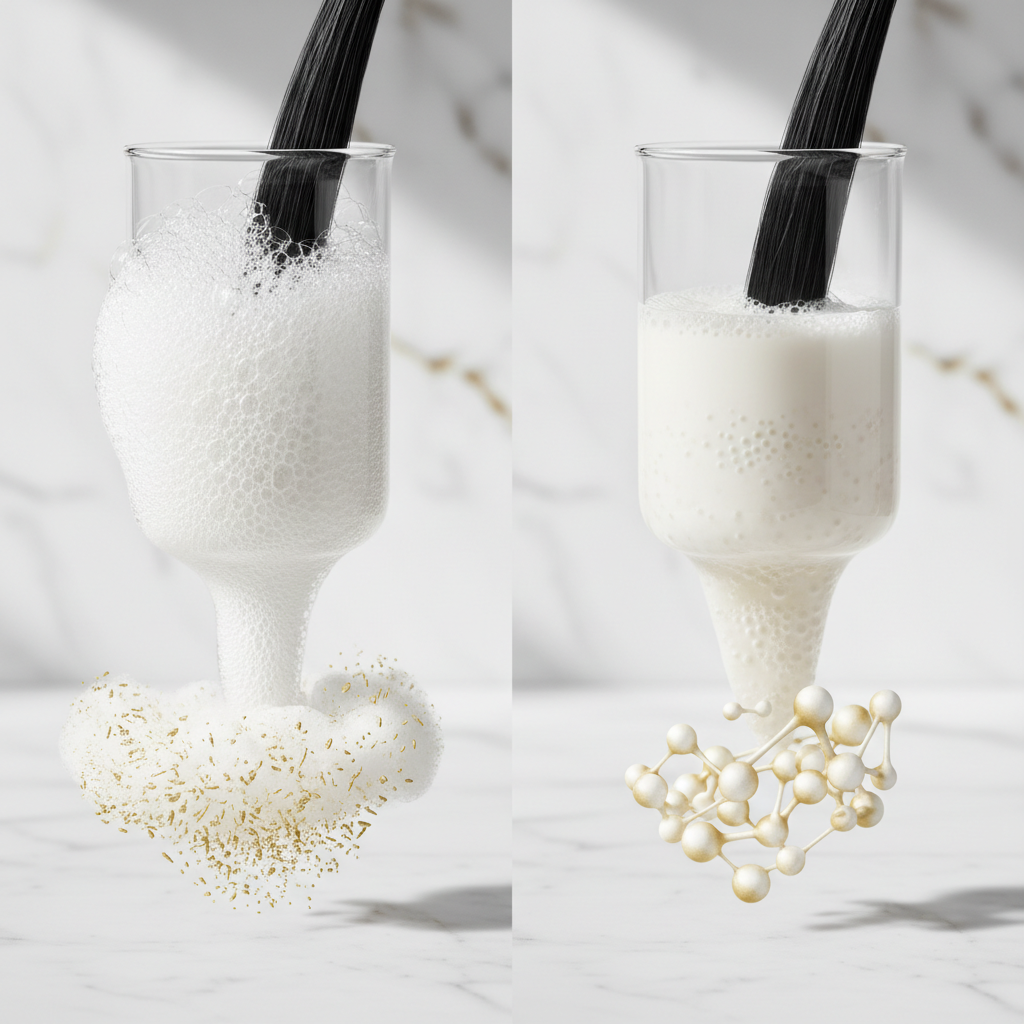
The distinction between conventional cleansers and Sulfate Free Hair Care lies in surfactant charge, molecular geometry, and lipid selectivity:
- Alkyl Sulfates (e.g., SLS): Small, highly charged anionic molecules. They exhibit rapid wetting and intense degreasing action. They strip natural sebum, cosmetic oils, and natural scalp moisture indiscriminately.
- Alkyl Ether Sulfates (e.g., SLES): Ethoxylated to increase molecular size, making them milder than SLS, but still capable of causing dryness with frequent exposure.
- Isethionates and Taurates (e.g., Sodium Cocoyl Isethionate): Mild anionic surfactants derived from coconut fatty acids. They produce a creamy, dense lather and clean effectively without penetrating the skin barrier.
- Betaines (e.g., Cocamidopropyl Betaine): Amphoteric surfactants that carry both positive and negative charges depending on pH. They mitigate the harshness of other cleansing agents and deliver antistatic conditioning.
- Glucosides (e.g., Coco-Glucoside, Decyl Glucoside): Non-ionic surfactants derived from plant starches and fatty alcohols. They carry no electrical charge, producing exceptionally low skin irritation and zero protein denaturation.
| Feature | Conventional Sulfate Cleansers | Sulfate-Free Cleansers |
|---|---|---|
| Primary Surfactants | Sodium Lauryl Sulfate, Ammonium Lauryl Sulfate | Sodium Cocoyl Isethionate, Coco-Glucoside, Betaines |
| Cuticle Interaction | Lifts cuticles, increases fibre swelling and friction | Maintains flat cuticles, preserves f-layer lipids |
| Colour Retention | Faster artificial dye leaching | Significantly slower colour washout |
| Scalp Barrier Impact | Higher risk of transepidermal water loss (TEWL) | Supports natural lipid barrier and low irritation |
| Sebum Removal | Aggressive, total degreasing | Balanced, targeted sebum removal |
| Lather Profile | Rapid, airy, high-volume foam | Denser, creamier, fine-bubble foam |
| Buildup Removal | Removes heavy styling polymers easily | May require extra rinsing or double cleansing for heavy silicones |
Signs you should switch to a sulfate-free routine
Your hair and scalp provide clear diagnostic clues when a cleansing routine is overly aggressive:
- Persistent mid-shaft dryness: The scalp feels oily within twenty-four hours, but the mid-lengths and ends feel like straw. This often indicates rebound sebum production triggered by barrier stripping.
- Rapid salon colour fading: Semi-permanent or permanent hair dye washes out substantially within two to three weeks of application.
- Tight, reactive, or itchy scalp: The skin on your scalp feels taut, irritated, or shows signs of micro-flaking immediately after washing.
- High cuticle frizz: Curls and waves lose their natural clumping pattern, showing raised, dry frizz along the perimeter of the hair shaft.
- Chemical processing fatigue: Hair that has undergone bleaching, perming, or chemical straightening has a compromised cuticle structure that cannot tolerate harsh detergency.
How to use sulfate-free products effectively
Because alternative surfactants behave differently in water than traditional sulfates, adapting your washing technique ensures optimal results:
- Saturate thoroughly with water: Sulfate-free surfactants need abundant water to activate their lather. Drench your hair under the shower for at least one full minute before applying product.
- Emulsify in your palms first: Rub the cleanser between your hands with a splash of water to start the micelle formation before touching your scalp.
- Target the roots: Focus your physical cleansing on the scalp skin, nape, and hairline where sebum and dead skin cells accumulate. Allow the lather to run through the lengths naturally when rinsing.
- Consider a double cleanse: If you wash your hair only once or twice a week, the first application may produce minimal foam as it breaks down heavy surface sebum. Rinse and apply a smaller second amount, which will produce a rich, creamy lather.
- Rinse meticulously: Spend thirty seconds longer rinsing than you normally would. Gentler surfactants adhere softly to hair fibres and need thorough rinsing to prevent dullness.
Healthy scalp support and professional care
For individuals seeking to optimise hair vitality and scalp balance, choosing a high-performance routine is essential. Watermans develops luxury hair care formulations engineered around gentle cleansing principles. Watermans GrowMe Shampoo is formulated without harsh sulfates, combining revitalising natural extracts such as biotin, rosemary, caffeine, and argan oil with skin-kind cleansing agents. This approach preserves the delicate epidermal acid mantle of the scalp (pH 4.5 to 5.5) while reinforcing hair fibre resilience against daily styling breakage.
If you experience persistent scalp scaling, thick silvery plaques, intense burning, or patchy circular shedding, these symptoms are not caused by your shampoo choice. They indicate clinical conditions such as seborrhoeic dermatitis, psoriasis, or an active scarring or non-scarring alopecia. Consult a registered trichologist, dermatologist, or your GP for an accurate diagnostic evaluation.
Frequently asked questions about Sulfate Free Hair Care
Does Sulfate Free Hair Care help with hair growth?
Sulfate-free formulas do not directly alter hair follicle genetics or speed up biological hair growth rates. However, they create an optimal scalp environment by preventing chronic barrier inflammation and reducing mechanical breakage along the hair shaft. By minimising cuticle damage, hair retains length better and appears fuller over time.
Why does sulfate-free shampoo lather less than regular shampoo?
Traditional sulfates produce high-volume foam quickly because of their chemical structure, which traps air rapidly. Alternative surfactants create smaller, creamier bubbles that may feel less foamy initially. This lack of massive lather does not mean the hair is not getting clean; cleansing occurs through chemical micelle attraction, not bubble volume.
Can you use Sulfate Free Hair Care if you have an oily scalp?
Yes, you can use sulfate-free formulas on an oily scalp. Over-cleansing with aggressive sulfates can trigger reactive sebaceous gland activity, worsening oiliness over time. Sulfate-free formulas gently clear surface oils while preserving balance. If excess sebum persists, washing more frequently or performing a thorough double cleanse usually resolves it.
Do I need to avoid silicones when using sulfate-free cleansers?
You do not need to avoid all silicones. Volatile silicones (like cyclopentasiloxane) evaporate naturally, and PEG-modified silicones are water-soluble. However, heavy, non-soluble silicones (like pure dimethicone or amodimethicone) can build up over several weeks if you use only very mild glucoside cleansers, requiring an occasional clarifying wash.
Is sulfate-free cleansing recommended after keratin treatments?
Yes, professional stylists routinely recommend sulfate-free hair cleansers after keratin treatments, Brazilian blowouts, and chemical straightening. Sulfates strip away the protective protein coatings applied during salon smoothing treatments, whereas sulfate-free alternatives clean the fibre gently, substantially prolonging the longevity of the smoothing result.
A balanced approach to Sulfate Free Hair Care
Sulfate Free Hair Care represents a functional shift toward barrier preservation and fibre integrity. By moving away from aggressive industrial degreasers and choosing scientifically balanced, milder surfactant systems, you protect the hair cuticles, retain cosmetic colour, and support long-term scalp comfort. Tailoring your wash frequency and cleansing technique to your specific hair porosity and scalp type will ensure your hair remains vibrant, clean, and strong.
Sources and references
- Cosmetic Ingredient Review Expert Panel. "Final Report on the Safety Assessment of Sodium Lauryl Sulfate and Ammonium Lauryl Sulfate." International Journal of Toxicology, 1983.
- Draelos, Z. D. "Essentials of Hair Care often Neglected: Hair Cleansing." International Journal of Trichology, 2010.
- Robbins, C. R. Chemical and Physical Behavior of Human Hair. 5th ed., Springer-Verlag, 2012.
- Trüeb, R. M. "Shampoos: Ingredients, benefits and adverse effects." Journal of the European Academy of Dermatology and Venereology, 2001.
- Gavazzoni Dias, M. F. "Hair Cosmetics: An Overview." International Journal of Trichology, 2015.