Silicone in Haircare: Science, Benefits, and Myths Explained
8 min read ·
Learn the truth about silicone in haircare: how it shields the cuticle, reduces breakage, manages frizz, and how to prevent polymer build-up.
Quick answer: Silicone in haircare refers to synthetic polymers derived from silica that form a protective, hydrophobic film over the hair cuticle. They reduce combing friction by up to 50 percent, smooth raised scales, seal in moisture, and provide thermal protection against styling tools. However, silicone in haircare does not repair internal protein bonds, and certain non-volatile forms can accumulate over repeated washes if hair is not periodically clarified, leading to limp, dull strands that resist hydration.
Key takeaways
- Silicones act as synthetic conditioning agents that coat the hair fibre, reducing mechanical friction, locking out humidity, and preventing surface moisture loss.
- They fall into three main categories: non-soluble (such as dimethicone), water-soluble (such as PEG-modified dimethicones), and volatile or evaporative (such as cyclomethicone).
- Silicones do not cause scalp toxicity, hormonal disruption, or follicular hair loss when formulated in standard cosmetic concentrations.
- Heavy build-up from non-soluble polymers can weigh down fine textures, flatten natural curl patterns, and block moisture uptake over time.
- Clarifying shampoos using anionic surfactants (such as sodium laureth sulfate or sodium C14-16 olefin sulfonate) effectively strip silicone residues without damaging the cortex.
Silicone in haircare: what the evidence shows
Silicone in haircare has been heavily researched in cosmetic chemistry for over four decades. When applied to hair, silicones deposit a thin microscopic sheath over the cuticle, the outermost layer of overlapping keratin cells. Human hair has an isoelectric point around pH 3.67, carrying a net negative electrical charge that increases significantly when bleached, coloured, or weathered. While silicones are largely non-ionic, their low surface tension (typically 20 to 22 mN/m, compared to roughly 72 mN/m for water) allows them to spread effortlessly across irregular, damaged fibre surfaces.
Cosmetic science demonstrates that this uniform film delivers several measurable benefits:
- Friction reduction: Studies published in the Journal of Cosmetic Science show that dimethicone application reduces dry and wet combing force by 40 to 65 percent. By smoothing the surface, the film prevents inter-fibre snagging, directly decreasing mechanical hair breakage during brushing.
- Moisture retention and frizz defence: Silicones are hydrophobic. By sealing the porous cuticle layer, they prevent ambient humidity from penetrating the cortex (which causes hydrogen bonds to collapse and hair to frizz) while retaining existing internal water balance.
- Thermal buffering: While silicones cannot stop intense heat from degrading keratin, their uniform barrier slows heat transfer and prevents cuticle blistering during blow-drying or flat-ironing at temperatures up to 200 degrees Celsius.
- Light reflectance: The flat, polished surface created by silicone films reflects light evenly, creating instant cosmetic shine and slip.
What the evidence does not show
Public discourse on social media frequently accuses silicones of severe harms that peer-reviewed literature does not support.
First, silicone in haircare does not cause hair loss or follicular miniaturisation. Silicones are large, stable molecules that cannot penetrate living dermal tissue or clog the follicle opening in a way that chokes hair growth. Independent assessments by the Cosmetic Ingredient Review (CIR) Expert Panel have repeatedly verified that dimethicones and related polymers are non-toxic, safe, and biologically inert when applied topically to human skin.
Second, silicones do not "suffocate" the hair shaft. Hair fibres outside the scalp are biologically dead filaments of cross-linked keratin proteins, water, lipids, and trace minerals. Dead tissue does not breathe or consume oxygen.
Third, silicones are not internal repair agents. While marketing descriptions often boast about "split end menders", silicones merely act as a temporary cosmetic adhesive. They stick split ends together and smooth the ragged edges until your next wash. They do not cross-link broken disulphide bonds or rebuild missing polypeptide chains.
Mechanisms and types of silicone
Not all silicones perform identically. Their chemical structures dictate how tightly they adhere to the cuticle and how easily you can wash them out.
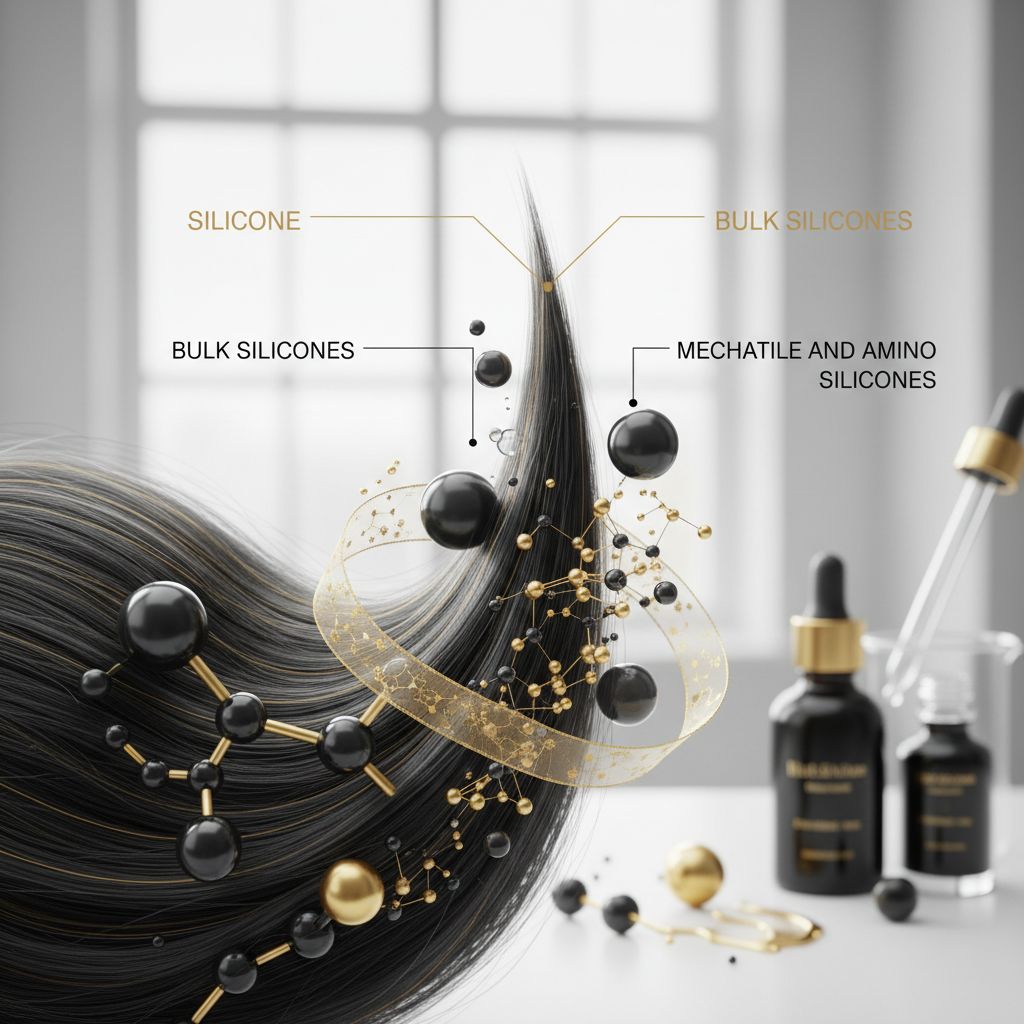
| Silicone Type | Common INCI Examples | Water Solubility | Primary Function | Removal Method |
|---|---|---|---|---|
| Non-Soluble Silicones | Dimethicone, Dimethiconol, Amodimethicone | Insoluble in pure water | High shine, heavy frizz control, significant friction reduction | Anionic surfactants (e.g. SLES, C14-16 olefin sulfonate) |
| Water-Soluble Silicones | PEG-8 Dimethicone, Dimethicone Copolyol, PEG/PPG-20/15 Dimethicone | Readily soluble in water | Light slip, conditioning without weight, detangling | Plain warm water or gentle non-ionic/amphoteric cleansers |
| Volatile Silicones | Cyclopentasiloxane (D5), Cyclomethicone | Evaporates into air | Spreading agent, lightweight initial shine, zero residual weight | Evaporates naturally, no washing required |
| Amine-Functionalised | Amodimethicone, Bis-Aminopropyl Dimethicone | Targeted deposition | Binds selectively to damaged (negatively charged) areas; resists multi-layer build-up | Standard clarifying shampoo |
Amodimethicone deserves special mention. Because of its amine groups, it carries a positive charge in cosmetic formulations. It seeks out the negatively charged, damaged sections of the cuticle, adheres firmly, and then repels further silicone deposition. This self-limiting behaviour stops it from creating excessive build-up compared to standard dimethicone.
Signs of silicone build-up
While silicones are safe, heavy non-soluble variants can gradually accumulate if you regularly wash with mild, sulfate-free cleansers or co-washes. Watch for these physical signs:
- Chronic dryness despite deep conditioning: Water and conditioning humectants cannot pass through an intact, heavy hydrophobic silicone layer. The hair feels straw-like underneath.
- Loss of natural curl definition: Wavy and curly hair patterns become weighed down, stringy, or elongated.
- Flaking or dullness: Layer upon layer of dried polymer can crack, giving the hair shaft a dusty, lacklustre appearance under direct light.
- Resistance to colour processing: A thick polymer shield can impede chemical penetration, causing semi-permanent or permanent hair dye to take unevenly.
Managing silicone: routines and alternatives
You do not need to purge silicones from your routine entirely to enjoy healthy hair. The key is matching the silicone type to your hair texture and pairing it with appropriate cleansing habits.
If you have fine, low-density, or wavy hair, seek out volatile silicones (such as cyclomethicone) or water-soluble silicones (such as PEG-12 dimethicone). These provide glide and brushability without pulling down natural volume.
If you have thick, highly porous, bleached, or coarse hair, heavier dimethicones and amodimethicones provide the substantial barrier you need against friction and moisture loss. To prevent build-up, use an anionic clarifying shampoo (pH 5.5 to 6.5) every three to four weeks.
For those who prefer silicone-free options, natural emollients such as squalane, argan oil, and plant-derived hemisqualane offer surface slip and moisture sealing. However, natural oils do not match the low friction coefficients or thermal buffering capacity of synthetic silicone polymers.
When the cause may be something else
If your hair is shedding excessively or snapping in high numbers, silicones are unlikely to be the primary culprit:
- Follicular shedding (Telogen Effluvium): If you are shedding more than 100 to 150 hairs daily from the root (visible white bulb intact), this is triggered by physiological stress, illness, iron deficiency, or thyroid fluctuations, not cosmetic ingredients.
- Severe structural breakage: If strands break when gently pulled while damp, the problem usually stems from over-bleaching, chemical relaxing, or extreme heat damage that has broken internal disulphide bonds. Silicones cannot fix this, but neither did they cause the internal void.
- Scalp irritation: Flaking, itching, or redness at the scalp is frequently caused by seborrhoeic dermatitis (an overgrowth of Malassezia yeast) or contact dermatitis. While silicone can trap scalp sebum if cleansing is inadequate, it does not directly irritate skin tissue.
Watermans approach to hair health
At Watermans, healthy hair starts with supporting the scalp ecosystem and delivering targeted nutrition directly where growth begins. We formulate our products to provide optimal bounce, volume, and scalp balance without relying on heavy polymer films that risk smothering fine hair or flattening natural texture. By pairing clean cleansing agents with botanical extracts, caffeine, biotin, and rosemary, Watermans products promote thicker, stronger-looking hair that retains natural movement and shine from root to tip.
Frequently asked questions about silicone in haircare
Does silicone in haircare cause hair loss?
No, silicone in haircare does not cause hair loss or damage the hair follicle. Silicones are biologically inert, non-toxic polymers that sit strictly on the outside of the hair shaft. Because they are too large to penetrate the scalp tissue, they do not disrupt the follicular growth cycle or induce shedding.
Can you wash out silicones without sulfates?
Yes, depending on the silicone type. Water-soluble silicones rinse clean with warm water alone. However, heavy non-soluble silicones such as dimethicone are stubborn. While mild surfactants (like cocamidopropyl betaine) can remove them over several consecutive washes, an occasional clarifying wash using sodium laureth sulfate or sodium C14-16 olefin sulfonate is much more effective.
Are silicones bad for curly or afro hair?
Silicones are not inherently bad for textured hair, but they require careful handling. Non-soluble silicones create excellent slip and lock in moisture, which dry coils need. However, curly and afro textures are prone to product build-up because they are washed less frequently, which can disrupt curl clumping and block deep hydration.
Do silicones prevent heat damage?
Silicones significantly reduce the surface damage caused by heated styling tools. By forming a heat-resistant barrier with low thermal conductivity, ingredients like dimethicone spread heat more evenly along the fibre, reducing the risk of cuticle blistering and moisture vaporisation up to 200 degrees Celsius.
Understanding your hair's relationship with silicone
Silicone in haircare remains one of the most effective, safe, and misunderstood tools in modern cosmetic science. Far from being a harmful toxin, it offers unmatched surface protection, friction reduction, and humidity resistance for compromised hair fibres. By understanding the distinction between water-soluble, volatile, and heavy polymers, you can choose formulas that enhance your hair's appearance without accumulating unwanted weight or blocking essential moisture.
Sources and references
- Cosmetic Ingredient Review (CIR) Expert Panel. Safety Assessment of Dimethicone and Related Siloxane Polymers. International Journal of Toxicology, 2003.
- D'Souza, P., & Rathi, S. K. Shampoo and Conditioners: What a Dermatologist Should Know? Indian Journal of Dermatology, 2015.
- Robbins, C. R. Chemical and Physical Behavior of Human Hair. Springer-Verlag, 5th Edition, 2012.
- Yahagi, K. Silicones in Hair Care Products. In: Schueller, R., Romanowski, P. (eds) Conditioning Agents for Hair and Skin. Marcel Dekker, 1999.
- Cruz, C. F., et al. Human Hair Characteristics and Methods for Hair Care Functional Evaluation. Cosmetics, 2016.
Find these ingredients in Watermans products
- Biotin: you will find this ingredient in our Hair Growth Shampoo.