Shampoo pH and Hair Health: The Science of Cleansing
9 min read ·
Discover how shampoo pH and hair health interact, why acidic cleansers prevent cuticle friction and breakage, and how to choose the right balance for your scalp.
Quick answer: The relationship between Shampoo pH and Hair Health centres on preserving the acid mantle and keeping the hair cuticle flat. Human scalp skin sits at a mildly acidic pH of roughly 5.5, while the hair shaft has an isoelectric point near pH 3.7. Using a shampoo with a pH above 5.5 increases electrical friction, swells the fibre, and causes cuticle lifting, which leads to tangling and mechanical breakage. However, pH alone does not determine product mildness, as surfactant chemistry also plays a critical role.
Key takeaways
- The natural pH of the scalp surface averages around 5.5, while the hair fibre itself is slightly more acidic at roughly 3.67.
- Alkaline shampoos (pH above 7.0) open and lift the cuticle scales, strip natural sebum, and generate static charge, leading directly to cuticle wear and fibre snapping.
- Shampoos formulated in the acidic range (pH 4.5 to 5.5) help minimise swelling of the cortex, reduce friction during combing, and maintain the scalp microbial barrier.
- Hair breakage from alkaline swelling is physical cuticle damage; it does not cause medical hair loss or follicular shedding.
- Surfactant selection works alongside pH. A low-pH shampoo built with harsh anionic detergents can still dry out your hair if poorly balanced.
Shampoo pH and Hair Health: what the evidence shows
Research into Shampoo pH and Hair Health demonstrates that the majority of commercial shampoos sit at a higher pH than the hair shaft they are designed to clean. A landmark survey published in the International Journal of Trichology in 2014 analysed 123 commercial shampoos and found that only 38 percent had a pH of 5.5 or lower. The remaining 62 percent had alkaline or neutral pH levels ranging from 5.6 to over 7.0, with dermatological and salon products often demonstrating more acidic formulations than basic mass-market alternatives.
When hair comes into contact with an alkaline solution, the outer protective layer, known as the cuticle, responds immediately. Cuticle cells are bound together by a cell membrane complex rich in lipids and proteins. At a neutral or alkaline pH (7.0 and above), the negative electrical charge on the hair surface increases. This repulsive force between negatively charged keratin molecules causes the cuticle scales to flare outwards and stand open.
Lifting of the cuticle increases the coefficient of friction between neighbouring strands. Friction leads directly to tangles, difficult wet combing, and surface abrasion. When you brush hair that has swollen cuticles, the mechanical force required to pull through knots frequently exceeds the tensile strength of the fibre, causing mid-shaft snapping. Acidic shampoos, conversely, maintain the hair closer to its isoelectric point. This preserves cuticle compaction, leaves the surface smoother, and reduces combing resistance.
Acidic Environment (pH 4.5 to 5.5) Alkaline Environment (pH 7.0+)
+--------------------------------+ +--------------------------------+
| [Cuticle scales stay flat] | | [Cuticle scales lift & flare] |
| -> Low surface friction | | -> High surface friction |
| -> Minimal fibre swelling | | -> Swollen cortex & moisture |
| -> Light reflects evenly | | loss |
| -> Less mechanical breakage | | -> Prone to tangles & snapping|
+--------------------------------+ +--------------------------------+
What the evidence does not show
The science linking shampoo acidity to hair integrity is robust, but misconceptions persist. Here is what the clinical literature does not support:
- Alkaline shampoo does not cause androgenetic alopecia: Genetic thinning involves sensitivity to dihydrotestosterone (DHT) inside the follicle beneath the skin. A high-pH cleanser cannot shrink a follicle or cause miniaturisation.
- pH is not the sole factor in scalp irritation: While an alkaline cleanser can disrupt the acid mantle, gentle surfactants at pH 6.0 can sometimes cause less skin barrier irritation than an aggressive anionic detergent formulated at pH 4.5.
- Acidity cannot repair severed bonds: Acidic rinses flatten the cuticle, which creates shine and temporary slip. They cannot permanently re-link internal disulphide bridges that have been broken by bleaching or chemical perms.
- Lower is not always better: Extremes at either end cause damage. Solutions below pH 3.0 can irritate sensitive skin, alter colour treatments, and over-contract the cuticle over time.
How pH impacts the scalp versus the hair shaft
Understanding the biological difference between the living scalp and the non-living hair shaft explains why formulating cleansers is a balancing act.
| Characteristic | Scalp Surface | Hair Shaft |
|---|---|---|
| Living tissue? | Yes (living stratum corneum) | No (non-living keratinised fibre) |
| Natural pH range | 4.5 to 5.5 | 3.6 to 3.8 (isoelectric point) |
| Primary protective layer | Acid mantle (sebum + sweat) | Cuticle scales + 18-MEA lipid layer |
| High pH consequences | Disrupted microbiome, dryness, barrier damage | Cuticle flaring, increased friction, snapping |
| Ideal shampoo pH target | 5.0 to 5.5 | 4.5 to 5.5 |
The scalp is covered by an acid mantle, a thin film of sebum, amino acids, and lactic acid that prevents opportunistic pathogens like Staphylococcus species from flourishing while keeping the resident microflora in balance. When exposed to high pH washes, the acid mantle is stripped. The skin compensates by altering its rate of desquamation, which can manifest as flaking, tightness, or reactive oil production.
The hair shaft, being non-living protein, has no natural mechanism to self-repair or restore its own pH once washed. The isoelectric point of hair, the electrical charge balance point where keratin is most stable, sits between pH 3.67 and 3.8. Immersing hair in pure tap water (typically pH 6.5 to 8.5 depending on your region) already swells the cuticle slightly. Following this with an alkaline shampoo exacerbates the swell, leaching the internal moisture reserve from the cortex.
Signs your shampoo pH is too high
Because cosmetic labels rarely print the exact pH value on the bottle, you must rely on physical symptoms to recognise if your cleanser is overly alkaline:
- Excessive wet tangling: Your hair feels "grabby" or matted the moment you rinse out the suds, requiring heavy force to separate.
- Dullness upon drying: Lifted cuticles scatter light rather than reflecting it uniformly, making your hair look matte and lacklustre.
- Frizz and flyaways: Increased negative surface charge causes individual fibres to repel one another, generating static.
- Mid-shaft snapping: You notice short, blunt-ended pieces of hair in the basin or on your shoulders (breakage, not root-bulb shedding).
- Scalp dryness or tight itchiness: The barrier lipids have been disrupted, speeding up transepidermal water loss across the scalp.
What you can do to protect your hair
Protecting your hair cuticle from high-pH swelling does not require a laboratory, just deliberate product habits.
- Check for pH-balanced claims: Look for bottles that explicitly state "pH balanced" or target a range between 4.5 and 5.5.
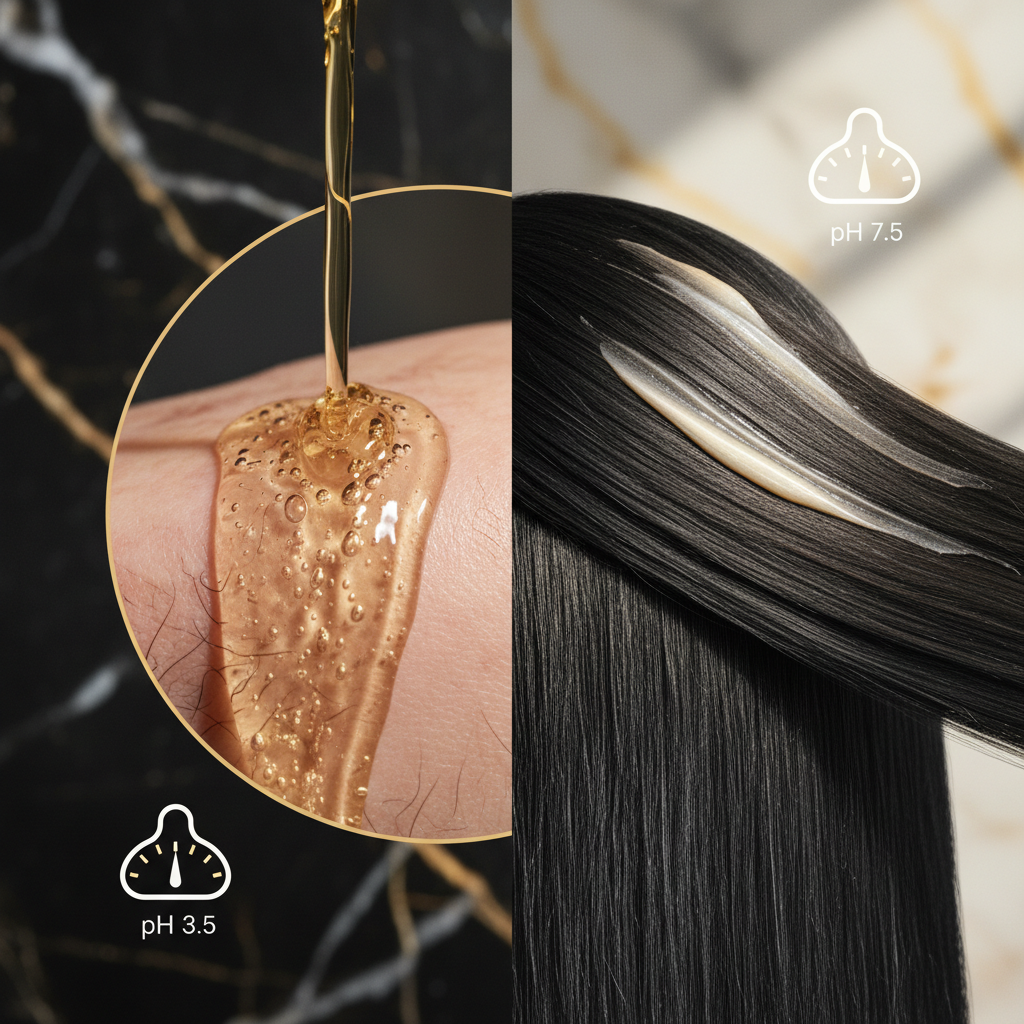
- Follow every wash with a conditioner: Conditioners are almost universally formulated at an acidic pH (typically 3.5 to 4.5). They carry cationic quaternary compounds that neutralise negative charges, close down the cuticle scales, and restore slip.
- Handle wet hair gently: Because wet hair can stretch up to 30 percent beyond its resting length before snapping, never rake a fine-toothed comb through wet strands immediately after shampooing.
- Use acidic leave-in sealants: A light leave-in conditioning spray adjusted to pH 4.0 helps lock down remaining flared cuticles before blow-drying.
- Be mindful of water quality: Hard water with high mineral carbonate content (calcium and magnesium) often pushes tap water up to pH 8.0 or 8.5. A chelating wash or an acidic rinse can counteract mineral accumulation.
When the cause may be something else
If you are experiencing true hair shedding rather than snapping, the pH of your shampoo is not the culprit.
If you notice hairs falling out from the root, identifiable by a small white bulb at the end, this is follicular shedding. Sudden, diffuse shedding that appears across the entire scalp two to three months after a physical illness, surgery, or intense emotional event is typically telogen effluvium. Gradual, progressive thinning focused primarily on the temples, crown, or central parting is characteristically androgenetic alopecia.
Similarly, severe scalp scaling, oily yellow crusts, or redness along the hairline are more indicative of seborrhoeic dermatitis or scalp psoriasis than simple cosmetic dryness from an alkaline wash.
When to seek professional advice
Consult a GP, dermatologist, or qualified trichologist if:
- You see distinct, smooth, circular patches of baldness appearing suddenly (possible alopecia areata).
- Your scalp burns, hurts, or shows open sores, weeping lesions, or pustules.
- Hair shedding exceeds 100 to 150 hairs daily for more than six to eight consecutive weeks.
- Flaking does not resolve after three weeks of using targeted over-the-counter anti-dandruff cleansers.
Watermans approach to balanced haircare
At Watermans, supporting hair condition starts with a respect for scalp physiology and fibre mechanics. Watermans formulations are developed to work harmoniously with your scalp's natural acid mantle, using balanced pH levels to cleanse thoroughly without triggering the aggressive cuticle swelling seen in high-alkaline alternatives. By combining gentle surface-active agents with premium botanicals, rosemary, caffeine, and biotin, Watermans products support a clean, refreshed scalp environment while maintaining the structural resilience of your hair strands against daily mechanical breakage.
Frequently asked questions about Shampoo pH and Hair Health
What is the ideal shampoo pH for human hair?
The ideal shampoo pH for human hair sits between 4.5 and 5.5. This matches the natural acidity of the scalp's sebum mantle and prevents the hair cuticle from flaring open. Cleansers within this specific range minimise static friction, keep wet combing forces low, and preserve the natural microbiome living on the scalp.
Does a high shampoo pH cause permanent hair loss?
No, a high shampoo pH does not cause follicular hair loss or baldness. It causes hair breakage. When an alkaline shampoo swells the hair shaft and raises the cuticle scales, the fibre becomes brittle and snags during brushing, snapping along the length. The hair follicle beneath the scalp surface remains completely intact and unaffected.
How does shampoo pH and hair health affect coloured or bleached hair?
The connection between shampoo pH and hair health is especially critical for colour-treated hair. Bleaching and permanent dyes naturally strip the protective lipid layer (18-MEA) and raise the cuticle to deposit pigment. If you subsequently wash chemically treated hair with an alkaline shampoo, the cuticles remain elevated, causing artificial colour molecules to wash out quickly and leaving the porous cortex exposed to rapid moisture loss.
Can an acidic shampoo dry out my scalp?
An acidic shampoo within the normal 4.5 to 5.5 range will not dry out your scalp. However, extreme acidity below pH 3.5 can cause irritation and redness. What people often mistake for "acid dryness" is typically the result of harsh primary surfactants that strip away sebum, regardless of the formulation's overall pH level.
Why do some clarifying shampoos have a higher pH?
Clarifying shampoos are occasionally formulated with a neutral to slightly alkaline pH (6.5 to 7.5) deliberately to lift the cuticle slightly. This controlled swelling allows the detergents to access and dissolve stubborn build-up from silicones, heavy styling polymers, and mineral deposits. They should always be followed with an acidic conditioner to seal the cuticle immediately afterwards.
Maintaining optimal balance
Mastering the connection between Shampoo pH and Hair Health is one of the simplest ways to transform the texture, shine, and durability of your hair. When you protect the scalp's acid mantle and prevent cuticle flaring, you eliminate unnecessary surface friction, stop preventable mechanical breakage, and keep moisture locked inside the fibre. By selecting pH-balanced products and respecting the biological chemistry of your hair, you create the best possible foundation for strong, resilient growth.
Sources and references
- Gavazzoni Dias, M. F., et al. (2014). The Shampoo pH can Affect the Hair: Myth or Reality? International Journal of Trichology, 6(3), 88 to 99.
- Robbins, C. R. (2012). Chemical and Physical Behavior of Human Hair (5th ed.). Springer-Verlag.
- Ali, S. M., & Yosipovitch, G. (2013). Skin pH: From Basic Science to Basic Skin Care. Acta Dermato-Venereologica, 93(3), 261 to 267.
- Dawber, R. (1996). Hair: Its Structure and Response to Cosmetic Preparations. Clinics in Dermatology, 14(1), 105 to 112.
- Tarun, J., et al. (2014). Evaluation of pH of Bathing Soaps and Shampoos for Skin and Hair Care. Indian Journal of Dermatology, 59(5), 442 to 444.