Shampoo pH: The Essential Guide to Scalp and Fibre Balance
8 min read ·
Discover why shampoo pH matters for hair health, how acidic cleansers protect the cuticle, and what scientific evidence says about scalp balance and breakage.
Quick answer: Shampoo pH measures how acidic or alkaline a cleansing formula is on a scale from 0 to 14. Healthy scalp skin has an acidic pH around 5.5, while hair fibres rest near pH 3.67. An ideal shampoo pH falls between 5.0 and 5.5 to prevent cuticle swelling, static, and friction. However, a balanced shampoo cannot repair internal cortex damage, cure follicular hair loss, or reverse chemical processing on its own.
Key takeaways
- The natural pH of the scalp surface averages 5.5, while the hair shaft's isoelectric point is approximately 3.67.
- Alkaline cleansers (pH above 7.0) increase the negative electrical charge of the hair fibre, causing cuticle lifting, frizz, and structural vulnerability.
- Acidic formulas (pH 4.5 to 5.5) help keep the cuticle scales flat, reducing cuticle erosion and comb-induced mechanical breakage.
- Shampoo pH directly influences the scalp microbiome; alkaline environments can encourage irritation and barrier disruption.
- Choosing a pH-balanced cleanser improves cosmetic manageability and reduces breakage, but it will not alter your natural hair density or resolve medical hair shedding.
Shampoo pH: what the evidence shows
Research published in the International Journal of Trichology examined 123 commercial shampoos and discovered that only 38 percent of commercial shampoos presented a pH equal to or lower than 5.5. Surprisingly, professional salon brands fared better, with roughly 75 percent formulating at or below pH 5.5, while over 60 percent of popular supermarket shampoos were alkaline or neutral (pH 6.0 to 7.5).
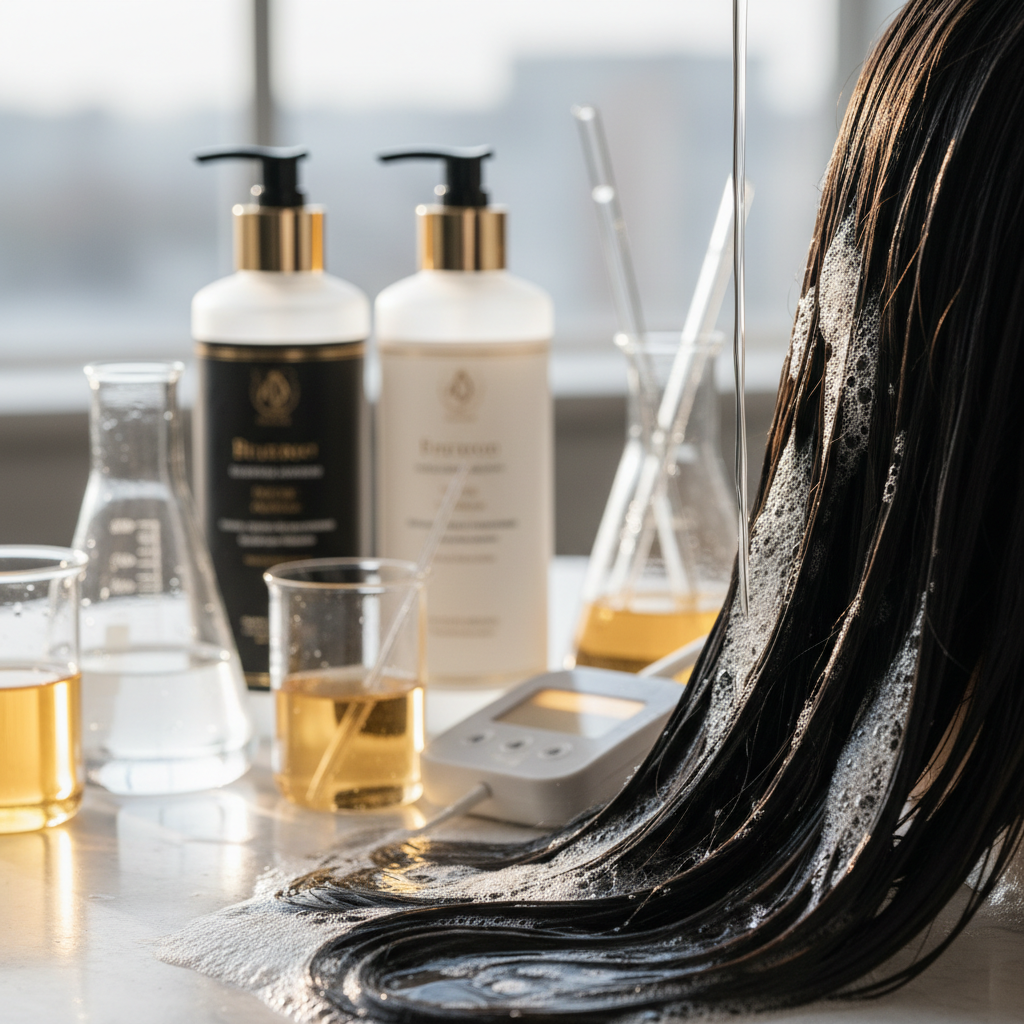
When you wash your hair, water alone softens the fibre and causes mild swelling. Introducing an alkaline surfactant formula accelerates this effect. Alkaline cleansers lift the imbrications of the hair cuticle. Once these protective scales lift, inter-fibre friction spikes. Independent measurements demonstrate that elevated friction directly increases the force required to comb through wet hair, snapping delicate strands along the shaft.
Furthermore, the scalp behaves like any other patch of human skin. It relies on an "acid mantle", a delicate film of sebum, sweat, and amino acids maintaining a surface pH between 4.5 and 5.5. Applying an alkaline product alters this ecosystem. It degrades the intercellular lipid bilayers, leaving the scalp vulnerable to moisture loss, irritation, and overcolonisation by opportunistic microorganisms.
| Product Type / Substrate | Typical pH Range | Biological or Structural Effect |
|---|---|---|
| Healthy Hair Fibre | ~3.67 (isoelectric point) | Zero net electrical charge; cuticle scales stay tightly compacted. |
| Healthy Scalp Skin | 4.5 to 5.5 | Intact acid mantle; optimal microbiome; minimal irritation. |
| pH-Balanced Shampoo | 4.5 to 5.5 | Gentle cleansing; minimal cuticle swelling; low comb friction. |
| Clarifying Shampoo | 6.0 to 7.5 | Swells cuticles to strip stubborn build-up; increases wet friction. |
| Traditional Bar Soap | 9.0 to 10.0 | Severe cuticle lifting; leaves mineral scum; causes severe tangling. |
| Chemical Relaxer / Bleach | 11.0 to 13.5 | Breaks chemical bonds; extreme structural swelling; cortex exposure. |
The underlying mechanism: cuticle swelling and surface charge
Understanding shampoo pH requires a look at surface chemistry. Hair keratin contains both basic amino groups and acidic carboxyl groups. At the isoelectric point, roughly pH 3.67, the positive and negative electrical charges on the fibre balance out to zero.
When exposed to an alkaline liquid with a pH above 5.5, the negative electrical charge on the hair surface rises significantly. Because like charges repel, the keratin scales of the cuticle push away from each other. They lift and flare. This cuticle flare produces three noticeable consequences:
- Increased friction: Raised scales catch against adjacent hairs, multiplying tangles and mechanical breakage during combing.
- Moisture and protein loss: An open cuticle provides less resistance against internal protein breakdown and cortical moisture loss.
- Loss of shine: Smooth, flat cuticle scales reflect light uniformly. Ruffled scales scatter light in multiple directions, leaving hair looking dull and matte.
On the scalp, a high pH compromises the enzymatic synthesis of ceramides. Without adequate lipids, the skin barrier weakens, increasing transepidermal water loss. The natural acidic defence against common yeast overgrowth diminishes, potentially triggering flaking and itchiness.
What the evidence does not show
It is vital to distinguish between hair fibre breakage and medical hair loss. The pH of your shampoo does not cause or cure follicular conditions such as androgenetic alopecia, alopecia areata, or telogen effluvium.
Hair grows from follicles situated roughly four millimetres deep within the dermis. Shampoo cleanses the external scalp surface and the dead keratinised strand. While an excessively alkaline formula can snap the fibre along the shaft through friction, giving the appearance of thinning, it does not alter follicular hair production cycles.
Similarly, an acidic shampoo cannot mend split ends that have already separated. Once the protective cuticle has worn away and the cortex splits, topical formulations can temporarily coat the surface, but they cannot restore broken disulfide bonds.
Signs your cleanser is too alkaline
If you are using a product formulated with an unfavourable pH, your hair and scalp will usually display distinct physical signs within a few washes:
- Instant tangling during rinsing: Hair feels squeaky, stiff, and matte the moment you rinse out the suds.
- Flyaways and static: Because alkaline environments increase negative surface charges, dry hair repels itself, causing stubborn frizz.
- Scalp tightness or itching: A compromised acid mantle leads to sudden dryness or reactive oiliness as the skin attempts to re-lubricate itself.
- Rapid colour fade: For colour-treated hair, open cuticles allow artificial pigment molecules to slip out effortlessly during washing.
How to manage your routine
Evaluating your cleansing products helps preserve both fibre integrity and scalp comfort. Here is how to keep your routine balanced:
- Look for explicit labels: Seek out formulations marked "pH-balanced" or specifically stating a pH between 4.5 and 5.5.
- Avoid traditional bar soaps: True soaps made from saponified oils naturally sit at pH 9.0 to 10.0. They are too alkaline for hair keratin and scalp skin.
- Condition after every wash: Most rinse-out conditioners and post-wash treatments naturally sit at a lower pH (around 3.5 to 4.5). Their acidic nature neutralises residual alkalinity, flattens the cuticle, and deposits cationic agents to smooth the strand.
- Use clarifying washes sparingly: Cleansers designed to strip heavy styling residue or hard water mineral build-up often sit at a neutral or slightly alkaline pH (6.5 to 7.5). Limit these to once every two to three weeks, and follow with an intensive acidic conditioning mask.
Consider Watermans for balanced scalp and hair care
Formulating with biological pH in mind is central to effective haircare. Watermans develops hair and scalp formulations designed to maintain a healthy scalp environment while respecting the hair fibre.
Products like Watermans GrowMe Shampoo are crafted with skin-compatible pH profiles alongside active ingredients such as biotin, rosemary, caffeine, and argan oil. By preserving the scalp's delicate barrier while cleansing away excess sebum, a balanced formula creates the ideal conditions for hair to look thicker, feel stronger, and resist daily mechanical breakage.
When the cause may be something else
If you switch to a balanced cleanser but continue to experience dry, brittle strands or persistent scalp irritation, other environmental and physiological factors may be at play:
- Hard water minerals: High concentrations of calcium and magnesium carbonate can react with your shampoo, leaving an insoluble film that mimics the rough feel of an alkaline wash.
- Thermal styling: Flat irons and blow dryers operating above 185°C degrade hair proteins irrespective of shampoo chemistry.
- Chemical processing: Bleaching, perm solutions, and chemical straighteners intentionally use high alkalinity to reshape the cortex, permanently raising fibre porosity.
When to get professional advice
Consult a GP, dermatologist, or qualified trichologist if you notice:
- Scalp redness, weeping, yellow crusting, or persistent pain that does not improve after switching to gentle cleansers.
- Hair shedding in distinct patches, round bald spots, or overall widening of your parting.
- Extreme shedding that leaves excessive amounts of full strands with intact white bulbs on your pillow or in the shower drain.
Frequently asked questions about Shampoo pH
What is the ideal shampoo pH for human hair?
The ideal shampoo pH sits between 5.0 and 5.5. This range mirrors the natural acidity of the scalp's surface and keeps the hair cuticle closed and smooth, preventing unwanted swelling, static, and friction during washing.
Can a high shampoo pH cause permanent hair loss?
No. An alkaline cleanser does not reach the dermal papilla or destroy hair follicles. However, high alkalinity lifts cuticle scales, making fibres fragile. This leads to fibre breakage along the shaft, which can easily be mistaken for genuine follicular hair loss.
How do I know the pH of my current shampoo?
Cosmetic labels rarely print the exact number. You can test your product at home by mixing equal parts shampoo and distilled water, then dipping a calibrated cosmetic pH strip into the liquid to read the colour change against the provided chart.
Why do some clarifying shampoos have an alkaline pH?
Clarifying formulas are engineered to strip heavy mineral deposits, chlorine, and stubborn silicone build-up. Formulators sometimes use a slightly higher pH (between 6.5 and 7.5) to swell the cuticle intentionally, allowing the cleansing agents to dislodge trapped residue from the strand.
Healthy hair begins with balanced chemistry
Balancing your cleansing routine against your body's natural chemistry is one of the easiest ways to safeguard hair health. Selecting an appropriate shampoo pH shields your scalp against barrier disruption and prevents the cuticle lifting that fuels daily breakage, frizz, and dullness. While it will not alter genetic shedding or rebuild severed strands, maintaining an acidic, scalp-friendly environment ensures that the hair you grow remains resilient, manageable, and visibly vibrant from root to tip.
Sources and references
- Gavazzoni Dias, M. F., et al. (2014). 'The Shampoo pH can Affect the Hair: Myth or Reality?' International Journal of Trichology, 6(3), pp. 95 to 99.
- Ali, S. M., and Yosipovitch, G. (2013). 'Skin pH: From Basic Science to Basic Skin Care.' Acta Dermato-Venereologica, 93(3), pp. 261 to 267.
- Robbins, C. R. (2012). Chemical and Physical Behavior of Human Hair. 5th edn. Berlin: Springer-Verlag.
- British Association of Dermatologists. (2022). 'General Hair and Scalp Care Guidelines.'