The Science of Hair Wash Frequency: An Evidence-Based Guide
10 min read ·
Discover The Science of Hair Wash Frequency: learn how sebum biology, hydral fatigue, and hair texture dictate your ideal washing routine based on real clinical evidence.

Quick answer: The Science of Hair Wash Frequency demonstrates that there is no universal rule for how often you should cleanse your scalp. Ideal cleansing intervals range from daily to once weekly, determined primarily by sebum production rates, scalp microbiome balance, hair fibre diameter, and environmental exposure. While infrequent washing can lead to Malassezia yeast overgrowth and follicular inflammation, over-cleansing with harsh surfactants disrupts the epidermal barrier. Matching your schedule to your scalp physiology prevents both lipid accumulation and fibre fatigue.
Key takeaways
- Sebum production is genetically and hormonally driven; washing your hair more frequently does not train your scalp to produce less oil.
- Leaving sebum on the scalp for extended periods allows Malassezia yeasts to metabolise triglycerides into irritating free fatty acids, triggering flakes and pruritus.
- Wetting and drying hair repeatedly causes hydral fatigue, weakening the cortex, while product build-up creates friction and fibre breakage.
- Fine hair and oily scalps typically benefit from cleansing every 1 to 2 days, whereas coarse, coily hair thrives on intervals of 5 to 7 days.
- Shampoos formulated around physiological skin pH (4.5 to 5.5) maintain cuticular integrity regardless of your washing schedule.
The Science of Hair Wash Frequency: what the evidence shows
The Science of Hair Wash Frequency centres on the physiological equilibrium between the scalp barrier and the hair shaft. Dermatological studies confirm that the primary goal of washing is cleansing the scalp skin, not merely the dead protein filament of the hair shaft. Human sebaceous glands produce sebum, a complex mixture of squalene, wax esters, triglycerides, and cholesterol. Sebum acts as a natural emollient, but its accumulation presents biological challenges.
Research published in the International Journal of Trichology demonstrates that regular scalp cleansing removes oxidised lipids, dead corneocytes, airborne pollutants, and microbial by-products. When cleansing is delayed too long, lipid peroxidation occurs. The scalp's resident yeast, Malassezia restricta and Malassezia globosa, hydrolyse sebum triglycerides, releasing unsaturated fatty acids such as oleic acid. In susceptible individuals, these free fatty acids penetrate the stratum corneum, compromising barrier function and generating subclinical inflammation, flaking, and telogen shedding.
Conversely, washing daily with aggressive, high-pH anionic detergents strips the intercellular lipids of the hair cuticle. Lipids like 18-methyleicosanoic acid (18-MEA), which coat the outer epicuticle, provide natural hydrophobicity. Depleting 18-MEA leaves the hair shaft porous, brittle, and prone to moisture loss. Therefore, clinical research supports an individualised approach where wash frequency mirrors sebum output rather than an arbitrary calendar schedule.
| Scalp and Hair Profile | Sebum Output Level | Recommended Washing Interval | Primary Biological Risk of Wrong Timing |
|---|---|---|---|
| Fine fibre, high sebum | High (greasy within 24 hours) | Daily to every 2 days | Seborrhoeic dermatitis, Malassezia overgrowth, follicular irritation |
| Medium fibre, balanced scalp | Moderate (greasy after 48 to 72 hours) | Every 2 to 3 days | Minor oxidative stress, dullness, styling product accumulation |
| Coarse, wavy or curly | Low to moderate distribution | Every 3 to 5 days | Mechanical tangling, fibre dryness, cuticle erosion |
| Afro-textured or tight coils | Low sebum migration down shaft | Every 5 to 7 days | Severe moisture depletion, hydral fatigue, shaft snapping |
| Chemically processed / bleached | Artificially compromised barrier | Every 3 to 5 days | Tensile failure, complete 18-MEA lipid loss, protein degradation |
What the evidence does not show: debunking the "hair training" myth
A widespread myth claims that you can "train" your scalp to produce less oil by simply stopping or drastically reducing washing. Dermatology does not support this claim.
Sebaceous gland activity is governed primarily by systemic hormones, particularly androgens like dihydrotestosterone (DHT), alongside genetic receptor density and local vascular supply. Withholding shampoo does not down-regulate internal androgen synthesis. When you cease washing, sebum continues to pool at the follicular infundibulum until the gland reaches its physical holding capacity. The perceived reduction in oiliness over time is merely the saturation limit of the scalp surface, often accompanied by microbial shifts that create low-grade inflammation.
Another unproven belief is that washing hair causes hair loss. When individuals wash their hair and notice strands gathering over the drain, they are seeing hairs that have already detached from the dermal papilla weeks prior during the telogen phase. The mechanical action of washing simply frees these shed fibres. Washing does not trigger telogen effluvium or androgenetic alopecia unless accompanied by violent mechanical pulling or untreated chronic inflammatory dermatitis.
The mechanisms: hydral fatigue versus lipid accumulation
Understanding hair wash frequency requires balancing two competing biophysical processes:
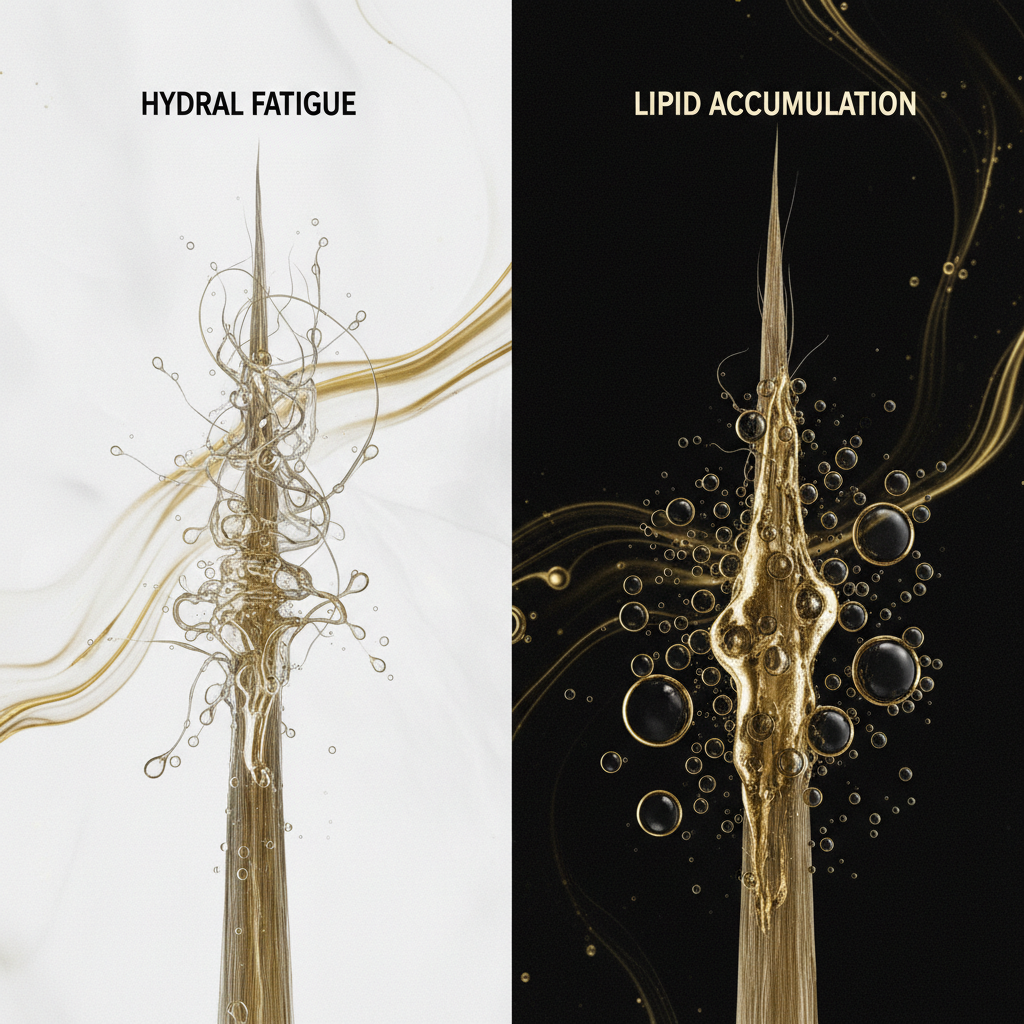
1. Hydral fatigue and cuticle swelling
Hair fibres are hygroscopic. When submerged in water, the hair shaft absorbs up to 30% of its dry weight in liquid, causing the inner cortex to swell. This swelling forces the protective outer cuticle scales to lift. When hair dries, the cortex contracts, and the cuticles flatten down. Cycling through rapid swelling and contracting every single day weakens the cross-linked cell membrane complex between cuticular layers. Over time, this mechanical stress, known as hydral fatigue, leads to split ends and breakage along the fibre length.
2. Lipid accumulation and microbial imbalance
At the scalp surface, skin sheds roughly 30,000 to 40,000 dead cells every minute. On an unwashed scalp, these dead corneocytes mix with sebum, sweat, and environmental particulates, forming a cohesive film. This anaerobic, lipid-dense environment fuels exponential colonies of Malassezia. As these yeasts consume saturated fats, they discard irritating unsaturated fatty acids. The resulting disruption of the stratum corneum leads to redness, itching, barrier damage, and compromised follicular anchoring.
Finding your optimal frequency means keeping sebum thin and non-inflammatory without subjecting the hair fibre to excessive water immersion cycles.
Signs your current washing schedule needs adjusting
Your scalp and hair provide clear physical cues when your cleansing cadence is out of sync with your biology:
- Signs you are washing too frequently: The lengths of your hair feel rough, brittle, and dry like straw. Your scalp feels tight, itchy, or stinging shortly after drying, yet shows no visible greasy flakes. You observe high levels of mid-shaft breakage without the white root bulb attached.
- Signs you are not washing frequently enough: Your scalp develops an unpleasant, rancid odour caused by oxidised squalene. You experience persistent itching combined with yellowish, oily flakes that cling to the skin. Hair feels heavy, limp, and lacks natural movement at the root.
Practical steps: establishing your wash routine
To tailor your frequency accurately, test your scalp output methodically:
- Perform the tissue test: Wash your hair with a gentle cleanser and dry it naturally without styling products. Approximately 24 hours later, press a clean facial tissue against your crown. If a distinct translucent oil mark transfers, your scalp is high-sebum and thrives on daily or alternate-day washing. If the tissue remains bone dry after 48 hours, an interval of 3 to 5 days is more suitable.
- Focus detergents on the scalp: When cleansing, massage shampoo directly into the scalp and root zone with the pads of your fingers. Do not gather the lengths of long hair into a ball on top of your head, as this abrades cuticles. Let the lather rinse down the lengths passively.
- Condition the fibre, protect the lipids: Always apply conditioner from the mid-lengths down to replace surface lubricity and smooth the lifted cuticle scales. This counteracts the drying effects of surfactant contact.
- Mind the drying technique: Never rub wet hair aggressively with a cotton terry towel. Gently squeeze water out using a microfibre towel or smooth cotton cloth, reducing mechanical shear forces while the cortex is swollen.
When the cause may be something else
If adjusting your wash frequency fails to resolve oily roots, dry ends, or relentless flaking, the underlying issue may not be cleansing frequency at all.
Water hardness plays a substantial role. Washing hair in hard water (exceeding 120 to 180 mg/L of dissolved calcium carbonate) leaves insoluble mineral films on the hair shaft. These deposits bind with natural sebum to create a sticky, heavy coating that mimics greasy hair, leading people to over-wash out of frustration.
Product build-up from heavy, non-volatile silicones, thick waxes, and polyquaternium polymers can also masquerade as sebum. A monthly clarifying wash clears these residues effectively without requiring daily stripping.
Finally, fluctuating hormone profiles, such as postpartum changes, polycystic ovary syndrome (PCOS), or thyroid imbalances, drastically alter sebum flow rates independently of your hygiene habits.
When to seek professional advice
Consult a dermatologist, trichologist, or GP if you experience:
- Persistent red, inflamed plaques across the scalp that burn or hurt.
- Flaking accompanied by yellow crusting or fluid weeping.
- Noticeable widening of your natural parting, focal patches of smooth hair loss, or generalised diffuse shedding exceeding 100 hairs daily for more than six weeks.
- Intense pruritus that disrupts your sleep or does not respond to over-the-counter anti-dandruff formulations.
Supporting the hair and scalp ecosystem
A measured cleansing routine protects the fragile biological systems that sustain growth. When selecting your cleansing products, look for formulations designed to support the scalp microbiome while supplying topical revitalisation.
Watermans focuses on non-stripping, nutrient-rich formulations that respect the skin mantle. Incorporating targeted components like biotin, caffeine, rosemary extract, and niacinamide alongside scalp-friendly cleansing agents ensures that dirt and oxidised lipids are cleared without stripping away the essential natural barrier. Choosing gentle, physiologically balanced scalp cleansers allows you to maintain optimal wash intervals without sacrificing shaft elasticity or scalp comfort.
Frequently asked questions about The Science of Hair Wash Frequency
How does The Science of Hair Wash Frequency apply to oily hair?
The Science of Hair Wash Frequency shows that naturally oily scalps benefit from frequent, even daily, washing using gentle, pH-balanced formulas. Cleansing prevents the accumulation of oxidised squalene and Malassezia yeasts, which provoke inflammatory responses and compromise the follicle. Daily washing does not cause the scalp to rebound and produce more oil; hormonal signals regulate that process internally.
Does washing your hair every day cause permanent thinning?
No. Daily washing does not cause follicular miniaturisation or permanent alopecia. While rough handling and excessive friction on wet hair can snap brittle fibres, the hairs seen shedding during washing are telogen-phase hairs already detached inside the follicle. Washing merely accelerates their physical exit.
Can dry shampoo replace regular hair washing?
Dry shampoo absorbs surface oils cosmetically using starches or clays, but it does not cleanse. It leaves particulates, oxidised lipids, and dead cells directly on the scalp. Over-reliance on dry shampoo without liquid washing clogs the follicular opening, disrupts the skin barrier, and can spark contact dermatitis.
How does hair texture alter ideal washing intervals?
Fibre geometry changes sebum transit. On straight, fine hair, sebum slides rapidly down the shaft, creating a limp appearance within 24 hours. On tightly coiled or afro-textured hair, the winding path limits sebum progression, leaving lengths dry while roots remain protected. Coily hair requires less frequent washing (every 5 to 7 days) to retain vital lubrication.
Does cold water close the hair cuticle during washing?
The hair cuticle is dead tissue containing no muscle fibres; it does not open and close in response to cold water. Cuticular swelling is driven primarily by water absorption (hydration) and alkaline pH, not water temperature. While extreme heat damages hair proteins, lukewarm water is optimal for dissolving sebum without scalding delicate scalp tissue.
Wrapping up your wash routine
Mastering The Science of Hair Wash Frequency comes down to observing your scalp's unique biology rather than conforming to rigid routines or social media trends. By balancing the need to prevent microbial irritation and lipid oxidation at the scalp against the risk of hydral fatigue along the hair shaft, you can pinpoint the ideal cadence for your lifestyle. Listen to your hair, choose skin-friendly formulas, and adjust your routine as seasons, styling habits, and environmental stressors evolve.
Sources and references
- International Journal of Trichology, "Shampoo and Conditioners: What a Dermatologist Should Know?", Gavazzoni Dias, 2015.
- Journal of the American Academy of Dermatology, "Scalp Seborrheic Dermatitis and Dandruff: A Review", Borda and Wikramanayake, 2015.
- British Journal of Dermatology, "Microbiome of the human scalp in dandruff and seborrhoeic dermatitis", Clavaud et al., 2013.
- Journal of Cosmetic Dermatology, "Hair shaft damage from shampooing and styling habits", Robbins, 2012.
Find these ingredients in Watermans products
- Biotin: you will find this ingredient in our Hair Growth Shampoo.
- Oleic Acid: you will find this ingredient in our Camellia & Black Castor Hair & Body Oil.
- Niacinamide: you will find this ingredient in our Hair Mask.