The Science of Hair Breakage vs Hair Shedding
9 min read ·
Learn the science of hair breakage vs hair shedding, understand follicle cycles and fibre strength, and identify what is happening to your hair.
Quick answer: Understanding the science of hair breakage vs hair shedding comes down to anatomy: shedding is a natural biological event where an entire strand releases cleanly from the follicle, complete with a tiny white bulb. Breakage, by contrast, is structural failure where the hair fibre snaps along its shaft due to mechanical, chemical, or thermal damage. The main limitation is that both can occur simultaneously, requiring different diagnostic checks and targeted solutions to manage effectively.
Key takeaways
- Hair shedding originates at the scalp follicle as part of the natural hair growth cycle, releasing roughly 50 to 100 strands per day.
- Hair breakage is a physical fracture along the hair shaft caused by degraded keratin, damaged cuticles, or reduced tensile strength.
- A shed hair displays a tiny, firm, white keratinous bulb at its root end, whereas a broken strand has blunt, frayed, or split ends without a bulb.
- Shedding typically produces full-length hairs, while breakage yields uneven, shorter fragments and causes thinning ends rather than scalp-level loss.
- High shedding rates often require medical or nutritional evaluation, while breakage responds directly to bond repair, lipid replenishment, and reduced heat or chemical styling.
The science of hair breakage vs hair shedding: what the evidence shows
The science of hair breakage vs hair shedding reveals two entirely separate physiological processes that look remarkably similar in your hairbrush. To treat your hair effectively, you have to pinpoint whether the root or the shaft is failing.
Hair shedding is driven by the internal biological clock of the hair follicle. Under normal conditions, about 85 to 90 percent of your scalp hair sits in the anagen (active growth) phase. Another 1 to 2 percent is in catagen (transition), and roughly 9 to 10 percent resides in telogen (resting). At the end of telogen, the strand enters exogen, releasing from the follicle base to make room for new growth. This natural process accounts for 50 to 100 hairs shed daily. When an internal stressor triggers premature progression into telogen, shedding accelerates into a condition called telogen effluvium, where daily loss can reach 300 hairs or more.
Hair breakage, on the other hand, is a mechanical failure of the hair fibre itself. The hair shaft consists of three main structures: an outer protective cuticle made of overlapping scales, a cortex packed with structural keratin proteins and disulphide bonds, and a central medulla. Breakage occurs when external insults strip away the cuticle's protective 18-methyleicosanoic acid (18-MEA) lipid layer. Once the cuticle lifts, chips, or erodes, the inner cortex loses moisture and structural integrity. Tensile strength drops, and regular combing, brushing, or washing exerts enough force to snap the fibre.
+--------------------------+---------------------------------+---------------------------------+
| Characteristic | Hair Shedding | Hair Breakage |
+--------------------------+---------------------------------+---------------------------------+
| Biological Origin | Hair follicle inside the scalp | Hair shaft outside the scalp |
| Root Bulb Present? | Yes (small, white or clear bulb)| No (blunt, tapered, or split) |
| Strand Length | Full length of your hair | Shorter, irregular lengths |
| Visible Scalp Impact | Diffuse thinning across scalp | Frizzy halos, frayed ends |
| Primary Causes | Hormones, stress, nutrition | Heat, bleach, friction, tension |
| Best Corrective Strategy | Medical, dietary, scalp care | Conditioning, bond repair, trims|
+--------------------------+---------------------------------+---------------------------------+
What the evidence does not show
The science of hair breakage vs hair shedding is surrounded by several persistent myths that clinical studies do not support.
First, topical shampoos, conditioners, and oils cannot stop true follicular shedding caused by genetics, severe hormonal shifts, or acute systemic illness. These products act on the dead fibre outside the scalp or soothe the epidermal surface; they cannot alter internal follicular signalling.
Second, breakage does not indicate that your hair has stopped growing. The follicle at the scalp level may produce hair at a normal rate of roughly 1 to 1.25 centimetres per month, but severe breakage snaps the tips off at an equivalent rate, creating the illusion of stalled growth.
Third, natural shedding is not permanent baldness. Shedding involves exogen hairs that have already been replaced by an incoming anagen hair beneath the scalp surface. Unless true follicular miniaturisation (androgenetic alopecia) is at play, the follicle remains active and capable of producing thick hair.
The mechanisms: why hair breaks or sheds
The cellular mechanics of shedding and breakage diverge completely.
The shedding pathway
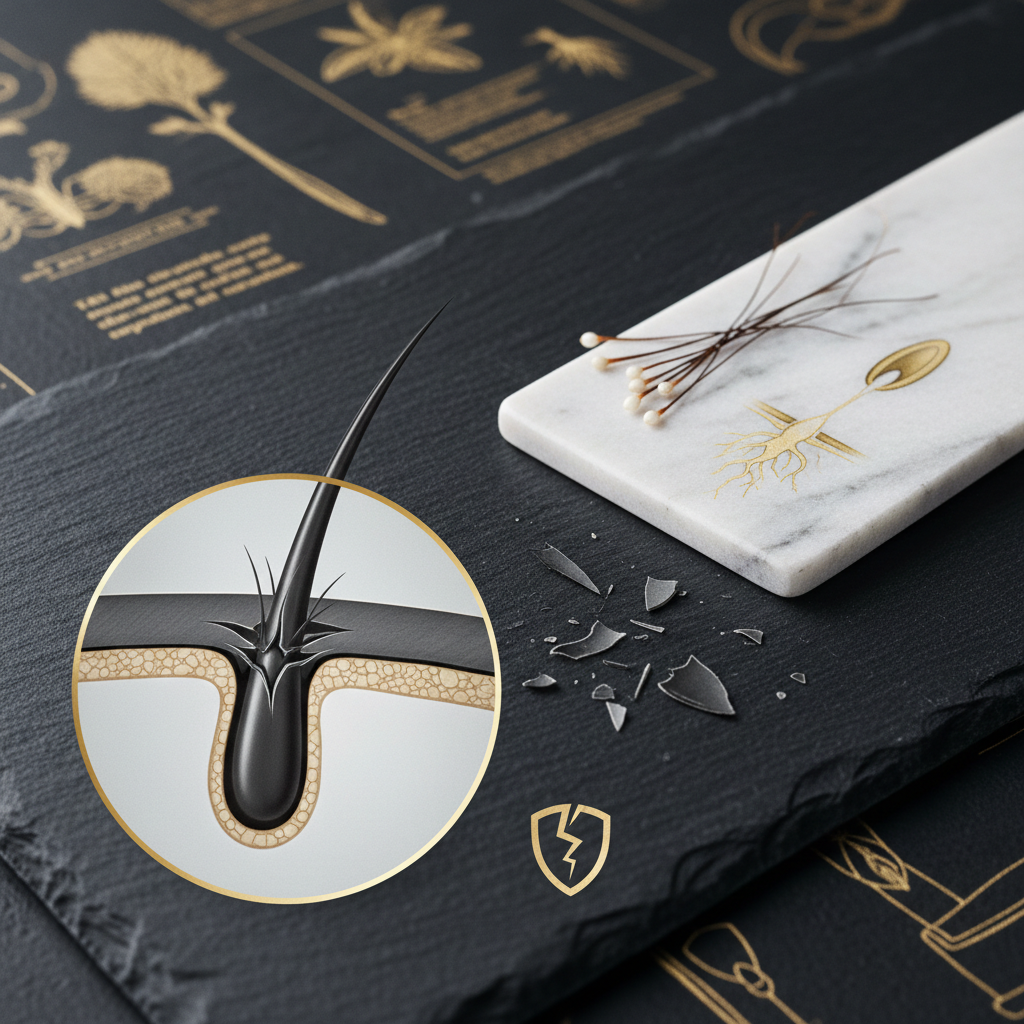
During follicular shedding, cell proliferation in the hair matrix stops. The dermal papilla condenses and isolates itself from the hair shaft, and the lower part of the follicle regresses. Desmoglein proteins that anchor the base of the hair shaft dissolve, loosening the club hair. Eventually, mechanical friction (like shampooing or brushing) simply dislodges the detached fibre. Because the shaft never suffered physical trauma, its cuticle and cortex remain intact from tip to root.
The breakage pathway
Breakage is driven by macromolecular degradation. Virgin hair can typically stretch up to 30 percent of its dry length before breaking. Chemical processes such as bleaching, permanent dyeing, and chemical straightening alter this by cleaving the cystine disulphide bonds that provide structural rigidity to the cortex. Thermal tools above 180 degrees Celsius convert the moisture within the hair into steam, creating microscopic vacuoles (bubble hair) and oxidising amino acids like tryptophan and tyrosine. Mechanical friction from rough towel-drying or tight elastic bands creates longitudinal micro-cracks along the shaft. When mechanical tension exceeds the reduced tensile threshold, the fibre shears.
Diagnostic signs: how to tell them apart
You can identify whether you are dealing with breakage or shedding using simple observational tests:
- The Root Bulb Check: Pick up several hairs from your brush or pillow and inspect the ends against a dark background or under good light. A shed hair always has a distinct, rounded, white or translucent bead at one end. A broken strand has no bulb; its ends appear jagged, flat, or split into two or more micro-fibres.
- The Length Assessment: Shed hairs match your overall hair length. Broken hairs are noticeably shorter, appearing as tiny fragments on your bathroom counter or uneven pieces throughout your brush.
- The Texture and Sound Test: Gently run your fingers down a single strand from root to tip. A healthy shed hair feels uniform and smooth. A hair prone to breakage feels rough, bumpy, and brittle, and may make an audible snap when stretched gently.
- Visual Hairline Inspection: If your scalp is visibly showing more skin across your crown or widening part line, shedding or follicular thinning is likely responsible. If you see short, broken hairs sticking upright along your part (a "halo" of flyaways) while your ponytail ends look thin and ragged, breakage is the culprit.
Practical steps to manage breakage and shedding
Managing each issue requires a targeted, evidence-based approach.
For hair breakage:
- Rebuild fibre integrity: Use treatments containing hydrolysed vegetable proteins, amino acids, or bond-building chemistry to temporarily bridge gaps in the cortex.
- Lower the heat: Keep hot tools below 185 degrees Celsius and always coat damp hair with a silicone- or polymer-based thermal protectant to reduce heat transfer rates.
- Reduce wet friction: Hair is weakest when wet because water breaks temporary hydrogen bonds. Never rip a fine-tooth comb through wet hair; use a wide-tooth comb or flexible wet-brush starting at the ends.
- Hydrate and seal: Apply lipid-rich conditioners formulated with ingredients like argan oil, shea butter, or cetyl alcohol to lubricate the cuticle layer, reducing the combing force needed to detangle.
For hair shedding:
- Assess internal triggers: If shedding spikes dramatically, consider events from two to three months prior. Physical illness, high fever, surgery, severe psychological stress, or rapid weight loss frequently prompt telogen effluvium.
- Optimise nutrition: Verify that your diet provides adequate protein, zinc, vitamin D, and iron (specifically serum ferritin, ideally above 50 mcg/L for healthy hair cycling).
- Maintain scalp hygiene: Wash regularly to prevent build-up of sebum, dead skin, and yeast (Malassezia), which can trigger inflammatory scalp conditions that aggravate shedding.
Supportive care from Watermans
When addressing overall hair health, combining fibre protection with scalp stimulation delivers the best results. Watermans GrowMe Shampoo and Conditioner are formulated to support this balance. GrowMe Shampoo cleanses without harsh sulphates, infusing the scalp environment with biotin, rosemary extract, caffeine, and niacinamide to invigorate the skin around the follicles. Pairing it with Watermans ConditionMe Conditioner helps seal lifted cuticles, restoring slip and reducing the combing friction that drives everyday mechanical breakage.
When to seek professional advice
Consult a GP or dermatologist if your hair shedding exceeds normal levels for more than six to eight weeks, if you observe circular bald patches (alopecia areata), or if shedding is accompanied by scalp itching, burning, redness, or scale. These signs may point to an underlying autoimmune disorder, thyroid imbalance, or scarring alopecia that requires clinical diagnosis and prescription treatment.
Frequently asked questions about The Science of Hair Breakage vs Hair Shedding
How can you tell if short hairs are new growth or breakage?
Look closely at the tip of the short strand. New growth tapers naturally to a fine, soft point and usually lies flush with surrounding hair. Broken hair has a blunt, split, or uneven tip that often stands rigid or frizzy. Furthermore, new growth feels soft and flexible, whereas broken hairs feel dry, stiff, and rough to the touch.
Can severe hair breakage cause permanent baldness?
No. Because hair breakage occurs along the shaft and leaves the follicle intact, it does not damage the growth machinery beneath the scalp. However, repeated mechanical traction (such as excessively tight braids or extensions) can cause traction alopecia, which damages the follicle over time and leads to permanent hair loss if left unchecked.
Why does hair break more easily when wet?
Water penetrates the hair shaft, lifting the cuticle scales and breaking the weak hydrogen bonds that give the cortex its elasticity. In this swollen state, hair can stretch further, but its breaking strength decreases significantly. Vigorous brushing, rubbing with rough towels, or aggressive detangling on wet hair shears the weakened internal proteins easily.
How does the science of hair breakage vs hair shedding explain postpartum hair loss?
During pregnancy, elevated oestrogen levels prolong the anagen (growth) phase, keeping hairs from entering the resting stage. Following delivery, oestrogen drops precipitously, pushing a large cohort of follicles into the telogen phase at once. Two to four months later, these hairs shed simultaneously. This is pure follicular shedding (telogen effluvium), not structural hair breakage.
Can a hair mask stop hair shedding?
No. Hair masks work on the external hair fibre to hydrate, smooth cuticles, and prevent breakage. Because shedding originates beneath the skin in the living follicle, topical masks applied along the lengths have no biological mechanism to stop hair from falling out at the root.
Concluding thoughts on fibre and follicle care
Mastering the science of hair breakage vs hair shedding allows you to diagnose hair concerns accurately and apply the right remedies. Shedding reflects internal biological cycles, systemic health, and follicle vitality, whereas breakage reflects how gently you handle, style, and nourish the exposed fibre. By learning to read the root bulb, track strand lengths, and treat the scalp and shaft as distinct systems, you can preserve your hair's density and length.
Sources and references
- British Association of Dermatologists. Telogen Effluvium Guidelines and Patient Information, 2021.
- Robbins, C. R. Chemical and Physical Behavior of Human Hair. 5th ed., Springer, 2012.
- Sinclair, R. "Healthy hair: what is it?" Journal of Investigative Dermatology Symposium Proceedings, 2007.
- Dawber, R. "Hair: Its Structure and Response to Physical and Chemical Treatments." Clinics in Dermatology, 1996.
- Trüeb, R. M. "Oxidative Stress in Ageing of Hair." International Journal of Trichology, 2009.
- Trueb, R. M. "The impact of oxidative stress on hair." International Journal of Cosmetic Science, 2015.
Find these ingredients in Watermans products
- Zinc: you will find this ingredient in our Hair Vitamins.
- Niacinamide: you will find this ingredient in our Hair Mask.
- Shea Butter: you will find this ingredient in our Curly Hair Conditioner.