Chelating vs Clarifying Shampoo: Which Cleanser Does Your Hair Need?
9 min read ·
Understand the difference between Chelating vs Clarifying Shampoo: learn which formula removes hard water minerals, which cleans product buildup, and how to avoid breakage.
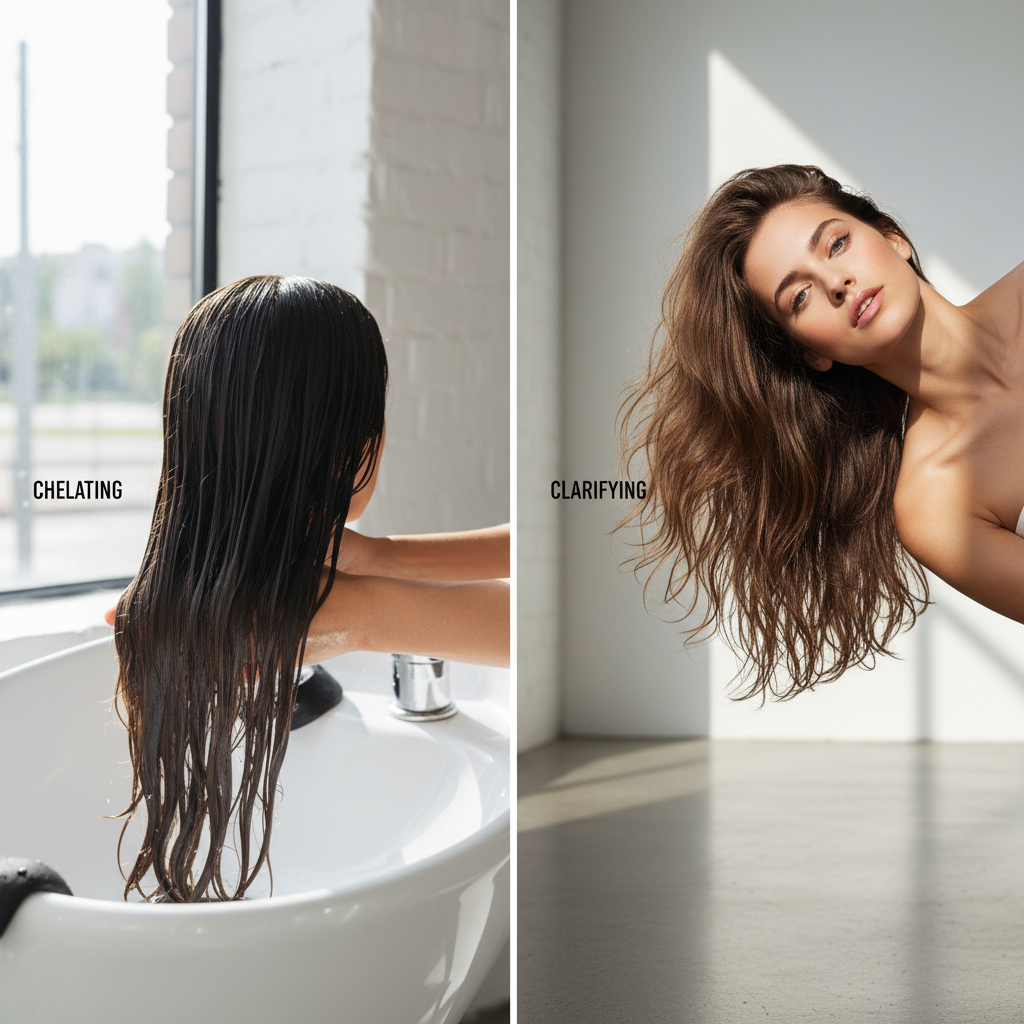
Quick answer: In the debate of Chelating vs Clarifying Shampoo, the main difference lies in what they remove. Clarifying shampoos use potent surfactants to strip away surface-level cosmetic buildup like silicones, waxes, oils, and heavy styling products. Chelating shampoos contain specialised bonding agents (chelators) designed to break down and extract deep mineral deposits, chlorine, and heavy metals from hard water or swimming pools. However, neither formula is a daily cleanser, as overuse can cause severe moisture depletion and fibre breakage.
Key takeaways
- Clarifying shampoos primarily target surface organic matter, including sebum, polymers, silicones, and styling product residue.
- Chelating shampoos specifically bind to and remove inorganic minerals and metals, such as calcium, magnesium, copper, iron, and chlorine.
- Hard water deposits require a chelating shampoo; standard clarifying shampoos lack the chemical binding agents needed to dissolve mineral buildup.
- Both shampoo types possess a higher pH (typically 5.5 to 7.0 or above) than daily maintenance cleansers (pH 4.5 to 5.5), which opens the cuticle layer.
- Overusing either formula leads to lipid loss along the hair shaft, resulting in structural dryness, rough cuticle texture, and mechanical hair breakage.
Chelating vs Clarifying Shampoo: what the evidence shows
Understanding the distinction between Chelating vs Clarifying Shampoo requires looking at cosmetic chemistry and hair fibre biology. Hair is porous and possesses a net negative charge, making it an ideal surface for positively charged substances to cling to. Over time, both organic cosmetic polymers and inorganic tap water minerals adhere to the cuticle and outer cortex.
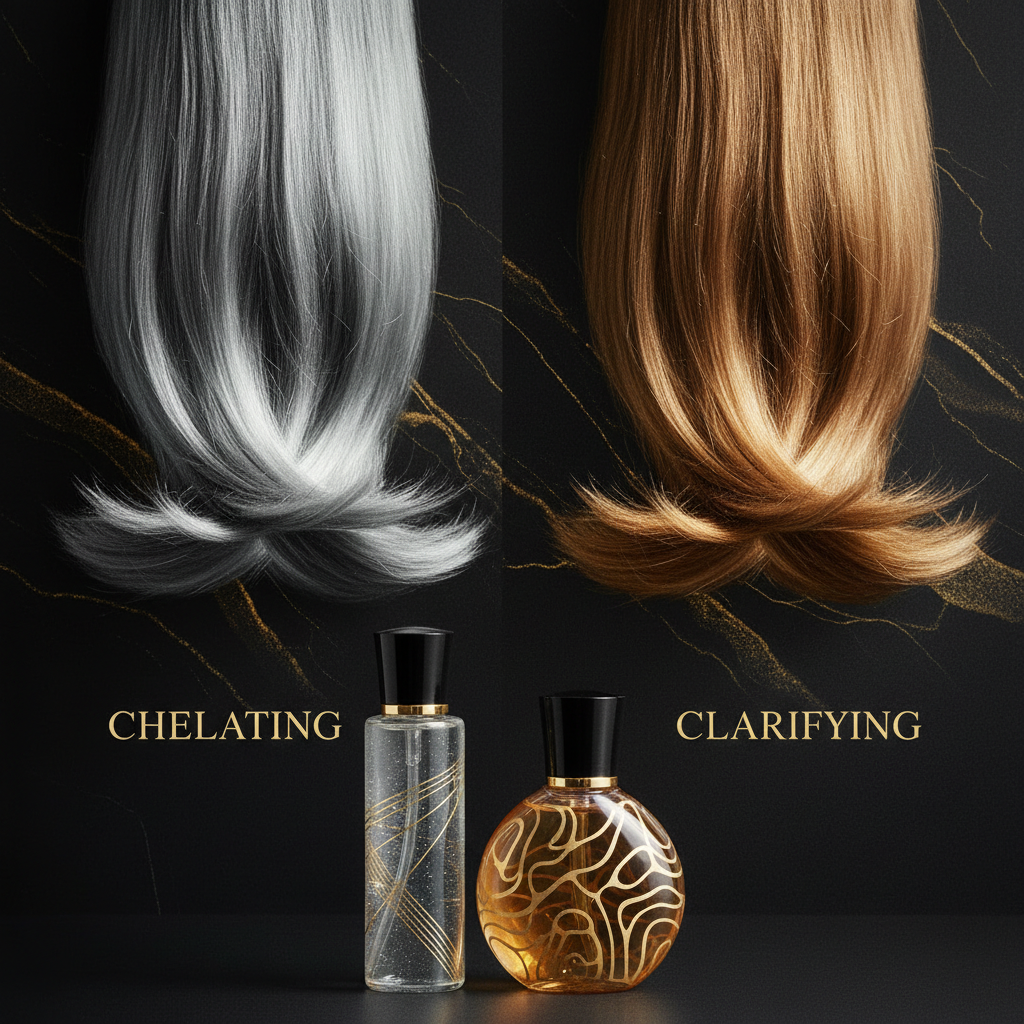
A standard clarifying shampoo functions like a high-strength detergent. It uses strong anionic surfactants, such as sodium laureth sulfate, ammonium laureth sulfate, or modern olefin sulfonates, to emulsify and lift away stubborn oils, heavy conditioners, and styling residues. These formulas are exceptional for resetting hair that feels limp, greasy, or coated from silicones and conditioning agents.
A chelating shampoo performs an entirely different task. It contains chelating agents (derived from the Greek word chele, meaning claw). Common chelating ingredients include tetrasodium EDTA, disodium EDTA, phytic acid, citric acid, and sodium gluconate. These molecules surround multivalent metal ions, such as calcium ($Ca^{2+}$), magnesium ($Mg^{2+}$), iron ($Fe^{3+}$), and copper ($Cu^{2+}$), forming a soluble ring complex that rinses cleanly down the drain. Without these chelators, metal ions bind tightly to the negatively charged keratins in your hair, creating hard mineral crusts that plain clarifying surfactants cannot dissolve.
| Feature | Clarifying Shampoo | Chelating Shampoo |
|---|---|---|
| Primary Target | Surface cosmetic buildup, excess sebum, waxes, silicones | Deep mineral deposits, heavy metals, chlorine, rust |
| Key Active Ingredients | High-strength surfactants (e.g., sodium C14-16 olefin sulfonate) | Chelating agents (e.g., Tetrasodium EDTA, Phytic Acid) |
| Water Type Addressed | Soft to moderate water, post-styling accumulation | Hard water, well water, pool water (chlorine/copper) |
| Cuticle Penetration | Mostly acts on the outer cuticle surface | Penetrates into the outer cortex where metals deposit |
| Typical Usage Frequency | Once every 1 to 2 weeks, or as needed | Once every 2 to 4 weeks (or post-swimming) |
| Risk of Overuse | Surface lipid depletion, frizz, static, dryness | Cuticle disruption, brittleness, accelerated colour fade |
What the evidence does not show
There is no scientific evidence showing that mineral buildup or product residue directly causes follicular hair loss, pattern balding (androgenetic alopecia), or shedding disorders like telogen effluvium. Hair grows from follicles situated roughly four millimetres beneath the surface of the scalp, fed by microcirculation in the bloodstream.
What mineral deposits and product overload actually cause is hair fibre breakage. When hard water minerals crystallise along the hair shaft, they create stiff, rough patches. This increases friction between adjacent strands, impairs hair elasticity, and leads to the fibre snapping during brushing, detangling, or washing. Snapping hair is mechanical breakage, not follicular shedding, even though the resulting thinning ends can look similar to genuine hair loss.
Furthermore, neither clarifying nor chelating shampoos are clinical treatments for scalp disorders like seborrhoeic dermatitis or psoriasis. While they remove flakes and excess oil temporarily, their high surfactant load can aggravate an already inflamed scalp barrier.
The mechanism: how chelators and surfactants work
Hair fibres are comprised of fibrous proteins, predominantly keratin, bound together by lipids and disulphide bonds. The natural isoelectric point of human hair is approximately pH 3.67, while the scalp's acid mantle sits between pH 4.5 and 5.5. Most regular shampoos are buffered within this acidic window to keep the cuticle scales flat, smooth, and tightly sealed.
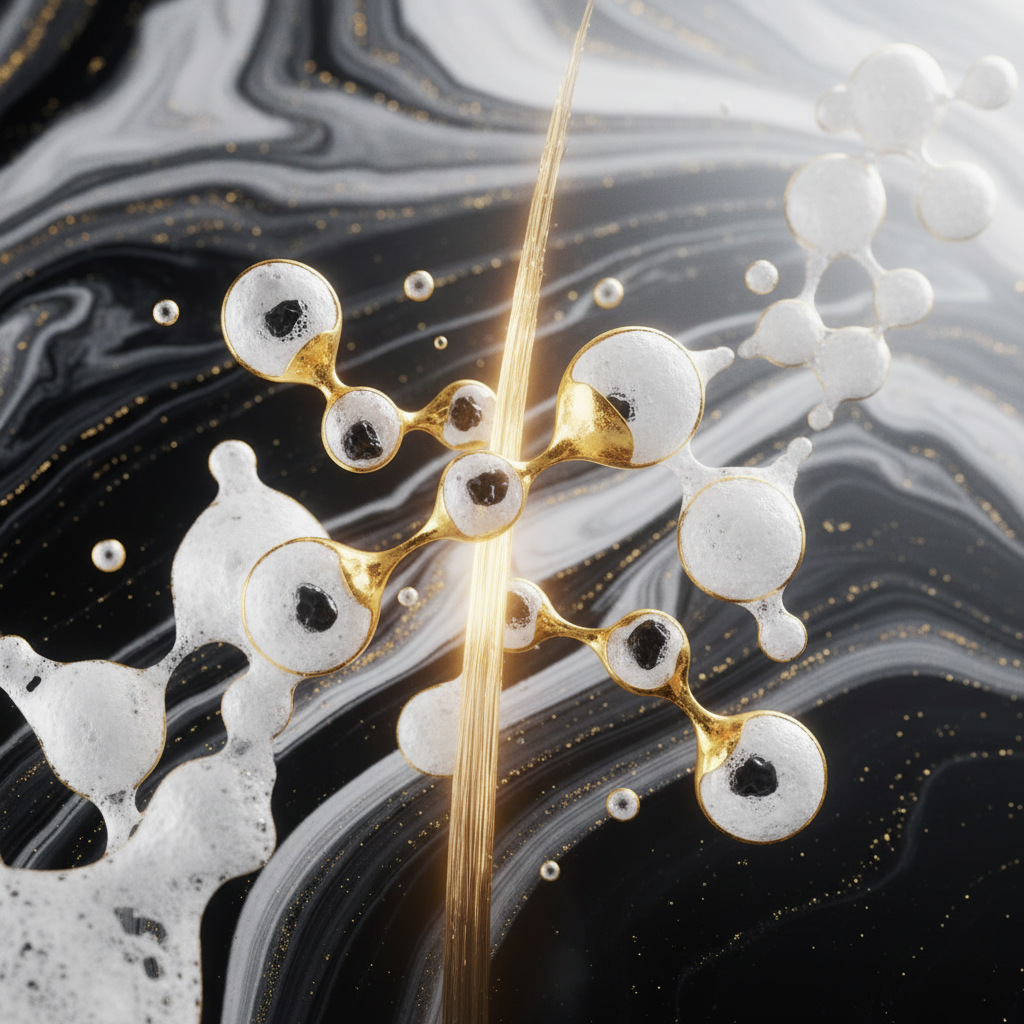
Clarifying shampoos deliberately elevate their formulation pH closer to neutral (pH 6.0 to 7.0). This slight alkalinity swells the hair shaft and raises the overlapping cuticle scales, allowing powerful surfactant micelles to reach trapped polymer coatings and lift them from the cuticle edges.
Chelating shampoos go one step further by introducing ligand chemistry. Hard water containing calcium carbonate and magnesium sulfate leaves calcified salts bonded to hair proteins. If you swim in treated pools, chlorine oxidises copper present in the water, which then binds to keratin and turns blonde or silver hair a greenish tint.
Chelators like ethylenediaminetetraacetic acid (EDTA) possess electron-rich donor atoms (nitrogen and oxygen) that wrap around these positively charged metal cations. By forming a water-soluble coordination compound, the chelator neutralises the electrical bond between the mineral and the hair protein, pulling the metal out of the strand and into the rinse water.
Signs your hair needs clarifying or chelating
Knowing which bottle to choose depends on the specific symptoms your hair displays:
When to choose a clarifying shampoo
- Product limpness: Your hair feels weighed down, flat at the roots, or lifeless despite recent washing.
- Slick or waxy coating: The mid-lengths and ends feel coated, gummy, or waxy, often caused by heavy oils, butters, or non-water-soluble silicones.
- Resistant styling: Your hair suddenly refuses to hold a curl, waves drop rapidly, or clean hair takes twice as long to air dry.
When to choose a chelating shampoo
- Hard water stiffness: You live in a hard water area (over 180 mg/L of calcium carbonate), and your hair feels dry, brittle, like straw, or tangles relentlessly after washing.
- Discolouration: Blonde, grey, or light-coloured hair takes on an unnatural brassy, orange, or green cast due to oxidised iron or copper.
- Chemical treatment failure: Permanent colour washes out prematurely, hair dyes take unevenly, or salon perms fail to process correctly because a mineral barrier blocks chemical penetration.
- Swimmer's hair: Frequent exposure to chlorinated pools leaves strands smelling of pool chemicals, feeling gummy when wet, and stiff when dry.
Proper application and aftercare
Because both formulas are aggressive cleansers, applying them incorrectly can compromise hair health:
- Saturate completely: Wet the hair thoroughly with warm water for at least two minutes before applying the product. This helps loosen outer residues.
- Focus placement: Work clarifying shampoo primarily through the scalp and root zone where sebum and product concentrate. Work chelating shampoo through the mid-lengths and ends where minerals deposit most heavily.
- Observe dwell time: Clarifying shampoos can be rinsed out almost immediately. Chelating shampoos often require a dwell time of 2 to 5 minutes to give the chelators sufficient time to complex with the metal ions.
- Restore moisture immediately: Both processes strip the protective lipid layer (18-methyleicosanoic acid) from the cuticle. Always follow with an intensive, acid-balanced deep conditioning mask (pH 3.5 to 4.5) to reseal the cuticle and restore lubrication.
- Set a sensible frequency: Limit clarifying to once every 7 to 14 days. Limit chelating to once every 2 to 4 weeks, depending on the hardness of your water supply.
Supporting overall hair health: The Watermans approach
Resetting the hair fibre using high-performance cleansers clears away the debris that obstructs healthy styling, but long-term strand resilience requires nourishment directly at the scalp level.
For routine maintenance between deep-cleansing treatments, alternating with an invigorating, nutrient-dense routine like Watermans Grow Me Shampoo and Condition Me Conditioner supports the appearance of fuller, thicker-looking hair without resorting to aggressive stripping agents. Formulated with revitalising ingredients like biotin, rosemary, caffeine, and hydrolysed lupin protein, it maintains a clean, balanced scalp environment while keeping the fibre hydrated, resilient against everyday mechanical breakage, and noticeably soft.
Frequently asked questions about Chelating vs Clarifying Shampoo
Can a clarifying shampoo remove hard water minerals?
A standard clarifying shampoo cannot effectively remove hard water minerals. While clarifying surfactants strip cosmetic oils, silicones, and waxes, they lack the specific molecular structure required to bind and dissolve calcified mineral ions like calcium, magnesium, and copper. To remove mineral buildup, you must use a formula containing chelating agents like tetrasodium EDTA or phytic acid.
In the choice of Chelating vs Clarifying Shampoo, which is harsher on coloured hair?
Chelating shampoos are generally harsher on artificial hair colour than clarifying shampoos. Chelators penetrate deeper into the hair structure to extract bound metal ions, which can dislodge oxidative colour pigments embedded within the cortex. Clarifying shampoos can also strip cosmetic colour over time, but chelating treatments cause faster colour loss if used too frequently.
How often should I alternate between these cleansers?
Most people do not need both in their weekly routine. If you live in a soft water area and use heavy styling products, use a clarifying shampoo once every fortnight. If you live in a hard water district or swim regularly, swap your regular shampoo for a chelating wash once every two to three weeks instead.
Can chelating shampoo stop hair from breaking?
Yes, indirect evidence shows that chelating shampoo can reduce hair breakage caused by mineral brittleness. Hard water deposits make the hair fibre rigid, rough, and prone to snapping during brushing. By removing these crystalline mineral deposits, a chelating shampoo restores natural flexibility and softness, significantly reducing friction and mechanical breakage.
Will these shampoos strip keratin treatments or perms?
Yes, both clarifying and chelating shampoos can rapidly degrade professional smoothing treatments, such as keratin treatments and chemical straighteners. These salon processes rely on protective outer coatings that strong clarifying surfactants and high-pH chelating formulas can strip away in a single wash. Always consult your stylist before using either cleanser on chemically treated hair.
Clarifying your cleansing routine
Selecting between a Chelating vs Clarifying Shampoo comes down to identifying the specific antagonist weighing down your hair. If your strands are coated by modern styling products, heavy silicones, dry shampoos, or natural scalp oils, a standard clarifying wash will hit the reset button effectively. If your issues stem from hard tap water, swimming pools, stubborn brassiness, or mineral-induced brittleness, an authentic chelating shampoo is essential to bind and dissolve those mineral bonds. By using these powerful clarifying tools sparingly and replenishing lost moisture immediately, you can maintain clean, responsive, and resilient hair.
Sources and references
- International Journal of Trichology, "Shampoo and Conditioners: What a Dermatologist Should Know?", 2015.
- Journal of the Society of Cosmetic Chemists, "The absorption of metal ions by human hair", 1978.
- Journal of Cosmetic Science, "Investigation of the effects of hard water on hair", 2011.
- Cosmetics & Toiletries, "Chelating Agents in Cosmetic Formulation", 2018.
- British Association of Dermatologists, "Hair Breakage vs Hair Loss: Clinical Distinctions", 2020.
Find these ingredients in Watermans products
- Copper: you will find this ingredient in our Hair Vitamins.