The Science of Disulphide Bonds in Hair: Structure, Damage, and Repair
11 min read ·
The science of disulphide bonds in hair reveals how covalent chemical links shape strength, curl pattern, and resilience against chemical damage.
Quick answer: The science of disulphide bonds in hair explains how covalent sulphur-to-sulphur linkages between cysteine amino acids give the keratin cortex its tensile strength, elasticity, and permanent curl pattern. Chemical bleaching, perming, and thermal styling break these covalent links, converting cystine into cysteic acid and leaving the hair vulnerable to breakage. While bond-building treatments can cross-link broken protein fragments temporarily, cosmetic products cannot rebuild the original biological protein architecture inside dead keratin fibres.
Key takeaways
- Disulphide bonds are covalent chemical bonds formed between two cysteine amino acid residues, creating cystine within hair keratin.
- Unlike weak hydrogen and salt bonds that break with water or heat, disulphide bonds require chemical reduction or oxidation to break and reform.
- Bleaching and high-lift colouring oxidise disulphide bonds irreversibly into cysteic acid, permanently weakening the hair shaft.
- A healthy hair cortex contains roughly 16 to 18 percent cysteine by amino acid content, providing the primary mechanical strength of the hair fibre.
- Bond builders create artificial cross-links between keratin chains, improving tensile strength and reducing breakage, but they do not biologically regrow or permanently restore the native protein lattice.
The science of disulphide bonds in hair: what the evidence shows
Hair is a biological composite fibre composed primarily of alpha-keratin, a fibrous structural protein packed tightly within the cortex. The cortex accounts for roughly 75 to 85 percent of the total volume of the fibre and dictates nearly all of its mechanical attributes, including tensile strength, elasticity, and shape. Understanding the science of disulphide bonds in hair requires looking closely at how these proteins lock together at a molecular level.
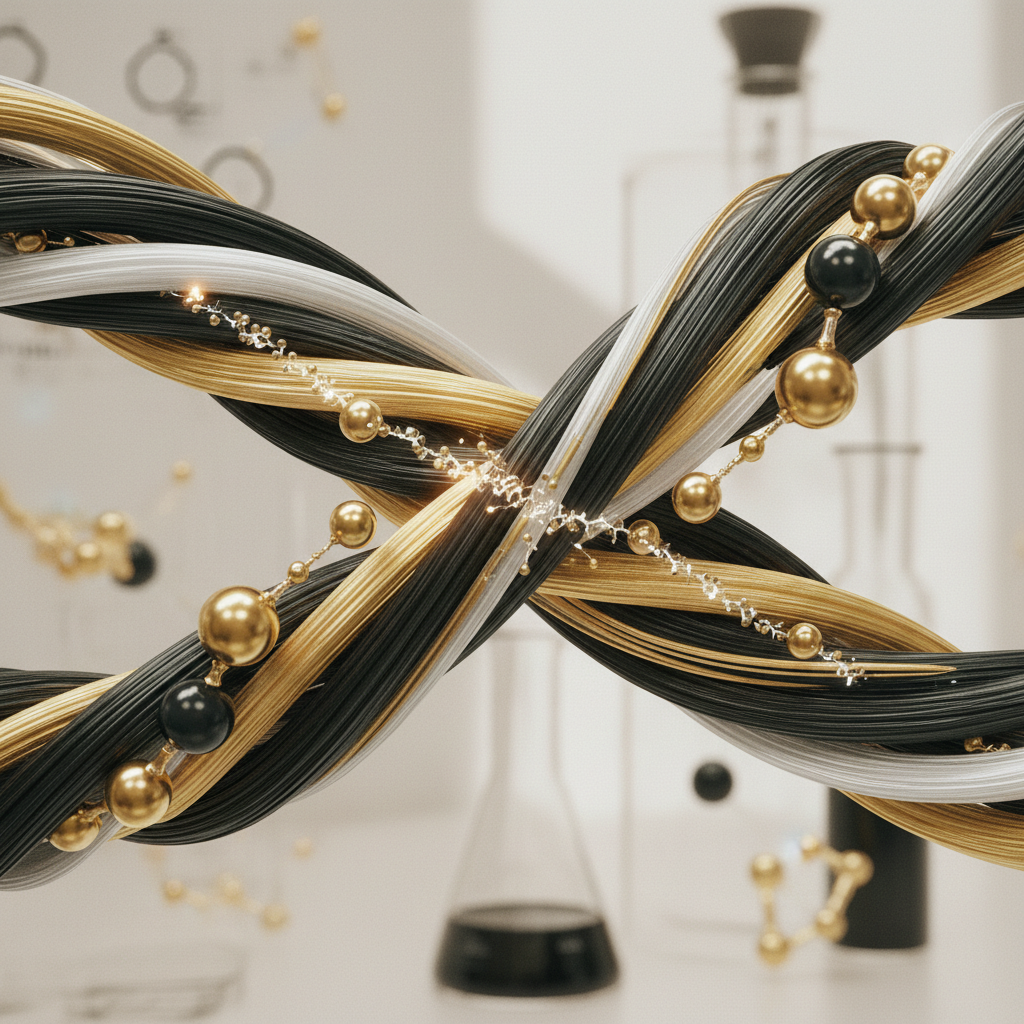
Keratin contains exceptionally high levels of the sulphur-rich amino acid cysteine, typically making up 16 to 18 percent of its total amino acid profile. When two cysteine molecules align within or between adjacent polypeptide chains, their thiol (-SH) groups oxidise to form a single cystine unit linked by a covalent disulphide bond (-S-S-).
These covalent bonds act as chemical cross-links. You can picture the keratin chains as the uprights of a flexible ladder and the disulphide bonds as the rigid structural rungs holding them in position. Because covalent bonds share pairs of electrons between atoms, they possess high bond energy (approximately 250 to 270 kilojoules per mole). This fundamental chemistry explains why hair does not dissolve in water, does not lose its shape in humidity, and can withstand substantial physical stress before snapping.
Polypeptide Chain A --- [Cysteine] - S \
 \ (Disulphide Bond: ~260 kJ/mol)
 \
Polypeptide Chain B --- [Cysteine] - S /
How disulphide bonds differ from hydrogen and salt bonds
Hair fibres rely on three distinct types of chemical bonds to maintain their architecture: hydrogen bonds, salt (ionic) bonds, and disulphide bonds. Each behaves differently when exposed to environmental stresses and salon treatments.
| Bond Type | Bond Mechanism | Relative Strength | What Breaks It? | What Re-forms It? |
|---|---|---|---|---|
| Disulphide Bonds | Covalent bonds sharing electrons between sulphur atoms in cysteine. | Extremely high (chemical bond). | Reducing agents (thioglycolates), bleaching oxidisers, extreme thermal heat over 220°C. | Neutralising oxidisers (e.g. hydrogen peroxide in perms) or artificial cross-linkers. Some oxidation breaks them irreversibly into cysteic acid. |
| Salt (Ionic) Bonds | Electrostatic attractions between positive and negative amino acid side chains. | Moderate (physical bond). | Shifts in pH below 3.5 or above 5.5, water exposure. | Returning the hair fibre to its natural isoelectric point (pH 4.5 to 5.5). |
| Hydrogen Bonds | Weak electrostatic attractions between polar hydrogen and oxygen/nitrogen atoms. | Low individually, but numerous (physical bond). | Water, moisture, standard thermal styling heat (blow-dryers, irons). | Drying the hair and cooling it in a new physical configuration. |
Hydrogen and ionic bonds account for the temporary changes you can create with a blow-dryer or curling tongs. Wetting the hair temporarily unzips hydrogen bonds, and drying the hair resets them. Disulphide bonds, by contrast, remain completely unaffected by water. They maintain the permanent curl pattern and mechanical integrity of the fibre through washing and drying cycles.
The mechanism: how disulphide bonds break and reform
There are two primary ways disulphide bonds are manipulated or destroyed: chemical reduction and chemical oxidation.
Chemical reduction and restructuring (perms and relaxers)
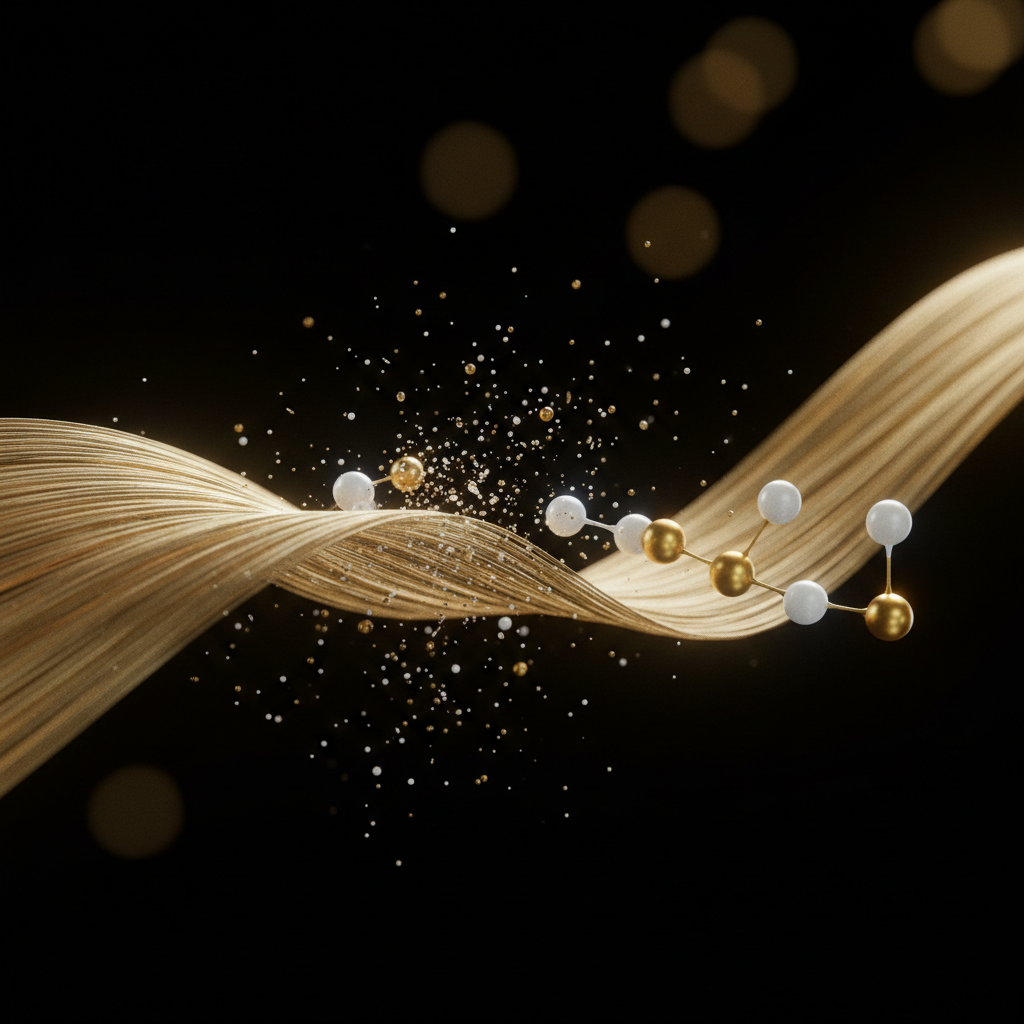
In traditional permanent waving and straightening systems, alkaline reducing agents such as ammonium thioglycolate penetrate the cuticle into the cortex. The alkaline carrier swells the cuticle, allowing thioglycolate ions to donate electrons to the disulphide bridges. This splits cystine into two separate cysteine residues containing free thiol (-SH) groups:
$$\text{R-S-S-R} + 2\text{R'-SH} \rightleftharpoons 2\text{R-SH} + \text{R'-S-S-R'}$$
With these structural rungs broken, the polypeptide chains can slide past one another. The stylist physically manipulates the hair into a new geometry using rods or flat tension. Once the desired shape is set, an oxidising neutraliser (typically dilute hydrogen peroxide at pH 3.0 to 4.0) is applied. The neutraliser strips the hydrogen atoms from the thiol groups, forcing the sulphur atoms to link together again in their new spatial arrangement.
However, this process is never 100 percent efficient. Scientific studies consistently show that between 10 and 20 percent of reduced disulphide bonds fail to reform correctly during neutralisation, forming mixed disulphides or remaining as free thiols. This uncoupled state leaves the fibre slightly weaker after every chemical service.
Oxidative destruction (bleaching and lightening)
While perming breaks disulphide bonds deliberately to reset them, bleaching destroys them as collateral damage. Alkaline persulphate bleaches and peroxide developers must penetrate the cortex to oxidise and dissolve melanin pigments.
In doing so, these aggressive oxidisers react with the sulphur atoms of cystine. Instead of creating reversible free thiols, bleaching oxidises disulphide bonds through intermediate states (monoxides and dioxides) before irreversibly converting them into cysteic acid ($\text{R-SO}_3\text{H}$):
$$\text{R-S-S-R} \xrightarrow{[\text{Oxidation}]} 2\text{R-SO}_3\text{H} \quad (\text{Cysteic Acid})$$
Cysteic acid carries a permanent negative charge and cannot reform a disulphide bridge. As the cystine content drops, the structural ladder loses its rungs. The cortex loses its elasticity, absorbs excess water, swells uncontrollably when wet, and eventually snaps under ordinary brushing tension.
Intact Keratin: Chain-S, , S-Chain (Stable, hydrophobic, strong)
 ↓ (Alkaline Persulphate / Peroxide)
Oxidised Keratin: Chain-SO3⁻ ⁻O3S-Chain (Cysteic acid: charged, weak, porous)
Signs of disulphide bond degradation
Disulphide bond damage is structural and occurs inside the cortex, though its effects manifest visibly on the surface. Key diagnostic signs include:
- Loss of wet tensile strength: Intact hair can stretch up to 30 percent of its dry length in water and return to its original shape. Hair with depleted disulphide bonds stretches abnormally like wet chewing gum and snaps without bouncing back.
- Inability to hold curl: Straightened hair or naturally curly hair that has been over-bleached loses its structural memory because the molecular braces holding the curve have vanished.
- Hyper-porosity: Oxidation introduces negatively charged cysteic acid groups, causing the cortex to attract and trap excess water. The hair takes an unusually long time to dry and tangles severely when wet.
- Fibre snapping (breakage): The hair snaps mid-shaft during light detangling or styling, leaving fractured ends without a white follicular bulb.
What cosmetic treatments can and cannot do
The emergence of modern bond-building additives has transformed salon chemistry, but realistic expectations are essential.
Cosmetic active ingredients used in bond treatments (such as maleic acid derivatives, dimaleates, or small dicarboxylic acids) function as artificial bridging molecules. They react with the free thiol groups left behind by chemical reduction, or create new covalent or cross-linking ionic bonds between fragmented keratin chains.
By inserting a synthetic bridge between two uncoupled amino acid sites, these treatments reduce wet swelling, increase tensile strength, and lower breakage rates. Peer-reviewed material testing confirms that treated hair shows higher resistance to mechanical stress compared to untreated bleached controls.
What these treatments cannot do is reverse cysteic acid back into cystine. Once a disulphide bond has been oxidised into cysteic acid by bleaching powder, that specific sulphur link is permanently gone. Bond builders patch the structural matrix, but they do not biologically heal the fibre. Hair is non-living tissue; it lacks cellular machinery to synthesise new proteins or regenerate biological bonds once grown past the scalp surface.
Practical steps to protect hair bonds
To preserve the disulphide architecture of your hair, consider the following evidence-based steps:
- Limit oxidation levels: Avoid overlapping high-lift bleach over previously lightened hair. Once melanin is dissolved, further processing simply destroys cortical cystine.
- Respect thermal limits: Thermal degradation of disulphide bonds begins between 190°C and 220°C. Keep hot styling tools below this threshold and always apply thermal protectants that reduce heat transfer rates.
- Use bond repair products pre- and post-lightening: Applying targeted cross-linking agents during and after oxidative services mitigates the drop in tensile strength.
- Balance protein and moisture: Highly porous, bond-damaged hair benefits from hydrolysed plant proteins and amino acid complexes that fill physical voids in the cuticle and cortex, alongside emollient conditioners to restore hydrophobicity.
When the cause is something else: breakage versus shedding
It is critical to distinguish between chemical bond degradation and biological hair loss. Broken disulphide bonds cause hair breakage, which is the mechanical snapping of the hair fibre along the shaft.
Hair shedding, by contrast, is a follicular process where entire hair strands shed from the root, complete with a small white bulb at the tip. Conditions such as telogen effluvium, androgenetic alopecia, and alopecia areata occur at the level of the dermal papilla beneath the scalp surface. Chemical damage to disulphide bonds on the hair shaft does not cause root shedding or inhibit the follicle from producing new hair. If you notice wide patches of scalp showing, diffuse thinning at the crown, or clumps of bulb-bearing hair shedding during gentle washing, consult a registered trichologist or dermatologist rather than relying on bond-repair hair cosmetics.
Supportive care from Watermans
While bond builders focus on patching damaged hair fibres, long-term hair health requires a dual approach that protects existing hair lengths while supporting the scalp environment where new hair develops. The Watermans GrowMore Elixir is a targeted, leave-in scalp treatment formulated to provide topical nutrients and invigorate the scalp. Pairing dedicated external bond maintenance on damaged lengths with evidence-informed topical scalp care ensures that your hair is supported from root to tip.
Frequently asked questions about the science of disulphide bonds in hair
Can broken disulphide bonds ever truly repair themselves?
No, hair cannot self-repair because the hair shaft is made of non-living, non-cellular keratin. Disulphide bonds broken during perming can be chemically reformed using neutralisers, but bonds oxidised into cysteic acid during bleaching cannot revert back to cysteine. Bond-building products create synthetic cross-links between protein fragments to restore functional strength, but they do not restore the original biological bond.
How does the science of disulphide bonds in hair relate to split ends?
The science of disulphide bonds in hair shows that these covalent cross-links provide the internal cohesion holding keratin filaments together. When chemical processing or heat breaks these bonds in the cortex, the structural fibres unravel. Without sufficient disulphide integrity to hold the core together, mechanical friction from brushing causes the fibre to split longitudinally, resulting in split ends.
Does washing hair in hot water break disulphide bonds?
No. Hot shower water reaches temperatures between 38°C and 45°C, which is far too low to affect covalent disulphide bonds. Water breaks weak hydrogen bonds and temporarily swells the hair shaft by lifting the cuticle, but it leaves disulphide bonds completely intact. Disulphide bonds require aggressive chemical reducing agents, strong oxidisers, or dry thermal styling temperatures exceeding 220°C to break down.
Why does bleached hair feel gummy or stretchy when wet?
Bleached hair feels stretchy or gummy because the alkaline persulphates have oxidised a large percentage of disulphide bonds into cysteic acid. Without these covalent cross-links holding the keratin chains firmly in place, the cortex absorbs excessive amounts of water. When you pull the hair, the unanchored protein chains slide past each other, leading to rubbery over-stretching and breakage.
Do bond-building shampoos replace deep conditioning treatments?
No, they serve entirely different functions. Bond-building products work inside the cortex to cross-link unbonded amino acid sites and reinforce internal tensile strength. Traditional conditioning treatments work primarily on the outer cuticle and lipid layer (18-MEA), smoothing the surface, replenishing lost lipids, and reducing detangling friction. Damaged hair requires both internal structural reinforcement and external surface conditioning to prevent further mechanical breakage.
Preserving your hair's structural integrity
A thorough understanding of the science of disulphide bonds in hair transforms how you approach chemical services, heat styling, and daily maintenance. These microscopic covalent bridges are the literal backbone of your hair fibre, dictating whether it resists everyday tension or snaps under minimal stress. While modern cosmetic chemistry provides valuable tools to cross-link damaged fibres and reduce breakage, these treatments are not an excuse to push hair past its chemical breaking point. Treating your hair with physical gentleness, moderating bleach processing, and keeping heat tools below critical thresholds remains the gold standard for keeping your keratin lattice intact.
Sources and references
- Robbins, C. R. (2012). Chemical and Physical Behavior of Human Hair (5th ed.). Springer-Verlag.
- Journal of Cosmetic Science. (2009). "Investigation of the effects of chemical treatments on the hair cortex."
- International Journal of Cosmetic Science. (2017). "The mechanical properties of bleached human hair."
- Society of Cosmetic Chemists. (2015). "Chemical reduction and oxidation of hair keratin."
- Feughelman, M. (1997). Mechanical Properties and Structure of Alpha-keratin Fibres: Wool, Human Hair and Related Fibres. UNSW Press.
Where Watermans fits
If you want a routine built around the science above, these are the products from the range that apply here: