Recognising the Signs of Damaged Hair: An Evidence-Based Guide
8 min read ·
Learn the biological markers of damaged hair. An evidence-based guide to identifying cuticle erosion, high porosity, and breakage before structural failure occurs.
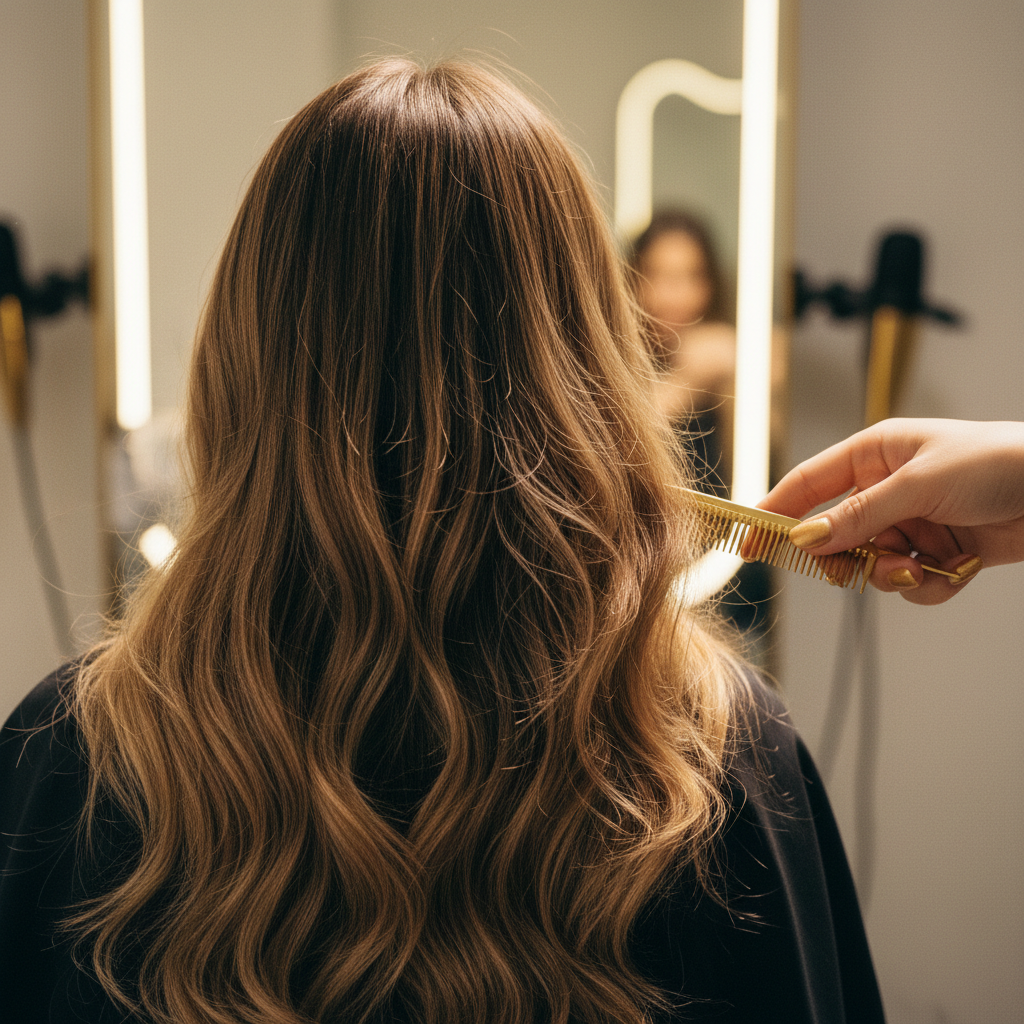
Quick answer: Recognising the Signs of Damaged Hair requires examining the physical cuticle and inner cortex rather than the follicle itself. True structural damage presents as raised or missing cuticle scales, split ends (trichoptilosis), high porosity, extreme brittleness, and snapping along the shaft. The main limitation is that hair fibre is non-living tissue; once keratin bonds break and the protective lipid layer strips away, cosmetic treatments can temporarily patch or reinforce the fibre, but they cannot biologically regenerate or permanently heal it.
Key takeaways
- Damaged hair involves physical or chemical degradation of the non-living fibre, distinct from scalp-based hair shedding or follicular hair loss.
- The earliest structural sign is lipid depletion of the 18-methyleicosanoic acid (18-MEA) layer, leaving strands hydrophobic-compromised and rough.
- Advanced signs include cuticle chipping, increased wet stretch without recovery, mid-shaft breakage, and split ends.
- High porosity allows rapid water absorption but equally rapid moisture loss, leading to chronic frizz and hygral fatigue.
- Professional diagnosis uses tactile, visual, and elasticity tests to separate structural breakage from telogen effluvium or androgenetic alopecia.
Recognising the Signs of Damaged Hair: what the evidence shows
Recognising the Signs of Damaged Hair starts with understanding hair biology. A healthy hair shaft consists of an outer protective cuticle layer (5 to 10 overlapping cells thick), an inner cortex providing mechanical strength via keratin chains, and sometimes a central medulla. Surrounding the outermost cuticle cells is a monomolecular layer of fatty acids, predominantly 18-methyleicosanoic acid (18-MEA), which provides a natural water-repellent barrier.
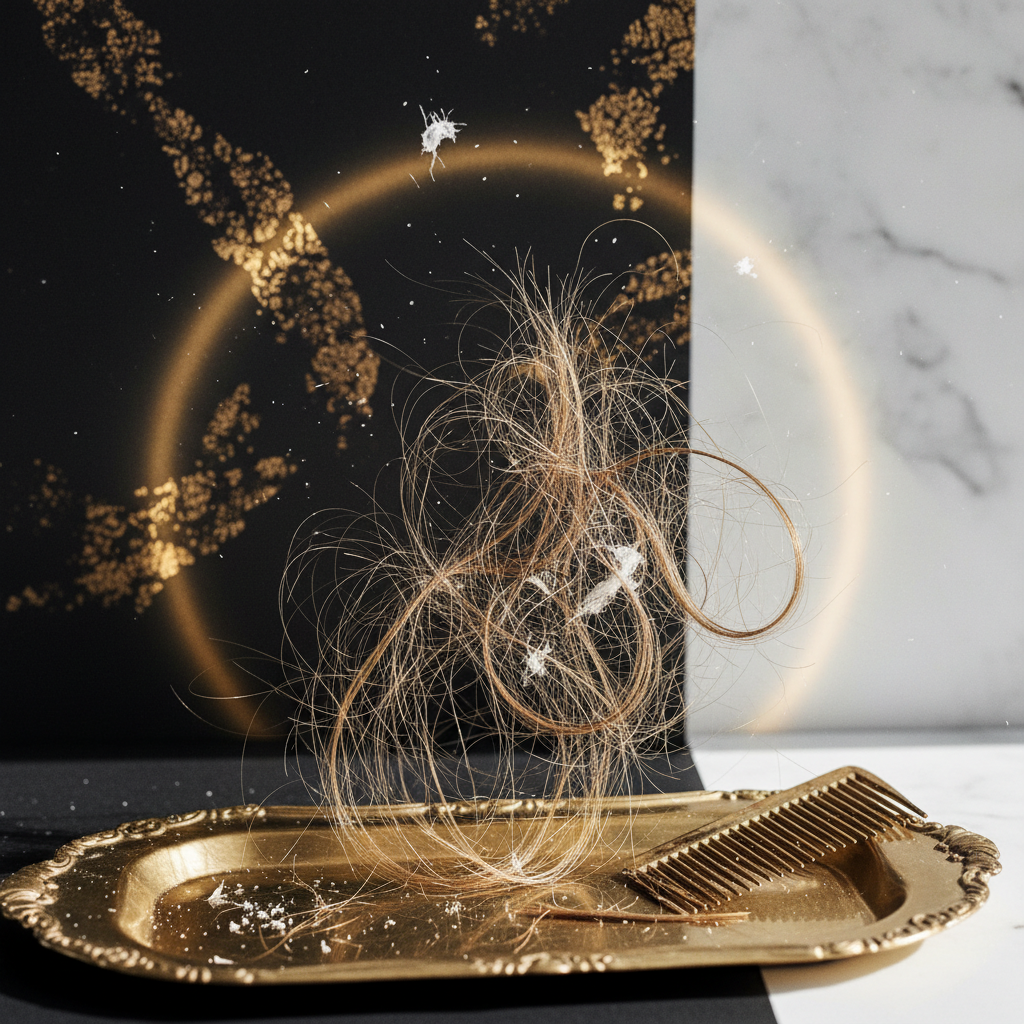
When hair undergoes chemical bleaching, high thermal heat, or severe mechanical friction, this protective lipid layer erodes first. Research published in cosmetic dermatology shows that chemical bleaching can strip upwards of 80 percent of the surface 18-MEA layer in a single high-lift service. As this barrier fails, the underlying cuticle scales lift, crack, and break off. Without the cuticle armour, the inner cortex is exposed to ambient moisture changes, oxidation, and mechanical friction, leading to structural failure.
Distinguishing these signs is critical because a damaged hair shaft snaps under normal tension, creating short, uneven fragments. This is mechanical breakage, not telogen shedding or follicular miniaturisation.
The physical signs to look for
Damage manifests in distinct, measurable ways across the fibre:
- Loss of natural slip and chronic tangling: Healthy cuticle scales lie flat like roof tiles, sliding smoothly past adjacent fibres. Raised or eroded scales cause friction coefficients to skyrocket, leading to persistent knotting, especially at the nape and ends.
- Dullness and light scatter: A smooth surface reflects light in a specular fashion, creating shine. Chipped, rough cuticles scatter light diffusely, leaving hair looking matte, faded, and chalky.
- Split ends (Trichoptilosis): When the cuticle completely strips away, the internal cortical macrofibrils unravel. This longitudinal splitting can occur at the tips or halfway up the shaft.
- White bulbs at the fracture point (Trichorrhexis nodosa): Small white dots along the strand are not follicular roots. They are points where the cortex has collapsed and expanded like a brush, waiting to snap under slight tension.
- Excessive wet elasticity or gummy texture: Healthy wet hair can stretch roughly 30 percent beyond its resting length and return intact. Severe chemical damage compromises the disulfide cross-links, causing the wet fibre to stretch excessively like wet chewing gum before snapping.
- Extreme brittleness when dry: Heat-depleted hair loses bound moisture, becoming stiff, glassy, and prone to clean transverse snapping upon light brushing.
| Characteristic | Healthy Hair Fibre | Damaged Hair Fibre |
|---|---|---|
| Cuticle Integrity | Flat, overlapping cells, intact 18-MEA layer | Lifted, chipped, or missing cell margins |
| Water Behaviour | Hydrophobic (repels water droplets initially) | Hydrophilic (absorbs water instantly, dries unevenly) |
| Tensile Strength | High resistance to mechanical pulling | Snaps under low to moderate tension |
| Friction Level | Low; individual strands slide freely | High; strands catch, tangle, and matte easily |
| Fracture Site | Minimal; normal shedding has white root sheath | Mid-shaft fractures, frayed tips, no root bulb |
| Surface Reflection | High specular shine | Diffuse light scatter, dull appearance |
The mechanisms behind hair shaft damage
Fibre degradation occurs through three primary mechanisms: chemical, thermal, and mechanical.
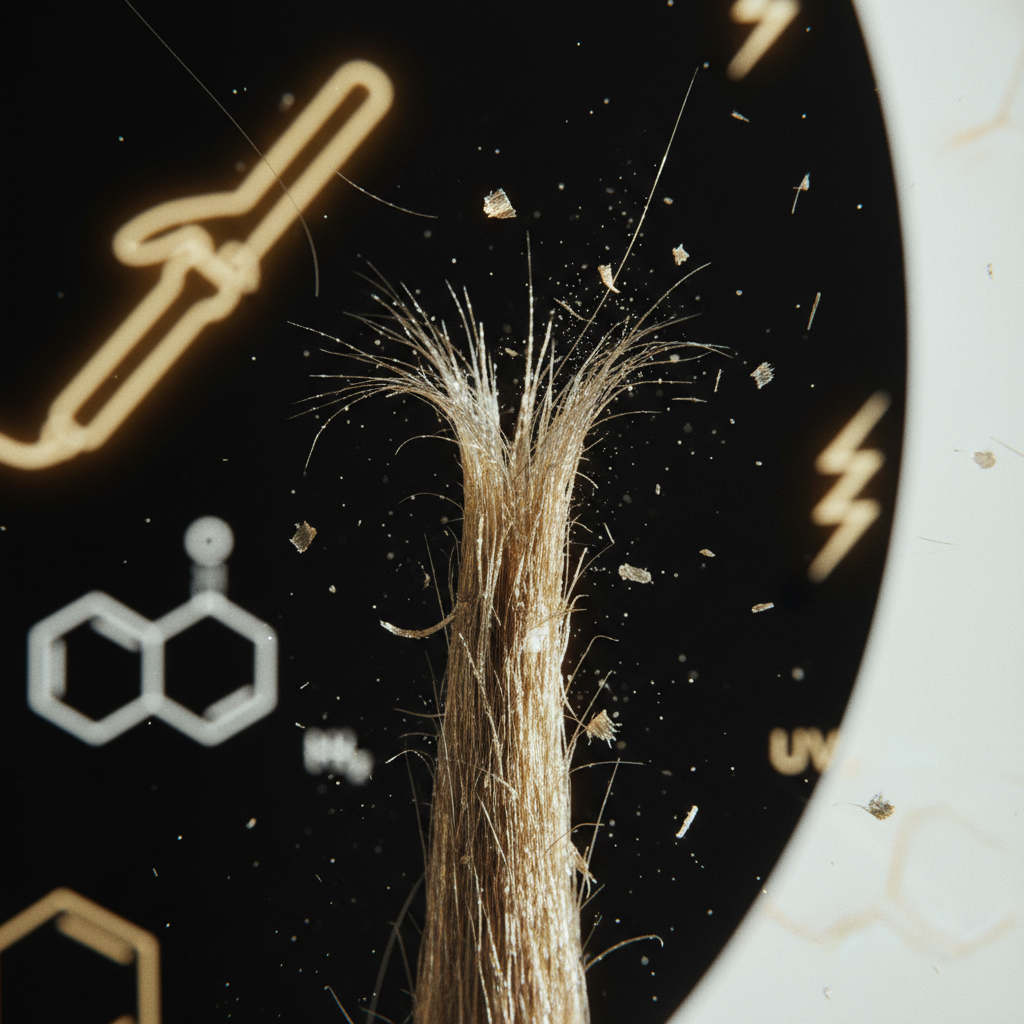
Chemical processing (bleaching, permanent colouring, chemical straightening) alters the structural pH of hair. The hair fibre's natural isoelectric point sits between pH 3.67 and 5.5. Alkaline chemicals lift the cuticle by swelling the shaft up to pH 9.0 to 11.0, enabling oxidising agents like hydrogen peroxide to dismantle melanin pigments or breaking disulfide bonds with ammonium thioglycolate. If these bonds are not effectively reconstructed, structural rigidity drops permanently.
Thermal tools (flat irons, curling wands) above 160 degrees Celsius cause the alpha-keratin helical structure to denature into weaker beta-keratin. If used on damp hair, thermal tools rapidly vaporise water inside the cortex, causing internal steam expansion that creates irreversible micro-cavities (bubble hair).
Mechanical stress involves routine brushing, backcombing, and rough towel drying. Friction against raised cuticles physically shears off the delicate margins of the cells, gradually thinning the shaft diameter over months.
What the evidence does not show
Controlled research does not show that damaged hair can absorb nutrients to "grow back stronger" along existing lengths. Because the hair shaft above the skin surface contains no living cells, blood supply, or metabolic machinery, it cannot undergo physiological cellular repair.
Cosmetic treatments, deep conditioning masks, and bond-building additives do not permanently restore original untreated keratin matrices. Hydrolysed proteins, silicones, and synthetic polymers adhere to the damaged surface via electrostatic attraction or cross-link fractured bonds cosmetically. They significantly improve tensile strength, lower friction, and reduce future breakage, but they wash out or wear down over time and require consistent reapplication.
Furthermore, evidence does not show that damaged hair slows down hair growth from the scalp. The follicle operates independently inside the dermis; hair continues to emerge at its typical rate of roughly 1 to 1.25 centimetres per month, but severe breakage can cause overall length to stay stagnant.
Practical steps to manage and protect compromised hair
When hair exhibits signs of structural degradation, an evidence-based care routine minimises further fibre loss:
- Lower mechanical friction: Switch to wide-tooth detangling combs or flexible-bristle brushes. Detangle working upwards from the tips to the roots while hair is coated with a conditioning agent to reduce surface friction.
- Restore the acid mantle: Use shampoos and conditioners formulated within the optimal pH range of 4.5 to 5.5. Acidic formulations contract the cuticle layers, reducing shaft swelling and light scatter.
- Incorporate low-molecular-weight ingredients: Hydrolysed keratin, wheat protein, and panthenol can penetrate micro-fractures in the cortex to provide structural reinforcement, while plant lipids help replace lost surface hydrophobic properties.
- Regulate thermal exposure: Never apply heat tools above 150 to 170 degrees Celsius on compromised hair, and always apply a thermal protectant containing polymers that slow the rate of heat transfer.
- Trim fractured ends: Once trichoptilosis (splitting) begins, mechanical forces will cause the split to travel upward along the shaft. A blunt physical trim is the only definitive method to eliminate split tips.
Supporting hair condition with Watermans
When managing hair compromised by chemical processing or environmental wear, preserving newly emerged growth at the root while conditioning existing lengths is essential. Watermans GrowMe Shampoo delivers a sulphate-free, pH-balanced cleanse that respects fragile cuticles, combining biotin, rosemary, caffeine, and argan oil to maintain scalp vitality without stripping the hair's surface lipids. Pairing this with Watermans ConditionMe Conditioner provides hydrolysed lupin protein and cholesterol, which physically deposit into minor surface fissures, softening rough cuticle margins and reducing mechanical breakage during brushing.
When the cause is something else
Before assuming poor condition is due to styling damage alone, evaluate whether the issue stems from an internal or follicular cause. If you observe hairs falling out with a small white bulb at one end, this indicates telogen shedding (the entire hair leaving the follicle), not breakage. Telogen effluvium is triggered by systemic factors including nutritional deficiencies (such as ferritin or zinc), severe psychological stress, thyroid imbalances, or post-febrile illness.
If hair is visibly thinning at the crown or parting while maintaining strong individual fibre integrity, androgenetic miniaturisation may be present. A board-certified dermatologist or registered trichologist should examine sudden, patchy, or high-volume shedding.
Frequently asked questions about Recognising the Signs of Damaged Hair
How do I tell the difference between breakage and natural shedding?
Examine the shed strands. Natural shedding involves hairs that match your full length, featuring a small white bulb at one end indicating it left the follicle. Breakage consists of shorter, uneven fragments with blunt, split, or frayed ends and no root bulb attached.
Can split ends be permanently sealed back together?
No. Split ends represent complete structural separation of the cortical fibres. While cosmetic serums containing polymers or silicones can temporarily glue the split edges together until the next wash, only a physical trim can permanently remove the damaged section.
Is high porosity always a sign of damaged hair?
Not always, but severe damage causes high porosity. Some hair textures, particularly naturally curly or coily hair, have naturally higher baseline porosity. However, if hair that once repelled water suddenly absorbs it instantly and becomes limp and tangled when wet, chemical or thermal cuticle erosion is the cause.
Why is Recognising the Signs of Damaged Hair important before a colour service?
Recognising the Signs of Damaged Hair before a colour service prevents catastrophic chemical breakage. Compromised hair has high porosity and an altered cuticle, causing it to absorb chemical dyes unevenly and struggle to hold pigment. If bleach or high-volume developers are applied to already fractured cortex bonds, severe dissolving or snapping of the fibre can occur.
Preserving fibre integrity
Recognising the Signs of Damaged Hair allows you to intervene before micro-fissures progress into visible breakage. Because the hair shaft cannot regenerate, protecting existing strands relies on low-friction styling, strict heat moderation, and targeted conditioning agents that seal the cuticle and reinforce the inner cortex. By treating the fibre with mechanical care and maintaining a balanced scalp environment, you ensure that fragile lengths remain strong, manageable, and resilient.
Sources and references
- Robbins, C. R. (2012). Chemical and Physical Behavior of Human Hair. 5th ed. Springer Science & Business Media.
- Gavazzoni Dias, M. F. (2015). Hair cosmetics: An overview. International Journal of Trichology, 7(1), 2-15.
- Marsh, J. M., et al. (2015). Role of internal lipids in hair health. Journal of Cosmetic Science, 66(4), 235-244.
- British Association of Dermatologists. (2021). Hair breakage and hair shaft disorders guidance.
- Sinclair, R. D. (2007). Healthy hair: what is it? Journal of Investigative Dermatology Symposium Proceedings, 12(2), 2-5.
Find these ingredients in Watermans products
- Zinc: you will find this ingredient in our Hair Vitamins.