Protein vs Moisture for Hair: The Scientific Guide to Fibre Balance
9 min read ·
Mastering protein vs moisture for hair prevents brittleness and snapping. Learn the science of tensile strength, elasticity, and how to spot hair imbalance.
Quick answer: Getting the right balance of protein vs moisture for hair comes down to balancing structural strength with fibre flexibility. Hair is roughly 85% to 90% keratin protein, while water bound within the cortex provides elasticity. Too much protein without sufficient conditioning leaves fibres stiff, brittle, and prone to snapping. Conversely, excessive water absorption without structural integrity causes hygral fatigue and mushy strands. However, topical cosmetic products cannot permanently rebuild broken disulphide bonds, meaning balancing them requires ongoing maintenance tailored to hair porosity.
Key takeaways
- Hair is predominantly composed of fibrous keratin protein (85% to 90%), while water (10% to 15% under ambient humidity) gives the strand its pliable elasticity.
- The debate over protein vs moisture for hair is essentially a question of tensile strength versus bendability.
- Hydrolysed proteins deposit temporarily on and within the cuticle to patch structural gaps, whereas humectants and emollients regulate moisture retention.
- "Protein overload" is not a medical condition. It describes a cosmetic state where excess protein cross-linking or surface buildup makes hair stiff, rough, and prone to mechanical breakage.
- Hygral fatigue occurs when porous hair repeatedly swells and contracts with excess water, weakening the cell membrane complex.
Protein vs Moisture for Hair: what the evidence shows
Understanding protein vs moisture for hair requires examining the physiological structure of human hair fibres. The hair shaft consists of three main morphological components: the outer protective cuticle, the middle cortex that dictates tensile strength and elasticity, and the central medulla. Keratin, a fibrous protein rich in cysteine amino acids, forms the primary structural scaffold of the cortex.
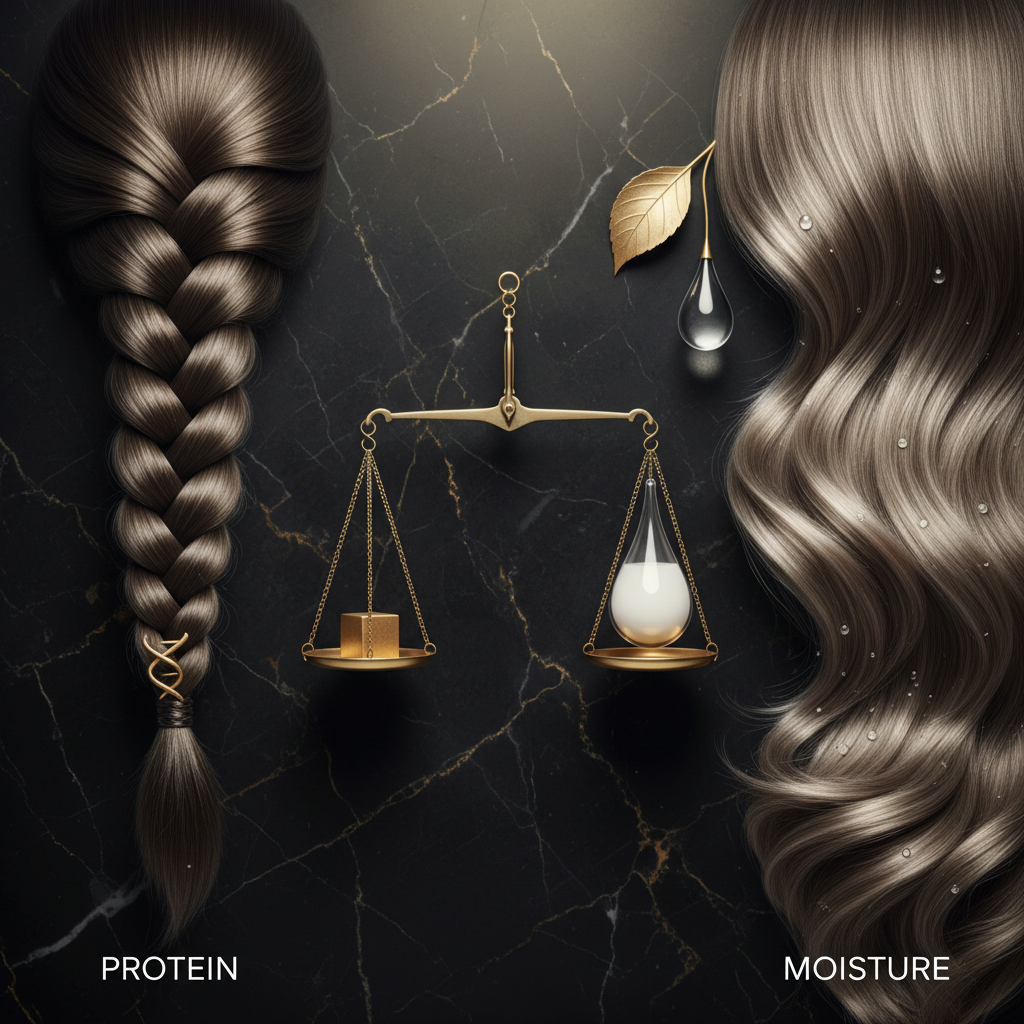
Cosmetic science demonstrates that hair needs both structural reinforcement and plasticisation to withstand daily grooming. Plasticisation refers to the softening effect that water has on keratin fibres. When hair contains adequate water, hydrogen bonds can break and reform temporarily as the hair bends, allowing it to stretch and return to its original length. When hair lacks water, it feels dry and unyielding.
Conversely, when hair is chemically bleached, dyed, or thermally styled, disulphide bonds and lipid layers (specifically 18-methyleicosanoic acid on the epicuticle) are stripped away. This raises cuticle scales, exposing the inner cortex and allowing keratin fragments to leach out. In cosmetic formulations, hydrolysed proteins (such as hydrolysed wheat, silk, or soy protein) have molecular weights small enough (roughly 1,000 to 3,000 Daltons) to penetrate shallow cuticle defects, temporarily restoring fibre rigidity and reducing friction. Larger proteins remain on the surface, forming a temporary film that slows moisture loss.
| Hair State | Primary Cause | Physical Symptoms | Wet Stretch Test Behaviour | Immediate Solution |
|---|---|---|---|---|
| Protein Deficient | Bleaching, relaxers, excessive heat, severe chemical processing | Limp, mushy, overly soft, lacks curl definition | Stretches far beyond normal length and does not snap back; feels gummy | Hydrolysed protein treatments, bond builders |
| Moisture Deficient | Dry climate, stripping shampoos, lack of conditioning emollients | Dull, rough, frizzy, sounds like dry straw when rubbed | Stretches minimally, snaps immediately under slight tension | Emollient masks, fatty alcohols, humectants (glycerin, aloe) |
| Protein Overload | Excessive frequent use of reconstructors and leave-in proteins | Stiff, brittle, tangled, dry to the touch, straw-like | Snaps almost instantly with no elasticity or stretch | Clarifying wash, followed by protein-free deep conditioning |
| Hygral Fatigue | High porosity hair kept continuously wet or over-conditioned | Weak, lifeless, spongy, dull, breaks easily when wet | Stretches excessively then breaks without returning | Balanced protein treatment, air drying, light sealing oils |
How hair fibre mechanics work: strength versus elasticity
The fundamental mechanics of hair fibre depend on two distinct properties: tensile strength and elasticity. Tensile strength is the maximum stress a hair fibre can withstand while being stretched before breaking. This strength is directly provided by the keratin protein chains, linked by disulphide bonds, salt linkages, and hydrogen bonds.
Elasticity is the fibre's ability to stretch and return to its original shape without permanent deformation. Healthy terminal hair can typically stretch up to 30% of its original length when dry, and up to 50% when fully saturated with water, before breaking. Water acts as an internal plasticiser: it temporarily lubricates the keratin protofibrils within the cortex, allowing them to slide past one another.
If you apply too much protein to undamaged hair, you increase fibre stiffness. Without adequate water molecules to lubricate those protein chains, the hair cannot flex under mechanical stress such as brushing or tying. As a result, the fibre snaps cleanly along the shaft.
Conversely, if hair absorbs too much water without a sturdy protein framework, it enters a state of hygral fatigue. Water causes the hair shaft to swell radially by up to 15% to 20%. Repeated swelling and deswelling weakens the cell membrane complex that glues cuticle and cortical cells together, leading to cuticle lifting, internal void formation, and eventual breakage.
Signs your hair needs protein or moisture
Assessing your hair requires observing how the fibre behaves both wet and dry, rather than guessing based on surface dryness alone.
Signs hair needs protein
- Gummy or mushy texture when wet: When saturated with water, the strands feel strangely soft, sponge-like, or stretchy without spring.
- Loss of natural curl or wave pattern: Curls appear dropped, elongated, or unable to hold their normal spiral or bounce.
- Excessive stretching without bounce back: When you pull a single wet strand gently between your fingers, it continues to stretch far beyond normal limits and fails to recover its original length.
- Recent chemical alteration: Hair that has recently undergone bleaching, permanent colouring, perming, or chemical straightening has depleted internal protein levels by default.
Signs hair needs moisture
- Straw-like dryness: Hair feels stiff, rough, and coarse across both the lengths and ends, even when conditioned.
- Tangles and friction: Strands snag easily against one another, creating persistent fairy knots (trichonodosis).
- Zero elasticity: When you pull a dry or slightly damp strand gently, it refuses to stretch even slightly and snaps immediately with an audible click.
- Dullness and frizz: Cuticles remain lifted due to a lack of surface lipid lubrication, preventing light reflection and letting humidity penetrate unchecked.
How to restore balance to your hair
Restoring harmony between strength and hydration involves a systematic approach:
- Clarify first: If hair feels brittle and rigid, wash with a chelating or clarifying shampoo to strip away accumulated protein films, silicone coatings, and mineral deposits from hard water.
- Apply targeted conditioning: For protein-heavy, stiff hair, switch to a rich, protein-free [deep conditioner](https://watermanshair.com/products/masque-me-luxurious-hair-mask) containing fatty alcohols (cetyl alcohol, stearyl alcohol), plant oils, and humectants (glycerin, panthenol). Leave it on under a warm cap for 15 to 20 minutes to restore cortical pliability.
- Use hydrolysed protein when structural support is lacking: If hair feels limp or mushy, use a treatment containing hydrolysed keratin, wheat protein, or silk amino acids. Follow immediately with a light rinse-out conditioner to maintain outer softness.
- Mind hair porosity: Low-porosity hair has tightly bound cuticles; it resists moisture absorption and easily suffers from protein buildup. High-porosity hair has wide cuticle gaps; it requires regular protein to plug voids, followed by heavier butters or oils to seal moisture inside.
When the cause is something else
It is easy to blame a lack of protein or moisture when hair condition deteriorates, but several other internal and external factors produce identical symptoms:
- Hard water mineral buildup: Calcium and magnesium ions bond to hair keratin, creating an impermeable, crunchy layer that mimics protein overload. No amount of moisturiser will help until a chelating agent removes the minerals.
- Heat damage: Extreme heat (above 185°C to 200°C) denatures keratin permanently and melts surface cuticles. Treatments can temporarily mask the texture, but the damaged portion must eventually be trimmed.
- Follicular shedding vs fibre breakage: If you are finding entire strands with a white bulb attached at the root, you are experiencing follicular shedding (such as telogen effluvium), not breakage from a protein-moisture imbalance. Shampoos and conditioning masks alter fibre mechanics along the hair shaft; they do not cure shedding triggered by systemic, hormonal, or nutritional factors.
Supporting hair health with Watermans
While cosmetic treatments balance tensile strength and flexibility along the hair shaft, healthy hair growth begins at the follicle. The Watermans collection supports optimal scalp health and fibre integrity. Watermans GrowMe Shampoo is formulated with biotin, rosemary extract, caffeine, and hydrolysed lupin protein to fortify the scalp and promote stronger-feeling, fuller-looking hair without weighing down delicate strands. Complementing this with Watermans ConditionMe Conditioner provides the essential emollient slip, cholesterol, and natural oils needed to seal the cuticle layer, softening dry hair and keeping the balance between strength and flexibility right where it belongs.
Frequently asked questions about Protein vs Moisture for Hair
How do I do the wet stretch test for protein vs moisture for hair?
Take an isolated strand of wet hair between your thumb and forefinger on both hands. Gently pull the strand outward. If it stretches slightly (around 20% to 30%) and bounces back to its original length, your balance is sound. If it stretches excessively, feels gummy, or snaps without bouncing back, it lacks protein. If it barely stretches at all and snaps immediately, it lacks moisture.
Can virgin, uncoloured hair get protein overload?
Yes. Virgin hair has an intact cuticle layer with minimal porosity. Because there are few microscopic gaps in the cuticle, applying heavy leave-in protein treatments or hydrolysed keratin serums leads to surface buildup. The proteins cross-link on the outside of the hair fibre, forming a rigid shield that prevents ambient moisture from penetrating, resulting in sudden brittleness and snapping.
How often should I use protein treatments compared to moisturising masks?
Most healthy hair needs deep moisture every one to two weeks, but protein treatments should be applied much more sparingly. Moderately damaged or high-porosity hair typically benefits from a protein treatment once every 4 to 6 weeks. Fine or low-porosity hair may only need mild protein once every two to three months, or simply a balanced daily conditioner.
Does drinking more water fix moisture-deficient hair?
No. While systemic hydration is vital for general metabolic health and follicular cellular activity, drinking water does not directly moisturise dead hair fibre shafts. Hair moisture is maintained topically by regulating water vapour exchange using humectants, fatty acids, and cosmetic emollients that seal the cuticle scales.
Finding equilibrium in your hair regimen
Achieving the right balance of protein vs moisture for hair is not a static destination, but an ongoing process of observation. Hair is a biologically inert fibre that responds dynamically to changes in humidity, styling tools, chemical treatments, and cleansing routines. By monitoring whether your strands are leaning toward limp elasticity or rigid brittleness, you can adjust your products to provide the exact structural reinforcement or hydrating emollients your hair requires.
Sources and references
- Robbins, C. R. (2012). Chemical and Physical Behavior of Human Hair. 5th ed. Springer-Verlag New York.
- Dawber, R. (1996). Hair: Its structure and response to cosmetic preparations. Clinics in Dermatology, 14(1), 105-112.
- Evans, T., & Wickett, R. R. (2012). Practical Modern Hair Science. Allured Business Media.
- Cruz, C. F., et al. (2016). Human hair characteristics and methods to assess hair quality. International Journal of Trichology, 8(3), 115-121.
- Wolfram, L. J. (2003). Human hair: A unique physicochemical composite. Journal of the American Academy of Dermatology, 48(6), S106-S114.
Find these ingredients in Watermans products
- Panthenol (Provitamin B5): you will find this ingredient in our Heat Protection Spray.