Protein Moisture Balance in Hair Care: Science, Signs, and Practical Solutions
10 min read ·
Understand Protein Moisture Balance in Hair Care. Learn the science of hair elasticity, how to spot protein or moisture overload, and how to fix fibre breakage.
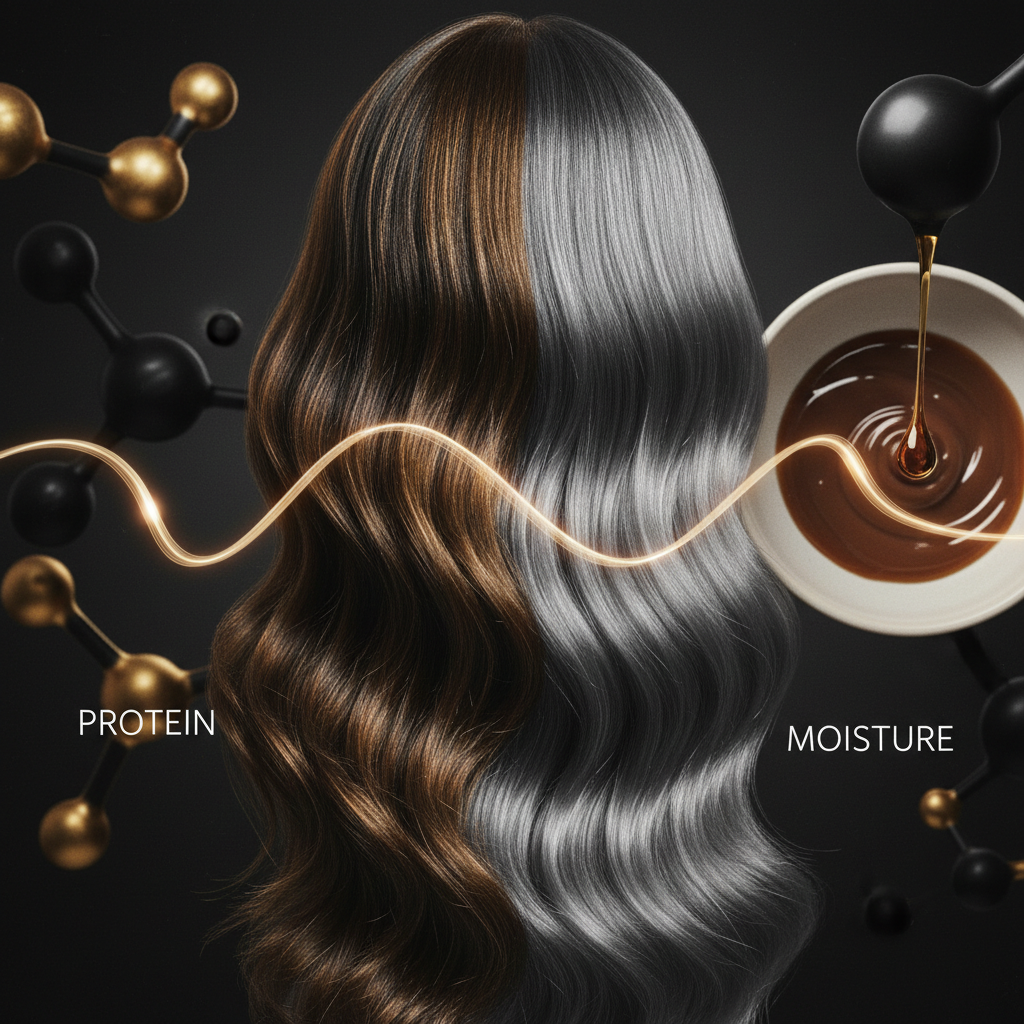
Quick answer: Achieving the right Protein Moisture Balance in Hair Care means managing the structural integrity of your hair's keratin cortex alongside the water content plasticised within its fibre. Hair relies on internal proteins for tensile strength and water for elasticity. Imbalances lead to either brittle breakage from excess rigidity or limp, mushy snapping from hygral fatigue. However, topical cosmetics cannot permanently rebuild internal keratin chains; they provide temporary reinforcement and moisture retention through surface adsorption and cuticle conditioning.
Key takeaways
- Human hair consists of roughly 65 to 90 percent protein (primarily keratin), 10 to 15 percent water, and small fractions of lipids and melanin.
- Structural protein treatments reinforce mechanical tensile strength, whereas humectants and conditioning emollients preserve elasticity and flexibility.
- Protein overload manifests as stiff, brittle, straw-like strands that snap under tension with almost zero stretch.
- Moisture overload (often linked to hygral fatigue) leaves strands limp, mushy, overly stretchy when wet, and unable to hold curl or shape.
- Cosmetic proteins do not fuse permanently into the hair cortex; they deposit on the surface and penetrate shallow porous gaps until washed away.
- Restoring balance requires adjusting the frequency of hydrolysed protein treatments, deep conditioners, and clarifying washes according to your hair's porosity.
Protein Moisture Balance in Hair Care: what the evidence shows
Understanding the Protein Moisture Balance in Hair Care starts with the physical chemistry of the hair shaft. Hair fibres are not living tissue. Once a hair emerges from the scalp follicle, its cellular machinery shuts down. The fibre cannot biologically heal or synthesise new tissue. Instead, healthy behaviour relies on a physical equilibrium between structural keratin proteins and water molecules.
Keratin filaments provide the framework of the cortex, held together by strong disulfide bonds, salt linkages, and weaker hydrogen bonds. Water acts as a natural plasticiser inside this matrix. When hair contains adequate water (typically around 10 to 15 percent of total fibre weight at moderate humidity), it bends, stretches, and recovers without snapping.
Cosmetic science demonstrates that hydrolysed proteins (such as hydrolysed wheat, silk, keratin, or soy protein) carry small molecular weights that allow them to adsorb onto the hair shaft. In highly porous or chemically damaged hair, smaller peptide fragments can penetrate into outer cortical cracks. They temporarily bridge structural defects, reduce porosity, and increase tensile strength. Conversely, conditioning emollients and humectants (like glycerin, fatty alcohols, and plant oils) coat the cuticles or attract ambient moisture, preventing water loss and lowering surface friction. Cosmetic balance is the intentional alternation of these two functional ingredient classes.
What the evidence does not show
The salon world frequently treats hair like a living sponge that demands equal parts water and protein on a daily basis. Controlled cosmetic chemistry paints a more nuanced picture.
First, scientific testing shows that topical proteins cannot permanently repair broken disulfide bonds or re-grow missing cuticle scales. Hydrolysed proteins deposit through hydrogen bonding and electrostatic attraction. Over subsequent washes with anionic surfactants, these deposited proteins wash out.
Second, hair cannot absorb infinite moisture. Water causes the cortex to swell. If hair swells and contracts repeatedly without adequate lipid protection, the cuticle lifts and fractures. Hair does not thrive on maximum water; it thrives on regulated water.
Third, pure oils do not moisturise hair. Oils are hydrophobic lipids that act as sealants or lubricants. They slow down the rate at which water leaves or enters the fibre, but they do not deliver hydration on their own.
The mechanical and biochemical mechanism
To see how protein and moisture interact, look at how hydrogen bonds function in the cortex. When hair is dry, hydrogen bonds between adjacent keratin chains remain intact, giving the fibre stiffness. When hair is exposed to water, water molecules intercalate between these chains, breaking weak hydrogen bonds and allowing the protein helices to slide past one another. This is why wet hair can stretch up to 30 percent of its resting length without breaking, compared to less than 10 to 15 percent when dry.
If hair undergoes bleaching, permanent colouring, chemical relaxing, or excessive thermal styling, its structural proteins degrade. Cysteic acid levels rise, the protective 18-methyleicosanoic acid (18-MEA) lipid layer strips away, and porosity spikes. Without structural integrity, water rushes into the hair too quickly and evaporates just as fast, leading to chronic dryness and brittleness. Applying hydrolysed proteins replenishes mass and reinforces the weakened matrix.
However, if you apply heavy protein formulas repeatedly to low-porosity, undamaged hair, protein layers accumulate on the cuticle. This creates excessive rigidity. Without sufficient water to plasticise the internal structure, the hair loses elasticity and breaks when manipulated.
| Property | Protein Overload | Moisture Overload (Hygral Fatigue) | Ideal Balance |
|---|---|---|---|
| Fibre Feel (Dry) | Rough, stiff, straw-like, raspy | Overly soft, mushy, limp, lacks substance | Smooth, pliable, pliable with natural resistance |
| Wet Elasticity Test | Snaps immediately with zero stretch | Stretches excessively, curls lose shape, snaps without bounce-back | Stretches roughly 20 to 30% when wet and springs back |
| Surface Appearance | Dull, frizzy, tangled ends | Flat, lifeless, indistinct curl pattern | Defined, light-reflective, cohesive strands |
| Primary Cause | Excessive leave-in proteins, bond builders, or high keratin use | Prolonged soaking, daily deep conditioning without protein, weak cuticles | Regulated routine matching hair porosity and styling damage |
| Corrective Action | Clarifying wash, steam treatment, protein-free emollient mask | Mild clarifying wash, hydrolysed protein reconstructor, reduced soaking | Maintenance with alternating gentle cleansers and conditioners |
Signs of imbalance: what to look for
You can evaluate your hair's current state using a simple manual elasticity test. Take a single, clean strand of wet hair between your fingers and gently pull it taut.
Signs you have too much protein
- The strand feels dry, coarse, and brittle, even after applying conditioner.
- During the wet stretch test, the strand snaps immediately under minimal tension.
- Hair sheds broken fragments (short, white-tipped pieces without a root bulb) across your shoulders when brushed.
- Strands tangle easily and catch on one another due to rough, rigid cuticles.
Signs you have too much moisture
- Hair feels gummy, spongy, or mushy when saturated with water.
- The wet strand stretches far past its normal point, feels like elastic, and either breaks without returning or remains stretched out.
- Hair feels perpetually damp and takes an unusually long time to dry.
- Waves or curls lose their spring, drooping into a loose, undefined pattern within hours of styling.
How to restore balance
Correcting an imbalance requires adjusting your product lineup based on ingredient functions rather than marketing labels.
Resolving protein overload
- Clarify the build-up: Wash hair with a chelating or clarifying shampoo to strip away excess surface proteins and polyquaternium polymers that have bound to the cuticle.
- Pause protein ingredients: Review your ingredient labels. Temporarily avoid products containing hydrolysed keratin, hydrolysed collagen, amino acids, oat protein, and silk peptides.
- Apply heat-assisted moisture: Use a deep conditioning mask rich in fatty alcohols (cetyl alcohol, stearyl alcohol) and humectants (glycerin, panthenol). Apply a shower cap and gentle warmth for 15 to 20 minutes to encourage the cuticles to relax and take in water.
- Seal with lightweight emollients: Use a light plant oil or silicone serum on damp hair to lock in the hydration without adding stiffness.
Resolving moisture overload
- Reset the cuticle: Cleanse with a balanced, non-conditioning shampoo to remove excess conditioning agents and residue.
- Introduce hydrolysed proteins: Apply a dedicated protein treatment or reconstructor. Look for hydrolysed vegetable protein, keratin, or wheat protein near the top of the ingredient list.
- Limit wet time: Avoid leaving hair wet for extended periods. Never sleep with wet hair or leave deep conditioners on overnight, which weakens the cell membrane complex.
- Dry with diffuse warmth: Blow-dry on medium heat with a heat protectant to remove internal free water, allowing the keratin chains to reform their stabilizing hydrogen bonds.
When the cause is something else
Not all breakage or texture changes stem from cosmetic formulation imbalances. Before changing your entire product regimen, consider these alternative factors:
- Hard water minerals: Calcium and magnesium ions bind to hair proteins, forming insoluble deposits that mimic protein overload. Hair feels coated, stiff, and snaps readily, but the culprit is mineral crust rather than keratin accumulation. A chelating shampoo containing disodium EDTA resolves this.
- True shedding versus breakage: If strands falling from your head contain a small white bulb at the tip, the hair has entered the telogen phase and shed from the follicle. This is physiological shedding, not structural fibre breakage.
- Bleach and heat degradation: Severe thermal damage (exceeding 220 degrees Celsius) melts keratin proteins irreversibly into amorphous structures. Cosmetic balancing improves manageable feel, but cannot reconstruct melted cortex mass.
- Underlying health issues: Hormonal shifts, thyroid conditions, and nutritional deficits affect the hair diameter and cuticle thickness as hair grows from the follicle, yielding inherently fragile strands.
The Watermans approach to resilient hair
A balanced haircare routine begins with a clean, nourished foundation at the scalp. Watermans focuses on formulations that respect the natural hair architecture rather than overloading fibres with heavy, unyielding coatings. Products like Watermans GrowMe Shampoo and ConditionMe Conditioner incorporate gentle, functional ingredients designed to cleanse without stripping the lipid barrier and condition without tipping hair into hygral fatigue. By supporting scalp vitality and providing lightweight moisture retention, these formulas help maintain natural tensile strength and surface smoothness for hair that feels fuller and more resilient over time.
When to seek professional advice
If your hair continues to snap despite careful adjustments, or if you notice hair coming out in large clumps with the root intact, book an appointment with a registered trichologist or a dermatologist. A specialist can perform trichoscopy to inspect your cuticle health, rule out underlying scarring or non-scarring alopecias, and verify whether internal systemic factors are altering your hair's physical growth.
Frequently asked questions about Protein Moisture Balance in Hair Care
What does Protein Moisture Balance in Hair Care actually mean?
It refers to managing the structural integrity of hair proteins alongside the water content plasticised within the hair fibre. Proteins provide tensile strength and prevent snapping, while water and conditioning lipids grant elasticity and flexibility, preventing brittle breakage.
How often should I use protein treatments on my hair?
For untreated, low-porosity hair, a mild protein treatment once every 4 to 6 weeks is usually sufficient. For bleached, heat-damaged, or high-porosity hair, using hydrolysed proteins every 1 to 2 weeks helps temporarily reinforce damaged areas and limit moisture loss.
Can virgin, undamaged hair suffer from protein overload?
Yes. Virgin hair has an intact cuticle with low porosity. When subjected to frequent protein-rich styling products, bond repair serums, or heavy leave-ins, proteins can accumulate on the cuticle surface. This creates an unyielding shell that makes the strand feel stiff and snap easily.
Does drinking more water fix moisture-deficient hair?
Drinking water is vital for biological health, but it does not directly hydrate the dead hair shaft. Hair hydration depends on external relative humidity, intact surface lipids (like 18-MEA), and topical conditioning agents that trap water inside the cortex.
How quickly can I fix an imbalance?
Mild protein overload or moisture overload can often be corrected in one to three washes. Clarifying followed by an intensive moisture mask softens protein stiffness quickly, while a concentrated hydrolysed protein treatment restores structure to limp, over-moisturised hair almost immediately.
Maintaining equilibrium in your routine
Managing the Protein Moisture Balance in Hair Care is an ongoing practice rather than a permanent milestone. Because hair is an exposed, non-living fibre, everyday habits such as shampooing, towel drying, sun exposure, and styling constantly alter its lipid layer and water content. Listen to how your hair responds under your fingers: if it feels rigid and snaps, bring in humectants and emollients; if it feels stretchy and weak, reinforce it with hydrolysed proteins. Tailoring your products to your hair's baseline porosity will keep your strands resilient, supple, and strong.
Sources and references
- Journal of Cosmetic Science, "The Effects of Water and Humidity on the Physical and Chemical Properties of Human Hair", 2007.
- International Journal of Cosmetic Science, "Hair breakage: a review of the mechanisms and common causes", 2015.
- Robbins, C.R., "Chemical and Physical Behavior of Human Hair", 5th Edition, Springer, 2012.
- British Association of Dermatologists, "Hair Breakage and Structural Shaft Anomalies", patient guide, 2021.