The Science of Protein and Moisture Balance in Haircare
9 min read ·
Discover how to achieve optimal Protein and Moisture Balance to stop breakage, prevent hygral fatigue, and keep your hair strong, supple, and resilient.

Quick answer: Achieving the right Protein and Moisture Balance means maintaining the structural integrity of your hair's keratin cortex while preserving sufficient internal water content to keep the fibre pliable. Human hair is roughly 85% to 90% keratin protein and 10% to 15% water under normal relative humidity. If either component dominates, hair becomes either brittle and stiff or limp and prone to stretching. However, topical cosmetic products cannot permanently re-engineer your cortex, meaning balance requires ongoing, sensible maintenance.
Key takeaways
- Human hair relies on insoluble keratin for tensile strength and bound water for elasticity and flexibility.
- Excess protein treatments cause stiff, unyielding strands that snap under low tension, known cosmetically as protein overload.
- Excess water absorption without adequate lipid protection leads to hygral fatigue, where the cuticle weakens from repeated swelling and contracting.
- The wet stretch test provides a practical diagnostic tool to evaluate whether hair requires structural strengthening or emollient hydration.
- True balance depends on cuticle integrity, because an intact lipid layer regulates water movement into and out of the cortex.
Protein and Moisture Balance: what the evidence shows
The biological reality behind Protein and Moisture Balance rests on the physical architecture of the hair shaft. Hair consists primarily of fibrous keratin proteins organised into intermediate filaments surrounded by an amorphous protein matrix rich in cystine. This matrix provides the hair fibre with its mechanical strength, rigidity, and resistance to environmental stress.
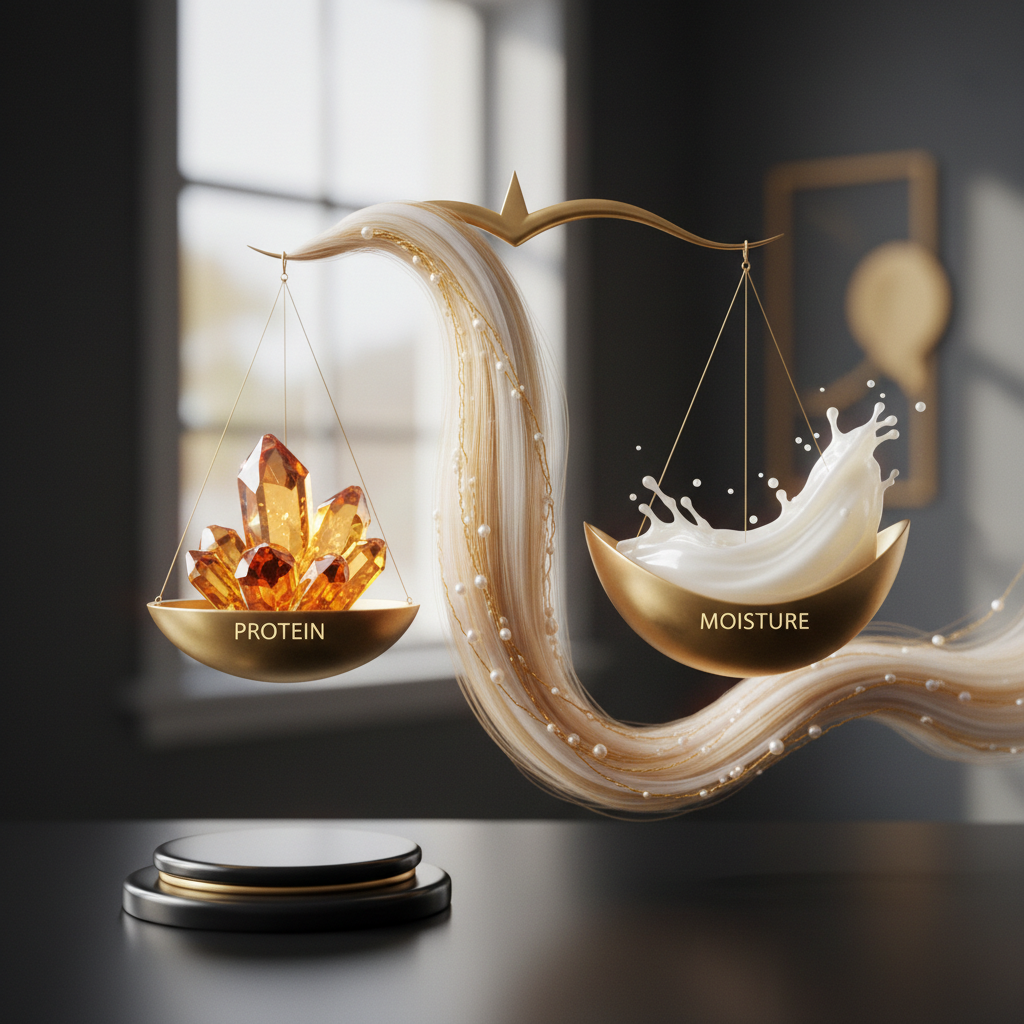
Water, by contrast, acts as a natural plasticiser inside the hair cortex. According to research published in the Journal of Cosmetic Science, hair fibres hold between 8% and 32% moisture by weight depending on ambient relative humidity. At typical indoor humidity levels (roughly 40% to 60%), hair maintains approximately 10% to 15% water content. This bound water slots between the keratin polypeptide chains, allowing them to slide past one another when bent or stretched.
Without sufficient water, keratin bonds become rigid and prone to mechanical fracture during combing. Conversely, when hair absorbs too much water without adequate structural reinforcement, hydrogen bonds break excessively, causing the hair to lose its shape, elasticity, and recovery force. Cosmetic formulations use hydrolysed proteins (such as wheat, silk, or soy peptides with molecular weights below 1,500 Daltons) to temporarily adsorb onto or diffuse into damaged cuticle gaps, while fatty alcohols, esters, and natural oils seal the cuticle to manage moisture retention.
What the evidence does not show
The salon world frequently treats protein and moisture as opposing forces on an absolute scale, but scientific research clarifies several common misconceptions:
- Topical protein does not permanently repair split ends or cortex fractures. Hydrolysed proteins deposit cosmetic patches on the cuticle surface and upper layers of the cortex. They wash away over successive cleanses and cannot create permanent covalent bonds with your natural keratin.
- Moisture does not mean soaking your hair in tap water. Pure water without conditioning lipids actually leaches soluble internal components and swells the shaft. True hair moisturisation refers to water retention within the cortex mediated by humectants and sealed by hydrophobic lipids.
- Protein overload is not an internal medical disorder. It is purely a physical, cosmetic phenomenon where rigid film-forming proteins and cross-linking conditioning agents build up on the cuticle layer, preventing normal flexing.
- Cosmetic products do not alter follicle production. Achieving balance on the lengths of your hair does not change how hair follicles grow from the scalp, nor does it resolve clinical forms of alopecia.
Mechanisms of hair fibre mechanics
Understanding how hair behaves mechanically explains why balance matters. Hair responds to physical stress in three distinct phases:
- The elastic region (up to 2% to 3% elongation): The hair stretches and returns completely to its original length without damage. Hydrogen bonds and cystine cross-links remain stable.
- The yield region (roughly 3% to 25% elongation): The helical alpha-keratin chains unfold into flat beta-sheet structures. Water content directly controls how easily this transition occurs. High moisture lowers the force required to yield, making hair softer.
- The post-yield region (beyond 25% elongation to fracture): Permanent structural deformation takes place. Without sufficient intact protein cross-links, the fibre snaps cleanly before reaching its potential elongation limit.
When hair lacks hydration, the yield point requires high force, and the fibre snaps abruptly in the elastic phase. When hair lacks protein structure (often after chemical bleaching or alkaline relaxers have dissolved cystine bonds), the fibre yields too easily, stretches like chewing gum, and fails to bounce back.
| Characteristic | Protein Deficiency / Excess Moisture | Balanced Hair | Moisture Deficiency / Excess Protein |
|---|---|---|---|
| Feel when dry | Mushy, limp, overly soft, lacks body | Smooth, supple, retains natural shape | Rough, stiff, straw-like, unbending |
| Feel when wet | Gummy, sticky, stretches excessively | Firm yet pliable, defined curl or strand pattern | Snappy, rigid, tangles immediately |
| Wet stretch test | Stretches past 30% without returning; snaps | Stretches roughly 20% to 30% and bounces back | Snaps instantly with minimal pull |
| Breakage pattern | Fibres stretch thin and tear unevenly | Minimal breakage during routine detangling | Short, clean, brittle snaps along the shaft |
| Primary remedy | Hydrolysed protein treatments, light bond builders | Balanced wash regimen with light conditioning | Deep emollient masks, humectants, clarifying washes |
Recognising the signs: the stretch test
Stylists and trichologists use the wet stretch test as a baseline assessment to evaluate physical condition:
- Select a small strand of clean, wet hair (roughly 5 to 10 shed or attached fibres).
- Hold the ends firmly between your thumbs and index fingers, leaving roughly two inches of fibre between your hands.
- Gently pull the ends outward, applying gradual, steady tension.
- Observe the response:
- If the strand stretches slightly (around a fifth of its length) and returns to its original starting point when released, your balance is sound.
- If the strand stretches out endlessly, feels sponge-like, and fails to retract, the fibre lacks internal protein structure.
- If the strand shows zero stretch and snaps immediately under slight pressure, the fibre lacks adequate moisture or carries excess protein deposits.
Practical steps to restore equilibrium
Restoring harmony to your hair involves tailoring your washing and conditioning routine to address the specific deficit you have identified.
If your hair feels brittle and over-proteinised
- Clarify thoroughly: Use a chelating or clarifying shampoo with an anionic surfactant base to strip away residual protein films and conditioning polymers.
- Pause protein-heavy formulas: Check ingredient labels for terms like hydrolysed keratin, hydrolysed collagen, hydrolysed wheat protein, or amino acids, and set them aside for two to four weeks.
- Apply emollient-rich masks: Look for fatty alcohols (cetyl alcohol, stearyl alcohol), plant oils, and humectants (glycerin, panthenol, sodium PCA) that restore suppleness.
- Incorporate gentle warmth: Use a warm damp towel or heat cap during deep conditioning to temporarily raise cuticle scales, allowing conditioning agents to deposit effectively.
If your hair feels limp, gummy, or over-moisturised
- Introduce hydrolysed peptides: Incorporate rinse-off conditioning treatments containing small-chain hydrolysed proteins, which temporarily bolster the cuticular sheath.
- Reduce water immersion time: Avoid prolonged wet styling, overnight conditioning, or leaving wet hair bunched up, all of which worsen hygral fatigue.
- Blow-dry gently on medium heat: Allowing hair to dry in a controlled manner helps the keratin matrix contract back into its stable dry configuration. Always use heat protection.
- Incorporate light acid rinses: Products formulated around pH 4.0 to 5.0 help flatten cuticle scales, reducing excessive swelling during subsequent washes.
When the cause is something else
Not all brittleness or weakness stems from cosmetic product ratios. What appears to be an imbalance may reflect underlying systemic, chemical, or environmental factors:
- Chemical processing damage: Bleaching, permanent hair dyes, and perm lotions break covalent disulphide bonds. Hydrolysed proteins help cosmetic manageability, but they cannot fully rebuild permanently dissolved chemical bonds.
- Hard water buildup: High concentrations of calcium and magnesium ions bind to cuticular fatty acids, forming an insoluble scum that mimics protein overload by making hair feel stiff and rough.
- Thermal degradation: Using styling irons above 185°C denatures alpha-keratin into disordered structures and oxidises natural lipids. No amount of moisturiser fixes cooked hair fibres.
- Nutritional deficiencies: While the hair shaft is dead tissue, newly formed hair depends on systemic nutrition. Severe protein-energy malnutrition, iron deficiency, or thyroid irregularities influence how fibres form within the follicle.
When to seek professional advice
Consult a qualified trichologist or dermatologist if you observe:
- Hair snapping close to the scalp surface accompanied by noticeable shedding bulbs (telogen effluvium).
- Sudden thinning, patchy loss, or scalp irritation, redness, burning, or scaling.
- Severe breakage that does not respond to four weeks of altered washing and conditioning habits.
Support your routine with Watermans
If you want to maintain a balanced foundation for your lengths and your scalp, Watermans Grow Me Shampoo and Condition Me Conditioner provide an ideal everyday baseline. Grow Me cleanses effectively to prevent heavy cosmetic buildup without stripping the scalp's natural barrier, while Condition Me supplies essential hydration, cholesterol, and natural emollients that soften the fibre without overwhelming it with excessive protein films. Used together, they help support a healthy scalp environment while keeping lengths resilient and manageable.
Frequently asked questions about Protein and Moisture Balance
Can low-porosity hair achieve Protein and Moisture Balance?
Yes, but low-porosity hair has tight, compact cuticle scales that resist product absorption. It easily accumulates protein build-up on the outside of the hair shaft. To achieve Protein and Moisture Balance, stick to lightweight humectants, apply conditioners with gentle indirect warmth to encourage penetration, and use protein treatments sparingly.
How often should I use a protein treatment on my hair?
For untreated hair, once every four to six weeks is generally sufficient. If your hair has undergone chemical bleaching, colouring, or heavy heat styling, incorporating a mild hydrolysed protein treatment every one to two weeks can help maintain strand integrity and reduce breakage during detangling.
Does drinking more water fix hair that lacks moisture?
No. Internal hydration supports overall cellular health and hair follicle function in the scalp, but it has minimal direct effect on dead, grown hair fibres. The moisture inside your hair shaft comes from atmospheric humidity and topical cosmetic conditioning that binds water into the cortex.
What ingredients indicate protein on a product label?
Look for words including hydrolysed keratin, hydrolysed wheat protein, hydrolysed silk, collagen, amino acids, oat peptides, and gelatin. Ingredients listed in the top six of the label indicate higher concentrations, while those near the bottom serve primarily as auxiliary additives.
Is hair breakage the same as hair loss?
No. Hair breakage refers to mechanical structural failure along the shaft due to weakness, brittleness, or rough handling, leaving the root intact. Hair shedding or loss originates at the follicle level, where the complete hair strand, often with a visible white bulb, detaches from the scalp.
Summary of hair fibre equilibrium
Maintaining a stable Protein and Moisture Balance is an ongoing practice of observation rather than an exact, permanent formula. Hair is a non-living biological fibre subjected daily to mechanical friction, atmospheric changes, heat, and chemical treatments. By paying attention to how your hair behaves when wet, avoiding excessive product layering, and balancing structural proteins with softening emollients, you can keep your strands supple, resilient, and protected against premature breakage.
Sources and references
- Journal of Cosmetic Science, "The mechanical properties of hair and its relation to water content", 2008.
- International Journal of Trichology, "Hair cosmetics: An overview", 2015.
- Robbins, C. R., Chemical and Physical Behavior of Human Hair, 5th edition, Springer, 2012.
- British Association of Dermatologists, "Hair care and cosmetic treatments", clinical guidance, 2021.