Protein and Keratin Treatments: The Evidence-Based Guide
9 min read ·
Understand how Protein and Keratin Treatments repair damaged hair, their structural mechanisms, risks of protein overload, and how to balance strength with moisture.
Quick answer: Protein and Keratin Treatments are salon and home therapies designed to reinforce compromised hair fibres, smooth the cuticle layer, and reduce mechanical breakage. They work by depositing hydrolysed proteins or cross-linking keratin derivatives onto and within the hair shaft. However, their primary limitation is that they are temporary cosmetic repairs rather than permanent biological cures. They do not alter hair growth from the follicle, and overusing them without sufficient moisture can lead to protein overload, causing extreme fibre brittleness and snapping.
Key takeaways
- Human hair is composed of roughly 85 to 90 percent keratin protein, which is depleted by bleaching, chemical relaxers, heat styling, and environmental weathering.
- Home protein treatments use hydrolysed proteins (wheat, soy, silk) to temporarily patch microscopic gaps in the hair shaft, reducing porosity.
- In-salon keratin smoothing treatments rely on heat-activated cross-linking agents to create a hydrophobic shield around the cuticle, repelling humidity and reducing frizz.
- Protein does not treat hair shedding or follicle-based hair loss; its sole mechanical role is preventing structural hair shaft breakage.
- Applying intensive protein therapies to hair that lacks elasticity or moisture can cause severe fibre rigidity and snapping, commonly termed protein overload.
Protein and Keratin Treatments: what the evidence shows
Scientific research confirms that Protein and Keratin Treatments alter the physical characteristics of damaged hair fibres, though their efficacy depends on molecular size and application method. Virgin hair possesses an intact cuticle sealed by the 18-methyleicosanoic acid (18-MEA) lipid layer. When chemical services such as bleaching or permanent waving break the disulphide cystine bonds within the cortex, the hair becomes highly porous, loses tensile strength, and absorbs water excessively.
Peer-reviewed studies published in cosmetic dermatology journals demonstrate that hydrolysed proteins with low molecular weights (typically between 500 and 2,000 Daltons) can diffuse through damaged cuticle scales into the cortex. Once inside, these peptide fragments bind temporarily via hydrogen and ionic bonds, increasing the fibre's tensile strength and water retention capacity. Larger protein polymers (above 5,000 Daltons) cannot penetrate the cortex; instead, they form a protective film over the cuticle, smoothing roughness and reducing combing friction by up to 50 percent.
Controlled trials on professional salon keratin procedures reveal that these treatments cross-link keratin hydrolysates around the hair shaft using high heat (often 200 to 230 degrees Celsius). This seals the cuticle down, creates a semi-permanent hydrophobic barrier, and temporarily realigns hydrogen bonds to relax curl patterns and prevent humidity-induced frizz for 8 to 12 weeks.
What the evidence does not show
Research does not support the idea that cosmetic treatments permanently rebuild biological hair structure. The dead cellular material of the hair shaft cannot biologically heal, regenerate, or permanently fuse artificial proteins into its native matrix. Once hydrolysed proteins rinse out over successive washes, the underlying structural damage remains unchanged.
Furthermore, evidence does not show that protein applications stimulate hair growth, prevent telogen effluvium, or alter genetic hair thinning. Protein applied to the hair shaft works solely on fibre mechanics, not follicular biology. A common misconception is that applying high-concentration protein directly to the scalp nourishes the hair root; in reality, protein buildup on the scalp can cause residue, flaking, and folicular irritation without providing any systemic benefit to emerging fibres.
The mechanical difference: home proteins vs salon keratin
Understanding how these procedures differ prevents costly application mistakes and unnecessary fibre damage.
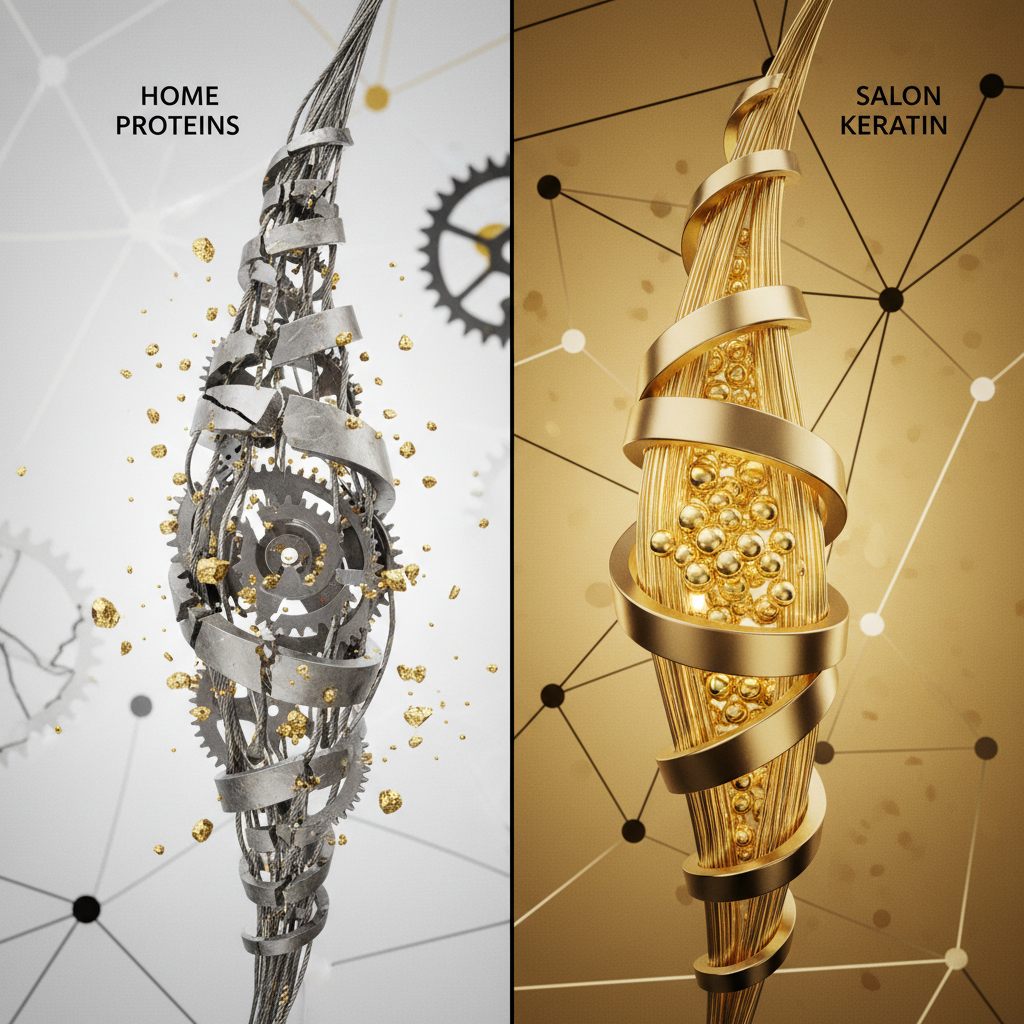
| Feature | Home Hydrolysed Protein Masks | Professional Salon Keratin Smoothing |
|---|---|---|
| Primary Goal | Restore tensile strength and patch cortex porosity | Eliminate frizz, smooth cuticle, relax curl pattern |
| Key Ingredients | Hydrolysed wheat, soy, keratin, or silk proteins | Glyoxylic acid, formaldehyde derivatives, keratin amino acids |
| Mechanism | Temporary hydrogen/ionic bonding in gaps and on cuticle | Thermal cross-linking film over the entire fibre |
| Heat Requirement | Ambient or mild heat (warm towel / cap) | High flat-iron heat (up to 230°C) to polymerise |
| Duration of Effect | 1 to 3 washes | 8 to 12 weeks |
| Primary Risk | Fibre stiffness and snapping from protein overload | Severe heat damage and hazardous chemical fumes |
Signs your hair needs protein
Hair signals its internal structural state through elasticity and porosity tests. You should consider reaching for a protein therapy if your hair displays the following symptoms:
- Gummy or spongy wet texture: When wet, damaged hair stretches significantly beyond its normal length without returning, feeling limp, sticky, or mushy between your fingers.
- High porosity: The hair absorbs water instantaneously in the shower, takes hours to dry, and tangles constantly due to raised, jagged cuticle scales.
- Mid-shaft snapping during styling: You notice short, blunt pieces of hair on your clothes or sink after gentle brushing (breakage, not bulb-tipped shed hairs).
- Recent chemical processing: Bleach, permanent tint, or chemical straighteners have cleaved internal disulphide bonds, leaving the cortex structurally hollow.
The risk of protein overload and how to fix it
Too much protein is just as damaging as too little. Hair fibre requires a balanced equilibrium between structural strength (protein) and flexibility (moisture and lipids).
When you apply intensive protein masks repeatedly to hair that is merely dry or mildly weathered, proteins accumulate across the cuticle and within the micro-fibrils. This excess accumulation strips the fibre of its natural elasticity, creating extreme rigidity. Hair in protein overload feels rough, straw-like, dull, and snaps with the slightest tension.
To reverse protein overload, immediately discontinue all protein-containing products. Wash thoroughly with a gentle clarifying shampoo to strip superficial peptide films. Follow with deep conditioning masks rich in fatty alcohols (cetyl alcohol, stearyl alcohol), humectants (glycerin, panthenol), and plant oils to restore pliability. It generally takes 2 to 4 weeks of consistent moisture therapy for the fibre to regain its normal mechanical stretch.
When the issue is not structural damage
It is critical to distinguish hair shaft breakage from genuine hair shedding or follicular hair loss. If you observe excessive hair gathering in your brush or shower drain, inspect the ends of the strands.
If the fallen strands possess a small, white keratinised bulb at one end, they have released from the follicle (shedding). This is characteristic of conditions such as telogen effluvium, androgenetic alopecia, or nutritional deficiencies (such as low serum ferritin or vitamin D3). Protein treatments will not stop shedding because the issue originates beneath the scalp surface.
If the strands are short, irregular, and lack a white bulb, the issue is structural breakage along the shaft. In this scenario alone, protein therapies provide a functional cosmetic benefit.
Practical steps for safe application
To gain the benefits of structural support without inducing brittleness, adhere to these guidelines:
- Assess first: Perform an elasticity test on a wet strand. If it stretches and snaps immediately without bouncing back, it lacks moisture. If it stretches excessively and feels limp or mushy, it requires protein.
- Select lower molecular weights: Check ingredient lists for "hydrolysed" proteins (such as hydrolysed wheat protein, hydrolysed keratin, or amino acids). Intact, non-hydrolysed proteins are too large to penetrate the cuticle.
- Always balance with moisture: Follow any intensive protein therapy with a dedicated moisturising conditioner to keep the cuticle supple.
- Mind the frequency: Restrict concentrated protein treatments to once every 3 to 6 weeks for chemically treated hair, and once every 6 to 8 weeks for natural hair.
- Protect your lungs: If undergoing salon keratin smoothing, verify that the salon uses adequate ventilation and products that comply with local regulatory standards for aldehyde emissions.
Supporting hair condition with Watermans
Cosmetic hair strengthening functions best alongside a comprehensive approach to scalp hygiene and fibre maintenance. While structural repairs address past physical damage, supporting emerging hair fibres at the scalp level reduces future fragility.
Watermans GrowMe Shampoo provides a nutrient-dense, sulphate-free wash that cleanses without stripping vital surface lipids. Formulated with biotin, rosemary extract, caffeine, and hydrolysed lupin protein, it coats the hair fibre to enhance volume and reduce surface friction. Pairing this with Watermans ConditionMe Conditioner supplies essential moisture and cholesterol analogues, helping prevent the moisture deficits that frequently accompany protein usage.
Frequently asked questions about Protein and Keratin Treatments
Can Protein and Keratin Treatments cause hair loss?
No, these treatments do not cause follicular hair loss or alopecia when applied correctly. However, overuse of concentrated protein or excessive flat-iron heat during salon keratin services can cause structural hair breakage. When brittle fibres snap close to the scalp, it can mimic thinning, but the follicle itself remains intact and capable of growing new hair.
How often should you use protein treatments on curly hair?
Curly hair types tend to have higher natural porosity and drier cuticles, making them vulnerable to mechanical damage. If your curls feel limp, mushy, or lose their spring after colouring, use a hydrolysed protein treatment once every 3 to 4 weeks. Always follow with a rich, protein-free moisturising mask to maintain elasticity and curl clumping.
What is the difference between keratin and regular protein treatments?
Regular protein treatments typically use plant-derived hydrolysed proteins (like wheat or soy) to patch porosity temporarily for 1 to 3 washes. Salon keratin treatments employ keratin-specific amino acids combined with heat-activated cross-linking agents to create a durable, semi-permanent hydrophobic coating over the cuticle that lasts up to 12 weeks.
Can I do a keratin treatment if my hair is bleached?
You can, but extreme caution is required. Bleached hair has compromised tensile strength and a fragile cuticle. If a salon keratin treatment uses flat irons heated above 185 to 200 degrees Celsius, the heat can permanently denature the remaining cortex proteins and melt weakened cuticle scales, leading to catastrophic fibre breakage.
The balanced path for Protein and Keratin Treatments
Successfully using Protein and Keratin Treatments comes down to understanding your hair's mechanical needs rather than following beauty trends. Hair is an inanimate biological filament that requires a precise balance of structural rigidity from protein and pliable elasticity from moisture. By correctly identifying signs of high porosity and chemical weathering, choosing hydrolysed formulations, and avoiding excessive heat, you can restore strength and shine to compromised hair without tipping into protein overload.
Sources and references
- Journal of Cosmetic Dermatology, "Effects of hydrolyzed protein on physical and mechanical properties of damaged hair," 2018.
- International Journal of Trichology, "Hair Cosmetics: An Overview," 2015.
- International Journal of Cosmetic Science, "Investigation of the penetration of hydrolyzed proteins into hair fibres," 2010.
- Cosmetic Ingredient Review (CIR), "Safety Assessment of Hydrolyzed Keratin and Related Ingredients as Used in Cosmetics," 2016.
- Occupational Safety and Health Administration (OSHA), "Hazard Alert: Hair Smoothing Products That Could Release Formaldehyde," 2011.
Find these ingredients in Watermans products
- Biotin: you will find this ingredient in our Hair Growth Shampoo.
- Vitamin D: you will find this ingredient in our Hair Vitamins.
- Panthenol (Provitamin B5): you will find this ingredient in our Heat Protection Spray.