Protecting Hair from Mechanical Damage: Causes, Science, and Prevention
9 min read ·
Learn evidence-based methods for Protecting Hair from Mechanical Damage, reducing cuticle friction, and preventing mid-shaft breakage with expert grooming advice.
Quick answer: Protecting Hair from Mechanical Damage involves minimising the physical friction, tension, and abrasion that strip the cuticle and fracture the hair shaft. Hair fibres are non-living structures composed of keratin; once broken, they cannot biologically repair themselves. By adjusting detangling habits, switching to low-friction accessories, applying protective lubricants, and moderating grooming tension, you reduce structural fatigue. While these physical interventions stop preventable mid-shaft breakage, they cannot reverse existing split ends or treat physiological hair loss arising from the follicle.
Key takeaways
- Mechanical damage occurs through external physical forces such as aggressive brushing, friction against rough textiles, and high-tension styling.
- Wet hair is especially fragile because absorbed water breaks internal hydrogen bonds, allowing the cortex to stretch up to 30% to 50% before snapping at lower force thresholds.
- Physical breakage along the hair fibre is structurally distinct from follicular hair shedding and alopecia.
- Protective routines rely on reducing the friction coefficient using leave-in conditioners, wide-tooth combs, and gentle handling.
- Once the cuticle chips away and the internal cortex frays into a split end, the only permanent remedy is trimming the damaged section.
Protecting Hair from Mechanical Damage: what the evidence shows
Textile and cosmetic science demonstrates that human hair undergoes structural degradation primarily through cuticle abrasion and tensile strain. Research published in the International Journal of Cosmetic Science shows that repeated combing generates significant friction, which systematically lifts and breaks the outer cuticle scales. The human hair fibre features between 5 and 10 overlapping cuticle layers that protect the inner cortical core. When mechanical stress chips these scales away, the cortex is exposed directly to environmental moisture, UV light, and further mechanical trauma.
Furthermore, studies measuring the tensile strength of hair reveal that while virgin, dry hair can withstand loads of roughly 50 to 100 grams per individual fibre, repeated cycling of low-level physical stress causes structural fatigue. Mechanical damage is cumulative. A single rough detangling session may only micro-fracture a few cuticle edges, but hundreds of brushing strokes, tight hairbands, and pillow friction over months eventually lead to longitudinal splitting (trichoptilosis) and transverse fracture (trichorrhexis nodosa). Protecting hair from mechanical damage requires reducing both acute tensile spikes and chronic daily abrasion.
The physical mechanisms of fibre wear
To protect hair effectively, you have to understand how external tools interact with the hair shaft:
Friction and cuticle wear
Friction occurs whenever two surfaces slide against one another. Brushes, rough cotton pillowcases, bath towels, and rough clothing all create a frictional force against the hair fibre. Virgin hair cuticles naturally point toward the tip, presenting a low-friction surface when brushed root-to-tip, but a high-friction surface when backcombed or scrubbed. Scrubbing wet hair vigorously with a terrycloth towel acts like fine-grit sandpaper, stripping the protective 18-methyleicosanoic acid (18-MEA) lipid layer from the cuticle surface.
Tensile stress and wet elongation
Water alters the physical properties of the hair cortex. When submerged, hair absorbs up to 30% of its dry weight in water, swelling the diameter and temporarily breaking the weak hydrogen bonds that stabilise the keratin protein chains. While dry hair can stretch by roughly 15% to 20% before sustaining permanent deformation, wet hair can stretch up to 30% to 50%. However, wet hair has a significantly lower yield point. When pulled with excessive tension (such as raking a fine-tooth comb through wet snags), the hair does not spring back. It undergoes plastic deformation, narrows, and snaps.
Tension and traction
Styling methods that exert continuous pulling force on the follicle and shaft produce both immediate shaft breakage and long-term follicular inflammation. Tight ponytails, slicked buns, heavy hair extensions, and tight braids stretch the hair fibres past their elastic limit. Over time, hair snaps near the point of restraint (where elastic bands compress the shaft) or is pulled entirely from the root, potentially contributing to traction alopecia.
Signs of mechanical damage: breakage versus shedding
It is critical to distinguish between mechanical damage and follicular shedding:
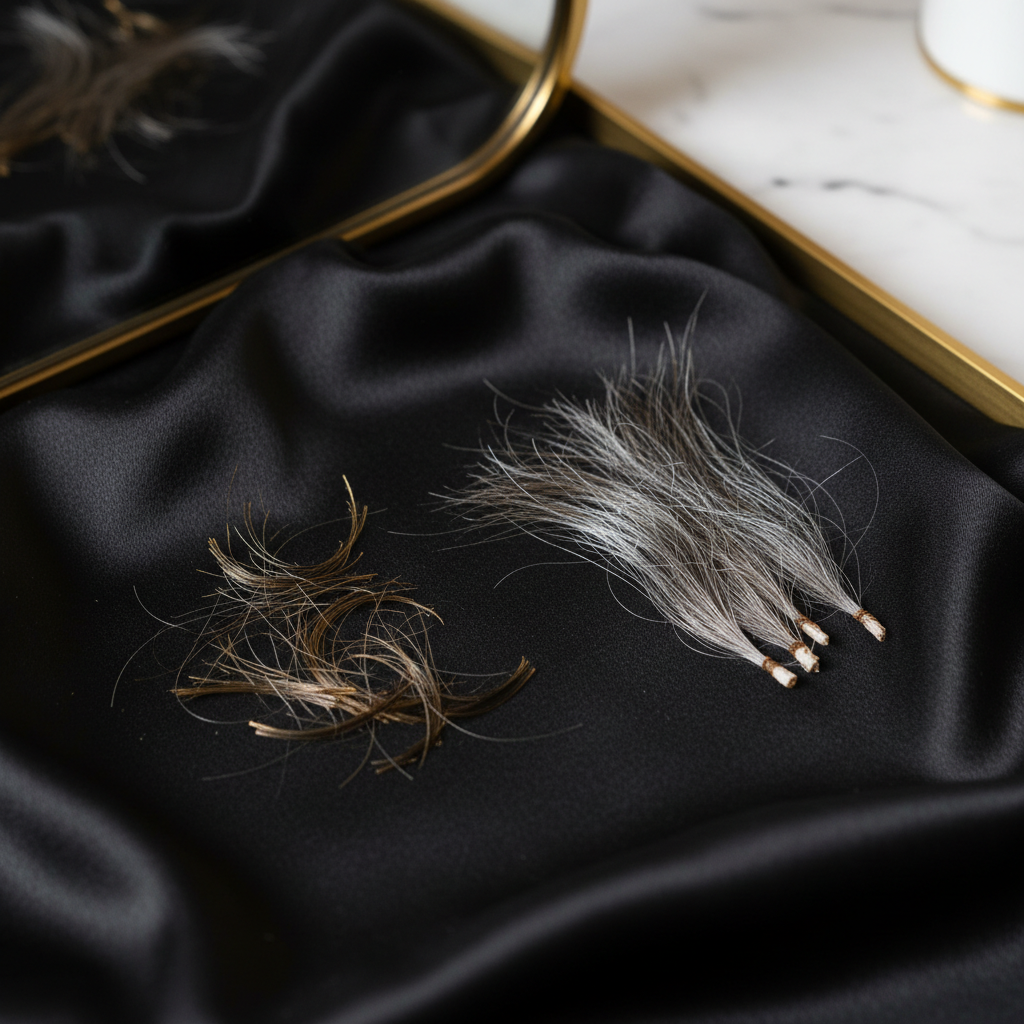
- Mechanical breakage: Characterised by short, uneven fragments of hair falling out during styling, white dots along the hair shaft (incomplete transverse fractures), split ends, and thinning that is concentrated through the mid-lengths and ends rather than the scalp. Broken hairs do not possess a white keratin bulb at the tip.
- Follicular shedding (Telogen effluvium): Characterised by full-length hair strands falling out with a white bulb attached at the root. Shedding originates beneath the scalp surface and is regulated by systemic biological cycles, illness, hormonal shifts, or nutritional status, not physical grooming habits.
| Characteristic | Mechanical Damage (Breakage) | Natural Shedding (Telogen Phase) |
|---|---|---|
| Fibre length | Short, fractured, variable lengths | Full natural length of the hair strand |
| Root bulb | Absent (rough, snapped ends) | Present (small, white bulb at root) |
| Primary location | Mid-lengths, perimeter, crown, ends | Uniformly across the scalp |
| Underlying cause | Friction, tension, rough styling, abrasion | Hormones, stress, systemic telogen cycle |
| Reversibility | Requires trimming; preventable with care | Resolves once follicular trigger abates |
Practical strategies for protecting hair from mechanical damage
Preventing mechanical wear requires modifying daily grooming routines to lower friction and mechanical resistance.
1. Detangle with lubrication and appropriate tools
Never attempt to force a comb through dry, tangled hair or unconditioned wet hair. Use a wide-tooth comb or a flexible-bristle brush designed to bend before breaking the fibre. Always begin detangling at the tips, working through tangles in small sections before moving up toward the roots. Applying a leave-in conditioner or hair oil prior to detangling significantly lowers the dry friction coefficient, allowing the comb to glide over cuticle scales rather than snagging them.
2. Manage wet hair with extreme care
Because wet hair is structurally weaker under tensile load, avoid rough handling straight out of the shower. Swap heavy, looped-cotton bath towels for smooth microfibre towels or a soft cotton t-shirt, and squeeze moisture out rather than rubbing. If you must comb wet hair, saturate it with conditioner first to provide slip.
3. Reduce nocturnal friction
A standard cotton pillowcase possesses microscopic fibres that tug at hair strands as you move during sleep, leading to overnight tangling and cuticle chipping. Using a silk or satin pillowcase, or wrapping hair in a smooth silk scarf, reduces this nocturnal friction. Loose, low-tension braids or loose buns secured with silk scrunchies also prevent tangles during sleep.
4. Re-evaluate styling tools and accessories
Traditional elastic bands with metal clasps or exposed rubber act as direct focal points for mechanical fracture. Replace them with silk or satin-wrapped scrunchies, seamless elastic bands, or spiral plastic ties that distribute pressure across a wider surface area. Avoid repetitive placement: securing a ponytail in the exact same spot every day creates a concentrated band of mechanical fatigue, eventually causing a halo of broken hairs at that exact circumference.
5. Regular trims to stop split propagation
A split end represents an irreversible structural failure of the cortex. Once the hair fibre splits at the tip, physical movement causes that split to travel upward along the shaft, much like a run in a pair of tights. Trimming roughly 0.5 to 1 centimetre every 8 to 12 weeks removes these compromised ends before they fracture higher up the shaft.
Supporting the hair fibre with Watermans
While mechanical damage is an entirely physical problem, the overall resilience of the hair fibre is influenced by scalp health and surface conditioning. Watermans focuses on evidence-based formulas designed to support the scalp environment while improving the feel and manageability of the hair shaft.
Watermans GrowMe Shampoo and ConditionMe Conditioner deliver targeted ingredients such as biotin, rosemary extract, niacinamide, and hydrolysed lupin protein. When applied to the hair, hydrolysed proteins and conditioning agents coat the outer cuticle, temporarily smoothing over lifted scales and improving slip. This reduction in surface friction directly complements your mechanical protection habits, helping tools glide through the hair with less tugging and snapping during styling.
Frequently asked questions about Protecting Hair from Mechanical Damage
Can split ends be repaired without cutting?
No. Split ends are complete physical fractures of the hair shaft. While silicone-based serums or conditioning agents can temporarily glue the split cuticle together until the next wash, they cannot fuse the keratin structure back together permanently. Protecting hair from mechanical damage prevents new splits, but existing splits must be cut away with sharp hairdressing shears to stop them travelling higher up the strand.
Does brushing hair 100 strokes a day make it healthier?
No, this is an outdated myth. Brushing hair 100 strokes a day actively accelerates mechanical damage. Every stroke of a brush exerts frictional force against the outer cuticle scales. Excessive, repetitive brushing wears down the 18-MEA lipid layer, lifts cuticle scales, and induces split ends. Brush only as much as necessary to detangle and style your hair.
Is hair more vulnerable to mechanical damage when wet or dry?
Hair is more vulnerable to tensile stretching and snapping when wet, but it is more vulnerable to brittle surface friction when completely dry and unconditioned. Wet hair absorbs water, weakening internal hydrogen bonds and allowing the hair to stretch and snap at lower pulling forces. Conversely, dry hair has a higher friction coefficient, making gentle handling and conditioning lubricants essential in both states.
What is the best way to dry hair without causing mechanical damage?
The best approach is gentle blotting using a smooth microfibre towel or a soft cotton t-shirt. Avoid rubbing, scrubbing, or wringing the hair, as these actions abrade the delicate wet cuticle. Gently squeeze excess water out from roots to tips, apply a protective leave-in detangling product, and allow hair to air dry partially or use a blow dryer on a cool-to-warm setting held at least 15 centimetres away.
Maintaining hair integrity
Protecting Hair from Mechanical Damage comes down to respecting the physical limitations of non-living keratin fibres. Every styling choice, detangling stroke, and accessory you use either preserves or degrades the protective cuticle layer. By adopting low-friction detangling methods, protecting wet hair from tensile stress, replacing damaging hair ties, and maintaining a regular trimming schedule, you safeguard the structural integrity of your hair. When you eliminate mechanical friction and combine sensible handling with high-quality surface conditioning, your hair retains its natural length, strength, and smoothness over time.
Sources and references
- International Journal of Cosmetic Science, "Combing damage of human hair: influence of grooming tools and grooming actions," 2007.
- Journal of the Society of Cosmetic Chemists, "Tensile properties of human hair," 1993.
- British Journal of Dermatology, "Hair shaft anomalies and structural defects," 2011.
- Clinical and Experimental Dermatology, "The structure and properties of hair cuticles under mechanical friction," 2016.
Find these ingredients in Watermans products
- Niacinamide: you will find this ingredient in our Hair Mask.