Preventing Styling Friction: Evidence-Based Methods for Hair Protection
9 min read ·
Learn how preventing styling friction protects the hair cuticle, stops mechanical breakage, and preserves tensile strength through better tools and slip.
Quick answer: Preventing styling friction requires reducing the mechanical force generated when tools, fabrics, and hands slide against the hair cuticle. Wet hair exhibits a coefficient of friction roughly double that of dry hair, making it especially susceptible to physical abrasion. By applying conditioning slip, using wide-toothed tools, and lowering physical drag during brushing and drying, you preserve the protective outer cuticle layer. However, preventing styling friction cannot repair hair fibres that have already split or suffered extensive cortical damage.
Key takeaways
- Hair friction spikes when hair is wet because the natural lipid layer (18-methyleicosanoic acid) is temporarily compromised by water swell.
- Mechanical friction chips away the protective overlapping cuticle cells, exposing the cortex to rapid moisture loss and mechanical snapping.
- Using lubricants such as silicones, plant oils, and cationic surfactants significantly lowers the kinetic coefficient of friction between hair fibres and styling tools.
- Brush selection matters: wide-spaced, seamless teeth or natural bristles create far less drag and snagging than closely packed, moulded plastic bristles.
- Preventing styling friction protects hair from breakage along the shaft; it does not alter follicular hair growth cycles or stop genetic thinning.
Preventing Styling Friction: what the evidence shows
Preventing styling friction is one of the most effective interventions for curbing mechanical hair breakage. Every time you run a brush through your hair, wrap it in a cotton towel, or glide a heated iron down the shaft, physical surfaces rub against each other. In cosmetic tribology (the study of friction, lubrication, and wear on human hair), researchers measure this resistance as the coefficient of friction.
When hair fibres rub together or encounter a styling tool, the surface cuticles absorb the physical impact. Undamaged virgin hair is coated with a microscopic lipid layer consisting primarily of 18-methyleicosanoic acid (18-MEA). This fatty layer makes the hair surface hydrophobic and naturally slick.
Peer-reviewed studies published in the Journal of Cosmetic Science reveal that mechanical manipulation rapidly strips this delicate fatty layer. As 18-MEA wears away, the hair becomes hydrophilic (water-attracting). The bare cuticles lift, swell unevenly, and create rough edges.
The friction coefficient rises, meaning that each subsequent stroke of a brush requires higher force to pull through the strands. When the mechanical force required to pull the tool exceeds the tensile strength of the hair fibre, the shaft snaps. Preventing styling friction stops this compounding cycle of wear and tear before structural failure occurs.
+-------------------------------------------------------------------+
| THE MECHANICAL WEAR CYCLE |
| |
| [18-MEA Lipid Layer Intact] --> Low Friction, Hydrophobic |
| | |
| Mechanical Abrasion (Brushing / Rough Towelling) |
| v |
| [Lipid Layer Stripped] --> Cuticles Lift & Catch Each Other |
| | |
| Repeated Styling Friction |
| v |
| [Cuticle Chipping & Loss] --> Exposed Cortex |
| | |
| Continued Tension / Drag |
| v |
| [Shaft Snapping & Breakage] (Not Follicular Shedding) |
+-------------------------------------------------------------------+
What the evidence does not show
Research does not show that physical friction directly causes follicular hair loss, alopecia areata, or androgenetic thinning. There is a common misconception that finding short, broken pieces of hair in your brush means your hair follicles are failing. It is vital to separate hair breakage (the fibre snapping along the shaft due to mechanical or chemical stress) from hair shedding (the follicle releasing the root bulb at the end of the telogen phase).
Furthermore, cosmetic formulations and careful styling practices cannot regenerate a broken cuticle. Cuticle scales are non-living structures composed of keratinised protein. Once a piece of the cuticle fractures and detaches, no oil, conditioner, or salon treatment can biologically reattach it. Products can temporarily glue the edges down or coat the shaft with a protective film, but the underlying cuticle loss remains permanent until new hair grows from the scalp.
The biological and physical mechanism of styling friction
To master preventing styling friction, you must understand how the hair shaft reacts to force. The outer layer of the hair consists of five to ten overlapping cuticle scales. These scales point downwards, away from the scalp toward the tips, much like tiles on a roof.
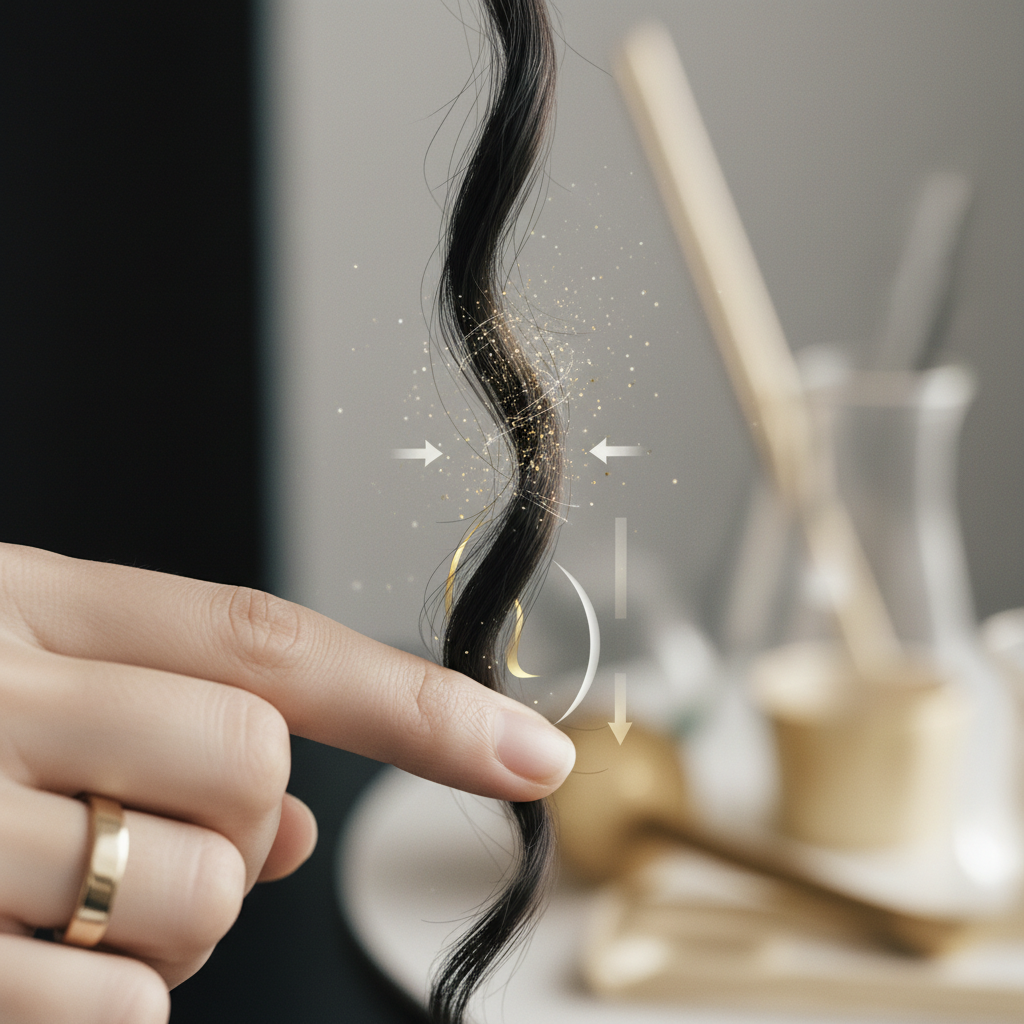
When you glide a styling tool from root to tip, you move in the "with-scale" direction. This path encounters relatively low friction. Moving against the scales generates up to three times more friction, bending and breaking the edges of the scales.
Wet vs dry hair dynamics
Water alters this mechanical equation dramatically. When hair is submerged in water, it absorbs up to 30 percent of its dry weight. This water uptake disrupts the internal hydrogen bonds within the cortex, making the fibre more elastic but significantly weaker under tension.
Crucially, wet hair fibres exhibit a far higher coefficient of friction than dry fibres. Wet strands stick to one another due to capillary forces, creating clumps. Passing a comb through wet hair without adequate slip forces the teeth against tangled, swollen cuticles, causing high peak stresses that rip scales clean off the fibre.
Signs of friction damage to look for
Friction damage rarely happens overnight. Instead, it accumulates through daily micro-trauma. Watch for these physical signs:
- Short, white-tipped broken pieces: Strands of varying short lengths on your bathroom sink that lack a rounded white root bulb.
- The "weathering" gradient: Hair that feels smooth and soft near the roots but progressively rough, dry, and raspy toward the mid-lengths and ends.
- Persistent tangling: Hair that snarls immediately after being detangled, caused by lifted cuticle scales hooking onto neighbouring fibres like microscopic Velcro.
- Loss of natural shine: Dullness caused by light scattering off fractured, uneven cuticle surfaces rather than reflecting cleanly off a smooth exterior.
- Split ends (trichoptilosis): The complete loss of cuticle layers at the tip, allowing the inner cortical fibres to unravel like an unbraided rope.
Practical strategies for preventing styling friction
Reducing physical drag requires a combination of lubrication, proper tool mechanics, and gentler daily habits.
1. Establish lubrication before manipulation
Never manipulate dry, unconditioned hair that is prone to tangling, and never pull a comb through wet hair without a slip agent. Leave-in conditioners, detangling sprays, and lightweight plant or silicone oils act as sacrificial layers. They coat the cuticle, filling in microscopic ridges and drastically lowering the surface friction so tools glide through effortlessly.
2. Upgrade your styling tools
The construction of your tools plays an immense role in friction management:
- Combs: Choose wide-tooth combs cut from solid acetate or hand-sawn wood. Avoid cheap injection-moulded plastic combs, which carry sharp seam ridges down the centre of every tooth that saw into the cuticle.
- Brushes: Use brushes with flexible bristles that bend when encountering resistance rather than forcing their way through a knot. For smoothing dry hair, natural boar bristles distribute natural scalp sebum along the shaft to lubricate the fibres.
- Heat tools: Ensure flat iron and curling iron plates are completely smooth, free of product crust, and coated with ceramic or tourmaline to allow snag-free passes.
3. Change your drying technique
Standard terrycloth cotton towels possess large, looped fibres that latch onto wet cuticles, roughing them up as you rub. Swap rough towel-drying for gentle squeezing with a smooth microfibre towel or an old cotton T-shirt. Blot and press moisture out; never scrub back and forth.
4. Minimise nighttime friction
Cotton pillowcases generate significant friction as you turn your head during sleep, roughing up the cuticles and causing morning tangles. Sleeping on a smooth silk or satin pillowcase allows hair to slide freely without catching. Alternatively, loosely securing long hair in a silk bonnet or scrunchie reduces fibre-on-fibre contact overnight.
| Tool / Habit | Friction Level | Cuticle Impact | Best Practice |
|---|---|---|---|
| Terrycloth Towel Rubbing | High | Severe cuticle lifting and surface chipping | Blot gently with microfibre or jersey cotton |
| Seamed Plastic Comb | High | Scrapes and gouges the cuticle edges | Use seamless acetate or wide-tooth wooden combs |
| Flexible Detangling Brush | Low | Flexes under tension, preventing cuticle snap | Start detangling at tips, working up to roots |
| Standard Cotton Pillowcase | Moderate | Continuous overnight abrasion and snagging | Switch to smooth silk or satin surfaces |
| Dry Detangling (Textured Hair) | Very High | High tensile strain, causing mid-shaft fracture | Detangle damp hair saturated with conditioner |
When the cause may be something else
If you take diligent steps toward preventing styling friction yet continue to see rapid hair deterioration, the underlying cause might not be mechanical.
- Chemical processing damage: Bleaching, permanent colouring, and chemical straightening break internal disulphide bonds and strip the protective 18-MEA layer chemically. This leaves the hair unnaturally porous, fragile, and prone to breaking even under minimal friction.
- Excessive heat degradation: High styling temperatures (above 180 to 200 degrees Celsius) degrade the structural alpha-keratin into amorphous beta-keratin, making the fibre brittle.
- Follicular shedding: If you are losing long hairs with a small white bulb at the end, this is shedding from the follicle (such as telogen effluvium), not mechanical breakage along the shaft. Styling adjustments will not alter shedding rates.
Supporting hair resilience with Watermans
While preventing styling friction relies primarily on thoughtful physical handling and surface lubrication, the overall physical resilience of hair starts at the scalp. A nourished scalp environment supports the growth of strong, well-formed hair fibres capable of handling everyday physical stressors.
Watermans GrowMe Shampoo and ConditionMe Conditioner are formulated to support the feel and appearance of hair health from root to tip. By cleansing the scalp of buildup and infusing the hair surface with moisture, quality conditioning ingredients smooth the external cuticle layer. This added softness and manageability provides crucial slip during the washing and detangling process, helping to minimise the mechanical drag that leads to premature breakage.
Frequently asked questions about Preventing Styling Friction
Does wet or dry hair suffer more from styling friction?
Wet hair suffers more from styling friction because water disrupts temporary hydrogen bonds and swells the shaft, raising the friction coefficient. When hair is wet, cuticle scales are more pliable and prone to peeling off if pulled with a comb. Always apply a slippery detangler or conditioner before working through wet hair.
What is the most effective tool for preventing styling friction?
The most effective tool is a seamless, wide-tooth comb or a brush engineered with ultra-flexible bristles. Moulded combs with rough seams abrade hair cuticles with every pass. Flexible bristles yield when they hit a knot, alerting you to untangle it gently with your fingers rather than forcing the brush through.
Can hair oils help with preventing styling friction?
Yes, hair oils are exceptionally good at preventing styling friction. Applying a few drops of lightweight oil, such as argan, jojoba, or mineral oil, coats the outer cuticle scales with a thin hydrophobic film. This film lubricates the hair shaft, allowing adjacent fibres and styling tools to glide past smoothly without snagging.
Why does brushing from the roots down increase friction?
Brushing directly from the roots downward pushes all small, existing knots down the shaft, compressing them into larger, tighter tangles near the ends. This concentrated knot creates massive resistance, spiking mechanical friction and snapping the hair. Brushing in sections from the tips upward eliminates tangles gradually with minimal tension.
Will stopping friction reverse existing split ends?
No, stopping friction cannot re-fuse hair that has already split. The hair shaft consists of dead, non-living cells that cannot biological heal or knit back together. While eliminating friction stops current splits from tearing further up the hair fibre, the only permanent way to remove existing split ends is to trim them off.
Conclusion
Mastering the habit of preventing styling friction is essential for anyone aiming to maintain long, smooth, and resilient hair. Mechanical drag strips the natural protective lipids from your cuticle scales, setting off a chain reaction of lifting, tangling, and mid-shaft snapping. By treating hair gently, introducing lubricating slip before styling, choosing seamless tools, and protecting strands from rough fabrics, you protect the cuticle from unnecessary wear. Combine thoughtful handling with dedicated surface conditioning to keep your hair strong and breakage-free.
Sources and references
- Journal of Cosmetic Science, "Tribological Studies on Human Hair", 2009.
- International Journal of Cosmetic Science, "The effect of physical and chemical damage on the friction of human hair", 2012.
- British Association of Dermatologists, "Hair Breakage and Shaft Anomalies", 2020.
- Journal of the Society of Cosmetic Chemists, "Surface Architecture of Human Hair and Its Tribological Properties", 1998.