Preventing Split Ends and Trichoptilosis: Evidence, Causes, and Care
9 min read ·
Learn the science of preventing split ends and trichoptilosis, including how cuticles break down, why mending creams fail, and proven ways to protect your hair ends.
Quick answer: Successfully preventing split ends and trichoptilosis requires protecting the hair's protective cuticle layer from mechanical friction, excessive thermal heat, and chemical degradation before structural cleavage occurs. Trichoptilosis is the longitudinal splitting of the hair shaft caused by loss of intercellular lipids and cortical weathering. The main limitation is biological: once a hair fibre splits, no cosmetic product can permanently mend it. True resolution requires mechanical trimming alongside preventative cuticle preservation to stop further upward tearing.
Key takeaways
- Trichoptilosis is the clinical term for longitudinal splitting of the distal hair shaft following severe cuticle erosion.
- Mechanical stress (vigorous brushing, friction), thermal tools above 180°C, and chemical processing (bleaching, relaxing) are the primary drivers of cortical fissure.
- Cosmetic serums containing silicones or hydrolysed proteins can temporarily glue split ends together, but they cannot repair the broken keratin structure.
- Preventing split ends involves reducing wet combing friction, lowering heat settings, maintaining an acidic surface pH (4.5 to 5.5), and getting regular micro-trims every 8 to 12 weeks.
- Differentiate trichoptilosis from other shaft abnormalities such as trichorrhexis nodosa, which presents with focal fragile nodes rather than terminal bifurcations.
Preventing Split Ends and Trichoptilosis: what the evidence shows
Preventing split ends and trichoptilosis is fundamentally an exercise in structural fibre conservation. Human hair is a non-living biomaterial composed of roughly 85% to 90% keratin protein, 3% to 5% structural lipids, and bound water. The outermost layer, the cuticle, consists of 6 to 10 overlapping shingle-like cells bonded by the cell membrane complex (CMC) and coated with 18-methyleicosanoic acid (18-MEA).
Research published in cosmetic dermatology journals demonstrates that trichoptilosis occurs when external aggressors wear down these protective cuticle scales completely. Without the cuticle armour, the internal cortex is directly exposed to the environment. The fibrous cortical cells, held together by macrofibrils and intermediate filaments, naturally separate along their longitudinal axis when subjected to tensile shear stress.
Controlled studies using scanning electron microscopy (SEM) illustrate that hair ends endure cumulative weathering over years. A 30 cm hair fibre has lived through roughly 700 shampoo cycles, thousands of brushing strokes, and hours of ultraviolet radiation. Preventing split ends and trichoptilosis requires minimising this cumulative erosion at every stage of the grooming routine.
What the evidence does not show: the mending myth
Marketing claims frequently promise that leave-in conditioners, oils, or luxury masks can "fuse", "heal", or "permanently repair" split ends. Controlled biophysical evidence does not support this.
Keratinocytes in the hair shaft are biologically dead. They lack cellular machinery to synthesise new proteins or regenerate lost cell walls. While polyquaterniums, amodimethicone, and plant oils can temporarily bind split ends through capillary adhesion and hydrophobic cohesion, this effect washes away with the next shampoo. Believing that a product has cured trichoptilosis often leads people to delay trimming, which allows the fissure to travel several centimetres up the hair shaft, weakening the entire strand.
The biological and physical mechanism of trichoptilosis
Understanding how trichoptilosis forms helps identify the points where preventative care actually works. The breakdown progresses through three distinct physical stages:
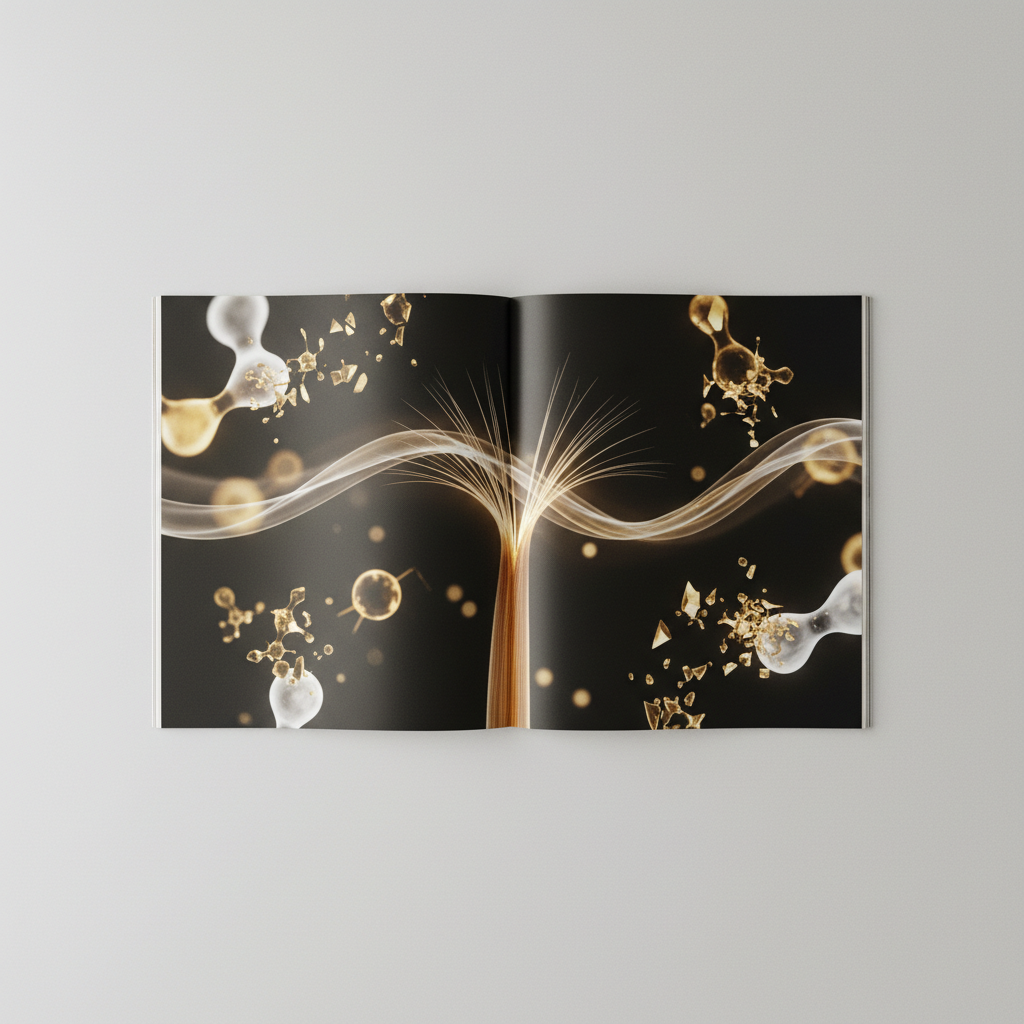
- Delipidisation and cuticle lift: Chemical processing (such as oxidation bleaching with alkaline hydrogen peroxide) strips the hydrophobic 18-MEA lipid layer. The cuticle's isoelectric point shifts, raising friction coefficients. Cuticle edges lift, chip, and break away.
- Cell membrane complex breakdown: High heat and friction degrade the intercellular cement (the CMC) binding adjacent cuticle cells. Once the CMC fails, entire cuticle shingles slough off, leaving bare patches of exposed cortex.
- Cortical fibrillation: Without radial pressure from the cuticle sheath, the parallel bundles of keratin intermediate filaments within the cortex unravel. Mechanical tension from a comb or collar forces these fibrils to separate lengthwise, producing the classic bifurcation (the "Y" split), tree-branching, or deep longitudinal fissures.
Intact Fibre: [Cuticle Scales] -> [Cell Membrane Complex] -> [Dense Cortex]
Weathered Fibre: [Lost Cuticles] -> [Exposed Core] -> [Longitudinal Cleavage (Split)]
Signs to look for: classifying hair shaft splits
Trichoptilosis does not always manifest as a simple fork at the very tip of the strand. Structural splits take several forms depending on the type of stress applied:
- Traditional split (bifurcation): The distal tip divides into two equal branches. This is standard wear from age, friction, and environmental drying.
- Feather or tree split: Multiple fractures branch along a single side of the shaft, indicating extensive cortical damage across several centimetres, common after high-lift bleaching.
- Incomplete or eye split: A hole forms in the centre of the hair shaft while the tip remains joined, typically caused by localized thermal burning from curling wands.
- Baby split: A tiny, early-stage fissure at the tip. Catching hair at this stage via trimming prevents deep fibre loss.
Trichoptilosis vs other hair shaft disorders
Not every fragile tip or breakage point is simple trichoptilosis. Other structural defects require different handling:
| Condition | Primary Physical Sign | Underlying Cause | Reversible with Products? |
|---|---|---|---|
| Trichoptilosis | Longitudinal splitting / branching at the distal end | Cuticle erosion from weathering, friction, and heat | No; must be cut above the split |
| Trichorrhexis nodosa | Small white nodes or swelling points along the shaft | Severe chemical trauma, extreme heat, or rare genetic defects | No; hair snaps cleanly at the node |
| Pili bifidi | Double hair emergence or shaft splitting near the root | Irregular follicular papilla structure (congenital) | No; structural growth variance |
| Bubble hair | Microscopic gas bubbles within the cortex | Flash boiling of water inside hair during rapid heat styling | No; creates fragile snap points |
| Trichonodosis | True physical knots tied along the hair shaft | Common in tightly coiled afro-textured hair due to curly friction | No; requires gentle detangling and trimming |
Practical strategies for preventing split ends and trichoptilosis
Because you cannot re-grow a broken hair shaft, preventative action must preserve the existing cuticle mantle for as long as possible.
1. Control thermal damage
Excessive heat alters the keratin protein structure from alpha-helical to beta-sheet conformation and degrades tryptophan residues. Keep thermal styling tools below 180°C. Above 185°C, thermal oxidation accelerates significantly. Always use a protective silicone or polymer-based formulation before styling. These agents improve heat dissipation and lower the thermal conduction rate into the cortex.
2. Mitigate wet combing friction
Wet hair is extraordinarily vulnerable. Water disrupts hydrogen bonds, allowing hair to stretch up to 30% to 50% beyond its dry length before snapping. When stretched wet, the cuticle scales lift and buckle. Never rip through damp hair with a fine-toothed comb. Use a wide-toothed tool or flexible detangling brush, and always apply a conditioner with high slip (cationic surfactants like behentrimonium chloride) to reduce mechanical dragging.
3. Maintain surface acidity
Hair and scalp exist at a natural physiological pH of 4.5 to 5.5. Alkaline water or harsh clarifying shampoos (pH above 7.0) cause the cuticle scales to swell and flare, increasing surface roughness and inter-fibre friction. Formulations adjusted to pH 4.5 to 5.5 keep the cuticle flattened, sealing the cortex against moisture loss and mechanical shearing.
4. Protect against fabric friction
Sleeping on coarse cotton creates significant abrasive friction over eight hours. Cotton also leaches moisture from hair fibres. Using silk or satin pillowcases, or wearing hair in loose, protective protective styles secured with snag-free bands, reduces nightly friction that provokes trichoptilosis.
5. Schedule dusting or micro-trims
The physical end of a hair fibre will eventually degrade due to unavoidable environmental exposure. Scheduling a "dusting" (cutting less than 5 mm) or micro-trim every 8 to 12 weeks removes nascent splits before they propagate upwards into healthy cortex.
When the cause may be something else
If you observe split ends occurring just a few centimetres from the scalp rather than on mature ends, or if hair snaps uncontrollably without long-term weathering, the issue is unlikely to be simple trichoptilosis.
Frequent breakage across short lengths points toward trichorrhexis nodosa or chemical overtreatment (such as overlapping relaxers or peroxide over-processing). Systemic issues, including severe iron deficiency anaemia, thyroid dysfunction, or extreme protein malnutrition, can also weaken hair matrix formation in the follicle, yielding a fragile shaft prone to early breakage. In these cases, superficial split end management will not fix the underlying vulnerability.
When to seek professional advice
Consult a qualified trichologist or dermatologist if:
- You notice diffuse breakage across the scalp rather than at the ends.
- Small white beads, nodes, or kinks appear along short hairs.
- Hair breakage is accompanied by significant shedding from the root (more than 100 hairs daily) or patchy hair thinning.
- Breakage continues despite eliminating thermal and chemical processing.
Supporting hair fibre integrity with Watermans
While no product can physically weld an existing split back together, maintaining overall fibre resilience goes a long way toward preventing premature wear. Watermans hair formulations focus on scalp health and fibre conditioning, creating an environment that supports resilient hair growth. Conditioners containing hydrolysed lupin protein, panthenol, and beneficial lipids coat vulnerable ends, improving lubrication and protecting cuticles against the mechanical friction that sparks trichoptilosis.
Frequently asked questions about Preventing Split Ends and Trichoptilosis
Can hair oils permanently seal a split end?
No. While botanical oils or cosmetic silicones can temporarily lubricate the cuticle and bind frayed cortical fibres through surface tension, this effect is entirely cosmetic. The split remains structurally broken and will reappear after washing. The only permanent resolution for trichoptilosis is trimming the damaged end.
How often should I trim my hair to stop split ends from traveling?
For general hair preservation, getting a micro-trim or dusting every 8 to 12 weeks is optimal. If your hair is heavily heat-styled or chemically lightened, trimming every 6 to 8 weeks helps catch baby splits before they tear further up the shaft.
Does cold water close the cuticle and prevent trichoptilosis?
Cold water has very little physical effect on closing cuticles. The cuticle layer responds to pH and chemical charges rather than water temperature. Using an acidic conditioner (pH 4.5 to 5.5) with cationic ingredients is what effectively flattens cuticle scales, reducing the friction that leads to trichoptilosis.
Why is wet hair more prone to splitting than dry hair?
When hair absorbs water, hydrogen bonds in the cortex temporarily break, increasing fibre elasticity while weakening structural tensile strength. Pulling or brushing wet hair stretches the cortex past its elastic limit, causing cuticle scales to fracture and initiating trichoptilosis.
What is the primary difference between hair breakage and hair shedding?
Hair shedding (telogen effluvium) involves hairs leaving the follicle naturally with the white keratin bulb attached. Hair breakage, including trichoptilosis, occurs when the hair fibre snaps or splits along the shaft due to structural damage, with the root remaining intact in the scalp.
Summary
Successfully preventing split ends and trichoptilosis is an ongoing discipline of minimising structural attrition. Once cortical fibres tear apart, biological repair is impossible, making regular trims the only definitive solution for split tips. By reducing heat, balancing hair pH, managing wet friction, and providing protective lubrication, you shield the delicate cuticle sheath and help every strand reach its full genetic length without breaking.
Sources and references
- Robbins, C. R. (2012). Chemical and Physical Behavior of Human Hair (5th ed.). Springer-Verlag.
- Swift, J. A. (1999). "The mechanics of split ends." Journal of Cosmetic Science, 50(4), 241-247.
- Sinclair, R. D. (2007). "Healthy hair: what is it?" Journal of Investigative Dermatology Symposium Proceedings, 12(2), 2-5.
- Dawber, R. (1996). "Hair: its structure and response to cosmetic preparations." Clinics in Dermatology, 14(1), 105-112.
- Gavazzoni Dias, M. F. (2015). "Hair cosmetics: an overview." International Journal of Trichology, 7(1), 2-15.
Find these ingredients in Watermans products
- Panthenol (Provitamin B5): you will find this ingredient in our Heat Protection Spray.