Porosity and Chemical Hair Damage: An Evidence-Based Guide
10 min read ·
Understand the science of Porosity and Chemical Hair Damage, how salon processing changes hair structure, and how to protect fragile, porous fibres.
Quick answer: Chemical processing alters the fundamental architecture of the hair shaft, and understanding the link between Porosity and Chemical Hair Damage is essential for maintaining fibre integrity. Permanent dyes, bleaches, chemical relaxers, and perms lift or destroy the protective lipid layer and open the cuticle scales, creating high porosity. While chemical services allow dramatic colour and structural changes, they permanently strip 18-methyl eicosanoic acid (18-MEA) and degrade internal keratin proteins, meaning high porosity from chemical damage cannot be biologically healed, only cosmetically managed.
Key takeaways
- Hair porosity describes the hair shaft's capacity to absorb and retain moisture, driven by the condition of the outer cuticle layer.
- Alkaline chemical processes (pH 9.0 to 11.5) swell the hair fibre and dissolve the protective f-layer lipid coating, forcing cuticles open.
- Disulphide bond cleavage from bleaching and permanent waving permanently degrades cortical keratin, leaving structural voids within the cortex.
- Chemically induced high porosity results in rapid water uptake, severe protein loss during washing, structural weakness, and increased fibre breakage.
- Topical conditioning agents, hydrolysed proteins, and low-pH sealants can temporarily reduce friction and patch porosity gaps, but they cannot regenerate severed disulphide bonds or restore natural 18-MEA lipids.
Porosity and Chemical Hair Damage: what the evidence shows
Scientific evaluation of Porosity and Chemical Hair Damage reveals that chemical alteration always leads to an increase in cuticle permeability and internal mass loss. The intact human hair shaft has an isoelectric point around pH 3.67 and rests comfortably in an acidic state between pH 4.5 and 5.5. In virgin hair, tightly overlapping cuticle scales are covered by an ultra-thin lipid membrane composed primarily of 18-methyl eicosanoic acid (18-MEA), known as the f-layer. This hydrophobic surface repels liquid water while allowing controlled vapour exchange.
When alkaline agents such as ammonium hydroxide or ethanolamine enter the fibre during colouring, bleaching, or perming, they raise the hair pH to between 9.0 and 11.5. This alkaline environment forces the cuticle scales to swell and flare outward. Oxidising agents like hydrogen peroxide then pass through into the cortex to dissolve natural melanin granules or alter structural proteins.
Research published in the Journal of Cosmetic Science and the International Journal of Trichology demonstrates that this process strips the hydrophobic 18-MEA layer completely after a single high-lift bleaching session. Deprived of its water-repellent shield, the hair becomes hydrophilic. The cuticles fail to lay flat again, resulting in permanent high porosity. Water rushes in rapidly when wet, causing severe hygral stress (swelling), and leaves just as quickly when dry, leaving the fibre brittle and prone to snapping.
What the evidence does not show
It is common to encounter claims that specialised treatments can permanently reverse high porosity or weld broken cuticles back into their original anatomical position. Controlled cosmetic science research has not found any treatment capable of re-establishing living biological cuticles once they have been chipped or chemically dissolved.
Topical products marketed as "cuticle repair" serums rely on film-forming polymers, silicones, and hydrolysed peptides. These ingredients temporarily deposit inside cuticle crevices or coat the shaft with an artificial hydrophobic layer. While they significantly reduce friction, improve tensile strength under testing, and reduce moisture loss, they wash out over successive shampoos. Furthermore, porosity cannot be accurately assessed by the popular "water glass float test", because surface tension, oil residues, and product build-up routinely produce false readings. Standardised laboratory assessment requires gas sorption or liquid uptake weighing.
Mechanisms of chemical hair damage and porosity changes
To manage chemically treated hair, you must understand the exact physical and chemical degradation taking place across each structural layer:
1. Stripping the F-Layer and 18-MEA
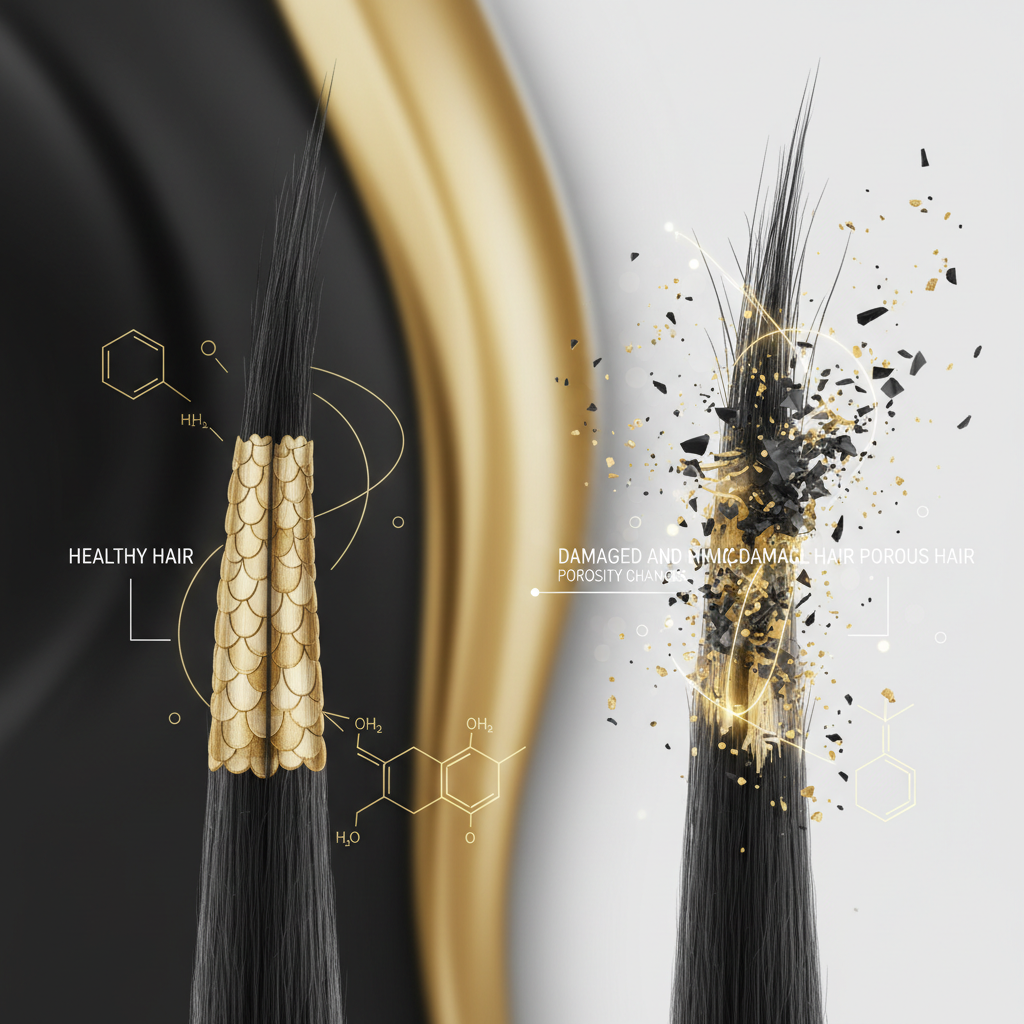
The outermost surface of virgin hair cuticles contains covalently bound fatty acids, dominated by 18-MEA. This lipid layer provides slip, sheen, and extreme water resistance. Alkaline oxidation cleaves the thioester bonds anchoring 18-MEA to the underlying protein matrix. Once lost, the surface turns from hydrophobic to hydrophilic, dramatically accelerating water absorption rates and raising porosity.
2. Cuticle lifting, chipping, and erosion
Repeated chemical processing erodes the endocuticle (the softer, protein-rich inner layer of each cuticle cell) and degrades the cell membrane complex (CMC) that glues adjacent cuticle cells together. Lacking adhesion, cuticles chip, crack, and break away entirely, exposing the delicate cortex beneath.
3. Disulphide bond cleavage and cysteic acid formation
Within the cortex, keratin fibres are held rigid by strong disulphide bonds formed by the amino acid cystine. Strong bleaching agents and alkaline reducers break these covalent bonds. During bleaching, cystine is oxidised into cysteic acid residues. Higher cysteic acid content correlates directly with increased cortical porosity, spongy wet-strength behaviour, and lower tensile breaking points.
| Processing Type | Typical Working pH | Primary Structural Impact | Porosity Outcome |
|---|---|---|---|
| Virgin Hair (Control) | 4.5 to 5.5 | Intact 18-MEA lipid layer, tightly sealed cuticles | Low to Medium (Balanced) |
| Demi-Permanent Colour | 6.5 to 8.5 | Minor lipid loss, light cuticle swelling | Mildly Elevated |
| Permanent Oxidative Dye | 9.0 to 10.5 | Complete 18-MEA loss, moderate CMC degradation | High Porosity |
| Bleach / Lightener | 10.0 to 11.5 | Severe cuticle erosion, high cystine oxidation | Extreme Porosity |
| Sodium Hydroxide Relaxer | 12.0 to 14.0 | Conversion of cystine to lanthionine, cortex reorganisation | Extreme Porosity / Fragility |
Recognising the signs of chemically induced high porosity
High porosity caused by chemical stress presents distinct visual and tactile symptoms that differ markedly from natural, low-porosity hair:
- Rapid wetting and drying: The hair absorbs water almost instantaneously in the shower rather than repelling it for the first few seconds, yet dries out unevenly and rapidly.
- Spongy, gummy wet texture: When wet, fibres feel excessively soft, elastic, or gummy, stretching abnormally before snapping without springing back.
- Matting and severe friction: Because stripped cuticles remain open and jagged, adjacent hair strands catch on one another like microscopic velcro, causing persistent knotting.
- Dull, matte appearance: Light reflects evenly off flat, sealed cuticles. Lifted, jagged scales scatter light irregularly, making hair appear flat and faded.
- Flash-absorbing colour: When applying fresh hair dye, porous sections absorb pigment rapidly, frequently turning darker or muddier than intended, only to shed that colour within two to three washes.
Practical steps to manage porous, chemically treated hair
While you cannot biologically restore destroyed protein or lipids, targeted cosmetic intervention stabilises high-porosity fibres and drastically curbs mechanical breakage:
- Acidify your washing routine: Use shampoos and conditioning rinses formulated at an acidic pH (between 4.0 and 5.0). Acidic environments neutralise residual alkalinity, contract swelling, and encourage remaining cuticles to lie as flat as possible.
- Introduce hydrolysed proteins: Small-chain peptides (hydrolysed wheat, soy, keratin, or silk with molecular weights between 500 and 2,000 Daltons) penetrate the porous cortex and lodge within structural voids, temporarily reinforcing tensile strength.
- Adopt the liquid-oil-cream layering method: Apply water-based leave-in conditioners to hydrate, followed by light polar oils (such as argan or jojoba) or fatty-alcohol-rich conditioning creams to seal open pores and simulate the missing 18-MEA lipid layer.
- Minimise thermal and mechanical friction: Porous hair has lost its protective lubricity. Detangle exclusively with wide-tooth combs on coated, conditioned strands, sleep on smooth silk or satin pillowcases, and reduce heat-tool exposure below 150°C.
- Protect against hygral fatigue: Excess water ingress and egress causes the cortex to swell and shrink violently. Pre-shampoo oil treatments using penetrating oils (such as coconut oil, rich in lauric acid) reduce excessive water absorption during washing.
When the cause may be something else
Not all elevated porosity stems from chemical treatments. Understanding alternative factors helps pinpoint the proper regimen:
- Environmental weathering: Chronic UV radiation produces photo-oxidation of cystine bonds and bleaches natural pigments, generating high porosity along lengths and ends without salon chemicals.
- Mechanical trauma: Aggressive backcombing, rough towel-drying, and vigorous brushing physically strip cuticles, mimicking chemical lifting.
- Thermal degradation: Unprotected styling with curling wands or straighteners above 185°C denatures alpha-keratin into beta-keratin, creates micro-cavities within the cortex, and melts natural surface lipids.
- Genetic texture variation: Naturally curly, coily, and afro hair textures naturally possess irregular cuticle patterns and raised scale edges at elliptical twist points along the shaft, giving them inherently higher baseline porosity without chemical exposure.
When to seek professional salon or trichological advice
If your hair begins breaking off in short, snapped sections across the crown or hairline, you are experiencing chemical breakage, not follicle hair loss. A certified trichologist can use dermoscopy to differentiate between follicular shedding (such as telogen effluvium) and structural breakage caused by severe porosity.
Consult an experienced colourist before applying any further chemical treatments. Attempting to bleach, lift, or relax hair that already exhibits gummy elasticity will cause severe structural failure and chemical haircutting. In extreme cases, the only permanent solution for heavily eroded sections is a strategic trim to eliminate unsalvageable lengths while nurturing new regrowth.
Supporting compromised hair with Watermans
When chemical processing leaves your hair porous and fragile, the goal is to protect fragile fibres from friction while fostering an optimal scalp environment for healthy, resilient new growth. Watermans GrowMe Shampoo is formulated as a 100% sulphate-free cleanser, ensuring that already-compromised cuticles are not stripped of their remaining surface moisture by harsh surfactants. Packed with hydrolysed lupin protein, biotin, rosemary extract, and niacinamide, it delivers gentle cleansing while bathing the hair shaft in strengthening nutrients.
Pairing this with Watermans ConditionMe Conditioner provides targeted reinforcement for chemically porous fibres. Containing hydrolysed vegetable proteins alongside cholesterol and nourishing botanical oils, ConditionMe fills micro-gaps across elevated cuticles, restoring slip, softening texture, and noticeably reducing mechanical breakage caused by detangling.
Frequently asked questions about Porosity and Chemical Hair Damage
Can chemical hair damage be reversed back to low porosity?
No, the link between Porosity and Chemical Hair Damage involves permanent structural alteration. Chemical services strip the outer 18-MEA lipid layer and oxidise disulphide bonds within the cortex. Because hair fibre is non-living tissue, it cannot biologically regenerate lost cuticles or bonds. You can, however, use acidic sealers, hydrolysed proteins, and conditioning lipids to temporarily smooth cuticles and mimic low-porosity behaviour until new hair grows.
Why does bleached hair dry so quickly if it absorbs water easily?
High-porosity hair absorbs liquid water rapidly because open, damaged cuticles offer no barrier to entry. However, because the protective hydrophobic lipid layer has been dissolved, there is no outer seal to prevent moisture from evaporating into the surrounding air. Consequently, the hair loses water just as quickly as it takes it in, leaving it perpetually dry and brittle.
How does hair relaxer change porosity compared to bleach?
Bleach oxidises cystine into cysteic acid and degrades melanin pigments under high alkaline peroxide conditions. Chemical relaxers (like sodium hydroxide or guanidine hydroxide) operate at an extreme pH of 12.0 to 14.0, breaking disulphide bonds and converting them into non-reversible lanthionine bonds to permanently reshape the fibre. Both processes destroy the protective lipid layer, producing high porosity, but relaxers alter cortical architecture even more aggressively.
Is the floating strand test accurate for testing chemical porosity?
No, the float test is scientifically unreliable. A strand of hair dropped in a glass of water is subject to water surface tension, which can keep even heavily damaged, high-porosity hair floating for hours. Conversely, styling product residues, natural sebum, or silicone coatings can distort how water interacts with the fibre. Professional assessment relies on microscopic examination, tactile wet-stretch elasticity tests, and liquid absorption measurements.
Managing Porosity and Chemical Hair Damage
Managing Porosity and Chemical Hair Damage requires an informed balance of chemical restraint and intelligent cosmetic maintenance. Every time you lift, tint, perm, or relax your hair, you make a permanent trade-off with the fibre's protective cuticle architecture and internal protein strength. By respecting the hair's natural acidic isoelectric point, replenishing lost structural mass with targeted proteins, and protecting vulnerable lengths from unnecessary friction, you can keep chemically treated, high-porosity hair strong, supple, and visually vibrant.
Sources and references
- International Journal of Cosmetic Science, "The structure and properties of hair cuticles and their role in hair damage", 2011.
- Journal of Cosmetic Science, "Effects of bleaching and chemical treatments on the lipids and protein structure of human hair", 2008.
- Dermatology and Therapy, "Hair Cosmetics: An Overview", 2015.
- International Journal of Trichology, "Hair shaft damage from cosmetic chemical treatments", 2013.
- Cosmetics, "Evaluation of Hair Damage Caused by Chemical and Physical Factors", 2020.
Find these ingredients in Watermans products
- Biotin: you will find this ingredient in our Hair Growth Shampoo.
- Niacinamide: you will find this ingredient in our Hair Mask.