Porosity and Moisture Retention: The Definitive Scientific Guide
8 min read ·
Understand how Porosity and Moisture Retention dictate hair hydration, fibre strength, and breakage resistance, supported by practical advice and cosmetic science.
Quick answer: Understanding Porosity and Moisture Retention is essential for maintaining hair fibre strength, elasticity, and hydration. Hair porosity describes how easily water and cosmetic lipids pass through the protective outer cuticle layer into the inner cortex. Moisture retention refers to the fibre's biological and physical capacity to hold onto that hydration. While routine conditioning can dramatically balance fibre moisture levels, cosmetic treatments cannot alter your hair's genetically determined cuticle architecture or permanently reverse extensive chemical cortex erosion.
Key takeaways
- Porosity governs how water enters and leaves the hair cortex through the cuticle scales.
- High porosity hair absorbs water rapidly but loses it just as quickly, leading to chronic dryness and breakage.
- Low porosity hair resists water entry due to tightly overlapping cuticles, making deep hydration slower to achieve.
- The 18-methyleicosanoic acid (18-MEA) lipid layer acts as natural waterproofing; losing it increases fibre porosity.
- Products cannot change your natural cuticle structure, but targeted formulations help regulate moisture evaporation.
Porosity and Moisture Retention: what the evidence shows
Research into fibre biomechanics reveals that Porosity and Moisture Retention depend entirely on the physical integrity of the hair cuticle and the cell membrane complex (CMC). Under scanning electron microscopy, a healthy hair fibre features between 5 and 10 overlapping cuticle scales per cross-section. These scales protect the cortex, which houses the keratin polypeptide chains responsible for tensile strength.
When cuticles lie flat, water molecules penetrate slowly through microscopic pathways in the intercellular cement. Once inside the cortex, water binds to polar amino acids such as arginine, serine, and glutamic acid. In healthy hair, the outer cuticle retains a hydrophobic surface monolayer composed primarily of 18-MEA. This lipid shield resists excessive water absorption while preventing internal water loss.
When chemical processing (such as bleaching or relaxers), excessive heat above 185°C, or aggressive mechanical brushing removes the 18-MEA layer, the fibre becomes hydrophilic. Water rushes in rapidly, causing rapid swelling of the cortex, a condition known as hygral fatigue. However, because the protective barrier is compromised, this moisture evaporates immediately into dry ambient air, leaving the fibre brittle and porous.
The mechanism of moisture retention across porosity levels
Moisture balance within keratin fibres is governed by sorption isotherms. Hair naturally maintains between 8% and 15% water content at standard room temperature and 60% relative humidity. The rate at which hair reaches equilibrium with atmospheric moisture depends directly on cuticle porosity.
Low Porosity: [ Tightly closed cuticles ] --> Hydrophobic barrier blocks rapid entry & exit
Medium Porosity: [ Smooth, aligned scales ] --> Balanced hydration rate and stable retention
High Porosity: [ Lifted / chipped scales ] --> Rapid water uptake followed by rapid dehydration
In low porosity hair, the cuticle scales are tightly packed. This structure shields the hair from environmental wear, but it also repels topical water and cosmetic conditioning agents. The hair often suffers from product build-up because ingredients sit on the exterior surface rather than penetrating the shaft.
High porosity hair features lifted, perforated, or missing cuticles. The exposed cortex readily absorbs atmospheric humidity, causing the shaft to swell unevenly and buckle the outer surface. Conversely, in low-humidity environments, free water desorbs from the cortex through the damaged barrier, leaving keratin chains rigid and prone to transverse fracture.
Comparative analysis of hair porosity grades
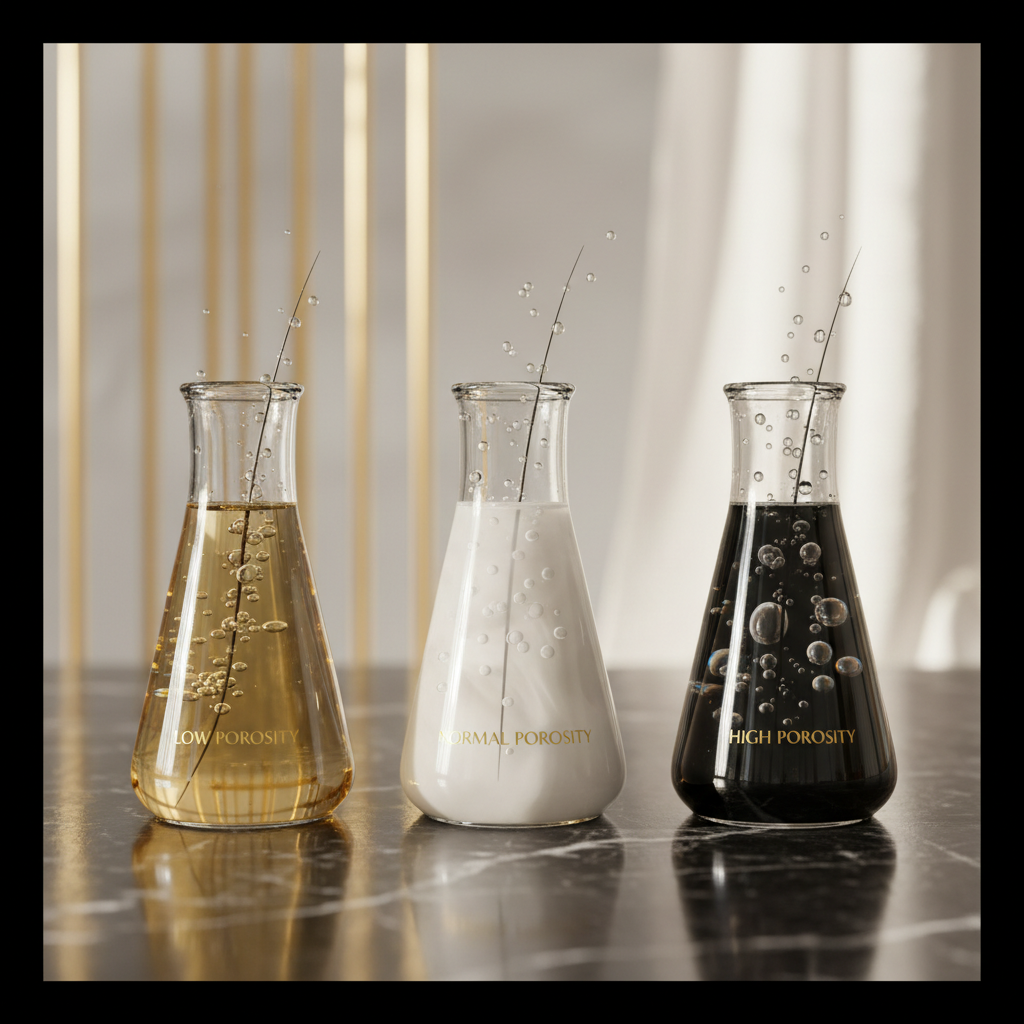
| Characteristic | Low Porosity | Medium (Balanced) Porosity | High Porosity |
|---|---|---|---|
| Cuticle Condition | Tightly shingled, compact | Intact, slightly flexible | Lifted, chipped, or missing |
| Water Absorption Rate | Very slow (beads on surface) | Moderate and steady | Instantaneous |
| Drying Time | Extended (holds water once wet) | Average (predictable) | Rapid, or deceptively prolonged if spongy |
| Lipid Barrier (18-MEA) | Intact and hydrophobic | Largely intact | Significantly depleted |
| Elasticity & Strength | High baseline tensile strength | Normal elongation (approx. 30%) | Low wet strength; snaps easily |
| Recommended Regimen | Light humectants, indirect heat | Balanced conditioning, routine care | Film-forming proteins, rich occlusives |
Common signs of impaired moisture retention
Identifying where your hair sits on the porosity spectrum helps prevent inappropriate product selection that exacerbates fibre degradation.
- Persistent dry crunchiness: High porosity hair often feels dry to the touch even minutes after applying water-based leave-in conditioners.
- Water beading: Low porosity hair displays visible water droplets resting on the surface of the dry fibre before saturating the shaft.
- Product build-up: Low porosity hair quickly develops a dull, waxy coating because oils and heavy conditioning agents fail to clear the tight cuticle barrier.
- Tangling and matting: High porosity strands feature raised, rough cuticle edges that physically snag on neighbouring strands, increasing friction and causing mechanical breakage.
- Loss of wet elasticity: Damaged, high porosity hair stretches excessively when wet without springing back, indicating weakened internal cortical bonds.
What you can do to optimise hydration
Managing Porosity and Moisture Retention requires adjusting formulation types, ingredient molecular weights, and application temperatures.
For low porosity hair:
- Use mild warmth during conditioning: Applying a warm towel or using indirect hooded heat opens the cuticle scales slightly, allowing conditioning agents to enter the cortex.
- Prioritise small-molecule humectants: Formulations containing glycerin, propylene glycol, or sodium PCA penetrate compact cuticles far more effectively than heavy plant butters.
- Clarify regularly: Use an amphoteric or anionic clarifying shampoo every 3 to 4 weeks to remove exterior surfactant and mineral residues that block hydration.
For high porosity hair:
- Incorporate hydrolysed proteins: Small-chain peptides (such as hydrolysed wheat, silk, or soy protein) temporarily adsorb to the damaged cortex and fill gaps in missing cuticles.
- Seal with occlusives: Apply dense lipid layers (such as shea butter, argan oil, or dimethicone) following water-based leave-ins to mimic the missing 18-MEA barrier and slow down moisture loss.
- Optimise formulation pH: Conditioners formulated at an acidic pH between 3.5 and 5.0 help contract cuticle cells, encouraging the scales to lie flatter against the shaft.
When the cause is something else
Dry or unmanageable hair is not always an issue of porosity. Several alternative conditions present with near-identical symptoms:
- Hard water mineral build-up: High concentrations of calcium and magnesium in tap water bind to hair proteins, forming an insoluble crust that mimics high porosity roughness.
- Seborrheic dermatitis or scalp inflammation: An unbalanced scalp microbiome alters sebum quality, leaving hair shafts deprived of natural conditioning lipids.
- Protein overload: Using intensive protein rebuilders on low porosity hair can cause extreme stiffness and brittle snapping, which is often misidentified as structural moisture deficiency.
- Telogen effluvium or follicular miniaturisation: True hair shedding originates beneath the scalp within the hair follicle. Porosity imbalances only cause shaft breakage, never root-level shedding.
Professional assessment and salon treatments
If your hair fails to retain moisture despite using targeted cosmetic regimens, consult a qualified trichologist or senior hair colourist. Salons use specialised tools, such as digital polarising microscopes, to inspect cuticle alignment and diagnose whether the problem stems from lipid depletion, mechanical weathering, or chemical destruction.
In-salon structural services can introduce cross-linking agents and semi-permanent conditioning polymers. These seal the shaft significantly longer than domestic wash-off conditioners, stabilizing the hair until new growth replaces damaged lengths.
Supporting fibre resilience with Watermans
Cosmetic formulations designed to support the scalp and hair fibre can help improve the look and feel of distressed lengths. Watermans incorporates nutrient-dense, revitalising ingredients such as hydrolysed lupin protein, biotin, caffeine, and natural botanical extracts within its targeted shampoo and conditioning systems.
For hair struggling with moisture management, balanced cleansing ensures that the fibre remains free of heavy, dulling deposits without stripping away residual surface lipids. Meanwhile, conditioning complexes provide lightweight structural support to reinforce brittle, porous strands against daily grooming stress.
Concluding thoughts on hair porosity
Balancing Porosity and Moisture Retention comes down to understanding your hair's unique structural limits. Porosity is fundamentally an architectural characteristic of your hair fibre, shaped by genetics and modified by your daily styling habits. While cosmetic products cannot permanently rebuild shattered cuticles, tailoring your hair routine to your specific porosity level preserves internal cortex moisture, eliminates unnecessary friction, and stops moisture loss before it leads to chronic fibre breakage.
Sources and references
- Chemical and Physical Behavior of Human Hair (5th Edition), Clarence R. Robbins, Springer, 2012.
- Journal of Cosmetic Science, "The effect of chemical treatments on the hair cuticle and moisture absorption", 2008.
- International Journal of Trichology, "Hair cosmetics: An overview", 2015.
- International Journal of Cosmetic Science, "Role of 18-MEA and cuticular lipids in hair hydrophobicity", 2011.
Frequently asked questions about Porosity and Moisture Retention
Does the float test accurately measure hair porosity?
The glass-of-water float test is notoriously unreliable. Surface tension, residual shampoo surfactants, and natural scalp oils can cause damaged high porosity hair to float, or completely clean low porosity hair to sink. Examining how quickly a dry strand absorbs a misted droplet of water or feeling the friction of the shaft provides a more accurate assessment.
Can you permanently change your hair porosity?
No, you cannot permanently change hair porosity through topical products. Cuticle cells are non-living biological structures. While you can artificially raise porosity through chemical bleaching or alkaline relaxers, lowering porosity relies on temporary cosmetic films, acidic pH rinses, and conditioning lipids that wash out over time.
How does weather affect Porosity and Moisture Retention?
High porosity hair is vulnerable to high humidity because it rapidly absorbs ambient water vapour, swelling the cortex and causing severe frizz. In dry winter climates, the reverse happens: water quickly leaves the fibre, resulting in static, brittleness, and breakage.
What is the ideal water temperature for washing low porosity hair?
Washing with comfortably warm water is ideal for low porosity hair. Warmth helps soften structural lipids and slightly relaxes compact cuticle margins, allowing cleansing agents and hydrating ingredients to reach the fibre rather than sliding off the surface.
Find these ingredients in Watermans products
- Soy Amino Acids: you will find this ingredient in our Heat Protection Spray.
- Shea Butter: you will find this ingredient in our Curly Hair Conditioner.