The pH Scale and Hair: Understanding Its Impact on Hair Health
14 min read ·
The pH Scale and Hair explains how acidity and alkalinity affect hair structure, scalp health, and the effectiveness of haircare products.
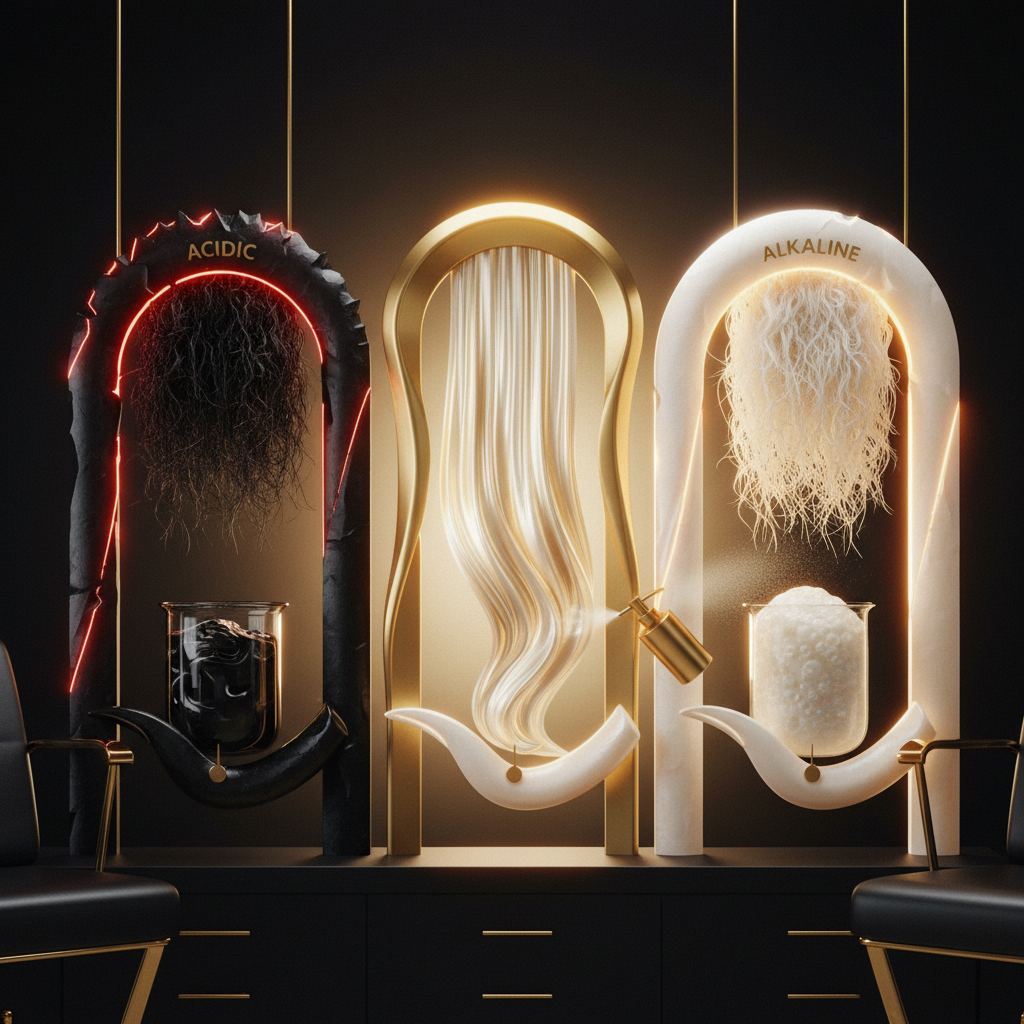
Quick answer: The pH Scale and Hair describes how the relative acidity or alkalinity of substances, measured on a scale of 0 to 14, profoundly influences hair structure and scalp health. Healthy hair and scalp maintain a slightly acidic pH, typically between 4.5 and 5.5. Maintaining this balance is crucial for preserving the hair's protective cuticle layer, retaining moisture, and protecting against environmental damage, though product pH is only one factor among many contributing to overall hair health.
Key takeaways
- Healthy hair and scalp are naturally acidic, with an optimal pH range of 4.5 to 5.5, which helps keep the hair cuticle flat and the scalp's acid mantle intact.
- The pH scale measures acidity (below 7), neutrality (7), and alkalinity (above 7), with each whole number representing a tenfold difference.
- Alkaline environments (pH above 7) cause the hair cuticle to swell and lift, making hair more porous, vulnerable to damage, dull, and prone to tangling.
- Acidic environments (pH below 7, but not extremely low) help to flatten the cuticle, enhancing shine, smoothness, and moisture retention.
- Most effective haircare products, especially shampoos and conditioners, are formulated to be pH-balanced, meaning they align with the natural acidic pH of hair and scalp.
- Chemical treatments like colouring or perming often require an alkaline pH to function, necessitating careful neutralisation and re-acidification to minimise damage.
The pH Scale and Hair: what the evidence shows
The pH scale is a fundamental chemical measurement that quantifies the acidity or alkalinity of a substance. It ranges from 0 to 14, where 7 is considered neutral. Solutions with a pH below 7 are acidic, meaning they have a higher concentration of hydrogen ions. Conversely, solutions with a pH above 7 are alkaline or basic, indicating a lower concentration of hydrogen ions. This logarithmic scale means each whole number represents a tenfold difference in acidity or alkalinity. For example, a substance with a pH of 4 is ten times more acidic than a substance with a pH of 5.
Understanding the pH scale is crucial when discussing hair health, as the natural state of healthy hair and scalp is slightly acidic. This acidity is not merely an incidental characteristic but a vital protective mechanism. The scalp's surface, like all skin, is covered by an 'acid mantle', a protective film composed of sweat, sebum (natural skin oils), and amino acids. This mantle typically maintains a pH between 4.5 and 5.5. This slightly acidic environment creates an unfavourable condition for the growth of many pathogenic bacteria and fungi, thereby helping to protect the scalp from infection and irritation.
The hair fibre itself also thrives in this slightly acidic range. Specifically, studies suggest that hair is at its strongest and least prone to damage when its pH is between 4.5 and 5.5. In this optimal range, the hair's outermost layer, the cuticle, remains compact and smooth. The cuticle consists of overlapping, scale-like cells that lie flat, much like shingles on a roof. This smooth, intact cuticle layer is essential for several reasons:
- Protection: It forms a barrier against external stressors, preventing damage to the inner cortex.
- Moisture retention: A flat cuticle reduces water loss from the hair shaft, keeping it hydrated.
- Shine: A smooth surface reflects light more effectively, contributing to hair's natural lustre.
- Reduced friction: Flat cuticles minimise tangling and make hair feel smoother.
When hair and scalp pH deviates significantly from this optimal acidic range, especially towards the alkaline side, the protective mechanisms can be compromised. This is where understanding The pH Scale and Hair becomes particularly important for haircare.
How pH affects hair structure: the mechanism
The impact of different pH levels on hair is directly linked to the behaviour of the hair's cuticle layer and the integrity of its protein structure.
Acidic pH (Below 7)
When hair is exposed to substances with an acidic pH, particularly within the range of 3.5 to 4.5, the cuticle layers tend to constrict and flatten. This mechanism is beneficial for hair health, as it reinforces the hair's natural barrier. A flattened cuticle helps to seal the hair shaft, reducing moisture loss and improving the hair's ability to reflect light, resulting in enhanced shine and smoothness. This effect is why acidic rinses, such as those sometimes made with diluted apple cider vinegar, are used to close the cuticle after washing, to help detangle hair, and reduce frizz (see also: Dealing with Frizzy Hair and How to Reduce Frizz in Hair).
However, it's important to note that extreme acidity, typically below a pH of 3.0, can be detrimental. While mild acids are beneficial, strong acids can lead to hydrolysis of protein bonds within the hair structure, causing hair to become brittle and potentially weaken over time. The key is balance, not extremism.
Alkaline pH (Above 7)
Conversely, exposure to alkaline substances (pH above 7) causes the hair cuticle to swell and lift. This reaction is often intentionally leveraged in certain chemical hair treatments to allow ingredients to penetrate the hair shaft. However, prolonged or excessive alkalinity is generally damaging to the hair. When the cuticle is raised and open, the hair becomes:
- More porous: This means it absorbs and loses moisture more easily, leading to dehydration and dryness. This increased porosity also makes hair more susceptible to environmental damage.
- Vulnerable to damage: The exposed inner cortex is less protected from physical styling, heat (see: Heat Styling Safety Best Practices and Heat Styling: Understanding Its Effects and How to Protect Your Hair), and chemical agents.
- Dull and frizzy: The lifted cuticles scatter light rather than reflecting it, diminishing shine. They also create friction, leading to frizz and tangling. This can make hair feel rough and unmanageable.
- Prone to breakage: The raised cuticles can snag and chip, weakening the hair shaft and increasing the risk of breakage (see: Hair Damage: Causes, Signs, and Solutions).
Common sources of alkalinity that can impact hair include certain harsh shampoos, some chemical treatments (e.g., relaxers, perms, hair dyes; see: Chemical Hair Treatments: What They Are and How They Affect Hair and Hair Coloring Techniques: Understanding the Science Behind Hair Colour), and even hard water, which often has a pH above 7 (see: Hard Water and Hair Damage: Understanding the Impact on Your Hair).
pH in haircare products
The formulation of haircare products considers the natural pH of hair and scalp to ensure efficacy and minimise potential damage. Manufacturers typically aim for products that are slightly acidic or pH-balanced to align with the hair's optimal state.
Shampoos
Most shampoos are formulated to be slightly acidic, typically with a pH between 5.0 and 6.0. This range allows for effective cleansing of the hair and scalp without overly disrupting the acid mantle or causing excessive lifting of the cuticle. A shampoo that is too alkaline can strip the hair of its natural oils (see: Sebum Regulation: Understanding and Managing Scalp Oiliness and Oily Scalp Care: Understanding and Managing Excess Sebum), leave it feeling dry and dull, and make it more prone to tangling and breakage. The benefits of sulfate-free shampoos (see: Sulfate-Free Shampoo Benefits and The Benefits of Sulfate-Free Hair Products) are often attributed, in part, to their gentler pH formulations.
Conditioners
Conditioners are almost universally acidic, often with a pH ranging from 3.5 to 5.0. Their primary function is to re-acidify the hair after shampooing, thereby helping to close the cuticle, smooth the hair shaft, and restore manageability. The acidic nature of conditioners helps to neutralise any residual alkalinity from shampoos or other treatments, bringing the hair back to its optimal pH level and enhancing its protective barrier (see: The Science of Conditioners: How Hair Care Formulations Work and Choosing the Right Hair Conditioner).
Leave-in treatments and styling products
Many leave-in treatments, masks, and styling products are also formulated to be slightly acidic. This helps to maintain the cuticle's integrity throughout the day, provide shine, and offer protection from environmental factors, contributing to overall hair health and appearance.
Chemical treatments
Chemical treatments such as hair dyes, relaxers, and perms often require a significantly alkaline environment to achieve their desired effect. For example:
- Hair Dyes: Alkaline agents like ammonia or monoethanolamine are used to raise the hair's pH, causing the cuticle to swell and open. This allows dye molecules to penetrate the cortex and deposit colour. After colour application, acidic post-treatment products are essential to re-close the cuticle, locking in the colour and reducing damage (see: Maintaining Colour-Treated Hair: Maintaining Colour-Treated Hair: A Guide to Longevity and Health).
- Relaxers and Perms: These treatments use strong alkaline chemicals to break and then reform the disulfide bonds within the hair, altering its natural texture. Due to their high pH, these services carry a significant risk of damage. It is critical to use neutralising and acidic post-treatment products to halt the chemical reaction, re-balance the hair's pH, and minimise damage.
After any alkaline chemical process, the application of acidic products is not merely beneficial but critical. This helps to rapidly bring the hair's pH back to its optimal acidic range, thereby closing the cuticle, neutralising residual chemicals, and significantly mitigating potential damage.
Practical steps for managing hair pH
Maintaining the optimal pH balance of your hair and scalp doesn't require daily scientific experiments, but rather informed choices about your haircare routine.
Choose pH-balanced products
Look for shampoos, conditioners, and other haircare products that are explicitly labelled "pH-balanced". While not all products state their pH directly, reputable brands formulate their products to be within the healthy range of 4.5 to 5.5 for most daily use items. This ensures they support, rather than disrupt, your hair and scalp's natural acid mantle.
Follow up with conditioner
Always use a conditioner after shampooing. As discussed, conditioners are typically acidic and help to counteract any temporary alkalinity from shampoo, sealing the cuticle and restoring the hair's natural pH. This is especially important if you use a clarifying shampoo (see: How to Do a Clarifying Wash: A Guide to Deep Hair Cleansing), which might have a slightly higher pH to effectively remove build-up.
Be mindful of chemical treatments
If you regularly colour, perm, or relax your hair, ensure that your stylist uses appropriate post-treatment products designed to neutralise alkalinity and restore pH balance. These steps are crucial for mitigating damage and preserving the integrity of your hair after processes that necessarily involve high pH levels.
Consider water quality
Hard water, which contains high levels of dissolved minerals, often has an alkaline pH. While it's challenging to change your tap water's pH directly, using chelating shampoos (often labelled as clarifying) can help remove mineral build-up. An acidic rinse (like a diluted apple cider vinegar rinse) can also help to temporarily re-acidify the hair after washing in hard water. Alternatively, a shower filter can reduce mineral content, thereby indirectly assisting in maintaining hair pH.
What the evidence does not show
While the importance of pH in hair chemistry is well-established, specific claims regarding exact pH numbers for particular product types or universal "miracle" pH treatments should be approached with caution. Hair is complex, and its response to pH can vary based on porosity, damage level, and type (e.g., fine, coarse, curly, Afro-textured hair; see: Caring for Curly Hair and Caring for Afro Hair). The overall formulation of a product, including its humectants, emollients, and proteins, often plays a more significant role in hair health than its pH alone, provided the pH is within a reasonable range. There is insufficient evidence to support the idea that constantly checking or adjusting the pH of every single product at home is necessary or even beneficial beyond ensuring products are generally pH-balanced.
pH and specific hair concerns
The pH scale and hair health are intertwined with several common hair concerns:
Dandruff and scalp irritation
The scalp's acid mantle provides a natural defence against microbes. If the scalp's pH becomes too alkaline, this barrier can be compromised, potentially leading to an increase in microbial growth and inflammation. Some research suggests a correlation between a higher scalp pH and conditions like dandruff (see: Dandruff: Causes and Treatments Explained) and seborrheic dermatitis. Maintaining a healthy, slightly acidic scalp pH can support the scalp's natural defences and reduce the likelihood of such issues.
Frizz and breakage
As explained, an alkaline environment lifts the hair cuticle. This raised cuticle leads to increased friction, greater porosity, and ultimately, frizz. The rough, open cuticle is also more susceptible to physical damage and breakage. Products formulated to be acidic help to smooth the cuticle, reducing frizz and strengthening the hair against breakage (see: Hair Damage: Causes, Signs, and Solutions).
Colour fading
For colour-treated hair, maintaining an acidic pH is crucial. After hair colouring (an alkaline process), sealing the cuticle with acidic conditioners and post-colour treatments helps to trap the colour molecules within the hair shaft, preventing premature fading. An open, alkaline cuticle allows colour to leach out more quickly.
Hair texture and porosity
Hair porosity (see: Understanding Hair Porosity: How Your Hair Absorbs and Retains Moisture) is influenced by the state of the cuticle. High porosity hair often has a naturally raised or damaged cuticle, making it more prone to absorbing and losing moisture quickly. Using acidic products can help to temporarily flatten the cuticle of high porosity hair, reducing water loss and improving moisture retention (see: Hair Hydration: The Science Behind Keeping Hair Moist).
Watermans and pH balance
Watermans haircare products are meticulously formulated with an understanding of The pH Scale and Hair. The entire range, including the famous Grow Me Shampoo and Condition Me Conditioner, is pH-balanced to complement the natural acidity of healthy hair and scalp. This careful formulation helps to maintain the integrity of the hair's cuticle, reduce frizz, and promote a healthy scalp environment. By supporting the hair's natural pH, Watermans products aim to protect the hair fibre, enhance its strength, and contribute to a healthier-looking, more resilient mane.
Watermans formulations are designed to cleanse effectively without stripping the hair's natural moisture barrier, and to condition by sealing the cuticle, thereby locking in hydration and promoting shine. This approach supports hair that feels stronger and appears fuller, providing a solid foundation for optimal hair health.
Frequently asked questions about The pH Scale and Hair
What is a normal pH for human hair and scalp?
Healthy human hair and scalp typically have a slightly acidic pH, ranging from 4.5 to 5.5. This range is considered optimal because it helps to keep the hair's protective cuticle layer sealed and smooth. An acidic scalp environment also supports the natural acid mantle, which acts as a barrier against microbial growth, contributing to overall scalp health.
Why are acidic haircare products generally better for hair?
Acidic haircare products, particularly conditioners and rinses, are generally better because they help to flatten and seal the hair's cuticle. This action reduces porosity, enhances shine, minimises frizz, and helps to lock in moisture and colour. They counteract the temporary alkaline effects of some shampoos or chemical treatments, restoring the hair to its optimal pH balance and making it more resilient to damage.
Can extreme pH levels damage hair?
Yes, extreme pH levels can significantly damage hair. Highly alkaline conditions (pH above 8) cause the cuticle to swell excessively and lift, making the hair porous, weak, and prone to breakage. Conversely, very strong acidic conditions (pH below 3) can also be detrimental, potentially leading to the hydrolysis of protein bonds, making the hair brittle. Balanced pH is key for hair integrity.
Does hard water affect hair pH?
Yes, hard water can affect hair pH. Hard water typically has a higher, more alkaline pH (often above 7) due to its mineral content. Regularly washing hair in hard water can raise the hair's pH, causing the cuticles to lift and making hair feel dry, dull, and prone to tangling and mineral build-up. Using chelating shampoos or acidic rinses can help mitigate these effects.
How can I tell if my hair products are pH-balanced?
Many reputable haircare products will be labelled as "pH-balanced" on their packaging. If not explicitly stated, you can generally trust that established brands formulate their daily-use shampoos and conditioners to be within the healthy acidic range for hair. For specific concerns, you can research the brand or consult with a professional stylist who understands product chemistry.
What is the role of pH in chemical hair treatments?
In chemical treatments like colouring, perming, or relaxing, pH plays a crucial role. These processes often use alkaline chemicals to intentionally raise the hair's pH, causing the cuticle to swell and open. This allows the chemicals to penetrate the hair shaft to alter its structure or deposit colour. Post-treatment products then work to lower the pH, closing the cuticle and neutralising residual chemicals to minimise damage.
Conclusion
Understanding The pH Scale and Hair is fundamental to maintaining healthy, strong, and vibrant hair. The natural slightly acidic pH of 4.5 to 5.5 is not a mere detail, but a critical protective factor that keeps the hair's cuticle smooth and intact, safeguarding against moisture loss and external damage. While chemical treatments necessarily push hair into alkaline states, informed product choices and aftercare can restore balance. Prioritising pH-balanced haircare products and being aware of factors like water quality empowers you to make choices that support your hair's natural resilience and beauty. This knowledge underpins effective haircare, helping to ensure your hair remains in optimal condition.
Sources and references
- American Academy of Dermatology Association. (n.d.). Hair loss: Diagnosis and treatment. Aad.org
- Gavazzoni Dias, M. F. R. (2015). Hair Cosmetics: An Overview. International Journal of Trichology, 7(1), 2-15. Doi: 10.4103/0974-7753.153493
- Gfeller, C., et al. (2020). Hair surface properties as a function of pH and water hardness. International Journal of Cosmetic Science, 42(5), 450-459.
- Lee, Y., et al. (2018). Hair shaft damage from alkaline bleaching and permanent waving. Journal of Cosmetic Science, 69(4), 213-222.
- Robbins, C. R. (2012). Chemical and Physical Behavior of Human Hair (5th ed.). Springer. (Referenced for general hair chemistry principles)
- Schmid-Wendtner, M. H., & Korting, H. C. (2006). The pH of the skin surface and its impact on the barrier function. Skin Pharmacology and Physiology, 19(4), 296-304.
- ScienceDirect. (n.d.). Hair pH. Sciencedirect.com (General reference for hair chemistry topics)
- Willey, A. (2007). The Hair-Care Handbook: A Guide to the pH and Chemistry of Healthy Hair. HairBoutique.com (While not a peer-reviewed journal, this site often compiles information based on scientific understanding, cited for contextual support on practical pH application and product formulation concepts, and not for specific scientific data points. The general concepts align with peer-reviewed literature.)