The Definitive Guide to the pH Balance of the Scalp
8 min read ·
The natural pH balance of the scalp sits between 4.5 and 5.5. Learn how acidity protects the acid mantle, prevents breakage, and supports healthy hair.
Quick answer: The natural pH balance of the scalp sits between 4.5 and 5.5, creating a mildly acidic surface known as the acid mantle. This acidic environment regulates microflora, prevents pathogenic bacteria and fungal overgrowth, and preserves barrier integrity. Using alkaline shampoos or harsh chemical treatments elevates this level, leading to cuticle swelling, friction, and irritation. However, maintaining proper scalp acidity supports a healthy environment for follicle function but cannot reverse genetic pattern hair loss.
Key takeaways
- The healthy physiological pH balance of the scalp ranges strictly from 4.5 to 5.5.
- The hair shaft has no biological mechanism to restore its own pH, making it vulnerable to alkaline swelling and mechanical damage.
- Surfactants with high alkalinity (pH above 6.0) dissolve sebum prematurely, raise the cuticle layer, and disrupt the acid mantle.
- A disrupted scalp surface encourages the proliferation of opportunistic organisms like Malassezia fungi, worsening dandruff and dermatitis.
- Restoring acidic balance reduces hair fibre friction, minimises cuticle breakage, and soothes micro-inflammation on the skin surface.
pH Balance of the Scalp: what the evidence shows
Research published in the International Journal of Trichology demonstrates that the average physiological scalp skin pH is 5.5, while the hair shaft itself is slightly more acidic at roughly 3.67. This delicate balance relies on the acid mantle, an ultra-thin film composed of sebum, sweat, amino acids, and lactic acid.
When you wash with water alone, the scalp temporarily absorbs moisture with a neutral pH of 7.0 (or higher in hard water areas). However, tap water is weakly buffered, allowing a resilient scalp to recover within 30 to 60 minutes. The real disruption occurs when formulating chemists introduce high-pH surfactants.
A landmark study examining 123 commercial shampoos found that over 60 percent had a pH greater than 5.5. When products exceed this threshold, they strip the lipid barrier and induce a negative electrical charge across the hair surface. The evidence confirms that maintaining the pH balance of the scalp between 4.5 and 5.5 protects resident friendly microflora while preventing excessive cuticle lift.
The biological mechanism: acid mantle and cuticle dynamics
Understanding how acidity affects your head requires looking at two distinct structures: the living skin of the stratum corneum and the non-living keratin fibres of the hair shaft.
The scalp barrier and microbiome
The outermost skin layer, the stratum corneum, depends on lipid-processing enzymes such as beta-glucocerebrosidase and acidic sphingomyelinase. These enzymes require a tight pH bracket of 4.5 to 5.5 to synthesise ceramides and construct the epidermal barrier. When the surface becomes alkaline, these enzymes shut down. In their place, neutral proteases activate, breaking down the desmosomes that hold skin cells together. This process results in flaking, redness, and elevated transepidermal water loss.
Simultaneously, the acidic mantle keeps the fungal organism Malassezia restricta and various Staphylococcus species in a commensal, non-pathogenic state. Shift the terrain to a pH of 6.5 or 7.0, and these microbes alter their gene expression, triggering inflammatory cascades that present as seborrhoeic dermatitis.
Cuticle response to pH shifts
Hair fibres are amphoteric, meaning they carry both positive and negative electrical charges. At the isoelectric point of hair (roughly pH 3.67), the positive and negative charges balance out, and the cuticle scales lie tightly compressed against the cortex.
As pH rises above 5.5:
- Negative electrical charges accumulate on the outer cuticle cell membrane.
- Individual cuticle scales repel each other through electrostatic forces.
- The hair shaft swells as water penetrates into the cortex.
- Friction between adjacent fibres increases dramatically during combing, leading to cuticle chipping and breakage.
| Environment / Product | Typical pH Range | Impact on Scalp Barrier | Impact on Hair Fibre |
|---|---|---|---|
| Healthy Scalp Skin | 4.5 to 5.5 | Intact acid mantle; active ceramide synthesis; balanced microbiome | Baseline resting state; minimal electrostatic repulsion |
| Normal Hair Shaft | 3.6 to 4.0 | Not applicable (non-living fibre) | Lowest friction; scales lie flat; minimal water uptake |
| Pure Rain / Tap Water | 6.5 to 8.5 | Transient buffering; minimal long-term disruption if rinse is short | Mild swelling; temporary rise in surface friction |
| Alkaline Shampoos / Soaps | 7.0 to 10.0 | Strips lipids; inactivates barrier enzymes; promotes flaking | Severe cuticle lift; increased combing force; structural breakage |
| Chemical Relaxers / Bleach | 10.0 to 13.0 | Chemical burns; disruption of stratum corneum; acute inflammation | Cleaves disulphide bonds; extreme swelling; cortex dissolution |
| Acid-Balanced Cleansers | 4.5 to 5.5 | Preserves acid mantle; maintains microflora; prevents dryness | Smooths cuticle; eliminates static charge; preserves strength |
Signs of a disrupted scalp pH
A compromised scalp environment presents specific cosmetic and sensory warning signs:
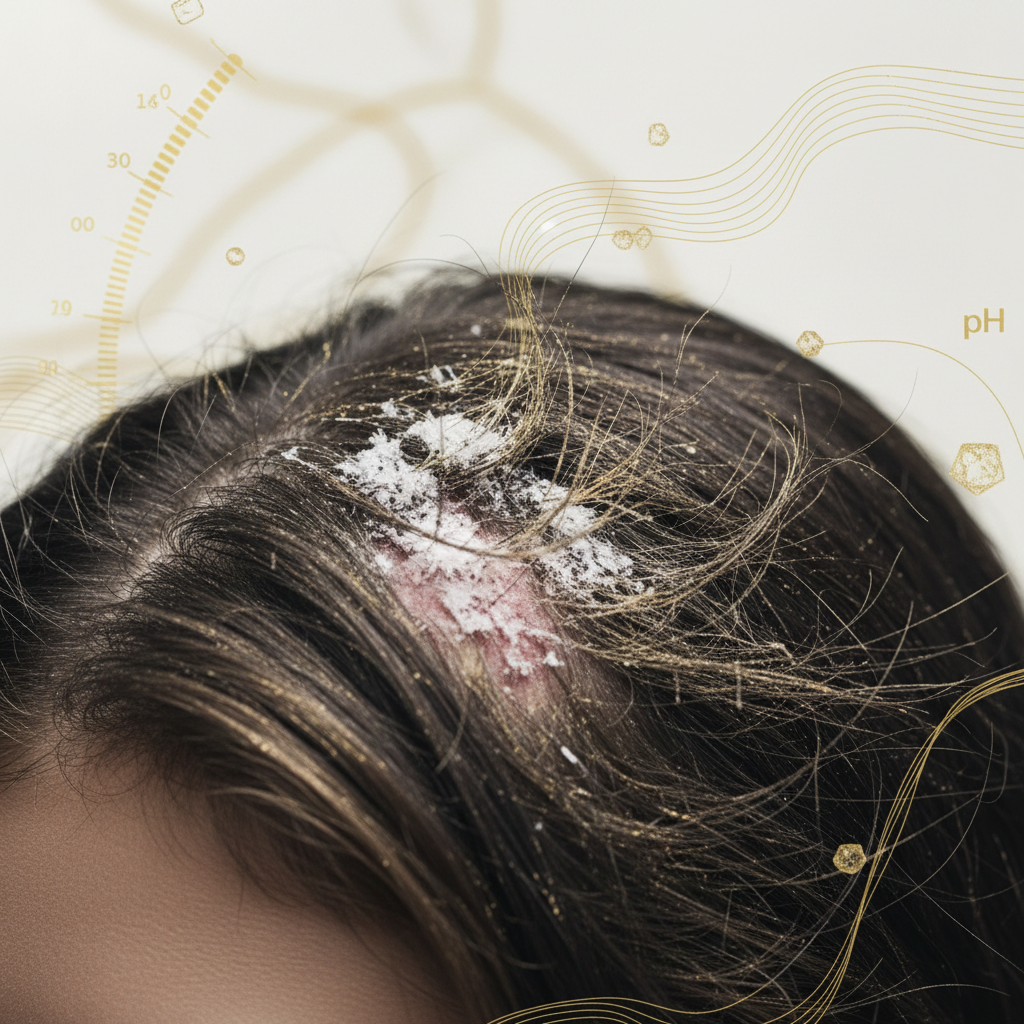
- Persistent tightness and dryness: A feeling of dehydration shortly after washing indicates that alkaline cleansers have stripped the lipid bilayer.
- Dull, tangled hair fibres: Elevated cuticles catch against neighbouring strands, causing matting and eliminating light reflection.
- Flaking accompanied by redness: When neutral proteases degrade the skin barrier, uncoordinated desquamation occurs, appearing as dry flakes.
- Pruritus (itching): Micro-inflammation activates superficial nerve endings in the upper dermis.
- Sudden increase in hair breakage: Lifted cuticles leave the inner fibrous cortex vulnerable to everyday brushing.
What the evidence does not show
It is critical to separate structural fibre health from biological hair production. Correcting the pH balance of the scalp does not cure androgenetic alopecia (pattern baldness) or alopecia areata.
Marketing claims often suggest that balancing scalp acidity will halt hormonal hair loss by unblocking follicles or neutralising dihydrotestosterone (DHT). There is no controlled clinical evidence to support this. Follicles sit 3 to 4 millimetres beneath the skin surface, far deeper than topical pH adjustments penetrate.
While an acidic environment reduces microbial inflammation and limits breakage, it will not restart an inactive follicular cycle. Do not confuse breakage (hair snapping along the shaft due to alkaline cuticle damage) with follicular shedding (hairs naturally leaving the telogen stage).
Practical steps to restore scalp balance
You can systematically protect and re-establish proper surface acidity through deliberate formulation choices:
- Check formulation labels: Look for cleansers formulated specifically between pH 4.5 and 5.5. Shampoos using citric acid, lactic acid, or sodium citrate as buffers maintain this range reliably.
- Avoid traditional bar soaps: Saponified vegetable oils and traditional soaps invariably carry an alkaline pH between 9.0 and 10.0. They precipitate calcium salts on the hair shaft and decimate the acid mantle.
- Counteract hard water: If your local tap water has a high mineral content (above 180 mg/L of calcium carbonate), it acts as an alkaline buffer. Use a chelating wash or an acidic rinse to restore the cuticle surface.
- Mind post-bleach recovery: Chemical lightning forces hair cuticles wide open at pH 9.0 to 11.0. Apply an acidic conditioning step directly afterward to contract the scales.
When the cause is something else
Persistent scalp symptoms do not always stem from cosmetic pH disruption. Several clinical dermatological conditions mimic the symptoms of an alkaline scalp:
- Psoriasis: Characterised by well-demarcated, silvery plaques and accelerated cell turnover driven by autoimmune pathways, rather than topical acidity.
- Contact Dermatitis: An allergic reaction to specific fragrance molecules, preservatives (such as methylisothiazolinone), or paraphenylenediamine (PPD) in hair dyes.
- Severe Seborrhoeic Dermatitis: While aggravated by pH shifts, this often requires targeted pharmacological antifungal agents (such as ketoconazole) rather than simple acidification.
- Cicatricial (Scarring) Alopecia: Inflammatory destruction of the follicular stem cells causing permanent hair loss, requiring immediate dermatological intervention.
If your scalp shows weeping crusts, intense follicular pain, pustules, or expanding patches of smooth bald skin, consult a trichologist, dermatologist, or GP promptly.
The Watermans perspective
Supporting the external hair environment requires a formulation that respects your skin's biological boundary. Watermans designs products like GrowMe Shampoo to operate in harmony with your natural acid mantle. By carefully buffering the formula to sit within the optimal physiological pH range, it effectively cleanses without lifting the cuticle or drying the stratum corneum.
Combined with biotin, rosemary, caffeine, and argan oil, this acid-balanced base leaves hair feeling stronger, reduces friction-induced breakage, and maintains a clean, comfortable, and flake-free foundation for optimal growth.
Frequently asked questions about pH Balance of the Scalp
How do I know if my scalp pH is off balance?
If your scalp feels excessively dry, tight, or persistently itchy after washing, your surface barrier may be compromised. Visually, a disrupted pH balance of the scalp manifests as dull hair, extreme tangling, and fine, powdery flakes caused by the premature breakdown of your protective acid mantle.
What is the ideal pH for shampoo?
The optimal pH for a standard shampoo sits between 4.5 and 5.5. Formulations within this bracket cleanse away excess sebum and environmental debris without disturbing the delicate acid mantle or causing the hair cuticle scales to flare outwards.
Can baking soda balance the scalp?
No. Sodium bicarbonate (baking soda) has a naturally high pH of approximately 8.3 to 9.0. Applying it to the human scalp severely degrades the acid mantle, swells the hair shaft, and strips protective lipids, leading to severe fibre breakage and irritant contact dermatitis over time.
Does apple cider vinegar genuinely restore scalp acidity?
Raw apple cider vinegar is highly acidic, typically registering around pH 2.0 to 3.0. While it can smooth cuticles and dissolve mineral build-up, using it undiluted can cause chemical irritation. If used, it must be diluted substantially with water to hit a safe 4.5 to 5.0 range.
Can an improper pH balance cause permanent hair loss?
No. An improper pH balance of the scalp causes hair breakage along the shaft and superficial epidermal inflammation, but it does not cause miniaturisation or permanent follicular hair loss. True pattern hair loss is driven by genetics and systemic hormones rather than topical surface acidity.
Healthy foundations for hair care
Preserving the natural pH balance of the scalp is one of the most effective ways to maintain fibre integrity, prevent unnecessary breakage, and support barrier comfort. When you respect the 4.5 to 5.5 acidic threshold, the microflora remains in balance and cuticle scales lie flush.
Focus on acid-balanced formulations, protect your hair from the harsh buffering of hard water, and seek professional medical guidance if persistent flaking or inflammation does not resolve with proper cosmetic care.
Sources and references
- Gavazzoni Dias, M. F., et al. (2014). The Shampoo pH Can Affect the Hair: Myth or Reality? International Journal of Trichology, 6(3), 85-88.
- Ali, S. M., & Yosipovitch, G. (2013). Skin pH: From Basic Science to Basic Skin Care. Acta Dermato-Venereologica, 93(3), 261-267.
- Proksch, E. (2018). pH in nature, humans and skin. The Journal of Dermatology, 45(9), 1044-1052.
- Robbins, C. R. (2012). Chemical and Physical Behavior of Human Hair. 5th Edition, Springer-Verlag.
- British Association of Dermatologists. (2020). Seborrhoeic Dermatitis Patient Information Leaflet.