PH Balance and Hair Cuticle Health: The Essential Science
10 min read ·
Discover how pH balance and hair cuticle health dictate shine, frizz, and breakage. Learn the science of the acid mantle and how to protect your hair.
Quick answer: Understanding pH Balance and Hair Cuticle Health is essential because human hair has an acidic natural state, resting at an isoelectric point of roughly pH 3.67 while the scalp sits between pH 4.5 and 5.5. Alkaline hair products force cuticle scales open, increasing friction, moisture loss, and mechanical breakage. Using acidic formulas keeps cuticles flat, compact, and smooth. However, while optimal pH prevents structural weathering and fibre snapping, it cannot cure genetic alopecia or repair dead cortex proteins once severe chemical damage occurs.
Key takeaways
- The hair shaft has an acidic isoelectric point of roughly pH 3.67, while healthy scalp skin maintains an acid mantle between pH 4.5 and 5.5.
- Alkaline exposures (above pH 7.0) cause the cuticle scales to swell and lift, generating negative electrical charges that lead to friction, tangles, and fibre breakage.
- Mildly acidic products (pH 4.0 to 5.5) keep the overlapping cuticle cells flattened against the cortex, preserving internal moisture and enhancing natural shine.
- Hair breakage along the shaft is often a mechanical result of cuticle swelling, which differs completely from follicular hair loss or shedding.
- Tap water in the UK and worldwide is naturally neutral to alkaline (pH 6.5 to 8.5), meaning routine washing naturally challenges the cuticle barrier.
pH Balance and Hair Cuticle Health: what the evidence shows
The scientific relationship between pH Balance and Hair Cuticle Health centres on the physical structure of the hair fibre. The outermost layer of human hair, the cuticle, consists of six to ten overlapping layers of dead, keratinised cells arranged like tiles on a roof. These scales protect the delicate inner cortex, which contains the hair's structural strength, colour pigments, and moisture reservoirs.
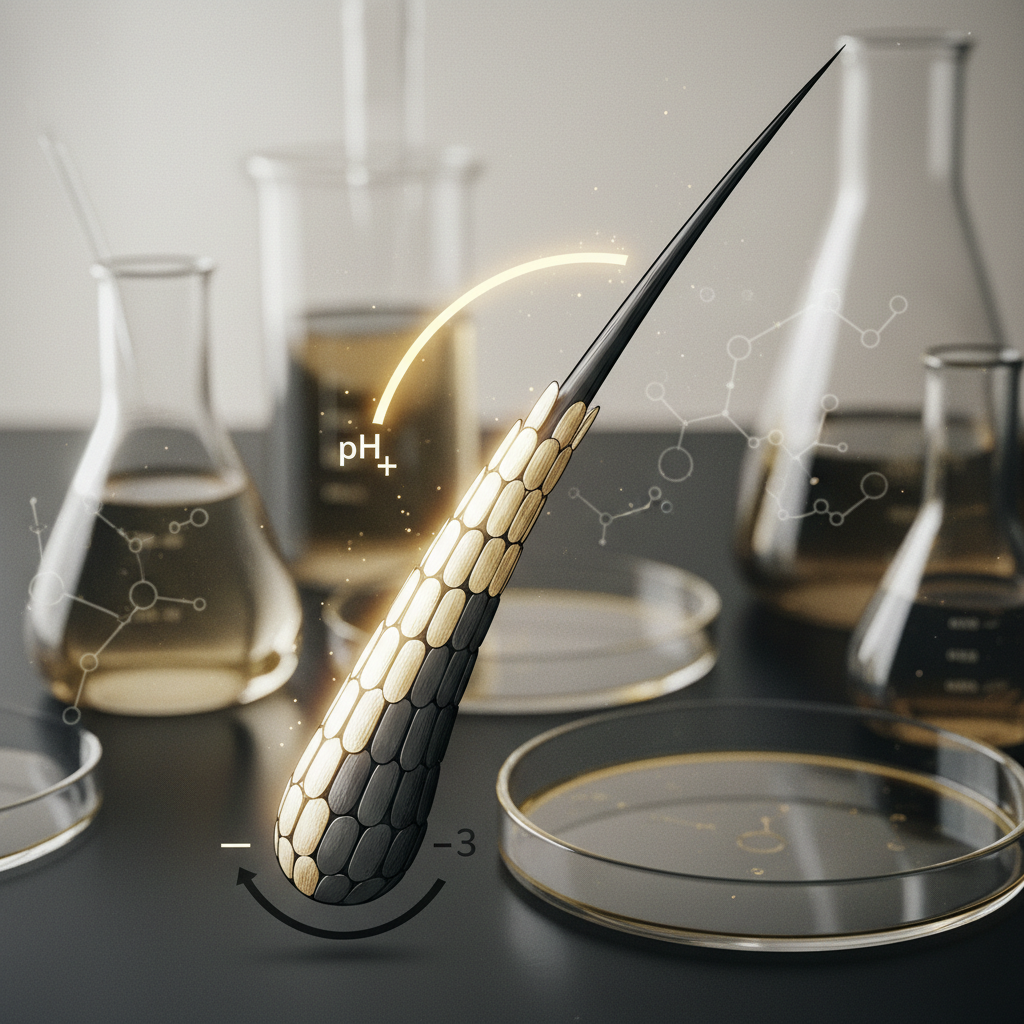
Research published in the International Journal of Trichology demonstrates that the majority of commercial shampoos lean alkaline, despite the known biological benefits of acidic formulations. When hair fibres encounter water or cleansers with a pH above 5.5, the chemical bonds at the surface shift. As the environment becomes increasingly alkaline, the hair fibre acquires an increased negative electrical charge.
This negative charge generates electrostatic repulsion between adjacent cuticle scales. The scales push away from each other and lift outward from the cortex. Lifted cuticles dramatically increase surface friction between neighbouring strands. When you brush, comb, or towel-dry hair in this state, the raised edges catch on one another, stripping the epicuticle away and leaving the cortex vulnerable to splitting and mechanical breakage.
In contrast, exposing the fibre to a mildly acidic pH (between 4.0 and 5.5) neutralises excess negative surface charge. This environment prevents swelling, allowing the cuticle shingles to lie tight and flat. A flattened cuticle reflects light evenly, creating visible shine, while locking natural lipids and hydration deep inside the fibre.
 ALKALINE pH (7.0 - 10.0) ACIDIC pH (4.0 - 5.5)
 Cuticle cells swell and lift open Cuticle cells remain flat and sealed
 [ / / / / / / / / / ] [ ----------------- ]
 High friction, cortex exposed Low friction, cortex protected
The biological mechanisms: how pH alters the hair fibre
The physical integrity of hair depends heavily on its isoelectric point. This is the pH at which a molecule or surface carries no net electrical charge. For human keratinised hair, the isoelectric point rests at approximately pH 3.67.
When hair is submerged in an environment at or near this point, it carries zero net surface charge. As the pH rises into alkaline territory, the carboxylic acid groups present in keratin lose protons and become negatively charged carboxylate ions. The resulting electrostatic repulsion forces the cellular structure to swell with water.
This swelling exerts hydraulic pressure against the cell membrane complex, which acts as the intercellular cement binding cuticle layers together. When the cell membrane complex is degraded by sustained high pH levels, cuticle cells chip, lift, and eventually break off entirely.
Scalp physiology also relies on acidity. The scalp skin produces a protective hydro-lipid film called the acid mantle, typically measuring between pH 4.5 and 5.5. This natural acidity deters the overgrowth of pathogenic microbes, such as opportunistic yeasts like Malassezia, which can trigger seborrhoeic dermatitis, flaking, and inflammation. Disruption of the scalp's acidic mantle compromises skin barrier function, leading to irritation and follicular stress.
| pH Range | Cuticle State | Hair Behaviour | Common Household or Salon Examples |
|---|---|---|---|
| pH 2.0 to 3.5 | Extremely contracted | Can cause brittleness if prolonged; tightens cuticle scales | Lemon juice, chemical peel solutions, strong clarifying rinses |
| pH 4.0 to 5.5 | Sealed, flattened, compact | Minimal friction, high shine, low moisture loss, preserved lipid barrier | Natural hair isoelectric zone, pH-balanced shampoos, natural sebum |
| pH 6.5 to 8.5 | Mildly swollen, slightly lifted | Increased surface drag, mild tangling, reduced shine | Standard UK tap water, non-balanced cleansing bars, baking soda solutions |
| pH 9.0 to 12.0 | Severely swollen, fully lifted | High breakage, structural cortex exposure, lipid stripping | Professional bleaches, permanent hair dyes, chemical relaxers |
What the evidence does not show
While maintaining an acidic environment preserves the cuticle, there are realistic limits to what topical pH management can achieve.
Topical pH does not alter genetic hair loss. Conditions such as androgenetic alopecia (pattern hair thinning) are driven by genetics and systemic hormones, primarily dihydrotestosterone (DHT) interacting with follicular receptors. Applying a low-pH conditioner will not stop hormonal miniaturisation at the dermal papilla.
Similarly, adjusting your hair's pH cannot rebuild broken disulphide bonds within the cortex. Once hair has suffered severe oxidative destruction from bleaching or chemical perm treatments, an acidic rinse can flatten the surviving outer cuticles, but it cannot miraculously restore the internal cross-linked polypeptide chains that have been snapped.
Finally, low pH cannot reverse telogen effluvium. Excessive hair shedding caused by nutritional deficiencies, severe physiological illness, or acute stress occurs inside the scalp within the hair follicle matrix, entirely separate from external cuticle behaviour.
Recognising the signs of cuticle disruption
When your hair's cuticle layer has been compromised by improper pH balance or aggressive alkaline products, the signs appear physically along the hair shaft:
- Rough, matte texture: Hair feels coarse or like straw when you slide your fingers from the root toward the tip.
- Persistent tangling and knots: Raised cuticle scales hook into adjacent strands, creating persistent friction and matting, particularly when wet.
- Lack of light reflection: Instead of a natural sheen, the hair looks dull and flat because rough, lifted cuticles scatter light rather than reflecting it.
- Frizz in humid conditions: Lifted cuticles allow airborne moisture to enter the cortex unchecked, causing hydrogen bonds to reshape and swell the strand into frizz.
- Breakage without a bulb: Strands snap mid-shaft or split at the ends during gentle brushing, yielding short broken pieces rather than full hairs shed from the root with a white bulb attached.
Practical steps to protect your hair's pH balance
Protecting your cuticle health requires a few simple, evidence-based habits:
1. Select pH-balanced cleansers
Look for shampoos that explicitly state a pH between 4.5 and 5.5 on the label. Traditional solid soap bars generally hold a pH between 8.0 and 10.0, which causes acute cuticle swelling. Syndet (synthetic detergent) bars or liquid formulas tailored to an acidic range are much safer for the fibre.
2. Never skip acidic conditioning
Conditioners are naturally formulated at lower pH ranges, typically between pH 3.5 and 4.5. This low pH serves a biological purpose: it closes the cuticles that opened during washing and deposit cationic surfactants that neutralise static friction.
3. Account for your tap water
Tap water across England, Scotland, and Wales generally ranges from pH 6.5 to 8.5 to comply with drinking water regulations and prevent metal pipe corrosion. Because water alone is slightly alkaline relative to hair, wetting your strands naturally initiates mild swelling. Finishing your wash with an acidic leave-in spray or a diluted apple cider vinegar rinse (one tablespoon per 500 ml of water, tested to ensure it sits above pH 4.0) helps counteract this shift.
4. Limit heat on raised cuticles
Applying hot styling tools to hair with lifted, swollen cuticles scorches the unprotected cortex and causes the moisture inside to boil, leading to a condition known as bubble hair. Ensure cuticles are sealed and dry before applying heated tools, and always use a heat protectant.
When the cause is something else: separating breakage from shedding
It is critical to distinguish between cuticle degradation and medical hair loss. Cuticle disruption results in mechanical breakage, which occurs when the hair fibre snaps along its length due to elevated friction and loss of elasticity. You will find short fragments of hair on your clothes, pillows, or brush with clean, blunt, or split ends.
Hair shedding, by comparison, involves hairs naturally completing their growth cycle and releasing from the follicle. These fallen strands will match the full length of your hair and display a tiny, hard white keratin bulb at the root end. If you notice wide patches of scalp appearing, a widening parting, circular bald spots, or clumps of full-length hair falling out daily (exceeding the standard 50 to 100 hairs), the root cause is follicular rather than cuticle-related.
When to seek professional advice
If your hair remains brittle, unmanageable, or snapping despite switching to pH-balanced products, consult a qualified trichologist or an experienced salon stylist. They can examine your hair shafts under high-magnification trichoscopy to evaluate whether the cuticle is intact or stripped down to the cortex.
If you are experiencing true shedding from the scalp, unexplained scalp itching, redness, flaking, or patchiness, consult an NHS general practitioner or a consultant dermatologist. Scalp conditions such as psoriasis, fungal infections, or scarring alopecias require medical diagnosis and targeted therapeutic interventions.
Watermans: supporting structural hair integrity
At Watermans, our product formulations are developed with human scalp and hair biology at the forefront. We recognise that maintaining an optimal, skin-compatible pH is essential for preserving the hair's natural barrier and keeping the cuticle layer smooth.
Watermans products are formulated to respect the natural acid mantle of the scalp and the delicate structure of the hair fibre. By combining revitalising ingredients such as caffeine, biotin, rosemary, and argan oil within balanced, non-stripping bases, our formulas help reduce mechanical breakage, enhance manageable shine, and provide an ideal environment for healthier-looking, stronger-feeling hair.
Frequently asked questions about pH Balance and Hair Cuticle Health
Does water pH affect the hair cuticle?
Yes. Tap water typically sits between pH 6.5 and 8.5 to protect plumbing systems. Because this is significantly higher than hair's natural isoelectric point of roughly pH 3.67, water alone causes the cuticle to absorb moisture, swell, and lift slightly. This is why finishing a wash routine with an acidic conditioner is vital to restore smooth cuticle alignment.
How does pH Balance and Hair Cuticle Health influence hair colour longevity?
An acidic environment locks hair colour pigments inside the cortex. When you use alkaline products, the cuticle scales lift, allowing cosmetic dye molecules to wash out quickly down the drain. Maintaining balanced acidity ensures cuticle shingles remain tightly sealed, preserving both semi-permanent and permanent colour vibrancy for far longer.
Can baking soda be used as a natural hair cleanser?
Baking soda (sodium bicarbonate) has an alkaline pH of roughly 8.3 to 9.0. Applying it to hair forces the cuticle wide open, strips the natural lipid barrier, and leaves the cortex unprotected. Continued use leads to extreme friction, rough texture, and widespread hair breakage. It is not recommended for routine hair washing.
What is the ideal pH for daily shampoo?
The ideal shampoo maintains a pH between 4.5 and 5.5. This matches the scalp's natural acid mantle and minimises cuticle swelling during cleansing. Formulations within this range effectively remove dirt and excess sebum without causing static frizz or stripping the protective cell membrane complex from the cuticle layers.
Conclusion
Mastering pH Balance and Hair Cuticle Health gives you direct control over the physical resilience, shine, and texture of your hair. When you protect the cuticle with mildly acidic care, the scales lie flat, preserving moisture, preventing friction, and minimising everyday breakage. While acidic products cannot reverse hormonal hair thinning or magically knit severed protein bonds back together, keeping your routine aligned with your hair's natural chemistry is the most dependable way to maintain strong, manageable, and vibrant hair from root to tip.
Sources and references
- Gavazzoni Dias, M. F., et al. (2014). "The Shampoo pH Can Affect the Hair: Myth or Reality?" International Journal of Trichology, 6(3), 88 to 99.
- Robbins, C. R. (2012). Chemical and Physical Behavior of Human Hair (5th ed.). Springer-Verlag Berlin Heidelberg.
- World Health Organization (WHO). (2011). Guidelines for Drinking-water Quality: pH in Drinking-water.
- British Association of Dermatologists (BAD). (2020). Hair Loss: Patient Information Leaflet.
- Ali, S. M., & Yosipovitch, G. (2013). "Skin pH: from basic science to basic skin care." Acta Dermato-Venereologica, 93(3), 261 to 267.